In short
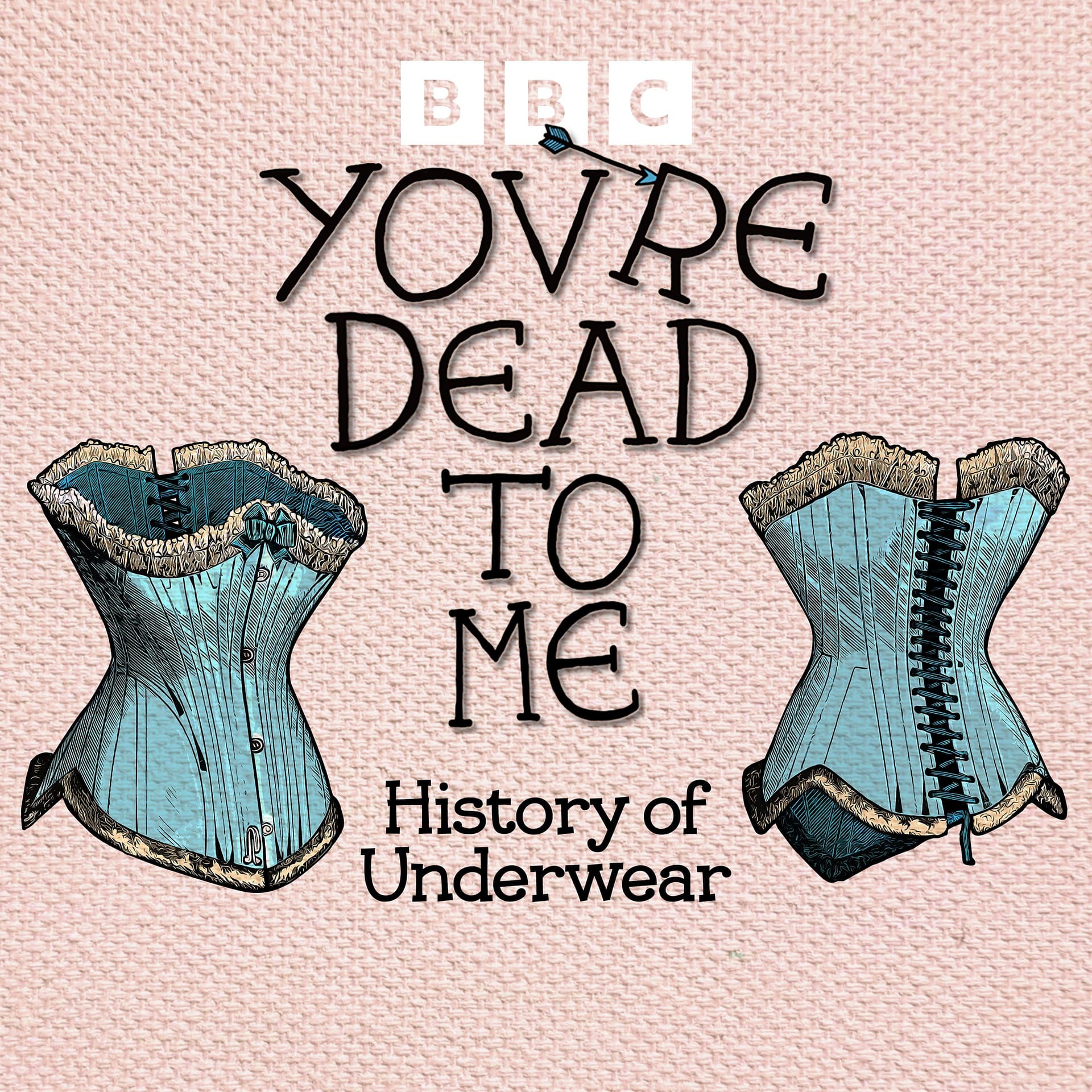
The history of underwear in Western Europe and the US, from medieval linen “shirts/shifts” (16th–19th centuries) to women’s drawers/knickers, men’s codpieces and stockings, corsets and their myths, and the rise of bras and briefs.
Guests
Dr. Serena Dyer (fashion historian, broadcaster, curator; Associate Professor of Fashion History at De Montfort University; author of Material Lives and Women Makers and Consumer Culture in the 18th Century). Vic Michaelis (comedian, actor, improviser; TV appearances including Make Some Noise, Game Changer, Very Important People; also acted in Upload and Ponies).
Key claims
“Underwear” is a shifting definition; early on, outer dresses could function as underwear. Linen shifts/chemises were protective and hygiene-focused, with daily laundering. Corsets were generally about silhouette, not extreme tight-lacing; “tight lacing” blame emerged in the 19th century via doctors. The gusset/crotch appears much later than people assume. Men’s briefs became prominent in mid-20th-century gay male culture.
Notable examples
Henry VIII’s wives making shirts; medieval laundresses using lye/urine; “tuck and plump” and codpieces; Amelia Bloomer’s bloomers vs actual drawers; archaeological underwear from Roman soldiers at Hadrian’s Wall and Ötzi; union suits; 1950s–60s brief catalogs named after queer holiday destinations; a bra-like cup garment from 15th-century Austria (Lengberg).
Written by AI. May contain mistakes. Listen to the episode to check what was said.
Chapters
Tap a time to open that second in VODefining Underwear
3:08 to 4:21
Discussion on the definition of underwear and its evolution over time.
“I have to ask, do you like history in general?”
Historical Context of Underwear
4:21 to 6:14
Exploration of historical undergarments and their purpose from the 16th century.
“This is where I have a go at guessing what you, our lovely listener or viewer, hello, might know about today's subject.”
Underwear's Protective Role
6:14 to 8:08
The role of underwear in protecting outer garments and hygiene practices.
“And today we're going to move around the body to explore the history of different undergarments in terms of where they go on our limbs and body.”
Laundry Practices and Social Norms
8:08 to 11:00
Discussion on laundry practices historically and their implications on social status.
“So maybe they weren't making his shirts as well as he was.”
Changing Perceptions of Men's Underwear
11:00 to 14:02
Exploration of how men's perceptions of wearing shirts evolved over time.
“Most people are changing them every day.”
Mr. Darcy and Acting
14:02 to 14:30
A humorous discussion involving Mr. Darcy and actors portraying him.
“I'd love to see Matt McConaghy doing - Take on the role.”
Evolution of Men's Shirts
14:31 to 15:37
Exploration of how men's shirts changed from the 19th century to the 1940s.
“for men to show off their uncovered, you know, their shirt.”
Women's Shifts and Modesty
15:38 to 16:10
Discussion on the function and evolution of women's shifts as undergarments.
“So instead of the shirt being the underwear, there's now a new garment that goes under the shirt and that becomes the underwear.”
Modesty Solutions in Historical Fashion
16:11 to 19:22
Exploration of how women adjusted their clothing for modesty throughout history.
“I was going to say something when I walked in but it's your show and I was like, I want to be polite.”
Neck Coverings and Their Purposes
19:23 to 20:56
Insight into various neck coverings and their dual purpose of modesty and sun protection.
“Well, so as well as the chemisettes and partlets, you also just have essentially big squares or triangles of fabric.”
Show all 28 chapters
Historical Knickers: Bloomers and Drawers
20:57 to 23:24
Discussion about the differences between bloomers and actual underwear for women.
“Okay, Vic, staying with underlayers, of course, but we're now going to head south on the body.”
Crotches and Men’s Underwear
23:25 to 26:36
Insight into the historical lack of crotches in women's underwear and men's alternatives.
“that most women are wearing at this time, that's a lot of fabric.”
Ancient Underwear and Cultural Practices
26:37 to 28:04
Exploration of ancient men's underwear practices and cultural significance.
“So the humble gusset, the crotch, dates to the same time as radio and film cameras.”
Introduction to Ancient Underwear
28:04 to 29:04
Explore the history of men's leg coverings and the appeal of calves.
“She wouldn't even know what to do with it.”
The Evolution of Codpieces
29:04 to 30:14
Learn about the purpose and transformation of the codpiece in men's fashion.
“Yeah, I walked in, you said, my name is Greg.”
The Functionality and Decoration of Codpieces
30:14 to 31:58
Discuss the ornamental aspects and functionality of codpieces in history.
“Oh, you think he's just stuffing courgettes down there?”
Introduction to the Union Suit
31:58 to 33:26
Discover the features and popularity of the union suit in the 19th century.
“I mean, you may not be familiar, I think every sort of child in England grows up studying the kind of Holbein paintings of Henry VIII, where he stands bestrident with a rather large codpiece.”
The Shift to Two-Piece Underwear
33:26 to 36:13
Explore the transition to two-piece underwear and its cultural significance.
“So, Vic, in the 19th century, there was a new innovation.”
The Rise of the Briefs
36:13 to 38:32
Learn about the introduction of briefs and their adoption by queer men.
“Because I think the briefs are quite a modern invention, which is quite surprising.”
Understanding Corsets Through Time
38:32 to 41:44
Examine the history and societal perceptions of corsets from their evolution to modern myths.
“Okay, let's move up the chest on the old body because we've gone south.”
Corsets and Their Role in Daily Life
41:44 to 42:00
Discuss the functionality of corsets and their impact on women's lives throughout history.
“for the medical issues that women are having.”
The Evolution of Corsets
42:00 to 45:50
Learn about the history and design of corsets, including their practical uses and the societal standards they embodied.
“and it's, you know, still a practice that goes on today.”
Historical Underwear Try-On
45:50 to 47:59
The hosts discuss and try on historical underwear, exploring the differences between stays and corsets.
“So producers Emma and Emmy are going to come and dress us, which is not normally in your job description.”
The Transition to Bras
47:59 to 53:15
Explore the evolution from corsets to bras and the societal influences that shaped women's undergarments.
“Serena, did corsets just keep getting shorter and that's how we get bras?”
Reflections on Historical Clothing
53:15 to 56:01
Discussion on the embodied experience of historical clothing and how it shapes our understanding of comfort and body standards.
“And then in the 18th century, which is the period that your panniers are from, Vic, and panniers being the French for baskets.”
Exploring Comfort in Historical Garments
56:01 to 56:40
Learn about how historical garments impacted comfort and body image.
What Do You Know Now? Quiz Introduction
56:40 to 57:11
Introduction to the quickfire quiz segment for the comedian.
“Yeah, I mean, like, that makes so much sense.”
Quickfire Quiz on Undergarments
57:11 to 1:00:40
Participate in a fun quiz about the history and uses of undergarments.
“this is our quickfire quiz for our comedian.”
Transcript
Automatic transcript. May contain errors.0:00This BBC podcast is supported by ads outside the UK.
0:30tomato. It feels good to ride with help. It feels good to Geico. Emergency roadside service is optional coverage. Labor Day deals are looking good at Lowe's. Save$10 on one gallon cans and $50 on five gallon pails of select interior paint via rebate. Plus get two 2.5 quart or three quart mums for just$8. A fresh look and savings even better. Labor Day deals are on now at Lowe's In-store and online. Valid through 9-9. While supplies last. Mum sizes vary by location and exclude Alaskan Hawaii. See store at Lowe's.com for more details.
1:10Hello and welcome to You're Dead to Me. We're the Radio 4 comedy podcast that takes history seriously. My name is Greg Jenner. I'm a public historian, author and broadcaster. And today we are tightening our corsets, tying on our cod pieces and trying not to trip over our crinolines as we learn all about the history of underwear. And to help us sort through the historical laundry pile, we have two very special guests. In History Corner, she's a historian, broadcaster and curator. She's Associate Professor of Fashion History at De Montfort University. She's an expert on the history of fashion, making and shopping.
1:41And you may have read one of her wonderful books, including Material Lives, Women Makers and Consumer Culture in the 18th Century. It's Dr. Serena Dyer. Welcome, Serena. Thank you for having me. Pleasure to have you in. And in Comedy Corner, they're a comedian, actor and improviser. You'll have seen them on any number of amazing dropout TV shows, including Make Some Noise, Game Changer, or the hilarious improvised interview show Very Important People. Maybe you saw them acting in Upload or in the movie Dead, or giving a star turn in the fantastic Cold War spy drama Ponies, which I love. It's the very important Vic Michaelis.
2:13Welcome, Vic. Now, this is embarrassing because I'm also a historian. Are you? Of underwear. Oh, what are the chances? I know, it's crazy. My step-grandparents, this is real, used to give me a$50 gift card to Victoria's Secret for every holiday. That's an underwear store. I don't know if that's an underwear store here. It is. That feels quite... It was a little weird. Yeah. But I feel like I did my research. I did my time. So I'm going to also call myself an underwear historian. Sort of mid-2000s would be my time period. I'm really looking forward to your insights. I feel like this is an oral history research moment as well.
2:46I really can't wait. I did two years of college and then sort of they asked me to leave. So you've got to be a little... So of this table, we sort of have... You have two degrees, right? Yeah. And you have three degrees. And so we're a five-degree table here. I really feel like we can sort of figure this out. Okay. This is your first time on the podcast. Welcome. Thank you. I'm thrilled to be here. Thank you for having me. Delighted to have you in. I have to ask, do you like history in general? Yes. Okay. Strong. I grew up with a single dad, so I watched so many Ken Burns, like Revolutionary War documentaries.
3:20Long form documentary. My dad is obsessed with war. Today we're talking more about social history. Yeah. Ordinary history. Normal. Not wars. Not war. Well, we'll see. We don't know that yet. We don't know that yet, Greg. Okay. I'm being told off already. Okay. And you worked in the fashion industry. Oh, kind of. I really wanted to be a model when I was like a teenager and all my friends were doing it. And I was working with an agency and I booked absolutely nothing. I booked, all my friends are booking these high fashion campaigns. I was booking commercials. Do you guys have Monistat over here?
3:55Is that a brand name that means anything? I don't know if this is a word that is going to get cut immediately, but it's a yeast infection medication. I was uncomfortable friend number two. So that's sort of different than what my dream was. So what do you know?
4:18Let's crack on with the first segment of the podcast. This is the So What Do You Know? Oh, let's crack. This is where I have a go at guessing what you, our lovely listener or viewer, hello, might know about today's subject. And you probably know all about the history of undercrackers, or at least you are wearing them, hopefully. I mean, it is very hot today. Did you just say undercracker? Yeah, undercrackers. That's a, it's a British phrase. Is it? Oh, yes. Okay. It's very important. Love that. But what about the pants of the past, underpants of the past, for our North American guest? No undercrackers, it is now.
4:47Maybe you're thinking of Keira Knightley fainting in her tight corset in Pirates of the Caribbean, or maybe the dubious bloomers in Bridgerton, perhaps a Victorian gent in his woolly long johns. Of course, millennials may go straight to Bridget Jones in her giant pants, or maybe the Little Mermaid in her shell bra. But how accurate are these on-screen depictions? Were corsets really such a health hazard, as they're often talked about? and have people always worn underpants? Let's find out. Right, Vic, easy one to start off with. How would you define... Are we going head to head in a competition about what we know about this?
5:20That's right, that's how it works. I love this, perfect. How would you define underwear? Things that we wear under our clothes. Fashion historian Serena. That's very accurate. Hooray! I'll take it. You're up and running. But underwear is actually a really recent term and something that changes in its meaning quite a lot because that is exactly its meaning. It's what you wear underneath your outer clothes. Sure. But what people have worn under their outer clothes has evolved a lot as fashions have evolved. So what we might now think of as something that covers the entire body like a dress was historically underwear.
6:00So basically, we're going to cover how this works in Western Europe and the US from mainly the 16th century to today. And we're going to think about how underwear changed across that period and how this definition of what's on top versus what's underneath has gone. And today we're going to move around the body to explore the history of different undergarments in terms of where they go on our limbs and body. So we'll start with the most common historical base layer. Vic, with your expert fashion background, not to rub it in. If you were going to design a universal piece of underwear suitable for everyone, what would it look like?
6:37One Piece swimsuit. One Piece swimsuit. Speedo brand. Okay. How One Piece are we talking? What's it covering? It is covering everything. Everything. Like, do you know the Mormons? Are you familiar? Yes. Sorry, the Latter-day Saints. I feel like they sort of have it figured out where it's like we're just sort of putting on a piece and then we don't worry about it. Okay. I'm assuming that's how it works. So you're thinking almost kind of wetsuit. Yes. Okay. Serena, for most of our periods that we're talking about, the past 500 years or 400 years or so, you know, 500 forward to the 19th century, the most basic form of underwear is even more simple than that?
7:09Absolutely. So from throughout the medieval period, so possibly even as far back as the 10th century, all the way through to the 19th century, there is a relatively consistent piece of basic underwear that both men and women wore. So this is a very simple T-shaped garment made from linen that has evolving terminology through time. T-shaped. So you've got arms and then a body. Ah, blown up T-shirt. Yeah, very glamorous. So for women, it evolves from being called a smock to a shift to a chemise. For men, it's reasonably consistently called a shirt. And they're more or less the same garments. They're generally made at home by women.
7:52And we even have evidence that Henry VIII's wives made his shirts. and that's sort of an important kind of social cultural ritual for a woman to be making the household linens for her family. And Henry VIII is the one whose wives kept like... Yes. Right, okay. So that is interesting. So maybe they weren't making his shirts as well as he was. I mean, maybe. I mean, that would put me off personally if my shirts weren't good enough. Jane Seymour, Jane Somore. Yeah, yeah. Whoa, come on, do two more. No, it took me long enough to think of that one. And this was kind of replaced by mass production in the 19th century.
8:27And that's sort of when we get this shift away from the shift. And the point of the shift or shirt, chemise, whatever, is really to protect you from your clothes and your clothes from you. It's this sort of protective interlayer. Do you have this problem with your clothes need to be protected from you? Constantly. I'm destroying outfits. I feel like as in, I do improv largely. And I do feel like if there is an undergarment that went down to the knees that helped protect the knees of my pants, The knees of my pants are constantly ripping. I'm crawling around all over the place. I'm sliding. I don't know what it is.
9:04My clothes desperately need protection from me. That's interesting. When I eat spaghetti bolognese, I have to wear an apron. It's, you know, I'm 43 years old, but that's necessary now. Huh. I feel like we can fix that. My wife's been trying for a while. Okay, sure. I'm just a messy pasta eater. Yeah, okay, great. I love that. Yeah, you know, so I wear outerwear, not underwear, for my spaghetti dinners. But then does your shirt become underwear? Well, I guess it does. Yeah? Can you talk us through what that means historically? Yeah, absolutely. So the core thing here is hygiene. So you are living in a society where you're not generally washing your outer layers.
9:43They're made from things like wool and silk that you're going to sort of give a bit of a brush down, but you're not going to stick in a washing machine. A brush down? A brush down. What does that mean? It's like you get quite a strong bristled brush and you brush the muddle. Like a horse. Yeah. I love that. Is that like when people put Levi jeans in the freezer? Have you heard this? I mean, I guess so, yeah. Okay. Yeah. Huh. You learn something new every day, especially on a history podcast. And the whole point really of the linen is that it is very, very good at wicking up sweat. So it kind of acts like bodily washing hygiene as well.
10:19So it's taking all the sweat off of your body. So then you can just really intensely launder that layer. It's stopping your stays, your corset, whatever, from rubbing your skin. And it's also stopping all of those oils and the sweat and the perspiration going into the garment. So it's sort of this shielding garment. And from the sort of the 14th century, you really, we develop a culture where changing your linens regularly is really important. Plague. I mean, yeah. Plague, Greg. Sure. I mean, a plague, unfortunately, you couldn't really cure a plague by changing your pants. But, you know, it's worth a try.
10:56I think, yeah, if people were trying it more, maybe we'd have less plague. Maybe. And I think we need to consider that. Can't argue with the logic. So how often are they changing them? Most people are changing them every day. Even your poorest person is going to have sort of two, three, maybe even more than that. They're going to be sort of working through them because it's a really important part of how you're presenting your morality to the world. You want to look like you can keep your linens white and clean. So people are seeing them. Well, you can see the very edges of them. Right. Dainty.
11:29It's sexy. Yeah. Yes, absolutely. A little cheeky bit of cuff, a little cheeky bit of the edge of your shift. Very sexy. There we go. So laundry, really, really important. And a lot of the time that's done at home with things like lye. but we also get the growth of professionalized laundry services like the laundrette of medieval early modern Britain. Would those have been businesses that would have been primarily run by women at those times too? Yes absolutely so it's a really good form of employment for women and some of those laundresses probably because they're in that kind of situation were treated suspiciously sometimes that they were doing it on the cheap that they weren't boiling it properly and they were using things like urine to do the cleaning.
12:16Now, urea in urine does have cleaning properties. It is a genuinely useful thing to use, but people were worried that it was just sort of being slapped on and calling that clean. So they were fine with there being a little bit, but they were just like, you're using too much urine. Serena, what is lye? What was lye? Lye is essentially the historical equivalent of laundry detergent. It's soap. It's what they to clean these pieces of underwear. Lovely. Okay, so Serena, you said early modern men wore their sort of snowy white shirts as underwear, which sort of defeats the point because if they're clean and bright and white, do you want to show them?
12:53Should they not be outerwear? Doesn't it feel paradoxical? Yeah, well, throughout the early modern period, so really all the way through to the beginning of the 19th century, you're getting little hints of how clean a man's shirt is. So you'll get a little bit of the top of the collar, you'll get a little bit of ruffle around the cuffs literal peacocking yes oh it's like we got our little feathers out of being like but then how do you could trick people you could just clean the collar we are we are going there yes travesty scandal well before the 19th century being in your shirt sleeves would be a little bit shocking a little bit scandalous it's a very intimate thing to do to be just in your bare shirt sleeves yeah the way that it is presented in a lot of period drama would be quite shocking.
13:40Sure, sure. Would have been absolutely scandalous. So Mr. Darcy, when he takes his dip in the water, Colin Firth, the classic iconic, him exiting the water, sort of dripping wet, he's in his lingerie. Yeah. And I think that that's part of why people do get excited about that scene, is that there's this kind of unspoken thing where we know that that's a bit naughty. That's a little bit scandalous. That's funny that that's your Mr. Darcy that you go to. Yeah, well, I'm old. No, nobody said that. Literally nobody said that. You said that. I did. I was thinking of, what's his name? The guy from Succession?
14:13Matthew McFadden. Matthew McConaghy, yeah. No, not Matthew McConaghy. Matthew McConaghy. I'd love to see Matt McConaghy doing - Take on the role. Let's see it, green light. Let's go. Incredible. Ms. Bennett. Matthew McFadden, sorry. Yeah, yeah. Yes, my go-to is Colin Firth. Sorry. No, that's okay. I love that. Yeah. Okay. When did it stop being a little bit slutty for men to show off their uncovered, you know, their shirt. Yeah. Well, even in the kind of mid-19th century, shirt fronts were still hidden by your waistcoat, by your kind of neckerchief. Everything is kind of covered up when you're properly dressed.
14:48But from the kind of the latter half of the 19th century, we start to see a little bit more of the front of the shirt kind of coming to the fore and being revealed. So you're still not showing too much of it, but you're giving a little bit more of a hint. and then showing too much shirt was still sort of seen as more of a lower class working class thing to do because you're laboring so you are going to take your coat off if you are doing physical labor so there is a kind of a class element to it as well it was literally rich people being like oh you're hot when you're working cute that's so crazy and then it's really from the kind of beginning of the 20th century, 1920s, 1930s, that mass produced shirts begin to become more popular.
15:37And by the 1940s, they're not really considered underwear anymore. But it has shifted what is underwear. So instead of the shirt being the underwear, there's now a new garment that goes under the shirt and that becomes the underwear. And that is your vest or your t-shirt. and the origins of the t-shirt are in sort of late 19th century naval uniforms because sailors needed that extra undershirt and then they sort of need permission to take the different layers off while doing different types of work. So I'm wearing underwear right now. It's very shocking, Greg. I'm so sorry. This is crazy. I was going to say something when I walked in but it's your show and I was like, I want to be polite.
16:17I'm so sorry. Thank you for apologizing. Yeah, you know, I'm trying to atone for my sins. Serena, when did women's shifts serve the same function as men's shirts? So you said the shift went through evolutions as well. Yes, but they're really minor evolutions. So it essentially stays a T-shaped garment throughout most of the period we're looking at. Towards the end, it kind of, its sleeves get a bit shorter and shorter and shorter, as women are wearing shorter and shorter sleeves on their gowns. Free the shoulder. Free the shoulder, absolutely. But they kind of fundamentally change very little over time, and they're still performing the same kind of function.
16:53How long was the shift back in the sixth? Are we ankle length, knee, thigh, above thigh? Between knee and ankle, really. They're quite long. And the shift being like a slip. Essentially, yeah. Okay, great. A slip with sleeves, sure. Vic, if a 17th century woman, so we're in the 1600s here, more plague, I'm afraid, if she felt that her dress was a bit too low cut and she was revealing a little bit too much, what could she do to make it more modest what would she do um i guess maybe like roll up a little like a little maybe a little puff a little puff in a sleeve i'm not explaining this well for an audio medium i'll tell you that much it's sort of like a little like just pop pop a collar a little bit on one button oh i think you're i think you're there if i just keep answering will i get it eventually yeah uh trip and fall and her skirt rips and then you see a little bit of the slip Nope.
17:49I think we're getting further away now. You're going more erotic. Goes to the hospital, gets the plague, has to be stripped off, and then all of a sudden she's just in the, what's it called, a slip? No, I said that. The shift, the slip, yeah. She's just in her shift. The doctors are like, you're going to die. I was asking for more modest, and you're going more and more risque. Oh, she wants to be? And so this is sort of audio dyslexia I have, I think. So this is, what would you do to be more modest? Yeah. Puffer jacket. Puff, just a full puffer jacket. and they go it's not snowing out isabel and she goes i am frigid i'd love to see elizabeth first in a puffer jacket yeah okay you've given us 19 answers sort of in either direction she gets the plague she dies she's in a coffin she's completely covered there's nothing more yes dying of plague serena give us the actual answer so most shifts and smocks have a kind of low square neckline.
18:44Not all of them. Some of them are high necked, but most of them. So women are using other kind of linen garments to fill in that space. So in some periods, things like partlets and chemisets are really popular that are more sort of fitted bits that might have a little frilly neck. I know exactly what you're talking about. I feel like that's big and they love those pieces and have you seen Gilded Age? I feel like shows like that, they love the pieces that are decorative around the neck. Yeah, and they're filling in that space. And of course, it's not just about modesty. It's also about sun protection.
19:15This is an era before SPF. So it's actually giving you a little bit of protection on a hot day as much as it is about modesty. And what are they called? What's the French word for them then? This sort of neck covering? Well, so as well as the chemisettes and partlets, you also just have essentially big squares or triangles of fabric. I love that. Now we're speaking my language. Which you wrap around, sometimes in a kind of tucking it in flat way, but sometimes in a more bouffant. way. Buffant. Oh, that's nice. So they kind of become known as a fichu later on as well. They're more routinely in Britain, just known as a neckcloth or even a handkerchief.
19:55Even though it's not for your hands, it's for your neck, which becomes very confusing. But the terminology is quite flexible because it is essentially a handkerchief in that it is a square of fabric. And are we still calling this underwear? Because this is fully visible. This is on top of your shift or chemise so it's it's sort of it's outerwear it's eye line height yeah it's on that line i think that it's you're tucking it in a little bit so a little bit of its underwear okay um with things like the partlet part of the point is that it looks like an extension of your underwear it's meant to look like the top part of your shift i see i feel like you're um i was gonna say you're uniform in very important people you've got the shirt with a little bit of frill a little bit of little bit of sort of lacy dangle there.
20:40It's called a pussy bow. It's sort of like the style of it. But yeah, so we've sort of done that for the last few seasons. So you're harking back to days of yore. There we go, yes. And we've done that on purpose. We did the research and we sort of said, we're not going to wash this shirt so we need something to distract. Okay, Vic, staying with underlayers, of course, but we're now going to head south on the body. Perfect. I'm going to ask you this in the least inappropriate way possible, please describe for me historical knickers. What comes to mind? Sorry, that's what it says in my script. What image comes to mind?
21:16Okay. Doubloon is not the right word because I think that's money. That's pirate money, right? Doubloons? Yes, that is pirate money. What word am I thinking of? Bloomers? Bloomers. Doubloomers. You're bloomers. It's sort of like, you know, I'm thinking it's like you got some sort of a waistband and then some sort of thing that's like, that's like getting your leg and they're sort of like voluminous and they're just sort of big and they're sort of, they could be a parachute in a pinch in sort of an Amelia Bedelia type situation. You know what I'm talking about? So you think quite a lot of fabric, quite long?
21:50I'd say down to the knee is what I'm thinking. Down to the knee. Or like mid-thigh. Okay. I'm trying to find the answer in your eyes here. Bloomers, technically, are outerwear. No! No! I feel betrayed. So, bloomers are something that was popularised by Amelia Bloomer in the middle of the 19th century as this kind of rational garment for women to not have to wear skirts, to wear sort of a two-legged thing. And it's kind of become conjoined in the public imagination with drawers, which is what women were actually wearing as underwear, because it is sort of a bi-legged garment for women. And drawers were...
22:32The bike-eat-all women on the girl. and drawers were sporadically worn from the 17th century or even earlier but they weren't really common for women to wear until we get to the 19th century where they really kick off but they're still not really knickers because there is no crotch there is nothing going on in the key area they're essentially the inverse of what you think of as modern it's just a tunnel from nether regions to ground? It is two tunnels for each leg. It's just a tube station. That is crazy. The London Underground. Whoa. It's stopping your thighs from rubbing together. So they're essentially like modern chub rub shorts.
23:20But you don't want anything in between because if you're thinking of the kinds of dresses that most women are wearing at this time, that's a lot of fabric. and it is much easier to just squat and go. Sure. So it's not really until the very end of the 19th century, beginning of the 20th century, as fashions are beginning to evolve away from that kind of big skirt silhouette that we do end up starting to get crotches in women's underwear. Right. It just feels like practically crotches would be so useful for so many different things. It feels crazy. Like, what do you what do people do with I'm assuming that periods weren't new as of, you know, the last hundred years here or whatever.
24:09So, like, what do you do? Do you just disappear? No. So some listeners may recall their parents or their grandparents wearing a kind of girdle type belt from which you would hang a little pad. and there is evidence particularly from the 19th and 20th century of these pads being made at home yeah a hammock in the tube station oh my god some of them are knitted knitted and that's kind of the more recent way so like in Christmas people get scarves they're getting those little hammocks from people where they're just like oh I just you know I was just knitting something I thought you might want this and then we have evidence earlier of women just using essentially scraps of linen, either in the same way you're kind of tying it around yourself or sometimes kind of rolled up into a tampon type thing and put where it needs to go.
25:02And we've got evidence of that archaeologically as well as sort of discard piles of these rolled up bits of linen that have got menstrual blood on them. Time is a circle. I mean, you're a fashion historian and I suppose you examine clothes, you examine all sorts of clothes. And do you see the sort of physical evidence of this in fabric and clothing? Do you ever see stains of perhaps sweat, blood, that sort of thing? Can you tell if this has been used? You know, is that visible? Yes. Sweat stains are on pretty much every single historical garment I've ever looked at, which I used to find disgusting and now find wonderful because it's like there's a little bit of that person that still exists.
Read the full transcript
25:39It's like amber. Like it's your Jurassic Park. We can create an entire theme park filled with 18th century people. Yeah. You're going to be mad, I feel like, about what's happening. Welcome to Jane Austen Park. I would go, sign me up. But most of the time with menstrual blood, we don't really see a huge amount of that evidence. Maybe partly because it's been laundered away, maybe partly because this is just linen that does disintegrate over the time. If you've got a bloodstained bit of linen, you're not going to want to hand it down to your grandchildren. So what would you do with that? So we get very little of that kind of evidence in the archive.
26:18And we also don't really see any evidence of bleeding on the inside of shifts and smocks or petticoats or anything. So it's possible that people did do free bleeding in the past, but we don't necessarily have very much secure, solid evidence of that. Fascinating. Whoa. So the humble gusset, the crotch, dates to the same time as radio and film cameras. That's crazy. Isn't it really weird when you think about it that way? I mean, that does feel wild. like that it is such a modern thing the things we take for granted yeah and what about the gents what about you know what would i be wearing in the late 19th century are we talking crotchless drawers please say bloomers am i wearing big frilly knickers sadly not oh what a shame so men more consistently do have a kind of a crotched undergarment it wasn't that we didn't like blue shorts yes yeah it wasn't that we didn't like have the technology to make crotches It's just that they weren't needed.
27:18But for men, we do have examples of that that go back to some of the earliest archaeological textiles that we have evidence of. So we know that there was underwear sent to Roman soldiers at Hadrian's Wall. We know that people like Otsu the Iceman, so one of the most ancient clothed people that's ever been discovered, had like braised kind of linen underwear type garment on. And we also know that King Tutankhamun's tomb contained 145 spare pairs of linen. Just in case you woke up. It's so many, Vic. I am so upset. I am like, I just can't believe that somebody was like, David needs a crotch. But Linda, what would she do with it?
28:06What would she even do with it? She wouldn't even know what to do with it. That's so crazy. Leave it. She can have a hammock. It's fine. so uh ancient undercrackers your favorite phrase vic i do like undercrackers they did exist um but what about in our period sort of you know post 1500s do they wear socks do they wear stockings do they wear underpants is it all one thing like do we get any kind of leg covering for men yes so it you don't have to wear anything but there is a it is possible it is a choice that you can wear under breeches essentially so that's just like a linen layer between you and your breeches.
28:42But that's not necessary at all. Breeches or, you know, the other sort of knee length type trousery garments that men are wearing stop at the knee. So the bit beneath the knee needs stockings. So the calf becomes a very sexy area for men. I've always said it. Yeah, I walked in, you said, my name is Greg. The calf is a very sexy area for men. So we get some stockings that are padded around the calf so that you get a little bit of definition and muscle tone in that area. They're padding their calves. Oh, yeah. They're padding everything. That's crazy. I love that. Yeah. But you also don't have to.
29:25If you've just got your long shirt, you can just kind of bunch it up in an appropriate manner and get a little bit of extra emphasis wherever you might want it. See, so the old tuck and plump. I'm obsessed with this. I love this. Men should be doing this more often. It should be a thing that we're sort of making it more... I guess that is kind of happening with looks maxing now. I was going to say, crotch maxing. It's kind of bringing it back. Yeah, there we go. Okay, calf maxing. Calf maxing, crotch maxing, yeah. All right, so we've met the tuck and plump, the old shirt that's, you know, it's a long shirt and you roll it under and up.
29:58Well, not up. No, not up, Greg. Just under, just under. Sorry, going too far there. But there was another way that a 16th century gentleman and could make his nether regions more voluminous. What do you think Henry VIII was doing? Vegetables. Oh, you think he's just stuffing courgettes down there? Like in Spinal Tap. Aubergine. I want to say that I'm thinking of a field hockey cup or something like that. We're doing that. You are spot on, I think. Come on, Hugh. We wouldn't call it a cup necessarily. We'd call it a cod piece. Is that right? We would, yeah. And this comes from an archaic word for scrotum.
30:36Cod meant scrotum. And this started as a very practical thing. It's essentially a triangle of fabric that you put over the area that you would occasionally need some access to. And you can just untie it when you need to go and tie it back up when you're done. So kind of like a modern fly. But it evolved through the 16th century and became a site of showing off your wealth, your virility. And the kind of sports cup bit is very relevant because in armor, you're also getting a cob piece. You need something to cover up and protect. The turtle shell for your bits and pieces. I love that. And that kind of, because obviously armor is made from metal, that's kind of a very solid thing.
31:23And that aesthetic kind of carries over into what men are wearing every day as well. um so I could make one note for people back like if I could get a message back to them if I could get one message back in time I would send it to the people doing the cod pieces and I'd say let's decorate them they can be quite because you know what I'm saying I'm like let's do like we have the little like let's do some decoration let's hand paint some flowers I don't know something lovely I mean you do get very ornamental embroidered decorated cod pieces Do you have any? I mean, not personally. Okay, great. Can I have one?
32:00No. I mean, you may not be familiar, I think every sort of child in England grows up studying the kind of Holbein paintings of Henry VIII, where he stands bestrident with a rather large codpiece. And I think it's a very clear image of what his masculinity is saying. Is it functional at all? Or is this purely ostentatious showing off, I'm the big dude? I mean, it's not functional in that you're not putting... How do you say this? But it is covering up that area. Like I said, it is kind of the equivalent of a fly or... The spaghetti is not in the bowl. Yeah, exactly. Yes. Right, okay. But you can unfasten it so that you can get access right.
32:43Was it a pocket? Could you keep stuff in there? You could, yeah. Could you? Absolutely, yeah. Oh, that's great. The murder of Tupac Shakur has generated nearly 30 years of rumours, conspiracy theories and unanswered questions. Now the mythology is about to meet the courtroom as the trial gets underway and Nevada prosecutors try and solve the mystery of who killed Tupac and what really happened on the Las Vegas Strip that night in 1996. It's time to separate fact from fiction. I'm Anushka Matanda-Doughty, and for the BBC's Fame Under Fire podcast, I'll be inside the courtroom every day, and I'm bringing you with me.
33:19Join me for Fame Under Fire, the Tupac murder trial, the testimony, the arguments, the moments that matter, and all the legal analysis. Listen on bbc.com or wherever you get your podcasts.
33:34So, Vic, in the 19th century, there was a new innovation. Oh, good, another question. Yeah, sorry, I've got loads more for you. There was a new innovation in unisex underwear. Historians of fashion would call it the union suit. Yes, the union suit. And it's my absolute favourite. I love that. And I'll let Serena tell you why it's my favourite. So this is essentially, exactly as you described, a full body underwear suit. Come on. That buttons up down the front and has a wonderful little flap, again, for access purposes, at the back this time. So you don't even ever have to take it off if you don't want.
34:08Exactly. I love this. Okay, yeah. Yeah, now we're cooking. So it's a bum flap for when you need a number two. Yes, yep. You know, because it's cold, it's windy. You don't want to strip off all your underwear. Yeah. So you just lower the flap. You might have a swim meet later that day. You got to keep it all on. I am obsessed with this. I feel like modern jumpsuits need this. Yes. It's a onesie for a number twosie. Exactly. There we go. Come on, you're on fire. Look at this. and these became nichely popular shall we say in the late 19th early 20th century a similar thing is kind of happening for women's wear where the smock by this point known as a chemise has kind of merged with the drawers and become a single uh combinations they're called single one-piece garment um but it's not quite as full-on as the union suits that we're talking about sure sure sure um in about 1910 uh the closed crotch kenosha variant um appears and was patented um and those are spelled with k so it's a kkk yeah that's very unfortunate and they had buttons all the way around so that you could access everything whoa there were uh some slightly more erotic adverts for these um like in newspapers and stuff like that are they looking for models it's the career that you never knew you wanted gonna be mean um so we get erotic adverts right sort of 1915-ish we're looking at here one by uh leyendecker which was potentially based on his lover charles beach and this kind of started the trend of using sexy men to sell men's underwear.
35:57And two-piece underwear was also still the most commonly widespread worn thing. So you're still wearing essentially long johns and a t-shirt. But this was the kind of niche, sexy, different alternative approach. Okay, so the sexy closed crotch you sort of mentioned there, that's a sort of good segue back into men's briefs. Because I think the briefs are quite a modern invention, which is quite surprising. Do you know which group of men was first to embrace them? Briefs? Hmm. Hold on. It was going to be, okay, picture this. You're going on a run. Okay. You're running a marathon. Sure. And so you're going, I need something tight.
36:36I need something secure. And so it's going to be marathon runners in Greece. Good guess. It's a good guess. You said Greece at the end. Yeah. Ancient Greece? Yeah. Wow. We're going back in time. They're hopping back. and then we sort of, because time is a circle, so it got created here and then they were sort of like, they were doing that in Greece, actually. So that's my guess. So the Roman word for underpants was supplicarchulom. Did the Greeks wear underpants and did they come back as briefs in the early 20th century? I mean, the Greeks did wear underpants, but I don't think that the connection was there in the 1950s.
37:05Definitively? I wouldn't want to stake my reputation on it. There we go. Unconclusive data is what I'm hearing. You're claiming that as a win. Yeah. Who were the first community to embrace the brief? Was it marathon runners? It was not. Was it women? No. Okay. It was queer men. Oh, yeah, sure. So they became a really significant part of gay male culture in the kind of mid-20th century. So it's the kind of 1950s, 1960s that we're seeing the growth of these kind of tighter, more colourful pairs of underpants for men. In the early 1950s, a photographer named Bill Green developed a kind of cut-down version of underwear for his models to wear and began to sell them.
37:52And then there were catalogs that featured photographs of men in this underwear, models and actors. Each of the garments was named after holiday destinations that were known for their connections to queer gay culture. That is incredible. That rocks. That's so cool. So you get the can, the capri, things like this. and we even know that Sean Connery modeled for them. Is that true? Do we have the ability to super cut seven pictures of him? Smash cut into Sean Connery. I guess that's why they called it Thunderball. I love that. Happy Pride Month. Here we go. Look at this. Okay, let's move up the chest on the old body because we've gone south.
38:36We've been up to the neck. Let's go to the chest. Sure. Let's talk about corsets. What do you know about corsets? Have you ever worn one for a roll? Yeah, I played a character in a maze, in a haunted maze at a place called Canada's Wonderland in Toronto. Shout out to Vaughn, Ontario. This is going to be for two people. But there was like Halloween horror nights there and I worked in a Jack the Ripper maze. Wow. And I played a lady of the evening and my outfit included a corset. Okay, and how did you feel wearing it? Fine. Great. completely fine because it was I think just sort of fabric that was made to look like a corset and I think it was probably just printed on a dress okay you know what I mean I was going to say my work here is done but no that doesn't sound like your work here is not done no I haven't worn an official one though I heard something and I don't know if it's true should I hold it to see if the information comes out or can I ask you can ask you can ask I heard that it's a myth that corsets were like crazy tight this is true okay they were not yeah TikTok is right sometimes.
39:44Yes, it sure is. Only sometimes, though. Yeah, and very rarely. I mean, there's probably as much on TikTok pushing that they were. Yes. So, yeah, women throughout the period that we've been talking about wore a form of corset. So it starts as bodies, it evolves into stays, it's eventually a corset. They're all a sort of an evolution of the same thing, which is a garment for the top half of your body, which is stiffened with something like baleen, which is whale bone which is not bone it's this sort of protein a substance that's in the mouths of whales and it's far more like fingernail and it's actually really quite bendy and supple and more shaped to your body so there's a kind of a terminological issue there in that because we keep saying whale bone people like there's bones in the corset yeah no that's just this like flexi so it's not like you can go into the natural history museum and seeing a giant whale over your head and thinking women are wearing that yes no yeah but whale fingernails just doesn't have the same ring it doesn't no i tend to stick with baleen which is the more scientific chemical term and they were generally waist length um they can have straps they don't have to the kind of silhouette that they're creating evolves over this period as well so it's just sort of this garment which is making your body match whatever is meant to be the physical sort of beauty ideal of that time.
41:08They're worn by all social classes. There's even a charity sort of set up in the 18th century to help poorer women get access to stays, the equivalent at the time. Whoa. And they're not really about restricting your body. They're not really about pulling you in. They are just about creating the right silhouette. And it isn't really until the 19th century that tight lacing and a lot of the ideas that we now have about corsets being bad for women emerge. And they're mainly because doctors are trying to find something to blame for the medical issues that women are having. And it's much easier to blame the women than to actually understand the medical side of it.
41:52Sure, sure. There's other cultural stuff going on about why we've received that kind of vision of them. And some women sure did tight lace, but it's very, very niche. and it's, you know, still a practice that goes on today. It is still a thing that people do, but it is definitely not something that was being done throughout society. So you could wear it in pregnancy. You could wear it breastfeeding. You could wear it as a manual labor in the fields. You could wear it as a maidservant, as a governess or as a duchess. Yeah, absolutely. There's even a corset that becomes really popular towards the end of the 19th century called the Pretty Housemaid Corset.
42:26Whoa, the Pretty Housemaid Corset. Which is really, it's really flexible. It's got a little bit of boning, but quite a lot of cording. So it really is made for women doing physical labor so that they can fully bend and move. Although because it does, you can't bend in the same way as you can when you're not wearing one. So it does actually end up meaning that your posture is a lot better while you're doing, you know, you actually do have to bend your knees. You can't bend your back. All of the kind of manual labor training that we might have today. Yeah. Don't need it if you're wearing a corset.
42:56Literally a built-in back brace. Yeah. That's crazy. And so this would have been under the clothes or this would have been over the clothes at this point? So on top of your shift, but underneath the rest of your clothes. I feel like when we see corsets now in modern day, like we're really showing off some pretty like elaborate corsets in media. Yeah. Yes. Yeah. And many of them were like a lot of 19th century corsets in particular are beautifully designed. designed. But that's more because they're a luxury item than necessarily because you're expecting other people to see them. But most people do just wear sort of an everyday, very practically made corset.
43:33Some of these corsets were designed to make women have a certain silhouette. Yes. And that silhouette could sometimes be inspired by birds. Vic, what is the, what would you say is the sexiest bird? Pigeon. It is the pigeon. Wait, there was a right answer on that yeah yeah i'm not saying i'm not for the record i'm not saying pigeons are sexy i don't i am okay pigeons are sexy but i'm not i'm saying the correct answer is pigeons that was the that was the trend inspiration for them well it makes perfect sense they're beautiful and they're social and i'm like there's something about their confidence that is sexy you know what i mean i'm like they'll come up to you they'll be like do you have a snack and you'll be like no and they'll be like okay let me know if you change your mind and they'll walk away and it's fine that kind of confidence you can't buy that kind of confidence you've Talk me around.
44:17Pigeons are sexy. Pigeons are sexy. Well, if you want to embody that sexiness yourself, what you need to do is wear the kinds of stays that are worn in the 1780s. So you are very gently reducing the waist, but very, very gently. But you're overemphasising the bust area. So the neckerchiefs, neckcloths that we were talking about earlier that you'd have in that sort of bouffant fashion that would be starched would make the top half seem a little bit more exaggerated, more emphasised, like a pigeon. And you'd also be wearing padding behind, which was often called a rump or a bum, which would give you the sort of the bottom half of the pigeon shape at the back.
45:01So you end up in this sort of pigeon S shape. Who is the first man that went, I want my wife to look like a sexy, sexy bird. Sadly not recorded. So it's the powder pigeon. is that the the peltier pigeon is the thing you want to emulate apparently wow presumably no wings as well people aren't going full like you know wings and little pigeon feet no I think that's not something that we have any evidence sorry going too far okay so Victorians being a bit weird and horny that's sort of classy Victorians but this is sort of the 1780s Regency era yes poetic they're like you're a bird I'm a bird well technically before the Regency era because the Regency era kind of ends up doing the opposite and you go very I was going to say, Regency's sort of empire line, isn't it?
45:44Very slim, I guess. I think it might be time for us to try some historical underwear. Are you game? Yes. I'm quite excited about this. I'm so excited. I'm intrigued. Oh, card piece, card piece, card piece. So producers Emma and Emmy are going to come and dress us, which is not normally in your job description. Oh, thank you. You know, PhD level historians. so if we go in chronological order with the two corsets that we have here so vic is wearing some stays that are from the latter half of the 18th century um so these are front lacing stays one of the most practical useful things about these is that you can wear them throughout pregnancy so if you wanted to do that you probably have two laces so you could have one up the top which holds the bust in place, and then a separate lace that can be tied a bit looser around the belly, and you can just let it out as the belly grows.
46:42So this is kind of creating a very conical effect. We're just beginning to see that kind of curve over the bust, which is the movement towards the powder pigeon look. I love this. Emmy's still yanking on mine. So this is an 1860s corset. So this is post that transition from it being stays into a corset. So really what makes it a corset is you've got things like that it's front opening. So you've got the corset busk, which means that you can get in and out of it much easier than Vic could. You don't have to start the lacing from scratch. You can just pop into it. But it also means that you actually can get a bit more reduction, a bit more tight lacing.
47:27So if you'd like to give us a twirl, Greg. A twirl. so so technically you're not laced right oh no so technically you look beautiful you pull the laces from there so that emphasizes um that you can sort of pull it in at the waist point rather than at the bottom as well great well we're now wearing our corsets how do you feel Vic I have this tied truly the loosest amount tied you can have and I feel like my posture is better Yes, mine's quite tight. But my posture is better. Serena, did corsets just keep getting shorter and that's how we get bras? Because we haven't talked about bras yet, but they obviously are, I suppose, a 20th century invention.
48:09Sort of. So we have evidence for a bra-like garment that's much older. So there was an archaeological find at Lengberg. In a castle, right? In a castle. It's sort of, it's bra-like in the sense that it has cups. and the cups are actually made in a very, very similar way to a modern sports bra. Cups would be kind of pattern cut and designed. And we think that they're mainly about compression. So it's basically a linen garment, but that fits to the body. That is full length. It's got a skirt on it, or it once had a skirt on it. It is now just some scraps with cups that are a sort of compression of the bust because in 15th century Austria, the beauty ideal was to be flat chested.
48:55um so this was sort of part of part of how you could achieve that if you were not naturally and then we have other moments where the emphasis is on the bust and not the waist and i give you my pitch for what happened yeah okay an inventor so far ahead of her time her time it was a woman inventor uh and she was like i have this great idea it's just gonna be a bra it's a sports bra people are gonna love it and everybody's like that's the stupidest idea we've ever heard becky she threw them all away. Yeah, that would explain it. That's it. Centuries later, rediscovered, yeah. So we get the kind of revival of a bra-like corset at the beginning of the 19th century.
49:34So this is the Jane Austen era, where your waistline is up here. So why on earth would you need to compress your waist? Nobody can see your waist, it's under the skirt. So it's all about the bosom. And you have a kind of lift and separate cup-like corset that's briefly in style. But then that goes away again and we move back to what Greg is wonderfully showing us. Starting to breathe slightly, but yes. Your t-shirt doing the job it was meant to do, being underwear. You're not describing the myths. That's true. My t-shirt is finally living its dream. Okay, so the bra, I guess by the mid-20th century, is the one-piece bra that we know?
50:13Yes. So it sort of evolves across the first half of the 20th century. There are various supposed origin stories for the bra, none of which I fully buy. A lot of them are a marketing spiel. But we do get quite a significant change in how women are clothing their bodies in this period. We're going from garments that need a corset to be kind of built onto and to kind of create that understructure to more flowing, loose, not quite as hugging garments. So you don't need that. So instead of the corset disappearing, it's more that it splits in half. You get a bra for the bust and a girdle for the waist and below.
50:55And I would suggest that that's never really gone away. You know, we still have the Bridget Jones pants. We still have control knickers. And that's all just an evolution from the corset, really. Do you know how the sports bra was invented? The modern one, not your fantastic inventor. Not Becky, yeah. No, I don't. It's, I mean, it's quite a fun story. Yes. So the sports bra was developed in the 1970s, and it's essentially... That late? That late, yes. That's crazy. Well, women were increasingly participating in sport through the 20th century. Allowed to, I suppose, as well, isn't it? Sure. Especially the more rigorous, bouncy kinds of sports that require this kind of thing.
51:34A woman had never played a sport until 1970. That's a fact. You can look that up. I did my PhD in it. so when they decided that women were allowed to bounce around and play sports a prototype was made from two jock straps which could be strapped around each breast my codpiece what I've been begging for and Serena you also brought in a hoop for us this was also a way of changing the silhouette of how a woman's shape looked and Vic is modelling them beautifully yes what do we call these, panniers? So these are panniers. So we've talked a lot about how women are compressing. It did fall through, but it does have a pocket-like quality to it.
52:18So we've talked a lot about how women are compressing the top, or not necessarily compressing, but shaping the top half of their body to a kind of a structured silhouette. The bottom half tends to get structured to go outwards. And it's been argued that this is actually quite a feminist thing. Women are taking up space. And most of the time in history, when there has been a move towards women wearing more emphasized bottom halves. There has been a backlash from men who don't like that the women are taking up the space. Smaller doorways. Well, if you're wearing the kind of skirt that is big enough to need a bigger doorway to go through, then you're wealthy enough to have a house that's got massive doorways in it.
52:54Double door. Yeah. There you go. Your husband's locking it. You're throwing away the key. Where is it? I don't know. You can't come to bed. That's tough. But you get an evolution of these kinds of garments through time. So in the 16th century, we have farthingales. So there's French farthingales and Spanish farthingales. So one is kind of inverted cone shape. And then the other one is more of a drum shape. And then in the 18th century, which is the period that your panniers are from, Vic, and panniers being the French for baskets. I was going to say, we're used to having panniers on a bike, right?
53:29Yes, yeah. I was not going to say. I've never heard that word before, but I love it. And you could put separate pockets inside the panniers as well. And we even have stories of women carrying entire chickens in their pockets. This is very practical. I love that. Look at this. It would be perfect. You pop the chicken in there and the little hen just pops right out there. Little pig maybe. Chicken in one, pig in the other. And a green cables. There we go. So that's the history of underwear. Oh, that's crazy. I loved that. Do you have a favourite piece of underwear that we talked about? Hot piece, hands down, not even close.
54:07The Nuance Window!
54:13Amazing. Well, it's time now for The Nuance Window. This is where Vic and I sit quietly and stitch Henry VIII's shirts for two minutes, while Serena tells us something we need to know about the history of underwear. My stopwatch is ready. Take it away, Dr. Dyer. So clothing is a fundamentally embodied thing. It shapes how we move, how we interact with other people, our environment and our relationship with our own bodies. But if we only think about the clothing of the past as observers, so by looking at paintings, by reading accounts, even when we're examining historic garments that have survived from the past, it's actually really difficult to access any of that bodily experience.
54:52And there's also a huge amount of survival bias at play and museum collections. So we have proportionally fewer examples of working women's corsets because they have literally been worn to rags. And so we risk making a lot of assumptions about the people inside those garments and aren't as equipped to be critical historians of the often quite biased texts that have survived, which talk about often other people wearing those clothes rather than yourself. but reconstructing historical garments and perhaps most importantly underwear can get us closer to understanding what it was like to wear a corset while going about your daily tasks or going to the loo in split drawers so we can understand why people made these choices and sewing these recreated garments teaches us about changing approaches to the labor of garment production how the various materials and tools worked, and while wearing them can show us how people moved, what their posture was like, how resourceful, practical and clever so many of these garments are.
56:01So it showed me, for example, that there is a very different kind of comfort to be found in wearing garments which form the fashionable silhouette around your physical body, as opposed to the predominant culture today of altering the body itself to fit the beauty zeitgeist through diets or procedures. So while we can never gain a holistic experience of what it was like to live in the bodies of the past, these experiments with clothes mean that we can better understand how ideas of comfort, freedom of movement, and occasionally restriction were experienced. Amazing. Thank you so much. Thoughts, Vic?
56:41I love that. Yeah, I mean, like, that makes so much sense. I think so much about like the way body standards change today. And I love that point of sort of being like clothes to fit you rather than you fitting into clothing. That really I think so much about. I think that, you know, a lot of people that think about fashion think a lot about that. So that is just, yeah, that was such a cool point. Yeah, it's lovely. So what do you know now?
57:08Amazing. Well, we've learned a lot, but it's time now for the What Do You Know Now? this is our quickfire quiz for our comedian. No, I forgot to take notes. No, no, no. You have taken... I literally started by writing Vicks notes, all camera speeding. That is literally my only note. Your only note is the camera's on. Well, let me try and write some. Okay. Codpiece. Codpiece. Peece. Undercrackers. Greg in underwear. Dashing in corset. Thank you. Very charming. I was going to ask, how are you feeling? I suspect, flustered? Panicked. These are all things we've talked about. Good luck, Vic. We've got 10 questions.
57:47Question one. What was the name of the most basic unisex undergarment worn for much of history? It was a SIF? Shift. Shift. I'll accept it. I'll accept shift. Very good. Question two. What practical purpose did a shirt or shift serve people? Underwear. Yeah. And what else did it protect you from? The sun. Yeah, absolutely. And from yourself and from stains. And from yourself and from stains and from snakes. Very good. Question three. What bleaching agent were people... Urine. Correct. Question four. What was unusual about women's drawers for much of the 19th century? Tunnel-shaped. Yeah. Two tunnels, two tube stations, no crotch.
58:24That's right, no train. A crime, a crime. And I hear you on that and I still think it's a crime. I'm sorry. Question five. Which male community first embraced wearing briefs in the 1950s? Oh, the gay community. It was, gay men. Question six. What was a union suit? My favorite. You repeat the question? What was the union suit? And then you said it was your favorite. So I was like, I listen extra hard because anytime it's your favorite, I go, well, I got to remember that for Craig's birthday. Okay, what? Okay, union suit, your absolute favorite. And I would like to get a... Based on your onesie design?
58:58Origin of the word? Origin of definition? What did it have at the rear? Can you use it in a sentence? My union suit is so handy for number twos. Okay, can you give me the definition of a union suit? No, I don't think so. Okay. Okay. I know this. A union suit. A union suit? We didn't talk about this. There's no way. This is the one with the bum flap. The bum flap! The bum flap, sorry. Wait, take it back and then cut it in the beginning, right? I can't give you that one. I'm sorry. Question seven. Name one purpose, a corset or set of stays served apart from creating a smaller waistline. Posture.
59:33Yeah, very good. Posture, bus support, back support for manual labour. Question eight. A sexy woman's silhouette in the late 18th century was inspired by which sexy bird? The pigeon. It was the powder pigeon. Question nine. What was the first sports bra made from? Becky made her sports bra. Well, this is a fact. Becky made her sports bra from whale bones, but that isn't going to be what your answer is. No, I'm talking about the 1970s one. Right, of course. Did we say? Yeah. We did. And we just talked about it. We just talked about it. Here we go. It was made out of swimsuit. Two. Two. Oh, two jock straps.
1:00:08Very good. Well done. Question 10. This is for 9 out of 10, which is a very strong score. Oh, huge. What was a rump? The tool that went in the back. Or like it was any, these, anything that you could fit back there. I'll let you have it. A chicken and a pig. Not a pig, but yes. Could have been. You don't know that you weren't there, Greg. Padding for the rear of the woman's dress. 9 out of 10, Vic. Well done. You powered through. It was sort of touch and go in the middle. I got scared. I got genuinely pretty scared there for a second you did very very well what's my prize? you get to take home two chickens yeah no you don't get that no we need that sure okay well that is the end of the show so thank you so much Vic and of course thank you Serena listener if you want more historical beauty and fashion trends check out our episodes on the history of high heel shoes which is a great one we did one on renaissance beauty and we did one on hair care entrepreneur Madam CJ Walker I'd just like to say a huge thank you to our guests in History Corner we had the superb Dr.
1:01:04Serena Dyer from De Montford University Thank you, Serena. Thank you for having me. It's been an absolute hoot. And in Comedy Corner, we have the magnificent Vic McHalice. Thank you, Vic. Greg, this was a blast. Thank you for having me. And thank you for putting on the corset. I know that was a weird request. No, I love it. This is the best. And to you, lovely listener, join me next time as we rummage around in the historical wardrobe to unearth some more forgotten gems. But for now, I'm off to go and buy 145 union suits to be buried with me in my future tomb. It's getting bum-claps a-go-go. Bye!
1:01:48Hi, I'm Phil Wang, and this is a podcast to podcast trailer for a different podcast than this podcast that you've listened to or are going to listen to. But nonetheless, I'm talking about another podcast that you should also definitely listen to. The podcast I'm talking about is Comedy of the Week, which takes choice episodes from BBC sitcoms, sketch shows, podcasts and panel shows, including my own show, Unspeakable, and puts them all into one podcast. Maybe I'll trail this podcast on that podcast. Who's to say? I'll do what I like. Listen to Comedy of the Week now on BBC Sounds. Podcast.
1:02:27The murder of Tupac Shakur has generated nearly 30 years of rumours, conspiracy theories and unanswered questions. Now the mythology is about to meet the courtroom as the trial gets underway and Nevada prosecutors try and solve the mystery of who killed Tupac and what really happened on the Las Vegas Strip that night in 1996. It's time to separate fact from fiction. I'm Anushka Matanda-Dowity and for the BBC's Fame Under Fire podcast, I'll be inside the courtroom every day and I'm bringing you with me. Join me for Fame Under Fire, the Tupac murder trial, the testimony, the arguments, the moments that matter and all the legal analysis.
1:03:01Listen on BBC.com or wherever you get your podcasts.
From the publisher
Greg Jenner is joined in western Europe by historian Dr Serena Dyer and comedian and actor Vic Michaelis to learn all about the hidden history of underwear. For as long as people have been wearing clothes, they have been wearing garments under them – Romans at Hadrian’s Wall were sent underpants, and even Ötzi the Iceman was discovered wearing a form of undergarment. But what were people wearing before the invention of underwires and elastic, so essential to our modern conceptions of underwear? This episode traces the history of our underthings in western Europe and the USA from the medieval period, through the Tudor, Regency and Victorian eras, and into the modern day. Moving around the body, it takes in the linen shifts and shirts that were the universal undergarment for much of history, the development of drawers and stockings, and the shockingly recent invention of knickers and briefs. It also tackles stays and corsets, asking whether they were really as painful as film and TV depictions suggest, and looking at the reliability of on-screen underwear in programmes like ‘Bridgerton’.
If you’re a fan of fashion trends of the past, evolving views on beauty and the body, and debunking historical myths, you’ll love our episode on the history of underwear. If you want more historical fashion and beauty trends, check out our episodes on the History of High Heels, Renaissance Beauty and haircare entrepreneur Madam CJ Walker. You’re Dead To Me is the comedy podcast that takes history seriously. Every episode, Greg Jenner brings together the best names in history and comedy to learn and laugh about the past. Hosted by: Greg Jenner Research by: Lily Tidman Written by: Dr Emmie Rose Price-Goodfellow, Dr Emma Nagouse, and Greg Jenner Produced by: Dr Emmie Rose Price-Goodfellow and Greg Jenner Audio Producer: Steve Hankey Production Coordinator: Gill Huggett Senior Producer: Dr Emma Nagouse Executive Editor: Philip Sellars