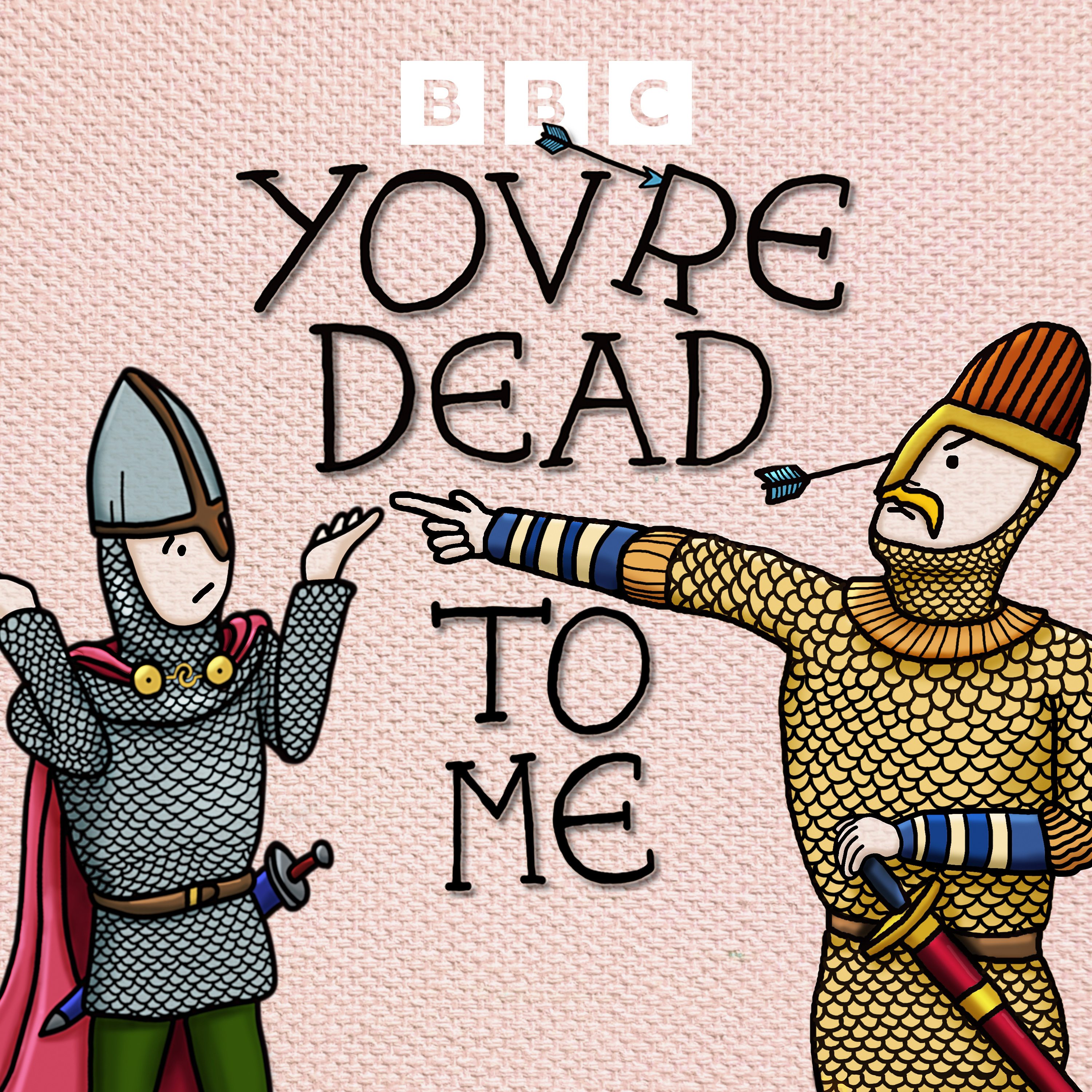
 You're Dead to Me
2 Oct 2026 · 1h 2m


 Add vo to ChatGPT or Claude to ask about everything you hear
vo listened to this episode to put together the overview and transcript, so there may be the odd mistake.
The succession crisis after King Edward the Confessor’s death in early January 1066, and how competing claims led to three invasions—Norwegian under Harald Hardrada, Norman under William of Normandy, and internal conflict involving Harold’s brother Tostig—ending with the Battle of Hastings.
Greg Jenner (host). Dr Erin Gorez is an Associate Professor of Scandinavian Studies at UCL and an expert on Norman and Scandinavian invasions; she wrote 1066: 19 Days in Autumn. Alison Spittel is an award-winning screenwriter/actor/podcaster/comedian, known for BBC Sounds Wheel of Misfortune and for appearing on TV comedy/history shows.
Edward’s deathbed message to “commend” Edith and the kingdom to Harold is ambiguous in sources; Harold’s coronation follows Edward’s funeral on 6 January. William’s claim combines Norman kinship and an earlier alleged offer from Edward (1051–52). Harold’s trip to Normandy (c. 1064) may have involved oaths and possibly a scandal in Norse sources involving Matilda of Flanders. Norwegian invasion succeeds at Fulford, then fails at Stamford Bridge where Tostig and Harald Hardrada die.
Westminster Abbey consecration missed due to Edward’s illness; Fulford swamp deaths; Stamford Bridge “bridge defense” by a lone giant; Hastings shield wall and cavalry breaking it.
0:00This BBC podcast is supported by ads outside the UK.
0:06Hey, it's your ceiling vent, so I'm dripping. Could be the rain, could be the upstairs bathroom. Yikes. You could hire the guy your neighbour recommended, but I'm pretty sure that's just his cousin. Do we know if he's licensed or does he just stone a ladder? Listen to your home. Go with Thumbtack. Upload a photo or voice note and we'll diagnose your project and match you with the right pro for the job. Thumbtack. We know homes. Hire the right pro today. In 1872, the Marie Celeste was found adrift in the Atlantic. Every person on board was gone and none of them were ever seen again. Every Monday on Hidden History, Dr Harini Bhatt takes an unexplained event from history, just like that one, reads the evidence like a case file, and tells you what she thinks happened.
0:56No hedging. Start with the Mary Celeste episode for a look at one of history's most enduring maritime enigmas. Follow Hidden History with Dr Harini Bhatt wherever you get your podcasts.
1:14Hello and welcome to You're Dead to Me with the Radio 4 comedy podcast that takes history seriously. My name is Greg Jenner. I'm a public historian, author and broadcaster. And today we are collecting our bodyguard, calling up the cavalry and galloping all the way back to medieval England and galloping back again to learn everything about the events of 1066 and the Battle of Hastings. And joining our ranks on this epic campaign, We have two very special guests. In History Corner, she's Associate Professor of Scandinavian Studies at University College London. Luckily for us, she's an expert on Norman and Scandinavian invasions of medieval England.
1:47And you might have read her wonderful new book, all about 1066, 19 Days in Autumn. It's Dr Erin Gorez. Welcome, Erin. Thank you. Pleasure to be here. Very excited to have you in. And in Comedy Corner, she's an award-winning screenwriter, actor, podcaster and comedian. Maybe you've seen her on tour or heard her BBC Sounds podcast, Wheel of Misfortune, or her new show. Ignore that feeling with Fern Brady. And of course on the telly, you may have seen her on Nowhere Fast, Celebrity Gogglebox, Richard Osman's House of Games, Pointless Celebrities. But most importantly, you'll remember her from our episode on the medieval papacy.
2:18It's Alison Spittel. Welcome back. Mad popes for life. I still talk about them. Even last week I was chatting to someone about them. It's a lot of people's favourite episode, that one. Mine too. Some pretty strange history. Popes are genuine drag queens to me. I love them. I love them. Dead popes on trial, all the good stuff. So we've done Medieval Popes and we're back in the Middle Ages with you. Yes, we are. And this is a subject I don't know that much about. Sure. Okay, so you grew up in Ireland. I did. I grew up in Ireland, yes. So what does 1066 mean, if anything? 1066, I think there was an advertisement for an insurance company.
2:55Was it Churchill? No, no, it's 1066, yeah. It's 1066. That's all I remember. It's Hastings, I think they're called, yeah. Yeah, Hastings. Yeah, sorry. I got my historical insurance companies mixed up. I'll let you off. It's a very niche subject, yeah. But yes, 1066 to me is either a passcode for something or a phone number for an English person. That's all I know. Fair enough. There's a battle. There is. Yeah. There's actually three. Someone won. There's actually three. But, you know, we'll get into it. We've got lots to cover. So it's good to know that you've got a kind of baseline, which is insurance companies.
3:30and then from there we can build. And you're Canadian originally, so you've come to this late as well. I have, I have, yes. I think for most Canadians, 1066 is just a big question mark. So it was a grand voyage of discovery for me. Lovely. What was it like for you? I love 1066. It's my favourite. I'm very excited. Oh, that's good. So, what do you know?
3:57This is the So What Do You Know. This is where I have a go at guessing what you, our lovely listener or viewer, hello, will know about today's subject. And if you're English, 1066 is the most famous date in all of English history, right? We all know it. 1066 and all that. It's William the Conqueror. It's the Battle of Hastings. Harold with the arrow in the eye. You know, our lovely podcast artwork, right? Maybe you got tickets to go see the Biotapestry at the British Museum. Maybe you saw the BBC TV drama King and Conqueror. You probably know a lot about it, but maybe not everything. So who were the men who fought for the English crown in 1066?
4:27Did Harold really get an arrow in the eye? And why should you never trust your younger brother? Maybe not. Let's find out. Okay, Alison. Yes. Obviously. Yeah. Easy question here. Who was the king before 1066? No, don't you dare. So William is the guy after. Yeah. And then the king before that was just Bob. King Bob. King Bob, yeah. I think he's a minion, isn't he? He's one of the minions, I think. That's Despicable Me. It's a very different genre. Is it like Arthur, Merlin, these legendary people that don't really exist before this? Or is it Alfred? Is there a guy called Alfred? Alfred is a king, but it's slightly a bit earlier, I'm afraid.
5:05You're sort of 120 odd years out. But those are, I mean, Alfred wrong, Merlin wrong. Was there something, the coward? No. Oh. Well, you've gone with an epithet. Yeah. There's an epithet. There's a nickname. There's a nickname. But he's not a coward. Okay. The early. Barry the punk short. Very defunctual. Erin, put us out of our misery. No, the epithet is the confessor. The confessor. Oh, Edward? Yes. Why do I know that? Why do you know that? Why do you know that? I don't know. This feels very Slumdog Millionaire for me. Edward the confessor. Edward the confessor, exactly. Not known as Edward the confessor in his early life or for some time.
5:52Because he had to confess. Well, indeed. He had to grow old and become holy. And obviously he wasn't that as a young boy. As a young boy, he was the son of King Æthelred. Another epithet. Æthelred the something. Yes. Oh, gosh. Okay, the confessor, the dad. Æthelred the dad. Again, a later nickname, Æthelred the Unready. The Unready. The Unready, which cue many jokes about him not being ready for all the Vikings that attacked his shores. Not what it meant. it meant the badly counseled. He was not a very effective king. The ill-advised, isn't it? The ill-advised, exactly. I don't like the idea of getting these names.
6:33These epithets. So when do you find it out, these epithets? If I went, hey, Greg, you're Greg the Dead. And you're like, what? Yeah, it's going to happen. It's going to, you know, that'll be inevitable. Yes, so Ethelredy Unready is the father. He's the father. The mum. The mum, Emma of Normandy. No epithet. And women don't get any epithets. The wife. The wife. Emma the wife. But no, Emma's a great wife. So Emma is a fantastic queen of England. She's actually twice a queen of England because Æthelred was so unready, if you like, that the Danes came and nabbed his kingdom. So if we think of Knut the Great, there's another one.
7:09So he kicked out Æthelred. Wasn't he that great? Didn't he have a fight with the sea? He was great. He didn't. It's a myth, Alison. It's a myth. It's a myth. But anyway, so in fact, Knut's dad, Svein, came, kicked Æthelred out and the family. So Emma was from Normandy, so across the channel. And she thought, you know what? Might be a bit safer in Normandy. So she and the kids, including Edward, her son, took refuge in Normandy. Knut came, nabbed England again. And Edward basically stayed in Normandy. He grew up in Normandy while this Danish-born king ruled England. and in fact you know we talk about the the French or the the Normans coming in and and grabbing England but actually Edward grew up in Normandy he you know from a very young age eight ten years old perhaps he effectively grew up as a Norman nobleman because of this issue of getting kicked out of his kingdom yeah and so when he came back to be king of England he was just as Norman really as English he was a bit French he was a bit French oh no that sounds like a slur he's a bit That's a bit French, mate.
8:19But in fact, we had two decades, a wee bit more than two decades of Danish rule in England while Edward was over in Normandy growing up. And so when Canute died, there was a bit of a kerfuffle with various sons of his. Kerfuffle, yes. A very bloody one. Trying, you know, ruling, but they were quite short-lived, these sons. And they had a habit of dying young, which is inconvenient if you want to rule a kingdom. And so eventually Edward was called back by his mum who had actually married the Danish king, Knut. Wait, Emma. Emma. Emma. Indeed. Wow. She married her enemy. This is very coronation-ish.
9:00It is. This is very Deirdre, Ken and Mike. Mike, get away from the door. Knut, Knut. I mean, listen, we do have an episode on Emma of Normandy. It's a fantastic episode. It's very funny. It's very confusing. And we probably need to move on from the confusion. I know, we do. So, I mean, Edward returns to the throne in England, having grown up in Normandy. He brings some French allies with him. He does. Which is obviously a little bit controversial because they're foreigners, but he's also got a powerful English ally. Indeed. And who's that? So this is, in fact, an ally of his mum, Emma of Normandy.
9:27This is the powerful... She has a lot of allies. Well, you have to, in the medieval period, as a woman, you can't wield a sword. What do you do? You make friends with men who can. Okay. So he's Earl Godwin, so the Earl of Wessex. And he was the kind of right-hand man of the Danish-born Knut. And he becomes this kind of kingmaker, a kind of power broker after Knut's death and a sort of ally of Emma. And so it makes sense to come, if you're Edward, you don't know a lot of people in England. You don't really have a lot of land or money. You don't know a lot of the nobles. It makes sense to have a powerful ally.
10:05Your mum's friend. Oh, God, your mum's friend. soon to be your father-in-law. Because Earl Godwin also has a beautiful young daughter, maybe 15 years younger or so than Edward. Oh, dear. How old is Edward? Well, Edward's 38 by the time he becomes king, right? Okay, yeah. You know, so Edith, Godwin's daughter, Edith. When Edward marries Edith, that's really kind of consolidating that alliance with the family of Earl Godwin. Yeah. And he's called Edward the Confessor. because he's always breaking stuff and then apologizing. But no, it's a religious thing. So he's a man who reputationally has sort of gone down as a man who's so obsessed with God and with faith.
10:50He can't even be bothered to rule the kingdom because he's just busy praying. Is that true? No, no, that's ridiculous. His redemption is perhaps after death. We know a lot about Edward's life and character from things that are called saints' lives because there was a kind of move to portray him as a saint. This is what the confessor is sort of alluding to. Yes. After he died for various kind of political and religious reasons. And he never was made a saint. Ooh. I think he sort of is. He sort of is. I think he is. Is he official? I don't know if he's official. We have to ask John. I think he is a saint in the English church, but yeah, we'd have to check it.
11:26We'd have to check that. It's after 1066. I don't bother. Of course. I can confirm Edward the Confessor was a saint and in fact is the only king of England. to ever have been canonized by the Pope, although that was 100 years later. Wow, the Pope. Okay, that's proper. Prophesion. That is a proper saying. Well done. Wow. So he had these allies. He had to have allies. He seemed to have ruled all right, but he did have to rely on these very powerful men, particularly this family, the family of Earl Godwin. Yeah. So he did. His mum's mates. His mum's mates and then his wife's mates. Yeah. So he's married to Edith for about five years and there's no children.
12:08So that's a problem. There's a lot going on. Maybe there's a kind of power play by some of his French and Norman allies. Yes. And this is dangerous to Godwin, Earl Godwin and the family of Earl Godwin. Yeah. So there's a big falling out. Earl Godwin and his sons sort of rebel. Edward kicks them out. He sends his wife to a nunnery, get thee to a nunnery. Wow. But Godwin comes back with men and ships and swords and he wins effectively. There's not a battle, but he kind of, there's a bit of armed diplomacy that goes on and he is reinstated in his position of power. Edith comes back from the monastery and is reinstated in the bedchamber.
12:52Bit awkward. Reinstated in the bedchamber. Indeed. I know. This feels very 2am, a wedding situation of my family when it's been around. People have been reinstated in the bedchamber. Yeah, so we have a king of England with no heir. No heir. His brother-in-law is a bit of a red flag. He's a bit of a red flag, but he's also really useful. Yeah, sure. So Harold, this is our first person of note. Yes. Harold, so he's the queen's brother, Harold Godwinson, son of Earl Godwin. Yeah. He's a really useful ally. He does remain loyal to Edward after this kind of slight civil war rebellion kind of problem.
13:32He helps administer the kingdom with his brother Tostig, his younger brother Tostig. They do a really good job. You know, there's almost 15 years of peace, really, more than 15 years of peace. Yeah. And Edward can kind of adopt a kind of senior statesman sort of approach. He's maybe not out leading the charge. He's not out attacking Wales like Harold and Tostig are doing. But he's a kind of elder statesman. he's off performing kingship wearing the crown he's chill doing all the things he's chill he's like Wayne Rooney nowadays yes exactly he's doing podcasts he's doing podcasts he's coming to Numbia I think he's more of a Beckham kind of Beckham yeah and he founds Westminster Abbey right exactly and this is a huge thing so Westminster Abbey that you can see now is the kind of brainchild of Edward the Confessor and then our senior king suddenly falls very ill he does out of nowhere he does they always do that I know.
14:31They're rubbish that way. And the kind of date is we're right at the beginning of 1066. We are. Because we are, we're what, January 4th, 5th? 4th or 5th, we're not quite sure. Well, at the end of 1065, December, Edward falls ill and he takes to his bed. And at the very end of December, they're going to consecrate, they're going to have a kind of ceremony to sort of officially open Westminster Abbey, you know, this project which is so close to him. They've got the giant scissors. They've got it ready to go. They've got the ribbon and he misses it because he's so ill. So it's really obvious he's very, very ill.
15:06Yes. January 4th or 5th, he dies. Right. Yeah. So the first on the scene, in fact, at the deathbed is Harold. Harold. Harold is there. He is there. He is watching, waiting, probably helping a little bit. Not helping. Not helping in that way. Hello over the face. Just helping. He's just waiting. Yeah. He's calling up Dignitas. Indeed. Yeah, exactly. But as Edward lies dying, he says these, he allegedly says these very important words. He says, Harold, I commend my wife, the Queen, my wife, Edith, and the kingdom to your care. Please protect her. Did anyone else witness this? Well, well, well, this is a question.
15:50I love your suspicious mind. This is very suspicious. Well, this is in a text which was commissioned, if not kind of heavily influenced by Edith, the Queen. And it's a very pro-Herald and Tostig version of events. So one, did he say it? Not quite sure. Two, what does it mean? I commend the kingdom to you? Does that mean you're the next king? Or does it mean, could you please look after the kingdom until William gets here? That's the trouble with a deathbed, isn't it? You're not really that clear. No, you're not thinking clearly at that point. No, no. And the amazing thing, of course, is that the funeral for Edward is on the 6th of January.
16:32January 6th. January 6th. Obviously, a lot of listeners will be thinking, hang on a minute. Hey, I remember that day. That's a whole other day. It's the funeral. It's also the coronation day. Also the coronation. Harold, he attends the funeral and then what? Swaps outfit? Chops to the vestry, puts on a new clothes. Yeah, this is great. How far away was the coronation from the funeral? It was in Westminster Abbey. Same building. Very good. So not very far. It's a multi-purpose building. It's a multi-purpose space. They take down the black, pop up some red. Yeah, exactly. Just get the band to change the music.
17:05Yes, exactly. It's like Weatherspoons when it changes from breakfast to lunch. Exactly. And the vibe changes completely. So a bit of a party planning nightmare, you know, funeral to coronation. But Harold pulls it off. He pulls it off. So well done. He's now king of England. He is king of England. And this is a really important thing, right? He's sanctioned by God as King of England. So it is no small thing for someone else to try and come and pinch that title. Absolutely. But someone's gonna. But someone's gonna. That's why you're here, Alison. I'd be like, that's the end of the podcast. That's it.
17:36Really straightforward transfer of power, actually. Yeah, lovely. Peaceful transition. There we go. so the story goes that he has either claimed power rightfully or he's grabbed power indeed depends on our sources depends on who's telling the story okay which is fine let's sort of get to the next stage of course which is that this is a man who's been running the country already he's been kind of doing it anyway peacefully peacefully yeah his brother's been helping him senior king sure has been off building a lovely church but really how old how old is the man he knows the job he's there he's quite well qualified so obvious question alison do you think he should be the king of england at this point well it's been consecrated by god sure who am i to argue um yeah i don't see any there's no children he's a close guy to edward and like i do feel like he should have so he's your front runner i think he's my front runner okay yeah well we're gonna will young versus gareth gates that's it there's gonna be some other candidates coming along because it's going to get...
18:38Oh, it's Casamore, some bombshells. Yeah, exactly. An ex-boyfriend walks in. No! Yeah, it's going to get a lot more confusing now. So you might want to start making some notes because if I do my video game voice, enter player two. Because here comes Duke William of Normandy. I've heard of this guy. The storming Norman himself. And he's quite an interesting character. I mean, do you want to give us the kind of, the sort of the very quick overview of who he is? because he's quite an interesting player. He's very, very interesting. So he is the illegitimate son of the Duke of Normandy, right? And so if you remember Emma of Normandy, he's basically Edward's cousin, right?
19:22Because of that Norman connection. So he's part of the family. He had a really difficult childhood in that his dad went off on pilgrimage and died when William was only seven, eight years old. which is really difficult. If you're then thrust into the position of being a duke, I have an eight-year-old, I wouldn't want her to be the Duke of Normandy because this is a period in which there's a lot of strong guys with big swords and pointy spears who want lots of land and lots of power. And if there's an eight-year-old kid in the way, they're going to try and kill him. And that's exactly what happens.
19:58And it'd be so easy. Exactly. You think it's easy. But William survived loads of assassination attempts in his child. He got kind of shunted around. He got kind of taken out of the castle in the middle of the night and hidden in peasants' huts to save his life. Wow. So he has a really difficult childhood. He makes it. He has to fight a few very difficult battles against powerful, powerful men, but he does it. So, I mean, you could say, like, he starts off in a difficult situation. he grows up as quite a aggressive, ruthless, kind of ambitious person. You know, arguably because he's got, it's quite a difficult life to start with.
20:37And he has to in order to survive. And he's got a name, a nickname. He's got a name. He's William, Duke of Normandy. But his nickname is William the... Conqueror. No. No, not yet. Not yet. Oh, right. He's not done it yet. He hasn't done it. He's not conquered. Billy the Kid. Billy the Kid. That's cute. That's really nice. No, William the Unkillable Bastard. William the Bastard. The illegitimate son. He's illegitimate, so he's not technically meant to have inherited, but he has. Well, no, he has. He's the only son. Yeah. It's actually fine. But he's born out of wedlock. He's born out of wedlock.
21:11But honestly, at this point, at this time in history, it's kind of okay. Yeah. You know, it's going to become more of an issue later. It's 1066. Get with the time. Exactly. It's a modern attitude. It's okay. He's the only son. Yeah. It's more a statement of fact, really. So it's not the bastard. It is also the bastard. It does become that, obviously. William the hard bastard, he is absolutely he's ruthless, right? He's ruthless and he's really good at doing what he has to do as a warlord effectively in the early 11th century. I suppose to be a warlord you do have to be a bit of a bastard. There's no cuddly warlords, are there?
21:50No, exactly. William the nice. He is a warlord, but he's lovely. So you said he's a cousin. So he's sort of part of the family. Yes, he is. So that's his claim to the English throne. That is part of his claim. Right. Part of his claim. I was going to say, so give us the second part. Give us the more important bit. I bet it's God. Did God get involved again? Well. He did, didn't he? He's such a troublemaker. No, so you remember I said there was that Earl Godwin, there was that rebellion slash civil war kind of argy-bargy that happened in 1051-52. So there was a little moment in there when Godwin and his sons had left England and Edward kind of thought, oh, right, they're gone.
22:33Who can I get to be king after me? Or maybe who can just support me at this difficult time? Allegedly, he either sent messages to William, Duke of Normandy, his cousin, who perhaps he remembered fondly for some reason, or he actually had William come himself to England we're not sure and allegedly at that time he offered the throne to William so but that's 1051 52 oh right that's a bit that's quite some time before 1066 it's 15 years almost it's a bit yes so lots can happen does the offer elapse the offer elapsed well not for William ah yeah so William would always look back and say well he offered me the throne in 1051 he can't take it back Yeah.
23:16Right? But it's been 15 years of peace. But it's been 15 years. Just be a peace. Exactly. And then in 1066, Edward is dying and he offers it maybe to someone else, to Harold. And in English law, if you're dying and you offer something to someone else, well, that's the kind of final word. Yes. So Harold is there saying, well, he offered it to me on his deathbed. That's legit. Yeah. And then William is over there in Normandy saying, no, I have a prior claim from 1051. So both of them are kind of saying, but it's mine. But there's also another story, right? There's another one. In 1064, give or take.
23:51There is. And the buyer tapestry confirms it. Confirms this. Question mark. Harold ends up in Normandy. Indeed. Okay. And we don't know why. We don't know why. Wow. So there's a couple of versions. Do you want to give us your possible version? What's he doing in Normandy? He's trying some croissants. Taking a little bit of culture. Do you know what? He's going on a wine cruise. Okay, wine tasting. He's getting cheap wines and bringing it back to Britain. There's no tax on it. Yeah. Booze cruise. Booze cruise. He's on a booze cruise. He's on a booze cruise. He might be. Completely. The stories we have, shipwreck.
24:23Shipwreck, he didn't mean to. Yeah. Possibly the most, he might have, you know, just been going over for political reasons. Political reasons. Some stories, Norman stories, are he was sent by King Edward to kind of reaffirm the fact that William was the chosen heir. Yeah. The most likely explanation is actually, again, during this argy-bargy of 1051 to 52, Edward had asked for hostages from the Godwin family, and he'd then kind of given them to William, as you do. He's kind of done past the parcel with some young boys from the Godwin clan. And maybe Harold is now so powerful in 1064, he wants to go and get them back.
25:03Right. But it goes a bit wrong. He ends up a prisoner, sort of in a very... Banked up abroad. his booze cruise has gone wrong the booze cruise goes very bad he ends up a prisoner of William and something happens we don't quite know what but Harold seems to have made some kind of promise to William the sort of Bayeux Tapestry alludes to him being shipwrecked maybe captured by Guy of Pontieux William may be rescuing him and then making him do a promise on a sacred oath on a reliquary or in fact on the Bayeux Tapestry on two he's kind of touching both of them Oh, right. So it's a double oath. It's a double oath.
25:42And Harold's kind of there like with his head drooping, like, oh, no. Or, you know, oh, you know, my glorious Lord. I acknowledge William, my sovereign and my, you know. Or, oh, no, what have I done? Yeah, exactly. We don't know. It's a very situationship type thing. Men need to just commit. These are two men who are kind of friends. Or are they friends? Will they, won't they? And actually, to add insult to injury, in the Scandinavian sources that you specialize in. There is a scandal. There's a scandal. Absolutely. So here the story. Shaggin. Yes, it is. Yes, it is. It is. I'm allowed to say that on Radio 4.
26:20I don't know. Is it? There's an illicit love affair. Consummation. Okay, lovely, lovely. So here the story. Again, shipwreck. Harold didn't mean to be there, but he spends the winter because the idea there is he travels in the autumn. Lots of big storms. He gets shipwrecked in Rouen. Oh, shipwrecked. And who do you think, of course, is at the court of William? There is also, who do you think? And we're talking, we're talking an affair. Yeah. Yes. Oh, okay. Is it Emma? No, that's the... Edith? No. Matilda. Matilda. She hasn't been in here yet, has she? So this is William's wife. Yeah. Oh, wow. Matilda of Flanders.
26:59Very, from a very powerful kind of principality. Yes. And the Norse sources. Has there been a TV depiction of this? because I can imagine a lot of powdered breasts. Yeah, there was the recent drama. Was he in there? I didn't watch all of it. Okay. But yes, the story goes that Harold lays his sweet charms. On Matilda, because William, he's a pious, ruthless bastard. He goes to bed early. My favourite type. He's the best kind. He goes to bed early. But Matilda likes to stay up late talking with Harold Godwinson and that is always a euphemism. in the sagas. So eventually, word gets round the castle that, you know, something's happening.
27:41And William kind of drags Harold into his kind of private chamber and says, I hear you've been talking with my wife. And Harold says, oh, oh, yeah. Yeah, no, I have. I have. Actually, it's not what you think. I really want to marry your daughter. And probably at this point, Matilda's like, what? Hang on. That's not what you said. You were kissing me. You were kissing me. But, you know, Harold, this is his excuse. And he's like, oh, you know, and your wife, Matilda, promised to help me in my suit. So William buys it. Right. Harold does his oath. He's now betrothed to William's daughter. Oh, my gosh.
28:19And then he goes back to England. Yes. In 1872, the Marie Celeste was found adrift in the Atlantic. Every person on board was gone and none of them were ever seen again. Every Monday on Hidden History, Dr Harini Bhatt takes an unexplained event from history, just like that one, reads the evidence like a case file, and tells you what she thinks happened. No hedging. Start with the Mary Celeste episode for a look at one of history's most enduring maritime enigmas. Follow Hidden History with Dr Harini Bhatt wherever you get your podcasts. Pretty quickly. so we now have two suitors possibly because harold is the rightful king obviously but maybe he's promised it to william yes and he's promised to marry william's daughter maybe maybe but now i can introduce a third suitor or a third player player three player three i'm going to call him the thunderbolt from the north yes uh it's not erling harland uh it's not it's not a big well i mean he's kind of if you had to draw a norm a sort of norse king it would be erling harland would be your kind of closest a big blonde scary man i think we should all be imagining the king of Norway as Erling Harald.
29:28Okay, so this is another Harald, but he's a Norwegian Harald. He's a Harald. He's Haraldur Sigurdersson. So he's the son of Sigurdur. Okay. Who was also a king of Norway. He's got a fun epithet as well. Again, later. But he's called Haraldurde. So the hard ruler. The hard ruler. The severe ruler. This does sound slightly pornographic now. At this age. Fair enough. I'm the hard ruler. and he's he is perhaps the most impressive of the contenders for the throne if you like how so he's just he's a viking he's just he's when you picture a viking yes so if you picture going in a ship yeah waving an axe yeah that's basically breathing heavily breathing heavily there you go so so he also actually a bit like william and edward he also got kicked out of his kingdom as a teenager.
30:24So again, this is Knud, lots of things going on in the north. So Knud also wanted Norway, you know, as well as England, as you do. And so Haraldur, Norwegian Haraldur, actually had to spend, you know, 10, 15 years as an exile. And he did this as a mercenary. So he went to the East, kind of Eastern Europe, what is now Eastern Europe. And he ended up in the guard of the Byzantine emperor, the East Roman Empire, in this very noted collection of soldiers called the Varangian Guard, who are kind of the fiercest, the ones who do all the dirty work for the emperor. And he comes back and he uses his wealth and his cunning to become king of Norway.
31:06Yeah. Harald Dursch is king of Norway for, you know, for some time afterwards. And he does it pretty well. But why does he think he should be king of England? Because his enemy was Canute, who was king of England. Because he's obviously amazing. That's not a claim. That's not a legal claim. You said, why does he think he should be king of England? Okay, fine. Okay, but legally that's not a claim. Legally it's not a claim. William has a legal claim. Harold has a legal claim. Hadrada, you know, Hadrada. He kind of has a legal claim. So basically when, so Knut was out kind of attacking everyone in the North Sea, basically.
31:37His Knut son, Harra Knut, was king of Denmark. He's half a Knut. He's half a Knut, famously. I'm really trying very hard not to. Don't worry, this is all in the quiz. I know we're broadcasting this. Well, he had a sort of agreement. Remember, I said there was this nephew that Haraldus kind of came and became half, he became kind of co-king with this nephew named Magnus. And so Magnus and the son of Knut, Haraldus Knut, had a kind of agreement while this was all kind of kicking off. And neither of them had sons. This is kind of a widespread problem. And they said, well, you know, when one of us dies, if we still don't have a son, we will inherit each other's thrones.
32:19Lovely. So Haraldur Knut dies. Like I said, the sons of Knut, they're always dying a bit young. So Magnus kind of claims to inherit Denmark. And because Knut was king of Denmark and England and a bit of Norway, when Haraldur inherits Magnus's kingdom, Norway, he then claims Denmark and England. He'd been kicked out of his kingdom by Knut as a young man. Yes. Knut had ruled a North Sea, what we would call a North Sea empire now. He didn't use that term exactly. But he reigned over multiple countries in the North Sea. He was incredibly powerful, cultured person that people at this time could have looked up to.
33:01You know, if you're a king, you're like, wow, Knut, you know, he did it really well. Yeah. He then served in the Haraldrsch, then served the Byzantine emperor, another very powerful person ruling over multiple lands. I think it makes a lot of sense. Sure. Harold says, you know what? I don't want to be just king of Norway. I would like another kingdom. How can I do this? It's basically returning to episode of succession here. It is, absolutely. Because there's going to be another name I have to add in here. Oh, no. Enter player four. Oh, no. This is Tosti, the little brother. Harold's little brother.
33:30What a cute name, by the way. It is cute. It's a cute name. It sounds like... He's not cute. No? No, no. He sounds warm. No. Tosti's not warm. He's an absolute nightmare. Because Tosti falls out with his brother, Harold Godmanson. the king of England, you know, rightful king of England on the throne. He's on the throne. His little brother, Tosti, is like, I don't like this very much. I'm going to go make trouble. And he goes and makes trouble in the most sort of kind of odd kind of way. He just sort of tours Europe. He does. He does. I mean, in fairness to Tosti, he has been exiled because there was...
34:02This is a common pattern. This is a common pattern. So because he was Earl of Northumbria, right? And so the North is the most wonderful place, but it doesn't really always like Southern rule. He imposes taxes. He kills a few noblemen from the North. The Northerners quite understandably say, you know, we don't really want this. They rebel. There's a kind of agreement in which Tostig has to be banished. He's kicked out in order to save Edward and save Harold. He's outraged when Harold is all of a sudden crowned in Westminster Abbey. And so indeed he goes on like a tour of Europe looking for someone to help him invade.
34:39He goes to Normandy. He tells William. William should invade. The Norse sources also say that Tosti goes to Denmark, looking for the king of Denmark to help him. King of Denmark says, no, I don't think so. And he rocks up in Norway. And Haraldr, king of Norway, is there. Tosti rocks up and says, would you like to help me conquer another kingdom? And Haraldr says, well, yes, absolutely. That's exactly what I want to do today. So William starts planning his invasion. He's doing that. But meanwhile, Haraldr is also planning his invasion. Okay, fine. And Haraldr sets off first. Harold sets off first.
35:13So basically, what you usually did in this period was you tried to invade and cross the Channel, especially in the summer, because the weather's nicer. I thought this is great. I'm sorry. Yeah, yeah, of course. It's like a barbecue. You don't go on holiday in England in the winter. No. You go in the summer. So they're kind of waiting. So William is down in Normandy, collecting his forces, waiting for kind of the proper wind, you know, the right direction to blow him across the Channel, all the ships. So the Norwegians sail first, they go via the Orkneys, they come down the northern coast of England and they rock up basically in Yorkshire.
35:49So our first big battle on the 20th of September, 1066, they trounce the kind of northern armies. So this is the army. So I said Tosti was the Earl of Northumbria, the guy who kind of kicked him out or took his place. He fights at the battle with his brother. This is Morkart. This is Morkart, Earl of Northumbria. his brother, Edwin, Earl of Mercia, and they fight at the Battle of Fulford. Fulford is kind of like a suburb of York now. So it's about two miles out of York. They have a big battle and it's kind of in very wet territory. And basically the English army gets kind of like pushed into like the swamp or the fen.
36:31Loads of them drown. They get killed. So many, according to the Norse sagas, that the Norwegians could cross without getting their feet wet. because of all the dead bodies. On their bodies. On the bodies. Gross, yeah. That is gross. So the Northern Earls are killed. The Northern Earls actually survive. Oh, do they leg it? They run away. They leg it. Good. Yeah. The Vikings, if you like, the Norwegians, seize York. The people of York are like, ooh, I think we should make peace with these people now. They make a big agreement. They pledge, they kind of pledge submission to Haraldur of Norway, who's got Tosti with him at this point.
37:05Tosti's kind of fighting on the side of the Norwegians. And then they say, okay, I think we should have like another little meeting. We should have a little assembly in a few days time at Stamford Bridge. Yeah. Does that ring any bells? Chelsea football club. Not those bells. It's still Yorkshire, actually. It's not London, not West London. I was like, wow, they travel fast. So that's the Viking invasion up north. So that's Tosti supporting Harald, you know, the Norwegian king. Indeed. Meanwhile, our Harold, Mr Mustachio, he's on the south coast waiting for the Williamites. Waiting for William.
37:40He's gathered the biggest land army and the biggest ship army, Navy. He's kind of patrolling the southern coast, waiting for something to happen from Normandy. And all of a sudden, these messengers come down from the north saying, Vikings! Oh, no! And your brother. And your brother. And by the way, they've just killed, you know, the English armies of the north. Please, could you come help? Oh, my gosh. That's annoying, isn't it? Yes. You're sitting there waiting for one invasion and then another one happens. Another one happens. It's like waiting for a bus. Exactly, yes. And then two come at once.
38:10Two come at once. So Harold is like, oh, all right. Oh, fine, we'll go north. Because he's just got, he's sent his army home. He has, in fact. Because September is when you do the harvest as farmers. So they need to go get the food in. He's just let them all go. Yeah. And all of a sudden the messengers come and they're like, oh, I'm sorry, but you need to bring an army north. Very, very sorry. And he does. He does. So we're not quite sure how. None of the sources specify, but probably Harold, King Harold, and his closest retainers probably ride north. That's what they typically did. They would have gathered more kind of militia, kind of local fighters as they went.
38:44Some might have gone by ship if they had the ships there at that time. And they arrive in the vicinity of York just after York has said, oh, yes, we're going to submit to the Norwegians. Right. And they do it in what, three days? It's very quick, isn't it? It's very quick. I don't know exactly how many days, but it's like under a week. They race up and the Vikings are not ready for them. The Vikings are not ready. No. What are the Vikings doing? Oh, are they putting together furniture? Flat pack furniture? It's a very hot September. It's a hot September. Are they Sunday? They are? No! Yes! I was trying to be facetious.
39:24No. Okay. They are? I bet they are absolutely gorgeous, these Vikings. Much like the Norway football team in the World Cup recently. There was lots of photos of them with their shirts off going, this is hot. Yes, that's exactly what the Vikings are doing. Yes, absolutely. So it's a hot day and they think, well, we're not going to fight. We'll leave our armor at the ships. Oh, dear. And we'll leave a third of our army at the ships who are, again, slightly out of York. It's a beautiful day. And all of a sudden they see this dust cloud. So they see this cloud of dust rolling down this road because it's a hot September, right?
39:58Yeah. And they think, ooh, what is that? And there's this wonderful description in the sagas where it says, and it looked like ice in the sun. And it's because the sun is glinting off weapons. And Harold kind of calls Tosti to him and says, I think there's an army coming towards us. And Tosti, at first he says, no, I think it's my friends. They're coming to help. And, you know, the weapons become more obvious. They come closer and closer and closer. And Harold says, no, I really don't think that these are your friends. I think this is an army. and we don't have our armour and also a third of our guys are not here.
40:33Could someone go get them, please? So he sends off messengers. But in the meantime, it's Harold Godwinson. He's arrived, he's leading a massive force and he attacks the Norwegians. Oh no, not these beautiful, righty Norwegians. And Erling Haaland defends the bridge. Now we've got two Erling Haaland. Sorry. So we've got this wonderful, possibly later, story about the lone Norwegian who kind of, so they're, you know, the English are coming on one side of the river, the Norwegians are on the other side of the river, and there's a bridge. There's a very narrow bridge over the river. And now we can imagine different Erling Island, number two.
41:10Martin Odegaard defends the bridge, yes. And he's like one guy who's got his armour, he's got like a big axe or something. He's a giant, right? He's a huge guy. Big guy. And the English keep attacking him and he keeps killing them. And he keeps throwing them off the bridge and there's lots of kind of blood and gore and sticky substances everywhere. Jam? Jam, absolutely. He's been flying everywhere. Exactly. And he defends the bridge for hours, which is really important because it allows the Norwegian troops to form up, get the weapons that they have, form a big wall, until, of course, someone finds a boat, which is a problem.
41:46They find a boat. One of the English people find a boat, take a spear, get in the boat, sail under the bridge. And what do you think happens? is it his uh is it is it wait does the big giant get a spear in in in in the the genitalia area which bit which bit which bit spear up the bum no i don't i don't think that's best is it not up the bum comes up through him yeah oh through himself probably the uh the perineal gland yes in ireland we call it the gooch yes yes it is yes and he does not survive that no oh No one is going to survive that. The sensation of that. And so, you know, we should move on because obviously we've got lots to get through.
42:29But the Vikings are defeated. The Vikings are defeated. And Tosti is dead. Tosti is dead. How did Tosti die? Did he get in the gooch as well? Not that we don't know. The sagas say he fought well and bravely. He fought with the standard and actually Haraldr, the king, he gets killed first with an arrow in the neck. No, not Haraldr. I know he does. But he does speak some poetry before he dies. So that's important. And then Tosti picks up the standard and even across the battlefield. The Raven Banner, right? The Raven Banner. It's called the Land Waster. Anybody who holds it will be victorious. Turns out that's a myth.
43:04Okay. Harold Godwinson offers a truce to Tosti twice. And Tosti says, no, I've joined the Norwegians. I'm going to fight and die with the Norwegians. I hate you, you know. And he does, he dies. They both die. And then guess what happens? then we have a battle in Hastings yes is that they travel down they go down so we now get another invasion so you joked before about the buses thing I did literally what happens okay another invasion Harold has raced north he's defeated his brother he's killed the king of Norway William's coming through Hastings and three days later yes yes pretty much yes so Stamford Bridge 25th of September William probably crosses on the 27th the night of the 27th to the 28th of September You'd be exhausted.
43:51You'd be exhausted. So a message comes up and King Harold is like, what now? Well, good news, Sire. You know that invasion you were waiting for? It's happened. Indeed. 200 miles away. Indeed. Got to come back down now. Got to come back down now. Come back down. And the story goes that he races down. He races down. We've often been told that he marches his men down, force marches. They're exhausted. They've just marched 200 miles, forced a battle. Now they have to march another 200. Is that true? I mean, it's nowhere specified. it would be unusual for him to do that. That's probably more of a Victorian imagining.
44:24Harold would have ridden, right? That's what high status men did in this period. His housecarls, his retainers probably rode. Some again may have gone by ship. He often did, in Wales, he had attacked by land and by sea. And he gathered men as he went. So that's what he really would have been doing. So he's calling up again, local kind of militia type people. So most of the people we hear about fighting at Hastings are men from the south, so Kent, Sussex, a bit further north, you know, Norfolk, Suffolk. Yeah, London area. London area, right? So he's collecting a new army, if you like. But the Corps, yes, absolutely, his kind of professional fighting guys.
45:06His bodyguard. His bodyguard absolutely are racing down and fighting, but probably on horses. And we should probably talk about William's invasion just very quickly, because it's incredibly impressive what he's pulled off. It's so impressive. It's so impressive. I've even got some really fun numbers for you. I do, I do. Give us some data. I'm giving you some data. So William, he's been collecting men, not just from Normandy, but from northern France. He's sent out the call, come join me. England is very rich. There's lots of loot, right? The booty. Yes. It's got a really effective tax system. Oh, who doesn't want that?
45:40He's also sent messages to the Pope. The Pope has sent him a papal banner, which basically says you can go kill some Christians in England. This Pope is... We're back to the Pope again, aren't we? We're back to the Pope. He's building ships, he's mustering men, and he's provisioning them. So in fact, because I said he's waiting for the wind, the correct wind doesn't blow. He gets sort of stuck on the coast of Normandy for six weeks. Wow. And to do that, he has to be a really, really good administrator. he has to come up with food fresh water and alcohol for men maybe 10 000 12 000 men maybe 3 000 horses oh yeah for about six weeks so much alcohol for those horses he also has to remove things from the camp so if you've got say 3 000 horses somewhere for a month yes how much poo do you think they would produce yeah that's a lot of poo i know so one estimate says five million pounds.
46:42Of poo? Of poo? Monetary value? In weight. Literal weight. So he would have had to have a system to remove the poo. 700 ,000 gallons of horse wee had to be removed. Of urine. So horse urine and horse poop is being extracted. And 450 tons of human poo. But wait, how would you extract horse urine? It's not like they've got urinals. He's got to have like a whole system of bringing in food and moving out waste. Yeah. So I think, you know, William's kind of achievements in this area are not fully acknowledged and they really ought to be. So he's so organized. Yeah. So 13th of October, Harold and his forces are sort of 10 miles, you know, they've come down to London.
47:22They've had a few days. They've had a few days in London. Harold's younger brothers say, don't fight or let us fight. Exactly. You stay here and we'll go fight for you. And he says, no, no, no, I'm going to, I'm the king, it's my land. Yeah. So they march down on the 13th of October. They're 10 miles outside the Norman camp. They're preparing for battle. where is the battle going to happen? Hastings. No. No. Oh, no. Where is it happening? It happens at a place called Battle. Battle? But only because we call it Battle because where the battle happened. That's beautiful. Okay, that's like the Barack Obama Plaza, which is a petrol station named after Barack Obama in Ireland.
48:00So it's about six and a half miles from Hastings. Exactly, exactly. There's a kind of ridge. It's quite rough ground. Right. It's kind of on the road to London. So the idea is William is kind of bringing his troops up out of this sort of peninsula around Hastings. He's coming up towards London. Harold is coming down from London. He's going to block the advance. And Harold grabs... They're commuting. They're commuting. Exactly, exactly. And Harold seizes the high ground. There's a kind of ridge through where there's an abbey, so Battle Abbey Ridge. He seizes the high ground. He puts his men in a kind of big wall.
48:34We call it a shield wall. Right. And the idea is that William and all his men are going to have to sort of charge up the hill and attack the wall. And that's how they're going to take out Harold. Right. Which is extremely difficult to do. It's very difficult. And they try and they try and they try. They try all day. Yeah. They try. This is one of the longest battles in medieval history. Absolutely. Which suggests actually they're very, very closely matched. Right. These two. So they're attacking, attacking the wall. They're sending arrows up over the wall, back and forth, back and forth. until there's a few times actually William, he fights on three horses.
49:09People keep kind of killing his horse. He keeps getting up and fighting again. I'm fine, I'm fine. You know, at one point, like the rumor goes around, William is dead, right? Because he's fallen and he has to kind of raise his helmet and say, nope, I'm still here. Keep fighting. Dead horse, but I'm fine. I'm not dead yet. But eventually there's an attack on the shield wall, the English troops. The Normans fall back, or the Normans and their allies fall back and the English follow. And the cavalry comes in and slaughters the guys who've run after him. So the English, they've given up the high ground.
49:41They've given up some of the high ground. And then the Normans come back around and just slaughter them. And then suddenly there's a chink in the wall, presumably there's a hole. And that's kind of, again, that's not it. It might have happened multiple times. William, presumably he tried to attack, you know, retreat, attack, as we say, all day. Until eventually, you know, the English are just kind of getting ground down. There's a final assault. we don't quite know what happens but there's lots of arrows in the air oh someone oh there he is oh lovely little Harold I love it he's like you did this to me yes our podcast artwork 12 series in finally makes sense what an honour to be involved in this episode wow so the story is arrow in the eye so early sources say he was killed yeah okay or other early sources say he was cut down by many wounds Harold Rex Interfectus Est exactly That's what the Bay of Tapestry says.
50:34One very early source says, so William stabbed him in the chest. William's mate got him through the stomach. Somebody else locked off his head. Oh, that's going to do it. And somebody else locked off his thigh, sometimes a euphemism, and walked away from the battle holding it. Right. So maybe his thigh, maybe some other piece of anatomy near the thigh. The upper upper thigh. The upper upper thigh. Manhood. They ran off with his manhood as like a weird trophy. Yes. Only in the 12th century, three generations perhaps, after the battle, do we have stories of him being wounded by an arrow. And then he got wounded by the arrow, but then he fell from other wounds.
51:18Yeah. And then the story kind of coalesces around this idea of he got it in the eye. By the kind of the 12th century, basically they're saying there was an arrow, there were loads of wounds, they ran off with his thigh. So like you get poets kind of giving all the modes of death in one. And the famous Bayer tapestry, the arrow in the eye, may be a 19th century restoration. Indeed. We don't know. It's probably not an arrow and it's probably not in his eye. Oh, wow. So we're not sure. So Harold Godwinson is killed in the Battle of Hastings. Yes. Harold Hadrada has already been killed. Tosti is killed.
51:47So William is the fourth king, right? Last man standing. Yeah. So he marches on London and everyone goes, all right, I guess you're the king. No, he pillages and burns. Okay, okay. He does what he does best. right this is this is very much his strength so he marches on dover and canterbury he circles london he crosses the thames basically so our northern earls morcar edwin um there's also the kind of last descendant of ethelred the unready he's still kicking about already about a hundred years and i'm still everybody who could rebel basically kind of they kind of all meet in Berkhamstead. It's a nice community town.
52:26The classic meeting. The classic meeting point for 11th century conquest. Yeah. And they kind of all bow to William and they're like, okay, fine. It's like a service station. I guess you've won. Exactly. And he is crowned king again in Westminster Abbey. Oh, that old chestnut. And it's still 1066. Yeah. This is all one year. He's crowned king on Christmas Day. 1066. It's a Christmas miracle. It's a Christmas miracle. New king of England, new chapter. Yeah. So Edward the Confessor had died on January 4th or 5th. And the funeral was January 6th. And then on 25th of December... We've got a new king.
52:57Brand new king. Brand new king. Three kings. Three kings. In one year. Yeah. Wow. I know. And William also famously builds Battle Abbey. Oh, yes. As a big apology to God. Yeah. I'm so sorry about all the bloodshed. So there we go. So Judge Spittle, you know, you've been given, did the right man win? William the Conqueror. Well, by the name, you'd think it would, wouldn't it? Because if he was called William the Conqueror and he didn't win it, that's going to be bad for him. No, if I'm being frank, I'm very attached to Harald there. Oh, okay. I quite fancy him, even though I haven't seen him yet.
53:32But I was like, oh, he sounds great. Alfred, Alfred probably should have morally kept the kingdom. Harold? No. No, Alfred. Oh, Alfred. No, he's long dead. Yeah, yeah. You're getting confused on the O 'Kings? I'm getting destroyed here. I'm getting destroyed. That's all right. It's a lot of names. It is a lot of names. You're right. Harold should have kept that. The way I stand on this one. You're Team Harold. Not so much Team Harold morally, but he just made an enormous blunder going to fight that battle. Because William had to come across all the ships, all the Navy. Do you think you should have left the brothers to do it?
54:04Yeah, leave the brothers to do it. Because if you lose that battle, you get a second battle. Yeah, that's true. And I'm glad Tosti's dead. So harsh on Tosti. The Nuance Window!
54:19Anyway, time now for the nuance window. This is where Alison and I embroider a more historically accurate by a tapestry. Maybe with more Gooch action, I don't know. For two minutes, while Dr. Erin tells us something we need to know about the events of 1066. So I'm getting my stopwatch up. Oh, gosh. And that's the wrong app. Sorry, that's my banking app. That's not helpful, is it? I bet your banking code is 1066. Must change it. No, it's not. Okay, so here we go. Two minutes. Dr Erin Gurris, take it away. Okay. So we've talked about the arrow and how Harold was killed. Yes. There was so much carnage on the field of Hastings that actually rumours started to circulate afterwards that first they couldn't identify his body.
55:02They had to get his partner, his long-term life partner, Edith Swannneck, to come to the battlefield. Edith Swannneck. Indeed. Walk the battlefield looking for his body because only she could identify it because he'd been so hacked to pieces. And also he was missing very important parts of himself. She's like, I know that gooch anywhere. I know it anywhere. Exactly. And in fact, so mutilated, apparently, was his body that there were then later rumors that he had survived. And there's a wonderful story from maybe around 1200 that he had been kind of spirited off the battlefield and he'd been healed by, weirdly, an Arab woman who's kind of shown up at this point in Sussex and nurses him back to life.
55:42He wanders the continent and he comes back to England. It becomes a kind of hermit, a holy man, and actually kind of atones for all the bloodshed that way. And he kind of sits in his cell, kind of watching William the Conqueror go to church. And he eventually dies many, many, many years later. And then William kind of hears about his death and says, who's that holy man that's died? And they're like, oh, Terrell Godmanson, didn't you know? And I think that tells us, you know, all these stories tell us that, in fact, the biggest myth about 1066 is that we think we know what happened or that we can discover what happened.
56:16You know, if we dig at battle or somewhere else, if we read the sources again, if we rediscover, if we reread the Anglo-Saxon Chronicle in a new way, we will know exactly what happened. And I don't think that's true. Battles are messy. Politics is messy. People are telling lots of different stories because they had many different experiences at this point. You have the Norwegians, you've got the English, you've got the Normans, you've got loads of different allies. You've got men, women, clerics, peasants, all experiencing these events differently. They all have a different story because they all have a different experience.
56:52So of course, we have different versions of what happened in 1066. And I don't think that's a bad thing. That's a good reminder that we can't always know history, of course. And it's what makes it so fascinating also frustrating if you try to write a book about it like i've just done but it also makes it really fun oh that's okay so that's a lovely message yeah so harold's still alive now actually that's what i took him out he's actually still he's actually just outside having a cup of tea like elvis presley's in a chip shop in sheffield or something like that um wow that's so like uh what is the most like prevalent kind of view of that battle then like in which aspect.
57:31Yeah. Well, from the headlines of like, it feels like it's like Harold messed up and William won and that's it. I don't think Harold messed up. Right. Remember as Greg said, this fight, the battle lasted all day. Most medieval battles lasted like an hour, maybe two. Right. So the fact that it lasted... This is a tantric war. They were really closely matched. These were three incredibly good commanders. They were followed by men who believed in them, who fought very, very well, actually. It might just be that, you know, there was an arrow in the wrong place or Harold was wounded. You know, once the head guy is killed, the other guys give up.
58:18But it could have been any of them. It might just have been bad luck. So what do you know now?
58:29This is where we quiz Alison to see what she's learned. Oh, gosh. Alison is panicking. There's so many men in this. Yeah, there weren't many women in the story. There's Matilda, there's Edith Swannneck. There's many Ediths. There's quite a lot of lads though, isn't there? Yeah, there's a lot of lads. I bet Edith Swannneck was a looker. He was. Also called Edith the Fair. Ah, very good. Okay, I've got ten questions for you, Alison. You feeling good? I think so, I think so. Let's do it. Here we go then. All right, question one. Which English king died in January 1066, sparking a succession crisis?
59:01Edward the Confessor. It was. Question two. Who were the three contestants for the English throne in 1066? Harold there. Yeah. Harold. Yes. William. Very good. Oh, yes, yes, yes. Question three. What event happened on the same day as Edward's funeral, the 6th of January 1066? The Trump and the riots? No, no, no. Oh, wait, wait, wait. Oh, wait, 1066, sorry. Okay. It was the coronation of Harold. It was. It was the combi event, wasn't it? Yes. Funeral and coronation. Although there were some similarities. Question four. While seeking support, which three foreign courts did Harold's exiled brother Tosti visit trying to round up kind of, you know, invading pals?
59:42Denmark. Yes. Norway. Yes. And, oh, crumbs. The first one? The first one he was, Tosti. Yes. And it's like, oh. France? Yeah, Normandy, yeah. You're the eventual winner. Very good, very good. I care a lot about this. Question five. Okay. Norse sources claim Harald did what with Duke Williams' wife Matilda prior? Oh, we talked to her all night long. All night. All night long. Yeah, yeah, yeah. Question six. It wasn't me. I was talking on the sofa. Sorry. Question six. Can you name the Yorkshire battle in which Tosti and King Harada Hadrada both died? Oh. Think of Chelsea Football Club. It's Stamford Bridge.
1:00:23It was good, yeah. Question seven. How many days after the Battle of Stamford Bridge did the Normans land? It was three. Very good. Question eight. We don't know how King Harold died. Thank you, Erin, for that. But can you describe one version found in the sources? Arrow in the eye. Sure. Or? Or in the thigh, in the upper thigh area. Yeah, exactly. But we don't really know. We don't know. The poor guy died or he didn't. Or he might not have. He didn't. Question nine. Can you name the abbey King William founded to... Oh, Westminster. Westminster. Oh, no, King William founded to atone for his sins at the battle.
1:00:56Yeah, battle. Absolutely very good. Westminster was the other. Abby, very good. You were listening. Question 10. For a perfect 10, on what date was King William crowned? 25th of December. Absolutely true. Telling our turn. Alison, perfect score. Sorry. You even flung our, you know, there he is. You flung our Harold across the floor. Our little puppet. He's dead now. He's dead now. Well done, Alison. Very good. Thank you very much. You seem happy. I am. I'm really competitive. I'm really competitive. And well done, Erin, for an excellent history lesson. Listeners, of course, if you want more medieval history with Alison, check out our episode on the medieval popes.
1:01:34They were messy. Let's be honest. It's a very funny episode. Plus, of course, we have episodes on Emma of Normandy, who we talked about earlier. And we have one on the Bayer Tapestry artwork itself. Again, a fascinating episode because there's lots we know and lots we don't. If you've enjoyed the podcast, please subscribe to You're Dead to Me on BBC Sounds, to hear the show 28 days earlier than anywhere else. And if you're outside the UK, you can listen at bbc.com or wherever you get your podcasts. I'd just like to say a huge thank you to our guests. In History Corner, we had the excellent Dr.
1:02:03Erin Goriz from University College London. Thank you, Erin. Thank you so much. And in Comedy Corner, we had the amazing Alison Spittel. Thank you, Alison. I'm so happy I'm here. I've got 10 out of 10. You did. You did very well. And to you, lovely listener, join me next time as we re-evaluate another historical grudge match. But for now, I'm off to go and offer myself as the half-English, half-French leader that this country needs to finally heal our divisions. Bye!
1:02:52Hi there, I'm Dilly Carter, and this is everything you need to know about my new podcast, Sort Your Life Out Unpacked. I interview a different celebrity every episode. They bring me in three items from their home that reveal the most about them, and we unpack the stories behind those items. And I give you a few tips and tricks along the way. Some of the guests that I'm going to be interviewing are TV presenters like Lorraine Kelly, reality stars like Kerry Katona, podcast royalty like Elizabeth Day and of course our very own Stacey Solomon. Oh and let's not forget some incredibly funny comedians like Phil Wang and Eddie Caddy.
1:03:28I think as with everything Sort Your Life Out based you are going to get so much motivation, inspiration and ideas for your own home. Sort Your Life Out Unpacked presented by me Diddy Carter. You can watch us on iPlayer and listen on BBC Sounds.
1:03:50In 1872, the Marie Celeste was found adrift in the Atlantic. Every person on board was gone, and none of them were ever seen again. Every Monday on Hidden History, Dr Harini Bhatt takes an unexplained event from history, just like that one, reads the evidence like a case file, and tells you what she thinks happened. No hedging. Start with the Marie Celeste episode for a look at one of history's most enduring maritime enigmas, Follow Hidden History with Dr Harini Bhatt wherever you get your podcasts.
Greg Jenner is joined in medieval England by Dr Erin Goeres and comedian Alison Spittle to learn all about the tumultuous events of 1066, famously depicted on the Bayeux Tapestry, to celebrate its arrival in London. The death of Edward the Confessor without an heir in January 1066 kicked off a three-way battle for the English throne. The contenders? His brother-in-law, Harold Godwinson, who had himself crowned before Edward’s body was cold. His cousin William, already duke of Normandy. And the Norwegian king and famed warrior, Harald. Over the course of just a few short weeks in early autumn, the fight between these three decided the fate of a nation. This episode explores the personalities of these men, taking in Harald’s dramatic life of exile in Constantinople, William’s illegitimacy, and Godwinson’s political credentials – and troublesome little brother, Tostig. And it tells the story of the battles they fought for the throne, at Fulford, Stamford Bridge, and most famously Hastings. And it asks, how accurate is the Bayeux Tapestry, and did Harold really get an arrow in the eye?
If you’re a fan of larger than life historical figures, bloody battles and messy medieval family drama, you’ll love our special episode on 1066.
The programme is part of Radio 4's Norman Day, marking the arrival of the Bayeux Tapestry in Britain with programmes reassessing the Norman Conquest and its meaning for us today.
If you want more on the events surrounding 1066, we’ve got episodes on Emma of Normandy and the Bayeux Tapestry. And for more from Alison Spittle, listen to our episode on the Early Medieval Papacy. You’re Dead To Me is the comedy podcast that takes history seriously. Every episode, Greg Jenner brings together the best names in history and comedy to learn and laugh about the past. Hosted by: Greg Jenner Research by: Dr Jon Norman Mason Written by: Dr Emmie Rose Price-Goodfellow, Dr Emma Nagouse, and Greg Jenner Produced by: Dr Emmie Rose Price-Goodfellow and Greg Jenner Studio and Edit Producer: Steve Hankey Production Coordinator: Gill Huggett Senior Producer: Dr Emma Nagouse Executive Editor: Philip Sellars
Scan the code with your iPhone camera
Listen in the app.