In short
Change Makers Podcast Episode Notes
Episode Title
185: Journeys: Anya Hindmarch on Confidence, Creativity and the Power of Doubt
Host
Michael Hayman
Guest
Anya Hindmarch
Recorded at
Cadogan Hall in collaboration with the Royal Philharmonic Orchestra
---
Overview In this episode, host Michael Hayman interviews British designer and author Anya Hindmarch, exploring her journey in the fashion industry, her love for music, and the complexities of self-confidence and creativity. Hindmarch discusses her early beginnings, the craftsmanship behind her work, and how self-doubt can serve as a source of strength.
---
Key Themes
- Music and Creativity
- Anya expresses her lifelong love of music and its impact on her creative process.
- Dreams of lying in front of an orchestra highlight her passion for music as a source of inspiration.
- Hindmarch integrates music into her fashion shows, enhancing the overall experience.
- Fashion as Emotional Expression
- Fashion is described as an emotional experience, akin to music in its ability to alter moods.
- Anya emphasizes the importance of craftsmanship and creating items that evoke feelings rather than status.
- Self-Doubt as Strength
- Anya discusses her book, “If in Doubt, Wash Your Hair,” exploring themes of self-doubt particularly among women.
- She argues that self-doubt is universal and can be a motivating factor that encourages growth and self-reflection.
- The conversation underscores that many successful people also experience self-doubt.
- Entrepreneurial Journey
- Hindmarch recounts her beginnings at age 19, starting her business from a kitchen table.
- She reflects on the importance of passion, perseverance, and the lessons learned throughout her entrepreneurial journey.
- The challenges of starting and scaling a business are likened to “bare-knuckle fighting,” emphasizing the highs and lows of entrepreneurship.
- British Fashion and Creative Industry
- Hindmarch discusses the current state of the British fashion industry, noting new leadership and emerging brands.
- She highlights London as a hub of creativity that combines historical and modern influences, aiding in the industry’s global reputation.
- The conversation touches on the importance of innovation and experimentation in maintaining the relevance of British fashion.
- Advice for Aspiring Entrepreneurs
- Anya emphasizes the value of listening to one’s gut when making business decisions.
- She encourages embracing self-doubt while also being willing to pivot and learn from challenges.
- The significance of enthusiasm and having a supportive team is highlighted as crucial for success.
---
Key Takeaways
- Emotional Connection: Both fashion and music are potent mediums for emotional expression and can significantly affect one’s mood.
- Honesty in Vulnerability: Acknowledging self-doubt is important for personal and professional growth; it is a common experience that should not be stigmatized.
- Craftsmanship and Responsibility: A focus on quality and sustainability in fashion is essential, aligning with a broader social responsibility.
- Perseverance in Entrepreneurship: The journey of starting a business is filled with challenges, but with passion and resilience, success is achievable.
- Cultural Significance: British fashion and creativity continue to evolve, reflecting both cultural heritage and contemporary innovation.
---
Final Thoughts Anya Hindmarch’s insights provide a valuable perspective on the intersections of creativity, emotion, and entrepreneurship. Her reflections on self-doubt and the creative process encourage listeners to embrace vulnerability and find empowerment in their journeys.
Written by AI. May contain mistakes. Listen to the episode to check what was said.
Transcript
Automatic transcript. May contain errors.0:00Welcome to Journeys of Discovery, a changemakers collaboration with the Royal Philharmonic orchestra. I'm Michael Heyman and today we're at Cadogan Hall where I'm joined by the designer and author Ania Hindmarch. From her early days in Florence to becoming one of Britain's most distinctive creative voices, Ania has built a career defined by curiosity, confidence and craft.
0:25Ania, welcome to Journeys. Welcome to Cadogan Hall. You're part of town no doubt. I mean we're just around the corner from fashion to food. This is Ania Town. it's very much my hood actually it's really it's a real treat to be here and um and yeah very local so thanks for having me well it's one of the residencies of the rpo we've been listening um to them rehearse for this evening's sibelius and strauss uh concert and um what they didn't know is that um the orchestral members needed to know i think that your dream is to sort of lie in front of an orchestra on the floor tell us tell us about that dream and we almost delivered I think that might slightly freak them out.
1:05No, I mean, I just, I absolutely love music. In fact, I actually considered it as a career. And so I've always had this, mine was more about choral music, actually, but I just have always had a sort of bucket wish list of actually lying in front of a huge orchestra and just feeling the music sort of float over you. And so tonight was pretty much that, so thank you very much. How far did you get in your musical ambitions? Sort of grade eight and sort of gave up when I realised it was probably not going to happen, sadly. But music continues to be important, I suppose, to your creative expression.
1:37I mean, your fashion shows are known not only for the wonderful fashion, the wonderful bands, but the wonderful music and creativity with it. I mean, I get the sense we're missing a kind of creative director in the musical sense, conductor, if you will. But it was fun. Actually, when we did big shows, we had the musical specially written, and actually we get very involved in creating. It's lovely because a show is very much about taking an idea and then amplifying it through all the sort of touch points. And music is obviously such a key one of those. So, no, but I would love it. When I have time, when I have more time in my life, I would love to sing again, actually.
2:10And I love, I mean, we listen to choral music here often. And so I just, I love music, yeah. So thank you for that treat. Oh, it's a pleasure. And it's a wonderful thing, actually. I mean, we were just talking before the rehearsal began, is that even listening to an orchestra tune tune has got a kind of experience all of its own hasn't it in terms of it really does and i think there's just something also the fact that you commit in a day when we're so on all the time digitally the fact that you commit to actually just being present i mean it's lame isn't it that that takes that but it really just walking into the the hall was just good it's almost like it's almost like a change in mood isn't it change it a change when you walk into a library there's something it does something yeah i mean i suppose that it's tempo it's rhythm how does that play its part in the creative experience in your world?
2:59Well it's emotion isn't it, it's feeling and I think that for me fashion which is you know in many ways a kind of silly subject actually, I mean no one needs another you know set of clothes on their back. I think we've just had a presidential visit where you've been the epitome of soft power so with a bag being given to the first lady I mean that I think that's that's a fairly serious contribution to the national effort. So you put your glasses on to answer that. But I think it's interesting. I think fashion can be lovely gifting, of course. It can be lovely memories. But ultimately, it's actually mostly how you feel.
3:35And I think that clothes and accessories and the same way music alters your mood. And that's a very special thing. And so in some ways, it's quite indulgent. But I think all those things are important. I mean, it's an interesting, I suppose, analogous world. because there's so much creativity in both. And I'm sort of also thinking about versatility. I mean, I was with the RPO yesterday. We had Symphonic Queen tonight at Sibelius. I mean, there is this sort of like incredible range of, I suppose, musical opportunity. In the world of fashion, how does that play out in terms of, I suppose, when you're in a world, one moment where you're in the world of first ladies and the royal family, but through to then being a brand where you've got people that will come out and buy your products on a day-to-day basis.
4:26I mean, in terms of actually that versatility, I suppose, from how you go from high fashion, I would never say high street fashion, obviously, but you have managed to capture the public consciousness. Tell us a little bit about that. Well, it's interesting, isn't it? I mean, I started very much because I love craftsmanship. That's always my starting point. And I love the mood-altering nature of fashion, as I just said. So those things really interest me. what I don't love is the sort of status aspect of fashion I find that not at all interesting and yet there's quite a lot Why is that? Because a lot of your contemporaries seem to quite like it Yes I guess and I think there's been a whole in the many many years I've been working in this field there's been a range of emerging markets coming out and people wanting the flashy car the flashy watch the expensive handbag and so it does a thing no judgement but that's not the bit that interests me I love how things are made how it makes you feel I love making things that last I've got a huge interest in kind of being responsible through, you know, the stuff that we don't need.
5:25And I think the sort of, you know, the range that I'm interested in, I like the fact that you can come into one of our stores and you can kind of go high or low. You know, we will work with a supermarket, and I'm sure we'll talk about it later, on something which you can buy for sort of£13, because that has a point of view that does a certain thing, but will also make the most useful things that are bespoke and made to measure for a lot more. So I like that. I think that there is, I mean, you and I met some years ago, and I think in all of our conversations, how you feel is an important part of a lot of what we talk about.
5:56And actually, when in doubt, wash your hair. I mean, you know, which is a book, not an instruction. I mean, it's your book. But it's also a manual for feeling better, I guess, in terms of five big lessons. Tell us a little bit about why you wrote it and a lesson for listeners to take from it. Well, I actually wrote the book in lockdown. And I had never, I don't know, I think probably I got to 50, which is when I wrote that book. I'm now 57. And I had sold my business and had bought it back. And it had been a pretty uncomfortable experience. And I wrote a book, the title, If In Doubt, Wash Your Hair, has the word doubt in it.
6:33And I wanted to write about self-doubt as a woman, as a creative, as a mother, as a stepmother, as a person running a business, and be really honest. Because I think so often there are so many books out there, particularly for women, who talk about lean in and, you know, all brilliant. And they're all really good books. But actually not being really honest about how vulnerable you feel. And actually, I think being open about the fact that that has to be the normal. That is the norm. Everyone feels like that. And so I wanted just to write a really honest book about all those things. Because to the outside eye, people would assume, here's somebody that is uber confident, has made it on anybody's measure.
7:12You've created a brand literally from a kitchen table at 19. You've become eponymous in terms of, I think, if you talk about British style, you'll be one of the top two or three names that people would mention. the idea that doubt might be the message the lesson that you want to share would would probably seem quite a stretch for most most listeners tell us why tell us actually what what might they be missing well i think that's almost exactly the point i think everyone has self-doubt i think actually well so i mean i think whether you're a prime minister or you're whoever you are everyone has self-doubt no one is very honest about that and i think it's only kind in a sort of i think it's interesting talking to my kids and there's all this sort of you know obviously this wonderful openness about mental health and all these things that you know I feel we're learning from them about being open and I felt I wanted to share back on how I felt but with experience I think in addition to that doubt actually is is a superpower you know doubt's what sits on your shoulder again you're going to mess up you're going to mess up but actually you learn to live with it and it keeps you questioning yourself and pushing yourself and I think doubt is therefore a really good thing.
8:20So I just felt it was right to talk openly about a range of subjects, you know, in my 50 years of this is where I struggled, this is how I got through it, this is, you know, and just to share that. And I've had a nice reaction for the honesty of that, I think. Well, and I'm just thinking about, you know, tonight we're going to hear from Midori, who is a famous violinist and was made all the more famous because in Carnegie Hall, she managed to break three violins, E-strings, one after the other. And you just think about that moment of self-doubt And actually, you've not done it once, you've actually then had to borrow two more violins, that sort of like coping strategy that you need.
8:56Now, I thought there were some really excellent ones. Small rituals can reset your mind. Well, the lack of difference between fear and excitement. Failure not a verdict. Kindness. I mean, these are all... Is there one of those that's the senior partner in terms of actually the sort of the abiding lesson you've learned? I've probably even dealt with your hair. It's such a stupid thing, but it's that thing where if you sort of feel good in yourself, you are more able to kind of cope somehow. I mean, just for me, a sort of, you know, a tidy bedroom can make my day much better, for example. But no, I think, you know, I think the simple fact is that everyone feels the same way.
9:32Anyone who pretends they're uber confident, I mean, if they are, then good luck to them. But I think mostly they don't feel that way. And I think, you know, I think we just need to be a bit kinder to each other. Do you know what I mean? And I feel as a, you know, as a woman of my age now that actually to say it as it is, that's the kindest thing I can do to people that want to learn from my experience. It's funny, I think of live orchestral music as quite a kind experience. I think it's one of the reasons why a lot of people just, the heartbeat lessons, you feel safe, you feel that you're in an environment where human kindness prevails, whether that's just the teamwork or the audience experience.
10:09But I wonder actually whether that's a central part of what you experience when you come to something like this in terms of one of the reasons why we relate as we do, perhaps in a way you don't relate to a CD or listening on stream? Well, I think there's also, in some ways, the vulnerability. I mean, if you play the wrong note and it's out of tune, you are very exposed. So it's exciting. And anyway, there's nothing like live music. I think the physicality of it, I think the vibrations quite literally. There's something amazing about live that's entirely different, I think. so yeah I find it makes me I think definitely has a physical effect on me and it's very special so thank you for that treat oh it's a pleasure I mean and I think there are lessons to learn from two sides of the creative industry because you know here you've got an orchestra which is a creative asset part of I suppose Britain's reputation around the world but so are its creative industries of which you know you are a leading name in that when When you look at the sort of state of the creative industries right now in the UK, how are we faring?
11:16How's the British brand travelling abroad, do you think? I think it's always good, and I think it's still really good. I mean, if I look at the sort of sectors I'm involved in, fashion actually is having an exciting new moment. There's new leadership, and there's a sense of a lot of actually just new brands coming through. So there's a nice moment that's happening in fashion. I think British fashion does something that's very special. It's very experimental. Often they're not the biggest businesses, unfortunately, but often they tend to have huge influence, and often there's a lot of British designers that are actually employed in brands overseas.
11:48So it has a very important place. I mean, London, I won't talk about the UK, but if I just talk about London, it's just the most amazing city. I think it's so easy for us. What's your London? What makes it special? My London is huge. It's diverse. It's old and new for me. I spend hours and hours walking around London for pleasure. That's like my sad, nerdy thing. sometimes actually with a guy, this amazing woman, who's an ex-divorce lawyer. He's called Meg Ryder. And her great-grandfather actually was Charles Booth who mapped all the poverty areas of did all the mapping of London. And we'd sort of chip off bits of London and go for walks and literally off to work and just do an area and learn all the history of that area and end up in some lovely pub somewhere.
12:28And learning is fun. London is just enormous. So exploration. It's just so exciting. But I think London mixes old and new so well. and I think that's what our creative industries do. If you look at architects and how, even City of London's an amazing place, you've got some incredibly old buildings next to something that's absolutely cutting edge and modern and I think that is very, very exciting. And how does that travel in your view? I mean, you are a global brand as well. People, as we've just seen with the state visit, will sort of gift your products because they know it has a reputation that travels When customers come through the door, when they actually sort of come to shop from overseas, what do you think, what's the dream they're buying into in terms of, I suppose, the British dream?
13:17I think that because of the history we have, I think that brings obviously a sort of sense of trust in craftsmanship because, you know, long trades tend to deliver beautiful work. And we can't be complacent on that, of course, and quite a lot of it has left. But I still think there is an eye and a craft and respect of materials that is considered a very British trait. You think about all the German streets and handmade suits and the beautiful shoes and all the things that you think about in the UK. But I also think that we are, so there's a kind of confidence and trust there. But I also think that we then completely mess that up.
13:55I was going to say, because your shows are known for being right. They're right out there. you're going to sort of be experimental and archic. You're going to sort of look at things not in that kind of traditional craft. Well, that might be part of the ingredients, but there's also something about pushing the frontier. I think that's the combination that's exciting. And I think you have that in spades in London. And I think you see it in the creative industry. If you take a theatre or you take a film, there's always that sense of history, but I think there's a confidence to mess with it. And that's when you get exciting progress and change, you know, when you play with things.
14:29So I think, and that comes out of this, for me, it comes out of the city, you know, whether it's me hanging around the VNA or going to Tate or coming here or, you know, looking at the architecture or seeing some amazing new area that's emerging. You're going to Bassi Power Station last weekend and wandering around there and seeing there's massive turbine halls. You know, it's just exciting. Yeah, but I mean, if you were to look at the national zeitgeist, I mean, I mean, doubt's the title of your book. You might say doubt's the title of the zeitgeist as well in terms of actually a period of time where we are questioning what it means to be British, questioning ourselves, questioning our confidence.
15:06I mean, in terms of that side of the UK, I mean, how does fashion help deliver an answer? How does creativity help deliver an answer? How can it? I mean, it's so funny. Do you remember that time just for the Olympics when every sort of taxi ride or anyone you spoke to was like, oh, it's going to be terrible. You know, it's just going to be awful. It's embarrassing. And then it sort of happened. And it was so great. You know, from that moment, the opening ceremony started all the way through to the volunteers. Do you remember the volunteers? Yes, absolutely. And I think, you know, the army, the architecture, the new build, the fact that we delivered it all on time.
15:41it was in the weather but I sort of feel actually deep down there is a really lovely confidence deep down there's also a sense of self-deprecation and certainly grumbling but actually I think Brits know that they're good, they know there's something special here and I think that shines through So does a Festival of Britain moment appeal? I mean that's on the cards, it's going to happen I mean is that our new Olympic moment do you think? or not. I haven't read much about it. I never love going backwards. I always love going forwards, honestly. Good idea for the 50s. But I'm sure it will be amazing.
16:20And there's so much creativity in the city that I'm sure it'll really deliver. But I think it's always good to showcase what we do. And actually, sometimes it reminds ourselves. I think that was the point of the Olympics. I think we needed a bit of a kick up the arse and sort of saying, you know what, come on, it's pretty great. And it's so easy to know, isn't it? I mean, our spirits are pretty good at that. You know, the moment we're sort of, you know, and then suddenly you realise that she's been pretty good in other respects. You know, people are plucking here because it's a great place to be.
16:44Well, I think there's that saying you rarely are as others see you, isn't there? Which is there is often a big difference between how you regard yourself and how that outside world is. And that might be true of a nation. I think it's human nature, isn't it, always? And it's always the grass is always greener and you always see the bad bits. But actually, I think it's quite important to stop and think that, you know, this is a pretty incredible city for sure if I'm sitting here in London today. You know, it's interesting, it's diverse. Yes, it has its problems. Of course it does. It's just, you know, real life.
17:11But there's still lots of good stuff to go after. So let's go right back. Florence, Harbison Queen, first sale, young entrepreneur. What gets the young Anya started? I loved business, I think partly because I come from a family of entrepreneurs. So everyone sort of started their own business in my family. And so it felt like my language. and it was also a time actually in the UK where there was a sense of lots of things starting up. It was post that sort of slump. So it was sort of, you know, the sort of 80s where suddenly there were, I mean, I remember there was Carphone Warehouse, there was Pret-a-Manger and there was sort of, you know, Next was starting up and suddenly we'd come out of that sight gloom of the 70s and it felt like actually there was sort of, you know, something exciting.
17:55So do you think, I mean, that's interesting because you're right, I mean, lots of things suddenly happened that it changed the way we dressed, the way we ate, the way we, you know, just on pretty much any retail measure anyway, things change. But do you think that kind of entrepreneurial beat, does that reflect the kind of the state of mind of a country at any one time? I mean, are there lots of new annuals, do you think, coming up in the UK today? I think there was, I think one leads to three and three leads to nine. I think that's the interesting thing. So you need a momentum. And I think there was a momentum at that point.
18:30I think there'd been quite a tricky patch. It was hard to remember because I was too young, but it was definitely kind of a bit of a doom and gloom era. And I think suddenly it felt like, actually, no, go, go, go. And there was definitely, you know, and you suddenly think, oh, they're doing it, that's quite fun, maybe I could do it too. And I really think that momentum is great. And, you know, but there is opportunity here. I mean, you know, some things are pretty tough for a lot of people right now. But there's still, you know, you can, you know, you're in a great geographical location, it's English, you've got, you know, British law.
18:57You know, there's a number of things, which are pretty steady employment laws. There's a number of things that actually make it quite a good place to start a business. So I think I felt pretty lucky. And so for me, that was what inspired me. And I was lucky enough to have an idea and lucky enough to have a family who said, listen, if you don't want to go to university, you want to give it a go, why not? Which was great because often you might not. And you've had the full journey, start, scale, sell, come back to it. I mean, in terms of like all of those chapters are the, you know, the pillars of the entrepreneurial law, aren't they?
19:35I mean, in terms of what you've learned about yourself along the way, what's the advice you'd give to people that are maybe in one part of that journey or another? Well, I always say it's the most exciting thing you'll ever do. It's also the hardest. I mean, it's like bare knuckle fighting, right? You know, really, there are moments where you're just like, what am I doing? I'm just imagining people saying, Annie Heimer is talking about bare knuckle fighting. as her experience. It's tough, right? It really is. And it's all about your people. It's all about, you know, it's about luck. And, you know, the wins are so exciting.
20:09The lows are really low. It's really hard. But I don't think I could do it any other way. I just, that's, I don't know whether you were born an entrepreneur or whether it's, I'm never sure it's nature or nurture. But it's really exciting. And I do believe it's important to encourage entrepreneurs because I think it's incredible for the economy. I think it's incredible, you know, huge benefits to employment. And I actually think it's so hard starting businesses that you have everything stacked against you all the way, it feels sometimes, that actually they really need to cut some slack for these idiots that decide to start a business.
20:38I was going to say, have you advised your children to do the same thing? Does it keep on going through the generations? Have they learned from their mum? Well, there's a range. So two of them, I suppose, are sort of self-employed. By that I mean one's an actor and one's an artist. I'm not sure of the word employed, really. but actually they're doing okay but I've got a lawyer and a management consultant an actor and artist and someone in comms actually so a rural range and so no they haven't I feel my job is to sort of actually just say whatever they want to do great go for it and I'm here if it goes wrong and to be there along the way to nudge you need to be I think as parents those people that sit down and just listen, my parents said that to me like I'm so worried about this so not yet but we'll see just just thinking because we're sort of coming towards the end of our time and i'm just thinking about well back to music back to that kind of orchestral experience and i'm thinking about about any of sort of considering a career in music um and then leaving that behind but but keeping it as a life passion is what did you take out of music in terms of your your life experience i mean obviously a love of it but it has it has sort of infiltrated it's end it strikes me your creativity your approach am i am i off off target i mean no i think i mean for me it's just ultimately when you're making things you know you're actually making people feel a certain way you're you know you're making desirable things and you know music does that doesn't it it's it's turns you know what it's just you know it's just music but it's it's amazing how it can alter how you feel and i'm feeling good yeah and that's ultimately what fashion is you know it's one of the core principles actually right you know is actually making people is there a formula to feeling good do you think um we know we've heard of that what about the other the opposite feeling good sorry what's what is there a formula to feeling good i'm thinking the five lessons to deal with that but are the five lessons maybe one or two lessons for feeling good through creativity well i mean I always talk about the creative dip where you have an idea.
22:48This is sort of the opposite of feeling good and weight. You have an idea and you're really into something. It's great. You love it. You start it and it gets hard and then it gets expensive and then it gets impossible. Then you hate it and then you hate yourself and then you're like, maybe there's a way. Then actually, I think I could do it this way. Then actually, maybe that could be affordable. Suddenly, actually, this is quite good. Then you look back five years ago and actually, it was a really great idea. I think all creativity has that sort of journey. I now know, having done it so many times, that I'm in that dip mostly, not always, but mostly if you just hold tight you find your way out and I think creativity is a weird thing and I mean I was looking at something only last week that I loved I was like this is the most beautiful product and I absolutely hated it when I first designed it right and it grows on you over time it grows and you just sometimes you're too close to it so I think you know just knowing the process and giving yourself space to do that is really important that's so interesting I mean I'm just sort of thinking also perspective matters in this I'm thinking if I could wave a magic wand and allow you to advise the entrepreneur that you were, knowing what you now know, with all of the sort of, I suppose, the success that you've had, the sort of the story that you've had.
23:58But if I was to take you back to that very first bag in Florence, the duffel bag, I believe it was, right? That moment in terms of, well, there might be something in this. What's the advice you'd give yourself? I mean, I think it really goes back to doubt, sorry. But if we're, I mean, I think it's so important which is that try and park the self-doubt and do what you feel in your gut you know i think that gut reaction is is more important than any business plan um it's just like if you really believe in something you can move mountains honestly um so i think it's just don't doubt go for it you know listen learn you know so much you don't know learn listen you know pivot all of those things but actually if you feel it and you believe in it go for it and did you doubt back then or was it yeah All the way.
24:40Yeah, all the way. It's absolutely all the way. I remember there's a million. But I kind of knew that I felt that product was going to sell. And I then knew that, you know, the next step was that. And I felt I should open a store. And then I felt I should open more stores. And then we go to Japan and we go, you know, da, da, da, da, da. And I think you've just got to trust that. And sometimes actually the ideas that are best are not the ones that are right. They're the ones that you also execute well or you do with great passion or authenticity. You know, I'm a great believer in being all in. You know, enthusiasm is huge.
25:08and of course it's all about your team. I just celebrated this morning 25 years of lovely Sue who's worked with me and we were sitting there laughing at all the stories. I can't tell you how many, I've forgotten most of them, funny stories of absolute disasters. It's about basically not giving up. Really, that's what success is. Well, I would just say in bringing it all together, I think all in is a very good phrase to describe your personality, I think your leadership style, and I think also the contribution you've made with your business. I mean, it's an amazing story. Annie, thank you very much for sharing it on Journeys.
25:41It's been a pleasure to talk to you. Thank you very much. I really enjoyed it. Thank you.
From the publisher
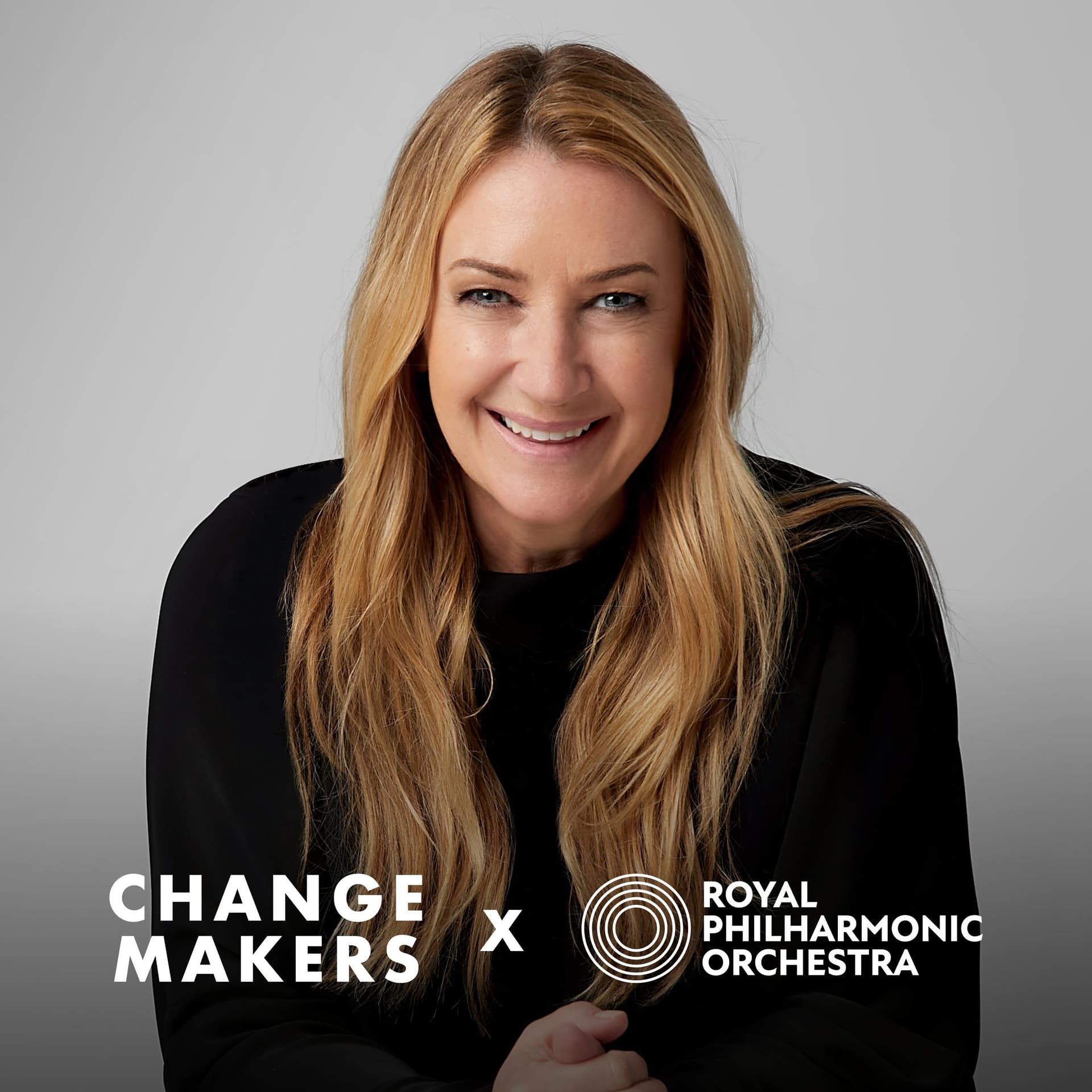
In this episode of Change Makers, Michael Hayman is joined by designer and author Anya Hindmarch. A defining voice in British fashion, Anya brings a lifelong love of music to her creative life.
Recorded at Cadogan Hall in collaboration with the Royal Philharmonic Orchestra, Anya reflects on starting her business at 19, the craftsmanship and curiosity that drive her, and why self-doubt can be a surprising source of strength.