In short
Future of Consumer Marketing - Episode Notes
Episode Title
5,000 to 500K Units: Retail Demo Strategy That Scaled
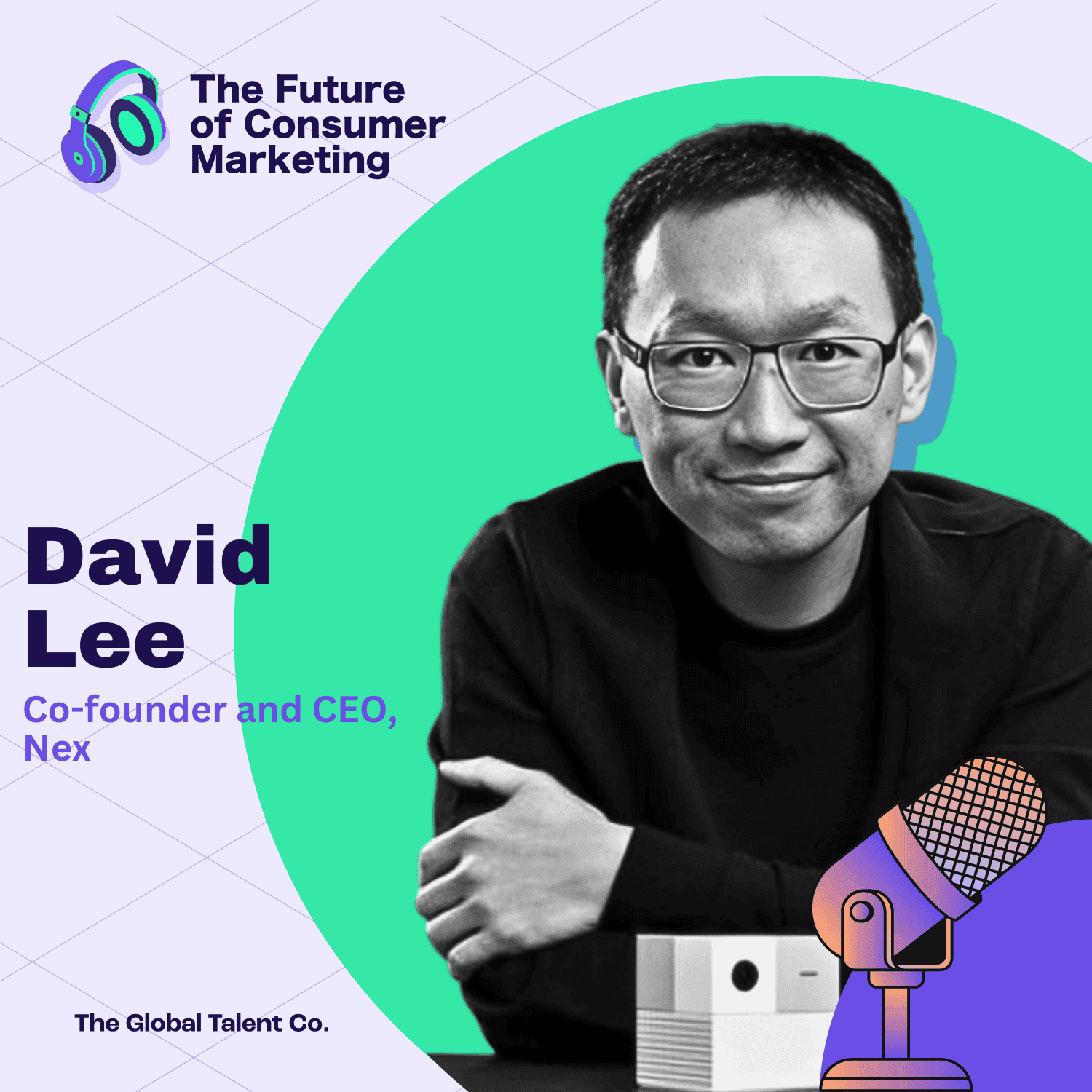
Podcast Description In this episode of The Future of Consumer Marketing, host Andres Figueira interviews David Lee, Co-founder and CEO of Nex. The discussion centers on Nex's innovative product, Next Playground, which transforms family screen time into interactive fitness experiences. The episode highlights Nex's journey from a basketball training app to a hardware platform, achieving significant sales and retail presence.
---
Key Topics Discussed
- Company Background and Product Overview
- David Lee's Journey:
- Former Apple employee for 8 years before founding Nex in 2017.
- Nex started as a mobile app called Home Court, focused on basketball training.
- Transition to Next Playground:
- Due to pandemic trends, the company pivoted to create Next Playground, an active play system for families.
- The device utilizes a motion-tracking camera to deliver interactive gaming and fitness experiences.
- Sales Growth and Market Strategy
- Initial Sales:
- Launched with a limited production of 5,000 units; sold out before Thanksgiving within the first year.
- Retail Partnerships:
- Established relationships with major retailers: Walmart, Target, Best Buy.
- Expanded to over 5,000 retail locations, with significant in-store demos to drive engagement.
- Marketing and Customer Engagement
- Omni-channel Marketing Approach:
- Focus on building trust for a $249 considered purchase through various marketing channels.
- Utilization of customer stories to amplify brand presence.
- In-Store Demos:
- Central to the marketing strategy, demonstrating the product benefits directly to potential customers.
- Subscription Model:
- Offers an $89/year subscription for continuous software updates and new game releases.
- Product Development and Content Expansion
- Partnerships with Major IPs:
- Collaborations with brands like Barbie, Kung Fu Panda, and Bluey to enhance content offerings.
- Continuous Innovation:
- Commitment to ongoing product development and customer feedback integration to improve the user experience.
- Company Structure and Culture
- Team Distribution:
- Nex operates with over 110 employees, with a distributed team model across various locations, including San Jose and Hong Kong.
- Mission-driven Focus:
- Emphasis on fostering family engagement and wellness, viewing their product as a means to enhance family bonding time.
---
Key Takeaways
- Market Positioning:
- Nex has successfully carved out a niche between traditional gaming consoles and fitness equipment, emphasizing family interaction.
- Scaling Strategy:
- The combination of retail partnerships, strong customer relationships, and a clear value proposition has facilitated rapid growth.
- Future Outlook:
- David Lee envisions a future where technology continues to enhance physical activity at home, bridging the gap between outdoor and indoor family engagement.
---
Conclusion In this episode, David Lee's insights illustrate how Nex's innovative approach to active play has resonated with families seeking healthier, interactive alternatives to traditional screen time. The company’s strategic marketing and retail partnerships position it well for future growth and expansion in the consumer market.
Written by AI. May contain mistakes. Listen to the episode to check what was said.
Chapters
Tap a time to open that second in VOIntroduction to Nix and Nix Payground
0:00 to 0:45
Learn about the origins of Nix and its innovative active play system.
“I worked for Apple for eight years and left Apple 2017 to start Nix.”
David's Journey and Next's Mission
1:54 to 3:03
Explore David's background and the mission of Next in enhancing family play.
“We're super excited to also have you be on this episode and really learn everything about what you've been doing, what Next is.”
The Evolution from Home Court to Next Playground
3:03 to 4:49
Understand how the Home Court app led to the creation of Next Playground.
“And I want to tell you a little bit about how we get started.”
Building a Unique Gaming Experience
4:49 to 6:46
Discover how Next Playground offers a family-centered gaming experience.
“So some of my investors told me that while for a thousand companies that would start with building a basketball training app, probably only one company would end up having like a game console type hardware.”
Subscription Model and Content Updates
6:46 to 8:11
Learn about the straightforward subscription model for Next Playground.
“and hit like a pretty massive plot of market fit with Next Playground.”
Innovative Marketing Strategies for Next
8:11 to 9:16
Examine how Next set itself apart in a competitive gaming market.
“and keep it simple and easy to understand.”
Retail Expansion and Consumer Engagement
9:16 to 12:02
Learn about Next's retail strategy and the importance of product demos.
“And David, now moving on to a bit more on the marketing aspect of Next and specifically Next Playground.”
Omni-channel Marketing Approach
12:02 to 14:02
Delve into Next's comprehensive marketing strategies to reach customers.
“And in terms then of marketing, have you really had to do much of it to make sure that you stay relevant or with being on the retailer shelves and just being present in those stores that people go about every day?”
Building a Product-Centric Marketing Strategy
14:02 to 15:08
Learn about the importance of a strong product foundation in marketing.
“And we have an omni-channel approach that we want to meet customer where they are.”
The Three Steps of Marketing
15:09 to 17:43
Explore the three key steps in the marketing approach for engaging customers.
“And we have places where when you heard about the product from a friend, you would want to come in and have a conversation with us.”
Show all 20 chapters
Targeting Families with Engaging Content
17:44 to 19:39
Understand how marketing targets families and appeals to both kids and parents.
“So that's how we think about our marketing strategy.”
Creating Family Experiences Through Gaming
19:40 to 21:22
Learn how gaming can create shared family experiences and bonding.
“And we can have our bowling experiences because it's so easy to just track your hand movement, how you spin it, how you roll it.”
Innovations in Motion Detection Technology
21:23 to 22:20
Discover how Next Playground utilizes motion detection and AI for gaming.
“Or is it something that is like a normal resource in gaming?”
Advancements and Challenges in Gaming Tech
22:21 to 24:46
Explore the journey of developing gaming technology and continuous improvement.
“At that time, it was iPhone XS with the chip A12 Bionic.”
Team Dynamics and Global Presence
24:47 to 26:17
Learn about the team's structure and global reach of Next Playground.
“I want to get my hands on the next playground and just try it out, even though I don't have a family here.”
Future Trends in Family Gaming and Activity
26:18 to 28:00
Discuss predictions for the future of family engagement through gaming.
“and a few places I cannot register right now.”
The Importance of Family in Physical Activity
28:00 to 29:20
Learn how outdoor activities contribute to family bonding and the challenges faced.
“The best physical activities should be done outdoor.”
Nix's Mission and Value Proposition
29:20 to 30:50
Discover Nix's commitment to enhancing family experiences through play.
“So we are a very mission oriented company.”
Empathy for the Cause
30:50 to 31:20
Hear the host express admiration for Nix's vision and impact on families.
“And I just really, really appreciate the fact that you're able to see that and you're helping people be able to obtain that family sentiment that is so important to make sure that we keep alive.”
Finding Next Playground: Availability and Access
31:20 to 32:38
Learn how to find Next Playground and its retail presence across the U.S. and Canada.
“And congratulations humbly from my side.”
Transcript
Automatic transcript. May contain errors.0:00Andres Figueira:I worked for Apple for eight years and left Apple 2017 to start Nix. And Nix now built Nix Payground, an active play system for kids and families. You know, this is a device that, you know, will be sitting in the center of your living room, connect to the TV, use the camera, and detect your motion, and recreate active play experiences on the device. Basically, games that get the move, bring the family together.
0:22David Lee:Once you buy the hardware, you would just need to update the software every now and then to be getting new games that you guys create.
0:28Andres Figueira:So you buy the hardware and we have five games bundled with the hardware already. We have the rest of the library available as a subscription and you get game updates. You get new games for a whole year. For us, it's important to innovate. It's important to push boundaries and having a persistent relationship with our customer, meaning that our customer actually supporting us to innovate more for them.
0:55David Lee:Hey, everybody. Thank you for tuning in. My name is Andres Vieira, and I'm going to be your host for the day. This show is brought to you by the Global Talent Company. We're helping fast-growing teams hire exceptional remote talent from Argentina, South Africa, and beyond. We connect companies with world-class professionals who bring skill, reliability, and global perspective to every role. And just for our listeners today, we're offering an exclusive 10 % discount on your first hire. So all you need to do is visit GlobalTalent.co, click Start Hiring, and mention the podcast listener discount when we get in touch.
1:30David Lee:And with me here today, I am speaking with David Lee, Chief Executive Officer and Co-Founder at Next, a company that is helping families reconnect with the joy of movement through fun, social, and interactive content that's accessible to all ages. So David, how's it going, man? It's a pleasure to have you on the show.
1:50Andres Figueira:Thanks for having me. I'm excited to be here.
1:53David Lee:No problem at all. We're super excited to also have you be on this episode and really learn everything about what you've been doing, what Next is. So, David, in order to start putting the audience a bit more in context here, would you be able to give us a brief overview of your background and maybe in your own words, what Next is?
2:12Andres Figueira:so Nix is a company that my second startup I worked for Apple for 8 years and left Apple 2017 to start Nix and Nix now built Nix Payground an active play system for kids and families and we sell quite a lot of them already I think 350 ,000 units so far in the US and this is a device that you know, will be sitting in the center of your living room, connect to the TV, use a camera, and detect your motion, and we create active play experiences on the device. Basically, games get to the move, bring the family together, and we're excited about what we have delivered for the customer so far, and excited about what we're going to deliver to the customer in the future.
3:04Andres Figueira:So that's a high level of what we are.
3:07David Lee:And okay, I would love to know, David, is then what was your kind of like aha moment when you noticed that there was this opportunity in the market to create next playground and what specifically um i mean like brought you to to actually do this endeavor of creating this this i want to say video game but i feel it's not technically a video game so it's kind of like a way to play with the tv yeah so um a living room
3:35Andres Figueira:and actually a space that brings people together. And I want to tell you a little bit about how we get started. When we get started with Next, the first thing you do is not Next Playground or motion games or acupade experiences. We start with a mobile app called Home Court, which gets people to play better basketball. So it's a basketball training app. So if you search for basketball app today, home court probably still will be your very first hit. So we're the first company. We just use Compatite Vision to, you can set up a phone on a tripod, you're pointing at a passable court. So shoot, you count your make-miss, you check your angle, you track how fast you move, how high you jump in real time.
4:25Andres Figueira:And it's a wonderful tool for basketball players to horn their shots. And this is the original of the company. It spent like 18 months building it up. And it's now still tracking over 150 ,000 shots a day. It's a pretty incredible piece of software that you, a very specific task, track basketball shot. So some of my investors told me that while for a thousand companies that would start with building a basketball training app, probably only one company would end up having like a game console type hardware. So the journey is like very atypical. So what happened is that, you know, we get started, we built a great tool, NBA, invested in the company.
5:12Andres Figueira:We thought, wow, we can basically take this basketball training app to globally. But we went through a pandemic. In the pandemic, like, oh, would people still pay basketball in the pandemic? Like get together? Kind of hard to imagine that. But HomeCourt app actually ran viral. But what ran viral is not the soft tracking capabilities, but we have a small, a lot of like mini interactive training games in it. The games that train your reaction, the game that train your ball handling, those are the things that ran viral. So in a pandemic, like, you know, we take those things out, we create another app called Active Arcade.
5:53Andres Figueira:Active Arcade ran viral again. Apparently there's a, people really want something like this in their life, something that basically is get them to move, make it fun, and we look into how the user has been using the Active Arcade app, we find that the bigger the screen, the better the engagement, the better the retention. And the bigger screen is the TV. So you compare retention of people who use Active Arcade on the phone versus on the TV. It's 10x. is quickly tell, oh, we are actually building for the wrong platform. And I've been, you know, go around, do they want to search for like a 65-inch iPad?
6:39Andres Figueira:Can I find it? Eventually, we build ourselves, build one ourselves, and that's Next Playground. And we keep building games, keep making it better, and hit like a pretty massive plot of market fit with Next Playground.
6:50David Lee:Wow, that is so cool because like I am a video game enthusiast, so I really like everything that has to do with tech and gaming and then now hearing what you've created with this next playground it's just so interesting and then once you buy the hardware you would just need to update the software every now and then to be getting new games that you guys create or then just seeing what else is
7:12Andres Figueira:is available for next playground yep so we keep things very simple so you buy the hardware and we have five games bundled with the hardware already so you buy it you can you can play it right away, five games included. We have the rest of the library available as a subscription. So just one simple, sustainable business model and help us basically offer all the content we create and we'll create in the future for you. The subscription costs$89 a year and the access to everything that we create and add to the playground. So it does not require you to buy individual games. All the games would come with the subscription services.
7:55Andres Figueira:and you get game updates, you get new games for the whole year. And we hope that we can like serve your family really well so we can earn an idea of your business for the next year. So that's how we think about business. Keep it very simple. We want to kind of serve our customers with our best and keep it simple and easy to understand.
8:13David Lee:I love that. I love that. And especially with something like a moment that you're creating for family time, you want to produce the less friction as possible just so that you can make sure they enjoy the moment the most and not have to be worrying about other stuff that might just affect the afternoon that they want to spend or their Sunday morning or something like that. So I totally understand that, David.
8:36Andres Figueira:Yeah, for us, it's important to innovate, important to push boundary and having a persistent relationship with our customer, meaning our customer actually supporting us to innovate more for them. If I open it up for many different games, and we may not be as curated. We have a curated experience. Oh, we have some new ideas there. We can invest in resources into those new ideas. So keep it innovative. Keep it very customer oriented. We are serving a group of customers already who is on a subscription plan with us. We learn them. We know about them better. We want to serve them better with every update, every new games.
9:16David Lee:And David, now moving on to a bit more on the marketing aspect of Next and specifically Next Playground. How was it when you finalized like creating the hardware and when you had the idea totally set up, then in order to market that, what was your angle? Because I feel you are also competing with a lot of legacy brands and there's a lot of static in the gaming industry. So how are you able to set yourselves apart? Is it by making it and making the consumer understand that it's for the family and it's to spend a better time, which is something that I feel video games aren't too aligned with. It's more of like the independent, solitary person playing in their room.
9:57David Lee:So I'm not sure how you went about that.
10:00Andres Figueira:Yeah, so I can share a little bit about our journey. We first have our, like, you know, as a hardware company, we always need to be able to find that initial audience. serve them really well, and grow from there. So what happened is in 2023, we only create 5 ,000 units. That's all we can create. We create 5 ,000 units. We have our pre-order campaign. We sold through all 5 ,000 units before Thanksgiving. So way before Thanksgiving, 2023, we sold through all of them. And our goal, at that time, I remember I bring the whole company together. And we only have one goal and one goal only to make sure there's 5 ,000 people who got our first generation hardware really happy with what we created.
10:56Andres Figueira:The hardware, the OS, the games on it, make sure that they're really, really happy. And they are. And into 2024, we make a pretty bold move. We send samples to Walmart, Target, and Best Buy. Wow. People said that it would take us two years to get into retail. And the great news we had then last year is that everyone come back and want to carry a product in the second year of existence. So we were at 1 ,000 stores last year, 2024. And with that, that is more like building our ecosystem together that is with the retail partners, with our IP partners, our internal game studios, our studio partners, keep building this ecosystem, keep building a distribution.
11:52Andres Figueira:And in 2025, we expanded 1 ,000 stores to now over 5 ,000 stores. And in over 4 ,000 of them, we actually have retail demo. So it would say like, because we are doing a product that is a physical component, meaning that like you when you see other people oh dancing and playing foot ninja or rolling a bowling ball you oh i you you understand what this product do so we put a pretty quick emphasis on our retail demo and want to make sure that hey people can get a try of the product you know in a store as a way to you know consider like you know whether this product should be going into their lives um so that's a little bit more journey like how we go from 5 000 150 000 last year this year we forecast to probably at least two half a million units no that that is crazy david and and
12:52David Lee:honestly i just love how organic the growth was because it was just making sure that the 5 000 people you sent or you sold the product you were very happy um but i love as and as you mentioned there i love the boldness of the move of sending a uh what's it called a sample samples walmart uh target and and what was the third one you mentioned best buy that was when you mentioned the physical demo in the place i imagined myself in best buy i remember the last time i went to the states i got to try out one of those new vrs the meta quest 3 or something like that but it's the best way to get the consumer to want your product without being too pushy and leaving them to decide like, oh, this is cool.
13:31David Lee:I could see this in my house. So I love that. I love that. And in terms then of marketing, have you really had to do much of it to make sure that you stay relevant or with being on the retailer shelves and just being present in those stores that people go about every day? Have you felt that the growth has been more natural without needing to actually invest in social media campaigns and user generated content and all that?
13:56Andres Figueira:Well, we have a full funnel marketing mix. So we actually do a lot outside of that as well. And we have an omni-channel approach that we want to meet customer where they are. We want to amplify the story that customers share. And I think it all rooted from that we want to build a great product that the customer would talk about. and we share with their friends, and would leave us really good reviews. I think all begin with having a good product first, and then obviously then we would selectively pick channels to amplify those stories, to amplify we have a new game coming, and we have a new game with Barbie, we have a new game with Kung Fu Panda, we have a new game with Bluey, and we keep doing this as we bring more really amazing franchises on board of our system.
14:54Andres Figueira:and we certainly want to create a great social media presence as well. So I would say, I think of our marketing as free steps in how I think about it, of how we think about our marketing. And we have places where when you heard about the product from a friend, you would want to come in and have a conversation with us. like it's like our website is our like retail presence is the retail demo is our um uh you know the product description page on on on amazon and walmart and target and best buy and sam's club our social media presence so when people oh i heard about this company i want to hear more about us and want to kind of visit one of our properties like we want to have those um you know those those places we have like you know communicate the product to you and want to make sure that you have good experience getting into one of those touch points with us so that's number one second would be hey we do performance marketing too and basically bring you back to the conversation that you have started a little bit more like like how i think about it is bring you back to the conversation you have started we have new things we have new games you know and and now you know we can continue the conversation with us understand us better to facilitate our purchase decisions we are selling like a 249 product is our conceded purchase is not an impulse purchase so as we go through the journey certainly we want to kind of in in every single instances we want to can build trust we also want to kind of serve our customer existing customer really well so that you know
16:37David Lee:you hear from them how they love it they're still paying a monthly subscription right your your existing customers they need to pay every single month to keep on being able to access the full possibilities of Next Playground, right?
16:51Andres Figueira:Yep. So we are on, we only offer a quarterly plan or an annual plan at the moment. So we are not doing a monthly plan yet. And the reason why is that we want to build a deeper, longer relationship with our customers because we are building game. We like that. Hey, give us a chance to serve you for a year. For the year, last year we shipped close to 20 games. and many more game updates. And next year, we also want to kind of do even more content for our customer into the next year. But we'll maybe shift more focus onto updating the games because we know which game people like. And some of the game, I think we would be more like a live ops approach for the game.
17:35Andres Figueira:And so that people who love the game get the content they want. And this is the process of building. So we talk about the performance marketing help us continue the conversation and the brand marketing, you know, is really about like how to kind of start more conversation with more people by basically clearly defining them like who we are, what we are doing and if you like, you know, what we're doing or if you'd like to look like, you know, one of our customers. So this like we amplify authentic customer story with our marketing engine to bring more people into the mix to, you know, go through that journey with us And, you know, hopefully at some point they make up their mind to, you know, start the relationship, a real formal customer relationship with PIX.
18:22Andres Figueira:So that's how we think about our marketing strategy.
18:25David Lee:And I feel that it sounds totally logical in the way of how you would approach this from the type of company and the industry that you're within. You need to create this type of trust and bring them back to the conversation. because buying a, like I was going to say a console, which is pretty much what I feel it is that you put on your living room. It's always a contemplated purchase, as you mentioned. So I totally agree with that. And David, is the marketing you guys create, and I feel I know the answer to this, but is it more tailored to the kids or the parents of the family when you're asking them and showing them all the features, different games, new updates?
19:04David Lee:I'm just wondering if you're tailoring it towards the young ones in the family or to the ones who actually have the money to buy the...
19:14Andres Figueira:Next playground is for design for kids and families. And yes, our audience of the family will have young kids, like kids 3 to 12 years old would be like our core demographic at the moment. We serve the kids. We also serve the parents. When kids go to school, we have fitness experience, all the parents. And we have something for the grandparents as well. So we also want to have sports experience, which really the best sports games would be on playground because I can actually holding a real baseball bat to play our baseball game. And we can have our bowling experiences because it's so easy to just track your hand movement, how you spin it, how you roll it.
19:55Andres Figueira:We can have like 90 years old playing our bowling game. And it's like people share like one new thing that they do for us. obviously the buyer most likely the parents sometimes the grandparents so the messaging is like you know would be a little more like oh our customer have a playground would look like this and using that as a messaging you know to and they're active they're happily they're playing games like kiss and family bonding time siblings and you know they're active they're happy they're sweating um so that's that's kind of master call messaging that we want to kind of you know how having our next playground in a home make you feel um and obviously that is for the for the you know i would say that you know for kids as well hey do you want to like do like this um do you want to do you want to have like you know these play with these characters that you know um and yeah so that's that's when you when you're uh if your kids like love Bruy?
21:05Andres Figueira:And do you want to be like play like the Bruy's family? And that's kind of the view that we want to you know, share with our audience.
21:16David Lee:I like that because of the fact that it really does, what's it called? The appeal isn't to the kids or the parents, it's just to the family in general and I feel that family is a feeling that a lot of people can empathize with and if they don't have that feeling that it's something they crave and next playground can be something that helps them understand that hey it's achievable it's achievable to have a nice time while resting on a sunday morning and not just all of us be watching tv silently and not doing anything or something like that um but i love it i love it and in terms of of of you guys is like the software that you're using with necks and how it's able to read so well how you move your hand for bowling or batting with the bat, is that yours and proprietary only to Next per se, David?
22:04David Lee:Like, did you patent this? Or is it something that is like a normal resource in gaming? I'm not even sure how to describe it because it's very techie, but it's me out of genuine curiosity just wanting to know.
Read the full transcript
22:16Andres Figueira:So we have a stack of patents here. So this is our stack of patents.
22:24but we've been working on this problem for a very long time since 2017 we are one of the first that
22:31Andres Figueira:to do motion detection ai on the edge and that's how why apple put us on stage in 2018 we were actually being put on apple stage when they announced iphone 10s in 2018 we are amongst one of the first companies actually, you know, bring that technology to an edge device. At that time, it was iPhone XS with the chip A12 Bionic. So we did a lot of optimization. We have been fooled like this. One thing that you have the technology, and now I think more people have the technology as well. But the thing is that how we keep making it better, how we use it and how we use it correctly. So that's a lot of things that basically we did over time in the last seven, eight years to make the technology better and better and better.
23:30Andres Figueira:And when we are out there solving customer problem, there's a lot of knowledge that we have accumulated as well. And we know, oh, these are where we should improve, then we improve over time. So I would say that we probably have the state of the art or next playground serving the use case. And because it's AI, so everything is software. Meaning that back in the days, we are not the first company which do motion games, right? Back in the days, you have the Wii, Nintendo Wii. You have the Microsoft Xbox Kinect. You have PlayStation Wii. So everybody actually try it, but everybody no longer trying.
24:09Andres Figueira:so we're coming in with a new tech technology which is ai and yeah move everything with software and we are able to keep improving it because we have customer using it we have customer complaints certain things not working well enough and over time over the years of effort we just make it better and better and better so that's the journey of creating tech and and making that tech really useful. And we're happy that we spend the time and make it really well, make it really great. And we see more things we can do too. We see more things we can do, more things around the corner.
24:45David Lee:I'm just so excited right now. I want to get my hands on the next playground and just try it out, even though I don't have a family here. I live by myself, but I would get some friends and just try it because it sounds like so much fun.
24:56Andres Figueira:Oh my goodness.
24:57David Lee:And I was going to actually ask you about AI, but now that you've mentioned that the product is so AI heavily infused with it, so that that's the way you stay relevant and able to update and everything like that, I believe I understand that aspect. And David, I would also love to know, so next per se, how big is the company and how many people do you have helping you out with all of this project? Because it really seems like a big endeavor.
25:23Andres Figueira:Yeah, it is. It is a picture. If you go to Amazon today on a desktop device, if you go to any kind of gaming console or gaming category, that Amazon is merchandising next playground right next to PlayStation, Xbox, Switch, and next playground. If you go through that, it's a little more like that. And we are being regarded as something that is at that level. Okay. And we have a little over 100 people. I think at the moment, we're 110 right now. Wow. And that's the size of the company.
26:02David Lee:Do you guys work, or is it like a remote first company? Or do you have some headquarters in, I believe I saw you guys are in Hong Kong, if I'm not mistaken?
26:10Andres Figueira:So we are in, our headquarters is in San Jose. And in the US, we are quite distributed. So we have people in Seattle, LA, New York, North Carolina, Chicago, and a few places I cannot register right now. but we are quite spread out. But I think we have a big enough cluster, 20-something people in the Bay Area, the San Francisco Bay Area. We also have a Hong Kong office, which we have two game studios there. We also have a hardware team, very close to manufacturing. Our design team is in the U.S., but it's also spread out as well. So the hardware design, we also have a really good industrial design partner working with us our os is all designed here you know design here and manufacture in at the moment thailand wow that like so you really you guys really are all around the world then we are over the place yeah this is like i don't
27:16David Lee:imagine it being any different with the with the idea that you've had and how you've been able to conceptualize and actually make it something real, you obviously need a hell of a team behind you to be able to help you out with that. So that is amazing, David. That is amazing. And I know that we're almost at the end of the podcast, but I did want to ask you one final question, David. And this is a bit more of a prediction on your side, just to know what do you think approach, like what do you think playing and movement and screen time with the family will look like five years from now, based on what you have as a vision with next playground, what you know of trends.
27:53David Lee:Do you have any type of, I don't want to say prediction again, but any type of feeling or hunch of how things will be looking in five years from now?
28:05Andres Figueira:The best physical activities should be done outdoor. You go hiking, you go swimming, you go bicycling, you go outside and play and that probably I would say if you have that, that would be the best but outdoor is not always accessible sometimes it's too cold, sometimes it's too hard sometimes it's too dark, sometimes it may be outside a little bit dangerous or you may not be able to go outside because you need somebody to go out with you so we provided that physical activities at home and as we serve family with younger kids we also want to be part of their growth journey as well and we have video being shared back to us and say you know what my kid jumped for the first time with playground wow and oh my 6 years old playing with her 90 years old great grandma so we play a special role for families in like some you know in the in the comfort of their home bring them together be a companion of their growth when we think about our sports game and when real sports is here like the difficulty everything is here what next one to do is we want to build a ladder for you to basically get you more ready to play real sport getting your body more ready, more confidence, maybe some skills that's transferable.
29:44Andres Figueira:So we are a very mission oriented company. And always when our customer gives us the privilege to be at the center of their living room, and we want to serve the family really well, and we see this as a privilege, we see there's a lot of trust they place in X to do good for their families. And regardless of of what kind of future trends is like, this is what we want to do. And sometimes I want to kind of put out all my time and effort into things that never gonna change. It's not about trend. It's not about like what next. It's about like something that people want to have, you know, for a very, very long time, something that doesn't change.
30:33Andres Figueira:And I believe in family time, believe in Kiss Grove believe in these other things that like Nix can play a role in and do something really, really wonderful for the families and that's where Nix want to spend our time on and it is how Nix would become my life's work
30:53David Lee:I must say David, that is just beautiful and congratulations to what you have created because I really empathize with your cause and how you frame it and how you explain it I can only see a positive new family member with the next playground because I feel we're almost talking as if it's a new entity that you're bringing into your home and it's going to help you out to make everything a lot cooler, funner, different. And I just really, really appreciate the fact that you're able to see that and you're helping people be able to obtain that family sentiment that is so important to make sure that we keep alive.
31:26David Lee:So that is amazing, man. And congratulations humbly from my side. I feel this is an amazing company and an amazing product. I'll try to see if I'm ever in the States, if I go to Best Buy or Walmart, if I can try a Next Playground out because I just got to know now. David, before I let you guys go, I did want to give you the chance before I finalize the episode to let anybody in the audience who's listening to us know how they can find out more about Next Playground. if they want to try it out, if they want to just look at your website to learn if it's a fit for their family? How could they go about doing that?
32:00Andres Figueira:You can just search us, you know, next playground, N-E-X playground. And you can see like, you know, our, you know, on Amazon, if you go to retail store, we're now in over 5 ,000 stores in U.S. and Canada. So in U.S., we're in most Walmart in nearly all target. uh, super or Sam's club, um, most best buy. Um, and we're excited about like, you know, uh, sharing our playground story with you. Um, and yeah, so that's easy.
32:37David Lee:Amazing. Now, and then to anybody who's listening, you heard it here first. If you're curious about seeing if next could be your next family member that you integrate into your living room, then you can make sure you go to next playground.com or just look at all these stores that David has mentioned. that you could be able to find it and even use a real life demo. So with that said, David, thank you so much for being on the episode. It has been an honor and we really appreciate your time to be able to tell us your story. So thank you very much, man.
33:05Andres Figueira:Thank you so much.
33:06David Lee:No problem at all. And to everybody who has been listening, thank you so much for tuning in once more. I hope that you return to keep on learning from the different industries that we talked to and all the different personalities that we're learning about. So thank you so much. Have a great rest of your day.
33:23Thank you.
From the publisher
In this episode of The Future of Consumer Marketing, host Andres Figueira interviews David Lee, Co-founder and CEO of Nex. Nex has built Next Playground, an active play system that's transforming how families engage with screen time by turning living rooms into interactive fitness and gaming experiences. Starting as a basketball training app called Home Court that went viral during the pandemic, the company pivoted to create a motion-tracking camera system that has now sold 350,000 units and secured placement in over 5,000 retail locations. Through strategic retail partnerships, mission-driven product development, and a subscription model that funds continuous innovation, Nex is carving out a new category between traditional gaming consoles and fitness equipment.
Topics Discussed:- Pivoting from a basketball training app to a family-focused hardware platform based on viral pandemic trends
- Scaling from 5,000 units to forecasted 500,000 units through retail partnerships
- Building trust for a $249 considered purchase through omnichannel marketing
- Implementing in-store demos as a primary conversion driver in 4,000+ retail locations
- Using subscription models (quarterly/annual only) to fund continuous game development and maintain customer relationships
- Leveraging major IP partnerships (Barbie, Kung Fu Panda, Bluey) to expand content library
- Operating a distributed team of 110+ people across product, hardware, and game development