In short
Podcast Episode Notes: Brand Worlds vs. Brand Logos: What Actually Drives Loyalty
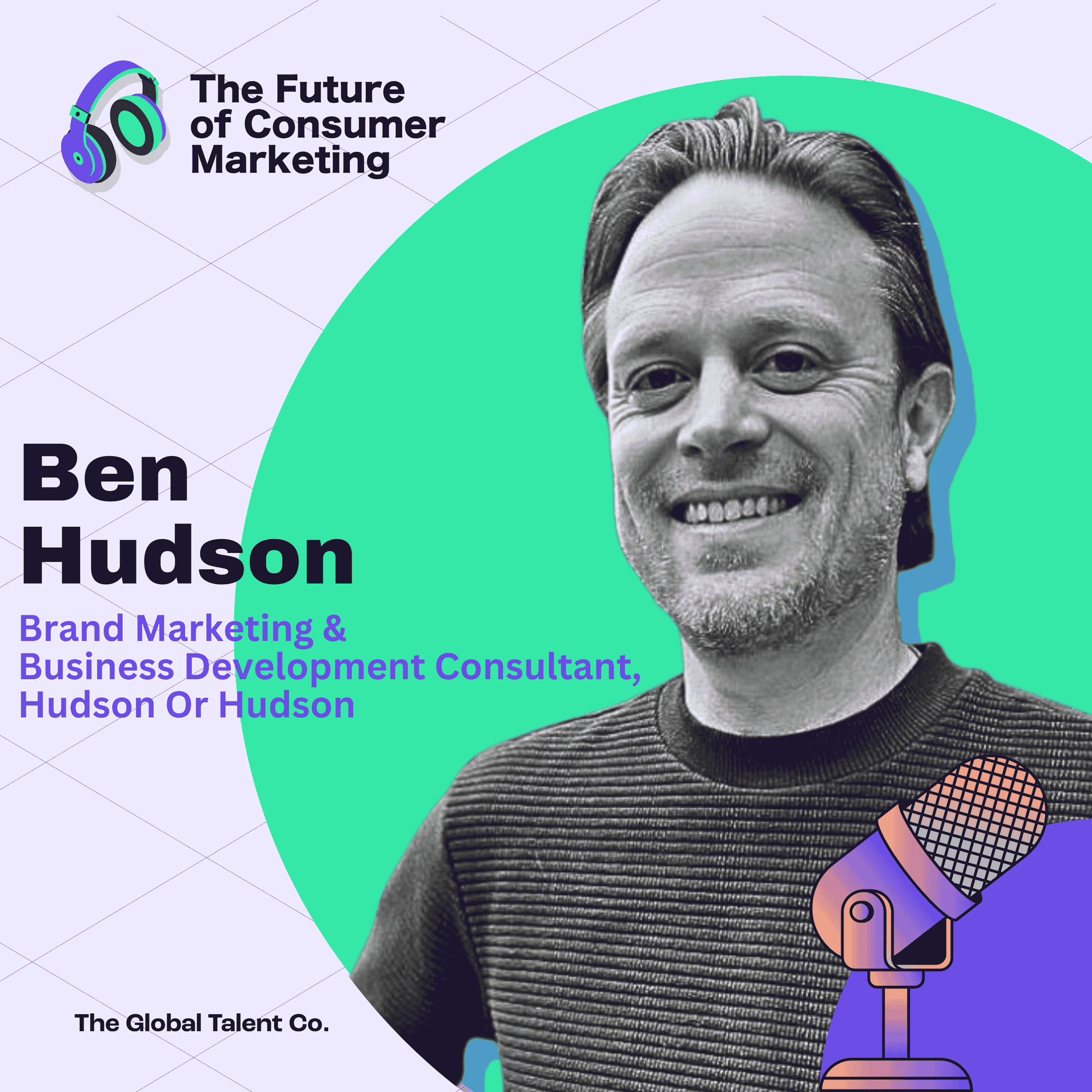
Episode Overview In this episode of Future of Consumer Marketing, host Andres Figueira engages with Ben Hudson, a Brand Marketing & Business Development Consultant, about the evolving landscape of consumer marketing. The discussion emphasizes the importance of experiential marketing in building brand loyalty amidst rising AI saturation and institutional distrust.
---
Key Topics Discussed
- The Renaissance of Experiential Marketing
- Definition: Experiential marketing is becoming a crucial marketing strategy, allowing brands to create memorable experiences for consumers.
- Impact of Engagement: Meeting consumers where they are (at events, etc.) enhances brand connection and trust.
- The AI Trust Crisis
- Consumer Skepticism: A significant number of consumers (approximately 58-60%) distrust brands that use AI for content creation.
- Need for Authenticity: Brands should utilize AI carefully to avoid devaluing their messages and compromising consumer trust.
- Building Brand Worlds vs. Brand Awareness
- Brand Worlds: Brands need to create immersive experiences that foster a sense of community and belonging among consumers.
- Inside Jokes and Lore: Successful brands develop narratives that engage consumers beyond just products, creating a deeper emotional connection.
- Creating Value in Attention-Scarce Environments
- Value Creation: Marketing strategies must focus on adding value in every interaction to attract and retain consumer attention.
- Counteracting Consumer Fatigue: Brands must avoid transactional pitches and instead provide meaningful experiences.
- The Analog Counterculture Trend
- Shift to Analog: There is a growing preference for analog experiences (e.g., painting events, workshops) as a response to technological saturation.
- Human Connection: The trend reflects a desire for genuine human interaction and creativity.
- Strategic Use of AI
- AI as a Tool: AI can be used effectively for organizing workflows and generating ideas, but should not replace the human element in connection and storytelling.
- Avoiding Devaluation: Brands must be mindful that AI-generated content can lead to instant devaluation of their message.
---
Key Takeaways
- Experiential marketing is becoming indispensable as brands seek to create authentic connections with consumers.
- Trust is a currency that brands must earn through genuine interactions, particularly in an age where AI is prevalent.
- Brands should focus on crafting rich narratives and experiences that resonate emotionally with their audience, moving beyond mere logos and advertisements.
- There is a cultural shift towards valuing analog experiences, reflecting a desire for deeper human connections amidst digital overload.
- Strategic AI use can enhance efficiency but it must be balanced with authenticity to maintain consumer trust.
---
Conclusion As marketing evolves, the focus must shift from mere brand logos to creating holistic brand worlds that engage consumers on a personal level. The insights shared by Ben Hudson highlight the need for brands to innovate in their approaches, leveraging both technology and human connection to drive loyalty in a rapidly changing consumer landscape.
---
Contact Information
- Ben Hudson: [Email](mailto:ben@hudsonorhudson.com)
- Substack: [The Real Ones](https://therealones.substack.com)
---
This episode serves as a reminder for marketers to prioritize meaningful consumer interactions and to navigate the complexities of modern consumer behavior thoughtfully.
Written by AI. May contain mistakes. Listen to the episode to check what was said.
Chapters
Tap a time to open that second in VOIntroduction to Marketing Philosophy
0:00 to 0:52
Discussion on the essence of marketing and its value addition.
“I went into business for myself with Hudson or Hudson and I really love partnering with motivated, optimistic and open minded entrepreneurs, bringing their brands to life.”
Ben's Journey in Marketing
1:40 to 3:40
Ben shares his career experiences from experiential marketing to agency founding.
“It's a pleasure to have you on the show.”
Lessons from The Onion and Craft Beer
3:40 to 7:40
Insights from Ben's time at The Onion and Brooklyn Brewery on brand storytelling.
“And nine months later, we got that thing down to about one hour setup time.”
Founding Hudson or Hudson
7:40 to 9:30
Ben discusses the founding of his agency and its agile approach to branding.
“being on the forefront of social media trends as that was blowing up to become the marketing lead at Brooklyn Brewery.”
Modern Marketing Philosophy
9:30 to 11:40
Ben explains how marketing must add value in today's landscape.
“And first of all, let me say that's one hell of a journey because you really have been around.”
Leveraging AI in Marketing
11:40 to 13:50
Discussion on the role of AI in marketing and its consumer reception.
“Marketing, of course, is recognized for its promotional capability, right?”
Trust in Advertising
13:50 to 14:01
Ben reflects on consumer trust in AI-generated content and advertising.
“So just wondering if you have any particular or unique use cases for AI.”
AI in Marketing: Trust Issues and Consumer Perceptions
14:01 to 16:34
Explore how AI is perceived by consumers and its impact on trust in marketing.
“I find it personally most useful for frameworks, for setting up outlines, for organizing the work that needs to be done.”
The Shift to Experiential Marketing
16:34 to 22:26
Learn about the emerging trend towards experiential marketing and its importance in building trust.
“And so I think brands need to be very careful about that perception when using it.”
Analog Comeback: How AI Shapes Consumer Preferences
22:26 to 26:51
Discuss the resurgence of analog experiences as a reaction to AI in advertising.
“actually, after a guitarist would spend 10 years learning how to play his instrument to finally be able to do a proper show or something like that.”
Show all 12 chapters
Connecting with Brands: Marketing Strategies
26:51 to 28:00
Understand how brands can stand out and connect with consumers in a noisy market.
“But I love how even something as simple as a sound bath with a person explaining or just telling you a story about something that is interesting to the community could add a lot of value.”
Engagement and Feedback Invitation
28:00 to 28:25
Host encourages audience engagement through comments and DMs.
“or follow my sub stack, therealones.substack.com.”
Transcript
Automatic transcript. May contain errors.0:00Ben Hudson:I went into business for myself with Hudson or Hudson and I really love partnering with motivated, optimistic and open minded entrepreneurs, bringing their brands to life. How would you summarize your marketing philosophy nowadays? You have to create value. Marketing needs to add value in everything it does. Everything about it needs to evoke feelings of a higher quality that did not exist previously.
0:24Andres Figueira:I'm just wondering if you have any particular or unique use cases for AI.
0:28Ben Hudson:I find it personally most useful for frameworks, for organizing the work that needs to be done. If an entity is using AI to create something and that's recognizable, it's automatically devalued. Brands need to be very careful about that perception when using it.
0:52Andres Figueira:Hey everybody, welcome to the show. My name is Andres Vieira and I'm going to be your host for the day. This show is brought to you by the Global Talent Company, helping fast-growing teams hire exceptional remote talent from Argentina, South Africa, and beyond. We connect companies with world-class professionals who bring skill, reliability, and a global perspective to every role. And just for our listeners today, we're offering an exclusive 10 % discount on your first hire. All you need to do is visit globaltalent.co, click Start Hiring, and mention the podcast listener discount when we reach out.
1:25Andres Figueira:And today with me here, I am speaking with Ben Hudson, founder of Hudson or Hudson, an agency that partners with founders and executives that brings beloved brands to greater global recognition and also helps introduce their products and services to larger and more engaged audiences. How's it going, Ben? It's a pleasure to have you on the show. Yeah, thanks for having me. I'm happy to be here. No problem at all. We're really happy as well that we were finally able to make this work. And Ben, just so that we can get the audience a bit more in context, would you be able to tell us a bit more about your background, what Hudson or Hudson is in your own words, and how you came to found this agency?
2:04Ben Hudson:Yeah, absolutely. There's a few through lines in my career. And the first one starts with experiential marketing, or as it was called when I first started over 20 years ago, mobile marketing. It was before that term was applied to phone marketing and things like that. I started off as a road dog for GMR marketing, which is one of the OG experiential agencies out of Wisconsin. And I was pounding the pavement with Panasonic going coast to coast, you know, wearing khakis and a royal blue polo shirt, telling everybody about the latest and greatest in digital technology from Panasonic at state fairs and NASCAR races.
2:49Ben Hudson:For me, as a 22-year-old, this was a pretty cool escape hatch for my limited worldview, which told me that I was going to be cooped up in an office all day. And instead, I was on this never-ending road trip, living in hotels and seeing the country, which was really just what the doctor ordered at that time in my life. What I took away from it, though, was that power of hand-to-hand combat in the marketing context. Really meeting people where they are. They're going to an event. They're excited about being there. And they see something that draws them in. In our case, it was this 44-foot trailer called the Panasonic D-Train that was showing off things that are no longer relevant, like plasma televisions.
3:32Ben Hudson:And starting off that tour, it took us about 22 hours to convert the semi-truck into three showrooms. And nine months later, we got that thing down to about one hour setup time. And during that time, my coworker and I really developed this Kranisonic product script into a live show. This was almost like a stand-up routine. And we knew where all the laugh lines were. We knew what people would think was cool, when, and really were able to get that storytelling down so that when people left the activation, they knew a lot more than when they came in. They felt a connection to the brand, and they were much more likely not only to purchase, but to tell other people about what Panasonic had in store.
4:19Ben Hudson:So that experiential highlight I've taken with me everywhere I've been since. Once I was finally ready to settle down, I went to one of my favorite cities that I discovered along my travels, which was San Francisco. I ended up working for the revered America's finest news source, The Onion, and originally set up their distribution network. This was when The Onion print edition was growing, so that ages me a little bit. And then I moved into my natural setting of marketing. I was running the local marketing for The Onion. And I was there for five years. What I learned there more than anything else was the power of brand voice and the building of a brand world.
5:06Ben Hudson:And that's something that I hope we get into a bit later, which is the lengths that winning brands must go to now to become more than just a logo on a product, more than a website that you visit from time, to really make an impact with audiences. The best brands will create a whole world that people feel welcome into, feel a little ownership over, and are able to contribute. And I'll give you an example from that time. The Onion had a bar promo called Wednesdays with the Onion. And this was a free happy hour for young professionals, Onion fans that would happen in a popular area of town right as work let out in service of their beer brand sponsors.
5:55Ben Hudson:So I think it was Grolsch at the time. And the Onion fans would come in droves. Who doesn't like free beer? They'd connect with each other. Really felt the sense of community. If you know anything about Onion fans, they feel such a strong sense of belonging when it comes to that fake news. This is because they do a masterful job of really pointing out not only what's funny about those in power or foibles of everyday life, but when they're really doing their job, they get right at us. If you see yourself made fun of in the paper, you feel so much closer. You feel seen. And Wednesdays with the Onion just didn't strike a chord with me.
6:36Ben Hudson:It didn't feel like it was really representative of this conceit that the brand has of being this all-powerful, all-knowing media entity. And so I threw out a different name, which was the Onion Society for Beer Enjoyment. and that really spoke more to how people see the character of the onion which is this never winking never joking just straightforward saying we're the biggest we're the best we're the most grandiose and that was then taken on by all the other chapters of the onion in the different local offices as well as in the headquarters in new york put me on the map within the organization and I followed them to New York.
7:18Ben Hudson:In New York, I had three more years with The Onion before they decided to pack up shop and head to Chicago. Nothing against Chicago, but I grew up in the Great Lakes region and I really felt like I was where I was meant to be in New York. And so I started looking around and ended up crossing into the wild and wonderful world of craft beer and was able to translate my skills of media mastery, being on the forefront of social media trends as that was blowing up to become the marketing lead at Brooklyn Brewery. This was a moment when craft beer was having its second explosion, and it was also where the neighborhood of Williamsburg and Brooklyn writ large was being recognized globally as this creative capital.
8:03Ben Hudson:Over the next eight years, I was able to build a team and use the brand's growing footprint to project this neighborhood of creativity, this idea of new but respecting the old, of craftsmanship, of all the culture that was coming out of that space, and really use that as an avatar for what the values of Brooklyn Beer was. And it was really a great mix that allowed the brand to gain entry into not only eastern half of the United States, but then start expanding globally. A key Carlsberg partnership brought the brand to Europe. And then the same thing happened with Kirin in Japan. And then South Korea, Australia, it really became this global brand, even made its way down to South America, which you may have caught as the years have gone by.
8:53Ben Hudson:That experience in CPG and craft beer in particular rounded out my experience. And I went into business for myself with Hudson or Hudson. And I really love partnering with motivated and optimistic and open-minded entrepreneurs and company founders to translate their values into brand guidelines, strategies, and especially experiential in bringing their brands to life and meeting their consumers where they are, deepening those relationships, which then naturally leads to increased revenue and market share.
9:33Andres Figueira:Of course. Wow. And first of all, let me say that's one hell of a journey because you really have been around. And I love the fact of being in the onion, how it really shaped you and helped you like finalize understanding a lot of things. But in the main takeaway that I have from what you mentioned is that I do agree with the fact that marketing sometimes with brands, Specifically, it turns into this whole world creation in that the brands need to have their own lore. And the followers of the brand, they'll be able to get those, what's it called? Like those inside jokes or something that was that didn't happen but then led to this.
10:11Andres Figueira:And that way you create this whole type of storyline towards what the brand is that allows people to connect so much more. And Ben, how long has it been since you founded Hudson or Hudson?
10:22Ben Hudson:It's 2017 and the agency is light and agile, we could call it. It does allow me to take on different roles as it could be just a time-walled engagement. We've got something really specific we want to accomplish, do a brand development project that leads to a refresh. That's going to be three months. Or it could be I'm going to be leading your marketing department part time as I did with the artisanal bakery brand Ovenly or as a fractional CMO. So there's times in my career since then where I have appeared to be inside the company. And it's a great place to be because you've got that intimate working relationship with the stakeholders and with those teams that they've employed in order to bring that strategy to life.
11:12Andres Figueira:Of course. And are you the only person that is behind Hudson or Hudson? Do you have a team that's helping you out with this endeavor?
11:19Ben Hudson:Yeah, I, at this point, we all have our vendor relationships and special forces. And I've got collaborators that have really helped me make an impact over the years. And that's usually tied, rolled into the overall budget of the project. And so I don't have to worry about payroll.
11:37Andres Figueira:After all the journey that you've had, Ben, and the different experiences between The Onion, between the beer company, with Panasonic, now, how would you summarize your marketing philosophy nowadays?
11:50Ben Hudson:Marketing, of course, is recognized for its promotional capability, right? You're trying to deliver the product key differentiators. You're trying to make clear what the benefits are. Ultimately, though, I think that this is something that marketing teams that I've run over the years, I really try to make sure that this is key to that initial understanding. It's the baseline that everything else is built on. And that is that marketing exists to add value to a company's products or services. Especially today, brands are so lucky to be able to attract eyeballs of any kind. We've all seen the data.
12:31Ben Hudson:In a contemporary context, we're being hit with thousands of messages hourly. to think that we're capturing some of that attention for a few seconds, a couple minutes, even longer. That's a great gift. That's something that you have to take full advantage of. And today's consumers are not going to sit around and wait for something to be handed to them. They're not going to sit through a transactional pitch. You have to create value. If you're not rewarding people for that attention, you're going to lose them. Marketing needs to add value in everything it does from the materials it chooses to the copy that it settles on to the packaging and the look everything about it needs to evoke feelings of a higher quality that did not exist
13:21Andres Figueira:previously of course now i understand that and and the fact that marketing does need to add value to those products and not just be a an empty commercial that just doesn't actually represent what the brand really means. And in that case, Ben, are you leveraging AI in any way? Because I know that AI and marketing have had a bit of a tense relationship with the fact that AI-generated content is not really properly received by the audience or the public unless you do it properly. So just wondering if you have any particular or unique use cases for AI.
13:55Ben Hudson:Absolutely. I think anybody who prizes efficiency and respects technology even a little bit has got to be using AI right now. I find it personally most useful for frameworks, for setting up outlines, for organizing the work that needs to be done. And I'll even take original suggestions from AI in that endeavor. The creative that is coming out of AI now, first of all, it's breathtaking how quickly this has now just become pretty standard in what we're seeing and hearing and experiencing. whether that's original entertainment or marketing. I think what we're seeing, though, is especially with the surveys that have started to come out last year and now routinely popping up in the trades, is that there's deep distrust.
14:45Ben Hudson:There is more than just uncertainty. Consumers, I think it's 58, 60 percent of consumers do not expect brands to be responsibly using AI when creating messaging that they're supposed to believe. I remember when I was a kid and in conversation with grownups, you'd talk about truth in advertising. And I feel like it was a value that if this is said on a commercial, then it's true. It is illegal to lie about a product or service. And I remember really taking that to heart. We also talked about how this is a persuasive media. It's trying to convince you to do something and you need to make sure that you've got your wits about you and you don't get persuaded by every ad that pops up.
15:32Ben Hudson:Now, that's not the conversation at all. I was talking to my son who's 14 and he is, I think, generally distrustful as a human. And I think this is exacerbated by the prevalence of AI around him. He sees his classmates using it in their schoolwork. He sees brands using it on subway ads. We live in New York City. It's become a thing of identifying AI and not, oh, that's AI. Look at how cool it is. That's AI. Isn't it neat how they were able to do that so quickly? It's that's AI and therefore it has no value to me. That's not something that I taught him. It's not something that I think is being spoken about in schools.
16:19Ben Hudson:It's something that culture is deciding on together, that if an entity is creating, using AI to create something, and that's recognizable, it's automatically devalued. And so I think brands need to be very careful about that perception when using it. And we all know that the quality is getting better by the millisecond. But I think that the human touch and being able to reach people emotionally through aesthetics needs to remain human-centered or you're going to be falling behind.
16:59Andres Figueira:I agree with that so much, but it's in the fact that I've lived through it as well. And I'm living here in Argentina. I'm in Buenos Aires. And since the rise of AI, which has been a while now already, it's funny to me how I also I stumble upon AI created or AI generated advertising or brands that you can clearly see they're using AI. And it's crazy how you just lump them in a fake news pile that you have in your mind and say, this isn't real. I will just have anything to do with it because I don't feel they're trying or even I don't feel they're even trying to gain my trust or to convince me about this ad.
17:36Andres Figueira:they're admitting and it just feels weird. The other day I remember I was going to order food via a delivery app that we have here in Argentina and the restaurant I was going to order from had all their food pictures generated with AI and that was enough to just make me say hey I'm not ordering anything if you're not capable or don't have the bravery to post a picture of your real food why would I order something that's AI generated that I don't even know how it's going to look and I feel that's what really as you mentioned we have to be really careful with AI because if people notice that it's being used, then it's, as you mentioned, it's devalued in the instant that it's seen.
18:10Andres Figueira:So it's a really sensitive topic at the time, but it is getting unrecognizably similar to any other thing we do as humans by the minute. So I'm not sure how much time we'll be able to actually tell if something is AI or not. I'm just having fun at the moment sending, what's it called? AI generated videos to my grandparents and them not knowing it's fake. And that's just so funny, because it's something like even generational now.
18:37Ben Hudson:Absolutely. The prank opportunities have skyrocketed since these things have come onto the market. What you're speaking about is going to be really interesting to see how our perception continues to develop as AI gets better. Right now, we're agreed that there's this instant devaluation. What that's caused that I see happening in marketing, and a lot of people are writing about this and talking about it too. My sub stack, the real ones, the premise for why I'm exploring the impact that culture and commerce are having through live experience, a lot of it stems from AI deep fakery and this distrust and distaste for
19:16Andres Figueira:AI aesthetic, AI writing, this lazy, automated way of trying to reach people.
19:23Ben Hudson:Trust has been plummeting for all of our institutions for well over 10 years. And the introduction of AI is making that just all the worse. So what's the antidote to that? How are advertisers who are trying to keep up with one another to make sure that their margins are acceptable levels, to give their shareholders that value, what are they supposed to deal? How are they supposed to deal with this when you've got a medium that is no longer able to keep that same trust in its audience. And I'm maintaining that a big part of the future of marketing is moving into experiential in bigger investment and more creativity than we've seen before.
20:06Ben Hudson:So that's what The Real Ones takes a look at. Things like immersive experiences, really engaging trade shows, membership clubs. The other things feeding into why I think The Real Ones is relevant are screen addiction and the loneliness epidemic. People are becoming sick of themselves and their inability to move out of their chair. They're missing real relationships. And this is making them think, hey, that social exercise is just as important as physical exercise, as educating themselves. And it's now becoming something that's a health concern Or for people who aren't thinking too hard about it, it's just a lot more fun to be out and interacting with people.
20:53Ben Hudson:So at The Real Ones, I'm taking a look at local traditions, underground events, big spectacles, and talking to the creators of these things and the communities that follow them in order to see what lessons can we draw from this stuff that's happening in real life. because these live activations and experiences are the closest thing from brands that we can trust.
21:17Andres Figueira:Of course. And I love how you're mentioning the fact that, yeah, AI is causing this whole change in how people see ads and like experiential marketing is something that is up in the rise again. And I feel that due to AI nowadays, we're seeing is a refocus towards the analog and things done by hand, instruments played by humans in the moment. And it's even art. AI can create art. So now there's a lot more value by just seeing the painter actually stroke the brush on the canvas and understanding that it came from him instead of something that is just automatically generated. Even like I'm seeing a whole trend with watches.
21:55Andres Figueira:Now, the Apple Watch or any smartwatch is not the best thing anymore. They prefer old school Casios or bringing the hands back to the watch is what I'm feeling. And I think this is all because of how traumatized people have become with deep fake and AI possibility to generate anything. So I do believe that, yeah, it's like real world experiences. What's going to bring us back to what we know and who we are? Because AI is just making everything else so easy that it just feels like you didn't work for it or you didn't earn it. actually, after a guitarist would spend 10 years learning how to play his instrument to finally be able to do a proper show or something like that.
22:34Ben Hudson:Yeah, that's I think that's a great point. You're you're bringing to mind a business that I'm thinking about here in New York City. Brooklyn Brewery is moving from its longtime home on North 11th Street in Williamsburg, just a couple blocks away, I think right over the border in Greenpoint. Their longtime lease was up, the rent was going up and they shifted for a more affordable opportunity with a new developer that was excited to activate their retail space on the ground floor. That all makes sense. It's a very New York story. In fact, I think we're all lucky that Brooklyn Brewery was able to find a new home so close.
23:09Ben Hudson:Replacing it, though, blew my mind. In that same spot that was a mecca business that brought brewery fans from all over the world to line up on a Saturday and Sunday, That storefront is now being taken over by a business called Craft Cafe. And this is their third location. So instead of a global recognized beer brand in that space, in prime real estate, is a place where people come to learn arts and crafts and make their own painting, do their own needlepoint. I need to learn more about this business and what the margins are and what the rent is. But to me, that really says a lot about where we are in terms of how we want to spend our money, how we want to spend our free time and what landlords are valuing.
Read the full transcript
23:56Andres Figueira:It's so true. But it's the fact that, yeah, we're like we're so immersed in technology and the everyday life of phone screen addiction and social platforms. And it's like it's become too much. So now people will pay in order to find a place that's quiet. And other people also want to paint. paint. Maybe they're practicing knitting or anything like that. But it's just crazy that it really replaced the beer company with this new local that you're mentioning. That's so cool. I haven't seen anything like that here in Argentina yet, but I am seeing a rise of, what's it called, a sip and paint club that every Friday they just get together to drink some wine and make some paintings.
24:34Andres Figueira:But I do believe that analog is in the comeback. And that's something to pay attention to because AI has just made us lean more into what I believe is what makes us human. And that's like the creativity, the ability to do something that you feel is nice and artistic because if not, it's just so easy to do everything else. Like I've made a billion of different pictures with AI of a logo I have. And it's like, I didn't have to do an arts degree or something like that in order to be able to make it. And that's something that is very beneficial for from AI, but it also is a bit complex in how it makes people feel.
25:12Ben Hudson:That's absolutely right. And I think that you're identifying what I've seen as some key things that brands need to think about with experiential marketing moving forward. And that is that we're seeing larger investments come into the experiential marketing space from those CMOs of the biggest brands in the world. They're creating that to be a larger part of their budget as the economy is a bit erratic right now. So it's not like companies are all getting bigger marketing budgets. A lot of companies are getting smaller marketing budgets. But we see a movement towards a large part of the sector continuing to believe in experiential.
25:51Ben Hudson:So those brands that can't put more money into that space are actually doing less events, but they're putting more emphasis on the quality and impact of the events that they're doing. And you could take the paint and sip idea for a brand to really have impact. They know that there's paint and sip events happening all over in big cities, in smaller municipalities, out in the suburbs. How's that going to stand out, even if it really accurately reflects your brand's values? Maybe you bring a wellness component into it. Maybe there's a sound bath that's happening and you're getting instruction from a mental health expert that talks about how the effort and the concentration focus of creating something with your hands amongst a community of supportive people is good for your well-being.
26:40Ben Hudson:Just an example of that extra effort that the brands who really want to make that connection with their audiences will be really emphasizing. Of course.
26:51Andres Figueira:Yeah, it's all about what makes you stand out in between all the noise that nowadays can be found because there really is a lot of static in the world with different brands, different media, different types of advertising. But I love how even something as simple as a sound bath with a person explaining or just telling you a story about something that is interesting to the community could add a lot of value. And Ben, I'm noticing that we're almost at the end of the show. But before I close the episode out, I did want to give you the opportunity to let anybody who is hearing us and watching us know if they're a company or if they have a product and they are interested in the service that Hudson or Hudson provides.
27:30Andres Figueira:How could they go about contacting you, seeing if it's a proper fit? Where could they learn more?
27:35Ben Hudson:Yeah, thanks for the opportunity again. Fun to chop it up with you from the comfort of my laptop. I just wanted to make sure that I threw a shout out to Buzzkill, who is actually doing these kind of mindful art making nights as a part of her non-alcoholic events programming. So shout out to her. Yeah, for folks who are looking for high-touch, engaging marketing strategies, brand refresh, or brand development guidelines, or marketing strategies in general, shoot me an email, ben at hudsonorhudson.com, or follow my sub stack, therealones.substack.com. Make a comment, send me a DM. Would love to hear from you.
28:19Andres Figueira:Amazing. Thank you so much, Ben. And anybody in the audience, you heard it here first. Make sure to go to the Substack, realones.substack.com. And if not, Ben at Hudson. Ben at Hudson or Hudson.com. Ben at Hudson or Hudson.com. Amazing. And with that said, Ben, thank you so much, man, for hopping on the show, for being able to tell us your insights and your experience and for letting us know about everything you're doing. It really has been amazing and we really appreciate it.
28:45Ben Hudson:Great to be here. Thanks again.
28:47Andres Figueira:No problem at all, man. And to anybody in the audience who still is here with us as well, thank you so much for hopping on these shows, for coming on every time to learn about the different personalities that we're bringing on and all the different industries that we're talking to. And with that said, I hope you have a good one.
From the publisher
In this episode of The Future of Marketing, host Andres Figueira speaks with Ben Hudson, Brand Marketing & Business Development Consultant at Hudson or Hudson, a brand marketing consultancy that has shaped some of the most culturally resonant consumer brands of the past two decades. From building live activations for Panasonic at NASCAR races to architecting Brooklyn Brewery's global expansion, Ben has developed a sharp perspective on what it actually takes to earn consumer trust in an era of AI saturation, screen fatigue, and institutional distrust. The conversation centers on why experiential marketing is becoming the most defensible channel in a brand's arsenal — and how smart brands are doubling down on human connection as their core growth strategy.
Topics Discussed:- Why experiential marketing is experiencing its most significant renaissance yet
- The AI trust crisis and its concrete impact on brand perception
- Building brand worlds versus building brand awareness
- How to add genuine value in an attention-scarce environment
- The analog counterculture trend and what it means for consumer behavior
- Using AI strategically without triggering consumer skepticism