In short
Podcast Summary: Future of Consumer Marketing
Episode Title
From 50 to 1,000 Clients: The Revenue Factory Model
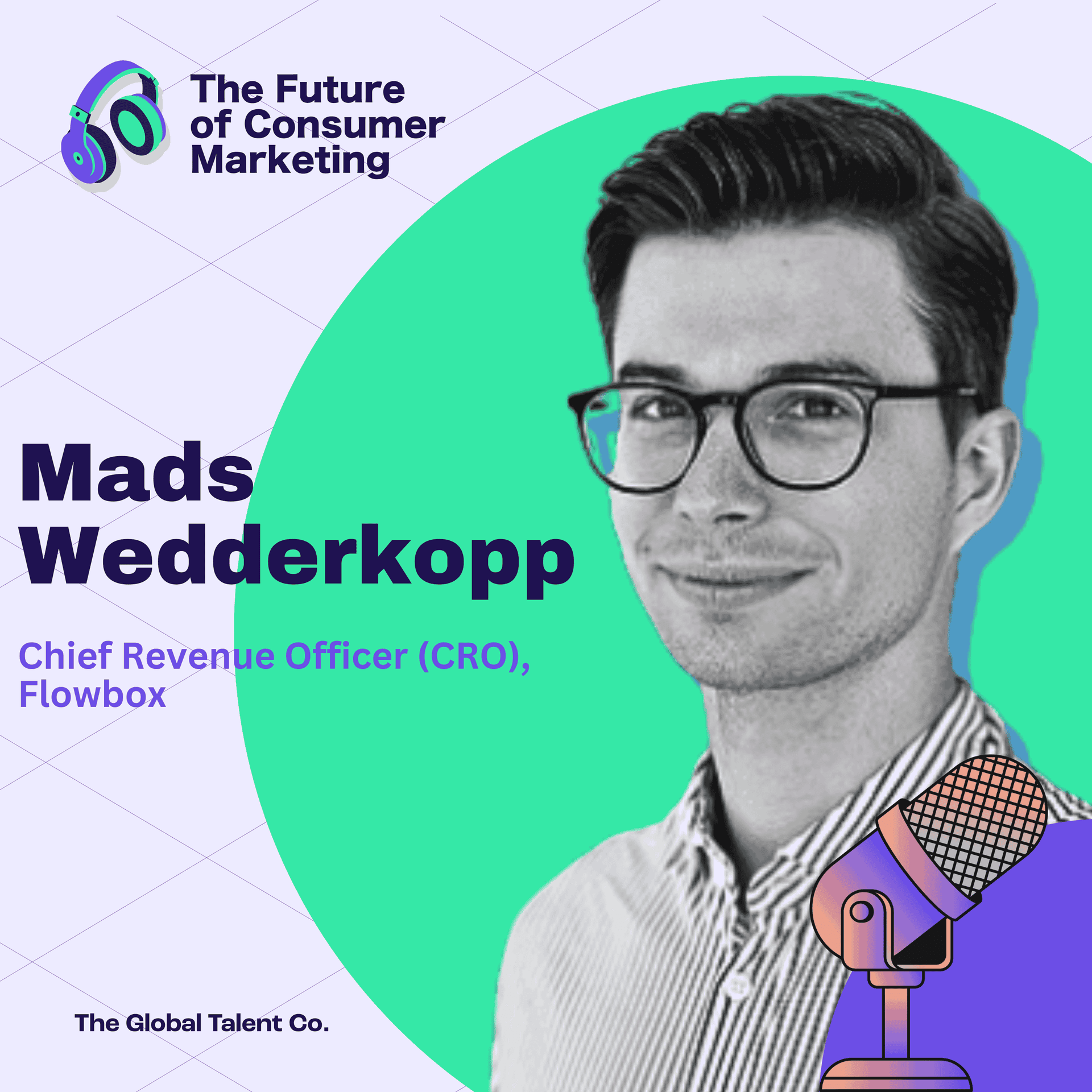
Host: Andres Figueira Guest: Mads Wedderkopp, Chief Revenue Officer at Flowbox Podcast Description: The episode focuses on how consumer brands leverage user-generated content (UGC) as a competitive advantage, emphasizing community building over product differentiation.
---
Key Topics Discussed
- Blended Attribution vs. Single-Touch Metrics
- Concept: Blended attribution is preferred for measuring UGC's impact on revenue.
- Metrics Used:
- Assisted Revenue: Tracks revenue attributed to customer exposure to UGC before purchase.
- Cost Per Mille (CPM): Ads using UGC perform better, leading to decreased CPM.
- The Shift from Google to Social Search
- Insight: Gen Z is increasingly using social platforms for brand discovery instead of traditional search engines.
- Implication: Brands must adapt their marketing strategies to engage consumers where they are most active.
- UGC, SEO, and LLM Visibility
- Connection: Strong UGC can enhance SEO and improve visibility in Large Language Models (LLMs), leading to better brand discovery.
- Community as a Competitive Advantage
- Argument: Products are viewed as commodities; differentiation comes from building a loyal community around the brand.
- Strategy: Engaging customers through UGC fosters a sense of community, leading to repeat business without direct customer acquisition costs.
- Micro-Influencers vs. Mega-Creators
- Trend: Smaller influencers often yield better engagement and conversion rates compared to larger ones, emphasizing authenticity and trust.
- Operational and Cultural Shift from 50 to 1,000 Clients
- Challenges: Managing cultural integration and operational alignment post-acquisition or growth.
- Revenue Factory Model: Streamlined processes from marketing to customer renewal must be established to handle increased client volume.
---
Insights from Mads Wedderkopp
- Background: Mads has extensive experience in software services and UGC, having founded and acquired companies in the space.
- Flowbox's Functionality: Flowbox assists brands in generating, organizing, and distributing UGC to enhance their marketing efforts.
Key Takeaways
- User-Centric Marketing: Brands should focus on building a community rather than merely selling products.
- Measuring Success Holistically: Success metrics should encompass the entire customer journey rather than isolated touchpoints.
- AI Utilization: Flowbox incorporates AI in operational efficiency and customer success, enhancing service delivery.
---
Flowbox's Strategy and Client Engagement
- Target Audience: Primarily consumer brands, particularly in fashion, cosmetics, fitness, and home goods, with a strong online presence.
- Client Acquisition Process:
- Initial qualification via marketing teams.
- In-depth discussions to understand brand needs, followed by tailored demonstrations of Flowbox's capabilities.
Adaptation to Growth
- Growth in Clients: Transitioning from 50 to 1,000 clients requires more structured processes and systems, moving from personal relationships to scalable solutions.
- Continuous Development: Flowbox releases updates every two weeks to keep their platform competitive and responsive to customer needs.
---
Marketing Strategy
- SEO Focus: Strong emphasis on SEO as a reliable customer acquisition channel despite claims of its decline.
- Social Presence: Importance of brand visibility across platforms like TikTok and Instagram to appeal to Gen Z consumers.
Final Notes
- Future Outlook: The integration of UGC and community-building strategies will be crucial for brands aiming to thrive in the evolving landscape of consumer marketing.
---
For More Information: Visit [Flowbox](https://getflowbox.com) to learn about their offerings and how they can assist in enhancing your brand's consumer engagement through user-generated content.
Written by AI. May contain mistakes. Listen to the episode to check what was said.
Chapters
Tap a time to open that second in VOGuest Introduction: Mads Weddercup
1:18 to 3:05
Background and experience of Mads Weddercup, Chief Revenue Officer at Flowbox.
“And today with me here, I am speaking with Mads Weddercup, Chief Revenue Officer at Flowbox, an award-winning SaaS company offering the most advanced user-generated content platform.”
Understanding User-Generated Content
3:05 to 4:23
Discussion on how Flowbox uses UGC to assist in revenue generation.
“If they don't have enough brand presence, that it happens organically.”
Attribution Challenges in Marketing
4:23 to 7:20
Exploring the complexities of measuring marketing effectiveness and attribution.
“People is the hardest thing in mergers and acquisitions.”
Building Brand Community
7:20 to 9:08
The importance of community in marketing and its role in customer retention.
“if we are a consumer packaged boot company that is on the shelves of the supermarket.”
Client Demographics and Relationships
9:08 to 10:41
Insights into the types of clients Flowbox serves and the nature of their relationships.
“Because I know it's a big thing right now to have you.”
Flowbox's Operations and Team Structure
10:41 to 11:43
Overview of Flowbox's operational model and team size relative to customer base.
“and the other 200 being distributed across Asia, the Americas, and Australia.”
Work Culture and Remote Policies
11:43 to 13:08
Discussion on Flowbox's work culture and office policies.
“And that's also why Flowbox acquired Dream Influence.”
Leveraging AI for Operational Efficiency
13:08 to 14:04
How Flowbox uses AI to improve internal processes and customer experiences.
“or any peculiar fashion that we might not know about?”
AI's Role in Client Onboarding
14:04 to 14:32
Learn how AI enhances the onboarding process for clients at Flowbooks.
“maybe one or two hours sitting together, talking about the client, doing a handover, that's also done by AI.”
The Client Acquisition Process
14:32 to 17:16
Understand the steps Flowbooks takes to qualify and onboard new clients.
“Like, how would they be able to reach out to you guys and make sure that it's a proper fit?”
Show all 16 chapters
Customization for Every Client
17:16 to 18:56
Explore how Flowbooks tailors its offerings to meet diverse client needs.
“It's very different what they are trying to solve.”
Scaling from 50 to 1,000 Clients
18:56 to 21:20
Discover the challenges and strategies involved in scaling a client base significantly.
“then your client wallet is about a thousand clients that you're working with and you're looking to expand that.”
Marketing Strategies for Growth
21:20 to 24:31
Learn how Flowbooks employs various marketing strategies to attract new clients.
“I like that analogy because it really feels like the organization that is required to be able to scale properly is what turns you into a navy.”
The Evolution of Consumer Influence
24:31 to 28:00
Understand how consumer behaviors are changing with the rise of social media and AI.
“So that we also take into consideration in Almagody.”
The Evolving Customer Journey
28:00 to 28:45
Explore the modern customer journey and trust-building in brand interactions.
“So it's just a new part of the customer journey or the buyer journey that, okay, I saw this post on TikTok.”
Product Versus Brand Differentiation
28:45 to 29:12
Learn why building a brand community is crucial for differentiation over products.
“Because your product at the end of the day in nine out of ten times, unless you are Rolex or something like that, it's just a commodity.”
Transcript
Automatic transcript. May contain errors.0:00Andres Figueira:Today at Flowbox where we help companies generate, orchestrate, moderate and distribute user generated content. How do you measure whether the user generated content is driving revenue or not? We kind of have a metric we call assisted revenue. If the user or the visitor has been exposed to one or more pieces of UTC and they end up buying, we assisted that order of the product that they have been having a look at.
0:23Mads Wedderkopp:It's a whole bunch of AI recommendations and data that it's like, how do we get in there? into having the AI recommenders back to building community, building a customer journey that is
0:33Andres Figueira:true to your brand so that your brand becomes your mode rather than your product because your product at the end of the day is just a commodity.
0:44Mads Wedderkopp:Hey everybody, thank you. Welcome to the show. My name is Andres Figueira and I'm going to be your host for the day. This show is brought to you by the Global Talent Company, helping fast-growing teams hire exceptional remote talent from Argentina, South Africa, and beyond. We connect companies with world-class professionals who bring skill, reliability, and a global perspective to every role. And just for our listeners today, we're offering an exclusive 10 % discount on your first hire. All you need to do is visit globaltalent.co, click start hiring, and mention the podcast listener discount when we reach out.
1:18Mads Wedderkopp:And today with me here, I am speaking with Mads Weddercup, Chief Revenue Officer at Flowbox, an award-winning SaaS company offering the most advanced user-generated content platform. And with that said, Mads, it's a pleasure to have you on the show, Mad. How are you doing?
1:35Andres Figueira:Fine, thank you. And a pleasure to be here. Thanks for the invite.
1:38Mads Wedderkopp:No problem at all. We're so happy that you were able to make it and that we got this episode to happen. And Mads, just so that we can get the audience a bit more in context, would you be able to tell us a bit more about your background, how you came to be Chief Revenue Officer at Flowbox, and maybe what Flowbox is in your own words?
1:55Andres Figueira:Absolutely. So I've been in software service for more than a decade now. Founded my first company when I was a teenager. That was a web shop. And the way I made that successful before it was sold was actually through what today is called influencer marketing and user-generated content. It was not coined that at all back then, but that was essentially what I was doing. Then later founded my first SaaS company, dropped out of high school to found that, drove that to 7.5 million annual recurring revenue, euros, left that, and later on joined a company called Dream Influence, which was acquired by Flowbox, first as a chairman, then later as CEO.
2:33Andres Figueira:And we were a Dream Influence acquired roughly half a year ago by Flowbox. And I then changed from being CEO of Dream Influence to CRO, or Chief Airing Officer of Flowbox. So I've been at it for quite a while and come from a commercial background, from marketing, from sales, and always been very commercially driven. And Zodai at Flowbox, where we essentially end-to-end help companies generate, orchestrate, moderate, and distribute user-generated content. So we generate it through influencers for the brands. If they don't have enough brand presence, that it happens organically. If they have a big enough brand that it happens organically, we help them capture all of that content that their fans and ambassadors are posting about them.
3:18Andres Figueira:We capture the usage rights automatically, and then we help them distribute it to their website, to their ads, to their own social media, to their community on newsletters and so on, so that at the end of the day, they can earn more money and get a stronger brand.
3:32Mads Wedderkopp:So first of all, I must say your journey is so cool, man. I can't believe you dropped out of high school, founded a company, and you even like so many acquisitions I heard on the way. Oh my goodness. Matt, just for my knowledge, because I'm just curious, what do you think is the hardest part of having to grow, to go through an acquisition? Like, were there any steps that people don't know about that were like kind of intense?
3:57Andres Figueira:I think what is underestimated most when doing acquisitions and mergers is the aftermath of making two cultures coming together and making two companies that operate in each stairway align the way of operating and SOPs, go-to-market strategies and so on, that that all comes together in a unified way. That's always by far the hardest thing. People is the hardest thing in mergers and acquisitions.
4:26Mads Wedderkopp:And Mads, okay, so Flowbox is, as you mentioned then, a platform that helps companies create user-generated content if they don't have it. If they do, then you help them get it more organized and get it better. And how do you measure whether the user generator content is driving revenue or not, are you able to provide that statistic to the companies you work with?
4:47Andres Figueira:Yeah. So attribution is always a feisty topic, right? So of course, we would like to claim that we generate tons of revenue solely due to the UGC, but I don't think that's wise. So what we do is we kind of have a metric we call a assisted revenue. So let's say on a webshop. In that case, they might embed UGC on their PDP or on their community page, on their homepage or whatever. And if the user or the visitor has been exposed to one or more pieces of UGC and they end up buying, we say, okay, we assisted that order of the product that they have been having a look at. So then we quantify it in that way.
5:26Andres Figueira:But there's multiple ways to go about it, which we also help our clients do. So another way to look at it is if you look at both our clients' data, but also just what TikTok and Meta is telling us, usually generated content in ads generally perform way better than branded ads. So another way you can benchmark this is saying, okay, so I'm now using this UGC in my ads and my CPM dropped 20%. That's another way of obtaining ROI, right? Now we get more efficient spend of marketing dollars, or we can spend more money now because we are getting further for fewer bucks so we can spend those additional bucks in someplace else.
6:07Andres Figueira:So that's another way to quantify it. And then there is obviously at the end of the day, there's less hardcore KPIs, which could be something like earned media value. It could be how many eyeballs have we been getting on this UGC. So we attack it from multiple fronts, but what I always try to educate those of the clients that I speak to, to do when they look at attributes is actually looking at it blended. So you take all of your efforts and you look at what did we generate from that and what have we changed? And then you say, did our ROAS, as an example, blended ROAS, did that go up or did it go down?
6:45Andres Figueira:Because if we only look at ROAS on an ad basis, then essentially we risk a huge fallacy because that's where we bust them funnel. So if we don't capture the activities across the funnel, we might risk the fallacy of saying, oh, this thing in the top funnel where we have an influencer post about us, we can't see any direct tie to revenue. So let's cut that. But that's not how consumer behavior works, right? We buy due to the sum of the marketing that is done as a brand. So all of the activities, the sum of that is what leads to a conversion. And that's no matter if we are an e-commerce company, if we are a consumer packaged boot company that is on the shelves of the supermarket.
7:27Andres Figueira:At the end of the day, the sum of the marketing we do is what drives the results. So we have to look at it from a more holistic perspective than a single touchpoint attribution perspective.
7:37Mads Wedderkopp:I totally agree with that, man. And I've noticed that marketing nowadays, it's not just posting an ad on a billboard or online. It's creating this whole world for the company that is doing the advertising and it's immersing the consumer into, yeah, you're exposed to this user-generated content. You saw the billboard. You heard a song or a pun on the radio and it's like these whole, as you mentioned, it's like the accumulation of these different things that drive for the sale. Exactly.
8:07Andres Figueira:And at the end of the day, your product is a commodity. Like I think Timo out of China is a really good example of products just being a commodity. Like there will always be a cheaper Chinese copy of your product. And that means the product becomes a commodity. But what is true differentiation is your brand and it's your community around that brand. And that's actually one of the big things we try to teach our customers that the reason you should be working with UGC is not only a conversion uplift or a better ads performance. It's actually that community is your customers and the people they know.
8:44Andres Figueira:And the ambassadors that you work with, their followers can become your community as a brand. and a community is lasting and organically expanding. So that's a way to keep recurring customers coming into your business rather than having to buy customers over and over again. Okay, okay.
9:03Mads Wedderkopp:Now, I totally agree with how you're painting it and I love that you're able to explain this to your customers. And that actually leads me to my other question that I have is, do you have a certain type of client that specifically comes to Flowbox Mads Or is it like just a general, everybody comes in and wants user-generated content? Because I know it's a big thing right now to have you.
9:25Andres Figueira:We do have a lot of different companies come to us, but we're pretty, I would say, narrow in who we want to deal with. So it needs to be a consumer brand, first of all. So we don't do any B2B things. So it needs to be a consumer brand. And ideally, it's also a brand that has an online presence in one way or another. So it's not only wholesale. It could be consumer packaged goods that don't even have an online presence and they're just on the shelves that we don't really work with. So they need some sort of online presence. And if they have a web shop, that's a plus for us. So consumer brands within fashion, cosmetics, healthy lifestyle is a bit of an umbrella for like fitness and nutrition and so on.
10:02Andres Figueira:Of course. And then fast-moving consumer goods and interior, home and interior. That's kind of the categories that we are big in.
10:10Mads Wedderkopp:Okay. And how many customers do you guys have like per month or something like that? Or do you have these customers that they never leave and you just keep on generating content for them? My question is, how many customers do you guys are you working with right now? Or do you have like customers per month? Or is it that a more long lasting relationship that's more on the long list?
10:29Andres Figueira:We are a software service business. So we are in it for the long haul with our customers. So they buy a subscription for the system. And right now we work with more than a thousand brands across the entire world. With around 800 of those being within Europe. and the other 200 being distributed across Asia, the Americas, and Australia.
10:46Mads Wedderkopp:A thousand brands is a lot, man.
10:48Andres Figueira:Yeah, it is. It is quite a lot.
10:50Mads Wedderkopp:And now then let's turn the perspective another way and be more insightful with Flowbox. And how many people do you have working at the company? Like how many people do you have helping you out with this whole endeavor?
11:03Andres Figueira:Just around 50, low model 50.
11:05Mads Wedderkopp:Only 50 people for more than a thousand companies that are being helped out? That is crazy, man.
11:12Andres Figueira:That's the beauty of software, right? Our software does the work. We're just there to help implement it and make sure that more customers gets into the business. And then roughly littlest than half of our staff is engineers. So what we do a lot is we continuously improve our product so that when you buy it today and you pay a subscription, in 12 months, you will have an even better product. And that's why you pay a subscription is to constantly get the newest tech and get the best features and we solve the most important problems to our clients. So it's very important for us to continuously expand and develop our offering.
11:48Andres Figueira:And that's also why Flowbox acquired Dream Influence. It was to expand the offering and deliver yet another crucial piece to the entire UGC engine.
11:57Mads Wedderkopp:Okay. Wow. Okay. So the acquisition wasn't just for whatever reason. It actually had a whole nature to it, honestly. And Mads, another question I have is, since you're a software as a service, are you a remote first company or do you have offices somewhere where everybody's getting together to work?
12:15Andres Figueira:Yeah, so I'm in our Amsterdam office right now. So we have four offices, Stockholm, Copenhagen, Amsterdam and Barcelona. And we are an in-office company, first and foremost. So Mondays are mandatory. And then we have three days a week as minimum in the office. So people can flex between being in the office and at home. But generally, everybody loves to be in the office and prefer to come into the office.
12:37Mads Wedderkopp:Of course. Now, I've been working remotely for, what, about five years now. But I do remember the office days and they were night. Like it was a different type of camaraderie that you had with your colleague since it really helps out with just even solving a problem over a coffee chat is a lot easier than just having, what's it called? than just having to go and wait for them to get online and actually be able to talk to them through Slack or whatever. Matt, are you guys leveraging AI in any curious way or any peculiar fashion that we might not know about?
13:14Andres Figueira:Yeah, so I think for marketing specifically, not so much, but operationally, we use it a lot. So one example is that we have like an AI sales coach. So we transcribe through AI, we transcribe all of our meetings and record them. that is then fed into an AI model that reads the transcript and then it scores the call for our account executive. So they will get a score on six different dimensions and they will get feedback on exactly what do you need to improve for your next meeting, next steps with this specific client, and it will draft kind of the follow-up email for after the meeting so that they save a bunch of time.
13:54Andres Figueira:That's one example. Another example that is really great for customer experience is that when sales then closes a new brand for Flowbox, instead of customer success and sales having to spend maybe one or two hours sitting together, talking about the client, doing a handover, that's also done by AI. So AI will read all of the transcripts from all of the meetings that sales have been having, and they will hand over the pieces of information that customer success needs in order to onboard the customer in an efficient and good way. So that's another example of how we use AI internally in the company.
14:28Andres Figueira:And then, of course, in engineering, they use it a bunch to write code.
14:31Mads Wedderkopp:Another question I have is then how is the process for a new client to be able to then get started with Flowbooks? Like, how would they be able to reach out to you guys and make sure that it's a proper fit? Because I know you have these types of requirements that allow you to work the best possible way with whomever comes into the company.
Read the full transcript
14:53Andres Figueira:Yeah, so what normally happens is essentially they come to a website. They find us on, I don't know, Reddit, Google. They ask ChatGPT, what's the best solution for UGC? And we pop up. They then on our website and they sign up to learn more. And then first, marketing will essentially qualify them. They will look a bit at how big is the company? How many employees do they have? What industry are they in? And if marketing deems it, okay, this is something that sales should have a closer look at, somebody from Salesforce will reach out to the brand. And then we will have a discussion on whether we can actually solve their situation, pain, and desired impact.
15:30So what we really do on the first meeting is we deep dive into why are we even here?
15:36Andres Figueira:What's the situation of the brand that comes to us? What is the problem they are having? And what is the impact they are looking to obtain by solving that problem? By when and by who? and when we have that understanding we can then kind of see if it makes sense to move forward with the conversation and if it does we'll go into a whole demoing phase and show them around the product show them the parts of the product that makes sense for exactly their problem and desired impact and then we'll at the end of the day have to talk about a price and do a contract
16:07Mads Wedderkopp:okay and do you guys when when you work with a customer do you already have like set guidelines into the best process or workflow you can help them out to do in order to achieve the results? Or do you guys experiment and change strategies with each new customer?
16:24Andres Figueira:Yeah, so each customer is kind of its own thing, right? Nobody has the exact same need. So what our tool is, it's a big toolbox of a bunch of different things that you can use to obtain the value that you're looking for and solve the problems that you're looking to solve. So while it has to stay within the limits of the product, there's like no single use of the product. Everybody uses it slightly different. So one brand might be using our creator management platform and our email marketing integrations and our Facebook ads integrations. And another brand might only be using the fact that we can scrape all of the content about them, we can obtain the usage rights, and then they put that on their webpage.
17:08Andres Figueira:So it's like very different compared to both which department is actually buying our tool. Is it brand? Is it marketing? Is it web? Is it e-com? It's very different what they are trying to solve. And based on what they are trying to solve, they will use the system slightly differently.
17:24Mads Wedderkopp:Okay. But then the system is, as you mentioned, it's a toolbox where they choose what we can use and what will work best for them. And anytime that you want to add a new tool to the box from the Flowbox side, then how do you approach testing and seeing if a new strategy or a new tool would work?
17:42Andres Figueira:Yeah, so we have an amazing product team that are really good at, first of all, like taking hypotheses from either customer success or sales, and maybe they come up with a hypothesis themselves. And then they will do some customer research, some internal stakeholder research to see what should we prioritize. They will scope how big of a task it is to make an MVP. And then it's essentially like, it's pretty simple. It's like way the shortest job first. So what is like the biggest job, the smallest job that creates the most value, then we do that first. And we deliver that, but we always deliver it in a controlled manner.
18:20Andres Figueira:So we will find somewhere between 10 and 50 clients that want early access. We'll have them tested, give us feedback. We'll iterate a bunch of times before we then release it to the entire customer base. So it's a continuous process and we release new things every 14 days. So we run in sprints on 14 days and every 14 days something new is released. That can be an improvement to something that already exists or can be an entirely new thing in the system.
18:47Mads Wedderkopp:Wow, 14 days is a pretty frequent cadence to have updates to the product. That's amazing. So you're always evolving and expanding. And you've mentioned that right now, then your client wallet is about a thousand clients that you're working with and you're looking to expand that. Any comparison that you can draw or learnings that you had from when you began and Flowbox just had 50 and to now 1 ,000, what has changed? Have you had to automate the product a lot more, streamline it so it's easier to use? What learnings have you had by gaining so many customers? Because a thousand people, a thousand clients,
19:19Andres Figueira:it must not be easy. Yeah, so full disclaimer, I was not at the company when we were only at 50, but I can talk in broader terms because I've taken that journey multiple times now from 50 to a thousand. And it's kind of the same thing every time. So, yeah, it's different. Like when you only have 50 clients, essentially yourself as a founder, probably closed all of them. And you know all of them by person, by first name. You maybe even have gone to their offices. So you know them very deeply and you have like a personal relationship to the first 50 clients, essentially. Whereas when you grow, when you get to process fast and you need way more systems, you need escalation, you need SLAs, you need like, there needs to be a very like streamlined process.
20:00Andres Figueira:So it's like, I kind of call it the revenue factory. So it starts all the way from marketing. The first time somebody sees one of our ads or visits our website or whatever, till the day that they renew their contract and they buy more, there needs to be a silver lining in that entire customer journey. And that you don't have when you close the first 50. It's just like, hey, you want to buy? Great, come in and we'll make sure that we can deliver something when you are in the door. And obviously that doesn't work when you get to a thousand. And what tends to happen is also you gravitate more towards upper market.
20:33Andres Figueira:So often you start with SMBs and smaller clients and then you'll get to the mid market. And then when you start to capture mid market, you start to get a bit of interest from enterprises and then you slowly move up market. And when you move up market, it's just like way higher requirements from the customers. You need to be able to complete like InfoSec interviews. You need to be able to showcase SOC2 compliance, ISO certifications, and so on. So there's like this whole gradual thing where compliance and regulations and so on becomes more crucial to stay up to date on and actually comply with in order to be able to close those types of clients.
21:10Andres Figueira:So it becomes a whole machinery. Whereas early days is just like somebody wants to talk to me. Great. Let me see if I can sell something to them. So it's kind of like going from being a band of pirates to becoming a navy. Okay.
21:23Mads Wedderkopp:I like that analogy because it really feels like the organization that is required to be able to scale properly is what turns you into a navy. Because pirates are just going around and shouting out and conquering the world. But totally understand what you mean. And yeah, it must be a fact. It must be a thing that the first 50 clients are a lot more personal because your company is just starting and you're going by word of mouth, more organic marketing. And that is also another question I have. How do you guys market yourselves? Like, do you have any channels that are working best? Any strategies?
21:59Mads Wedderkopp:Like, do you use user generated content to market Flowbox? Or do you have another way of doing that?
22:05Andres Figueira:Yeah, so we use our own product to showcase our clients and how happy they are with it. But again, it's a bit of an off usage because we are B2B. And it's very rare that somebody in a marketing department gets so excited that they start posting publicly about this great new tool they bought. It happens, but it's rare, right? So we have to be more proactive in reaching out to our most successful clients, inviting them into our office, doing a video interview so that we can showcase that on the website. But our most successful channels is actually something as boring as search engine optimization.
22:41Andres Figueira:We're really big on SEO and it works really well and drives a lot of our inbound. And I know it's like in 2026, for many people, that's super unsexy. It's super old-fashioned. And every year somebody is tooting the horn of SEO is dead. It's not. It's growing for us. And what's really interesting is that we can actually see a lot of our SEO efforts translate directly into being showcased in LLMs. So if you're a really good SEO, a lot of the time you will be picked up by the LLMs too. So we do see a big influx of leads coming from recommendations from Clawed and CheckDubt and Perpexity and Gemini.
23:21Andres Figueira:And most likely they find us mostly due to the fact that we have good ranking in search engines. But this translates to our clients too. So when Instagram made Instagram crawlable, all of a sudden having really great UGC and influencer marketing was important for SEO. Because the more people that talk about you on Instagram, the higher you'll rank. Because you get a lot of links, you get a lot of attention, Google validates that. And it's the same thing with the LLMs. They also crawl Instagram. So if you have a lot of people talking about you on Instagram as a brand, you will be featured more, both in search results, but also via LLMs.
23:57Andres Figueira:It's the same on TikTok. The more people that talk about you there, the more you will be discovered. And we are very present on social too. Both our own Instagram and our TikTok or on TikTok with our creators. We are very present as a brand because for the new generation, which are hitting the work market or the labor market now, by 2030, the biggest cohort of workers will be Gen Z. so so the way gen c they search is not the way millennials or generation x searched that's that that was google and we would google our problems but the way gen c approaches this and they will bring that into their professional life too is that they do social search so they will go onto instagram and look for inspiration and they will go onto youtube and they'll go onto tiktok so if you're not present there with a bunch of user-generated authentic trustworthy content you will not be discovered as a brand anymore.
24:50Andres Figueira:So that we also take into consideration in Almagody.
24:53Mads Wedderkopp:That is amazing that you have that so well thought out because it happened to me with something as simple as I went to a trip to Bariloche in the Patagonia. I'm in Argentina. And I went with this group of people that a Gen Z person was part of the group. And they were the only people that were looking for nice restaurants to go to because they would search for all of them via TikTok. And it was like, you can really search via TikTok like that? and I felt old. I was like, I'm Googling Google Maps and looking for the best restaurant. But it is so true, man, that they're using that as their, like, their, what's it called?
25:26Mads Wedderkopp:Their knowledge base. And they're finding them that somebody who went to the restaurant and saying, I just ate here. It's the most amazing thing I ever tried. And they show the picture. And that is worth so much more than 10 ,000 reviews and five stars on Google Maps. That is still worth something. But it's different. Yeah, but it's very different.
25:43Andres Figueira:And it's like, it's the authenticity and trustworthiness of somebody that looks like me, speaks like me, feels like me, is posting a piece of content where you can see they're genuinely excited about the restaurant in this example. But that could also be a new pair of jeans or a new pair of sneakers or some new makeup or the new sofa they bought. It applies to every single product we buy. And especially you can see, but essentially everyone is getting more and more influenced by profiles they follow. And I'm not speaking about like the profiles with a million followers or even 100 ,000 followers.
26:20Andres Figueira:I'm speaking about your friends and family and micro-influencers. So like these small communities of profiles that might have a few thousand followers where people are actually interacting on the post and there's conversation going on in the common fields. Like that's where we are influenced today. And that's where the future consumer will be influenced even more. And that all reflects on AI too, because that's where AI finds its recommendations. It literally minics the way we like to shop. It just does the research for us. But the way you get highlighted in AI is exactly that. It's true, authentic, trustworthy conversations with positive sentiment about a product on social.
27:01Andres Figueira:Be it Reddit, be it Instagram, be it TikTok. That's the top three channels that influences being promoted by an AI.
27:08Mads Wedderkopp:Wow, I love that, man. And I love how you're also positioning yourselves to be also picked up by the AI? Because I know you mentioned that some people are saying that SEO is dead, but I disagree with that. It's just evolving into the fact that now the first thing that appears in searches isn't the website that you work so hard to have listed as the first one. It's a whole bunch of AI recommendations and data that it's like, how do we get in there into having the AI recommend us? So it's so cool that you're able to crack that and be able to be showcased within these LLMs because that's what people like.
27:39Mads Wedderkopp:Like I look for something in ChatGPT. I am a bit skeptical when it gives me results, but I usually trust it. And it's like, I understand that people must not think twice when ChatGPT recommends.
27:50Andres Figueira:But it's just yet another area where we get exposed. Like we talked about earlier in this conversation, it's like the aggregation of all of the exposure you get. So it's just a new part of the customer journey or the buyer journey that, okay, I saw this post on TikTok. I saw this post on Instagram. And now ChatGPT is also telling me about this brand. And also I visited that web shop and I saw other trustworthy people on the website through ratings and reviews and through UGC by people like myself on the website. And I can see a person that is the same size as me wearing the clothes, not only like a model shot picture of the PDP.
28:28Andres Figueira:And now I trust this is right by for me. And it's that journey. It's back to building community, building a customer journey that is true to your brand so that your brand becomes your mode and your positioning becomes your differentiator rather than your product. Because your product at the end of the day in nine out of ten times, unless you are Rolex or something like that, it's just a commodity. It's true. It's true, man.
28:54Mads Wedderkopp:No, it's so nice how you have everything like so well thought out and you have this logical train of thought of how things should be because I really agree with what you have mentioned in the way you think about things, man. And Matt, I'm noticing that we're almost at time with the episode. It just flew by. I didn't even notice the 30 minutes already passed. But I did, before I close it out, I did want to give you the chance. I know that you mentioned how the beginning of the customer journey is, but just to reiterate and let anybody in the audience who is interested in listening to us, what would be the website they need to go to to see if it's a proper fit, if they can use Flowbox or anything like that?
29:30Mads Wedderkopp:Getflowbox.com. Okay, amazing. Well, you just heard it here first. Hit up the link that Matt's just mentioned if you're interested in seeing what different tools you can pick up from Flowbox and see if it's a proper fit, get in touch with their marketing team. And if it all goes well, you'll probably get a lot of user-generated content out of the relationship that is created. But with that said, Matt, thank you so much, man, for hopping on the show, for coming with your insights and for teaching us all about what you're doing. And I really wish all the best to you and Flowbox, man, because it really sounds like a hell of a project.
30:05Andres Figueira:You too. Thank you so much. It was a pleasure.
30:07Mads Wedderkopp:No problem at all, man. And with that said, thank you to anybody who is here with us as well, listening. We really appreciate you coming on these shows to learn about the different personalities that we talk to and all the different industries that we're learning about. So have a good one.
From the publisher
In this episode of The Future of Marketing, host Andres Figueira sits down with Mads Wedderkopp, Chief Revenue Officer at Flowbox, a UGC platform working with over 1,000 consumer brands across fashion, cosmetics, fitness, and home goods. Mads unpacks how the smartest consumer brands are turning authentic customer content into their most durable competitive advantage — and why the brands that win in the next decade will be the ones that make community their moat, not their product.
Topics Discussed:- Why blended attribution beats single-touch metrics for measuring UGC impact
- How social search is replacing Google for Gen Z — and what that means for brand discovery
- The connection between strong UGC, SEO, and LLM visibility
- Why your product is a commodity and your community isn't
- How micro-influencers and friend networks are outperforming mega-creators
- Scaling from 50 to 1,000 clients — the operational and cultural shift