
In short
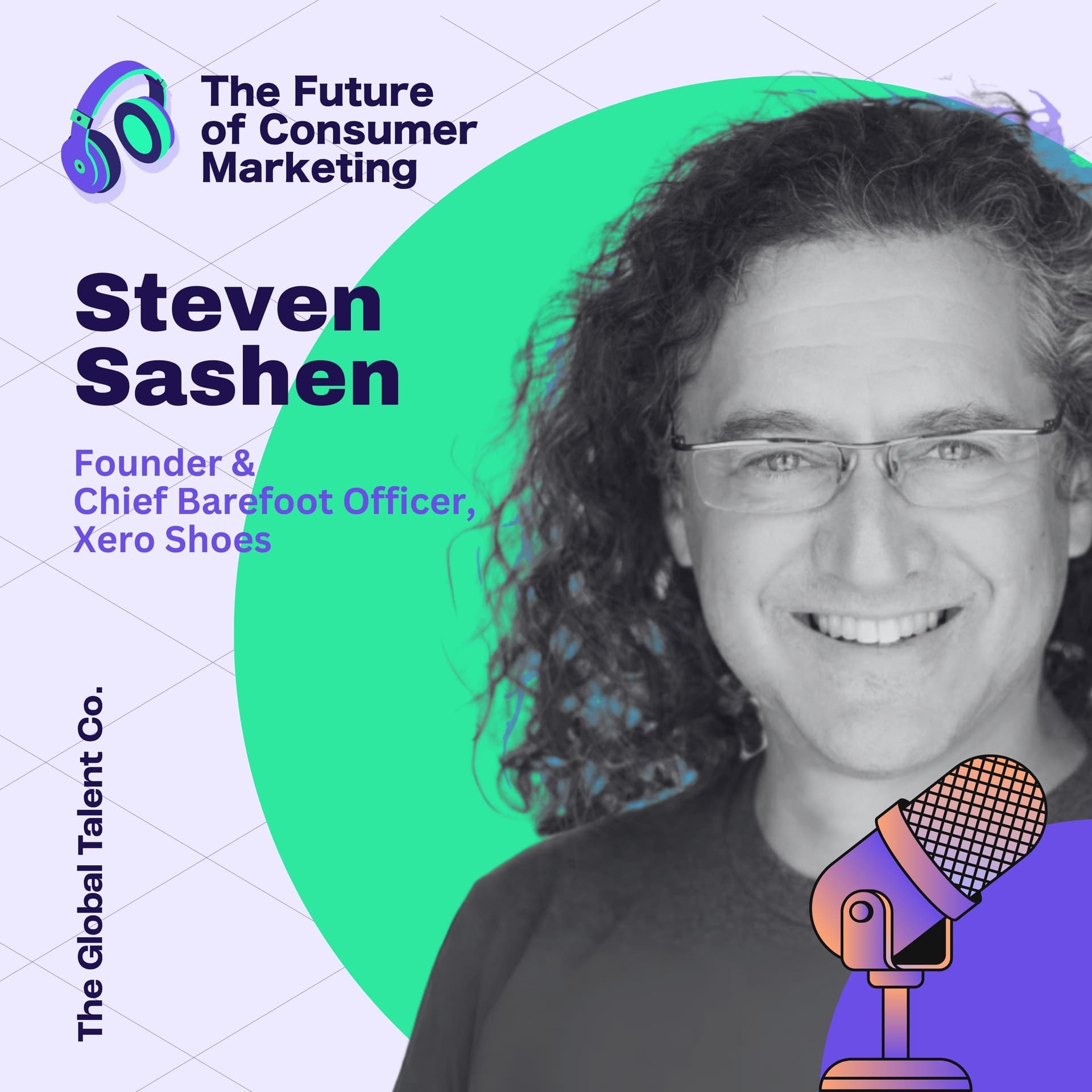
Steven Sashen, founder of Zero Shoes, explains how barefoot-style footwear is designed for “human feet” (wide toe box, no elevated heel, flexible sole with sensory feedback) and how his guerrilla marketing built the brand from 2009 to a Shark Tank appearance, including a campaign placing 50,000 bookmarks in Born to Run bookstores.
Guests
Steven Sashen, founder and “chief barefoot officer” of Zero Shoes; he’s also a master’s All-American sprinter (60m ~8.3–8.4, 100m ~13.2–13.3) and an internet marketer since 1992. The host is not named in the transcript.
Key claims
Thick shoes reduce sensory input, leading to harder landings, reduced mobility, and higher fall/injury risk in older adults. Brand growth came mainly from customer experience and word-of-mouth, amplified by content/SEO and timing.
Notable examples
injury recovery via barefoot running; “Born to Run” influence; 50,000 bookmarks campaign; sending shoes to Joe Rogan’s security; introducing Peter Attia to researchers; Shark Tank “jitters” and Kevin’s offer moment.
Written by AI. May contain mistakes. Listen to the episode to check what was said.
Chapters
Tap a time to open that second in VOThe Philosophy Behind Zero Shoes
0:28 to 1:12
Steven explains the unique design and philosophy of Zero Shoes.
“Well, I'm upset that you rock the five o 'clock shadow way better than I do.”
Steven's Athletic Background
1:12 to 1:52
Discussion of Steven's athletic achievements and motivations.
“Men over 60, I'm like one of the top 20 fastest guys in the country.”
The Journey Back to Sprinting
1:52 to 2:18
Steven shares his return to sprinting and the challenges faced.
“I was always, you know, the fastest kid, blah, blah, blah, until I went to junior high and my best friend was faster than me.”
From Barefoot Running to Shoe Development
2:18 to 3:21
Discover how running barefoot led Steven to develop better footwear.
“And getting better at it is also fun for me.”
Impact of Born to Run and Marketing Strategies
3:21 to 4:34
Steven discusses the influence of Born to Run and his marketing tactics.
“And then people kept asking me for more and more and more.”
Understanding Human Biomechanics
4:34 to 5:02
Insights into biomechanics and the importance of sensory feedback.
“and how they run and how they live and about the science behind natural movement.”
The Evolution of Internet Marketing
5:02 to 6:04
Steven reflects on his experiences in early internet marketing.
“And how much can you feel through a big, thick shoe with an inch of padding?”
Lessons from Shark Tank Experience
6:04 to 7:20
Steven shares his experiences and lessons learned from Shark Tank.
“Like, did you know this internet thing was going to be real big?”
Building the Zero Shoes Brand
7:20 to 14:01
Details on how Zero Shoes was built and the role of customer feedback.
“When he started his show, it was really intellectual and brilliant.”
The Role of Luck in Success
14:01 to 14:59
Explore how luck and timing play critical roles in business success.
“This product developer has this phone to Moran to our friend.”
Show all 14 chapters
Innovative Guerrilla Marketing Campaigns
15:00 to 16:32
Learn about unconventional marketing strategies that have proven effective.
“I feel like that's the story for every successful company, right?”
Hiring and Building a Marketing Team
16:33 to 18:35
Understand the challenges and strategies in assembling an effective marketing team.
“We just did a lot of stuff where we just found people who we knew could create content and sent them shoes.”
Navigating Marketing Talent Challenges
18:36 to 21:38
Discuss the complexities of finding and retaining marketing talent.
“because I'm the easiest client to ever deal with.”
The Future of Consumer Marketing
21:39 to 24:40
Gain insights on the evolving landscape of consumer marketing strategies.
“I mean, there's a couple of things that you want in-house, like content.”
Transcript
Automatic transcript. May contain errors.0:00This show is brought to you by the Global Talent Co, a marketing leader's best friend in these times of budget cuts and efficient growth.
0:07Brett Stapper:We help marketing leaders find, hire, vet, and manage amazing marketing talent for 50 to 70 % less than their U.S. and European counterparts. To book a free consultation, visit globaltalent.co. Hey, everyone, and welcome back. Today, we're speaking with Steven Sashen, founder and chief barefoot officer of Zero Shoes. Steven, how are you? Well, I'm upset that you rock the five o 'clock shadow way better than I do. This looks like crap. You look good. So it wasn't good. Tell us about the shoes behind you. We make footwear that is designed for human feet. So lightweight, bending, flexing. So the simple thing is nice, wide foot-shaped toe box instead of squeezing your toes together.
0:46No elevated heel to mess with your posture. Really, really flexible to let all the bones and joints in your feet do what you're supposed to do. A sole that's designed to give you feedback so your brain knows what you're stepping on or in so you can move better. But also, of course, the protection you want. And we've got a whole line of 60 different casual and performance shoes, boots, and sandals that people wear for everything we've taken a walk to literally playing on the NBA and WNBA courts.
1:08Brett Stapper:You must be an athlete. I feel like there's no way you sit behind a desk all day. I am a master's All-American sprinter. So for men over, now I'm 63. Men over 60, I'm like one of the top 20 fastest guys in the country. What's your like go-to measurement of speed? 60 meter indoor, 100 meter outdoor. And I actually a better 60-meter runner than 100-meter runner. So there's all-American times, and that's kind of a frame of reference. So the all-American time for men my age, for the 60, indoors, 8, 9, and I run about an 8, 3, 8, 4, which is actually all-American time for people like 5 or 10 years younger than me.
1:41And the 100, I run like a 13, 2-ish, 13, 3.
1:44Brett Stapper:What drives you to want to do that? We were just talking pre-interview. I told you I do distance running. People always ask, like, why do you do this? So for you, why? Why are you doing that? You know what? It's like going to Vegas. You can never do it perfectly. So, I mean, running fast is fun. I was always, you know, the fastest kid, blah, blah, blah, until I went to junior high and my best friend was faster than me. And it wasn't a good sprinting coach. So I focused on gymnastics. I was an All-American gymnast then. I got back into sprinting 18 years ago when someone told me there's a whole master's track and field circuit.
2:12And it's not fun if there's not a reason to do it for me. So competing is really fun for me. So that gives me a reason to do it. And getting better at it is also fun for me. And like at the end of a race, people go, how'd you do? And I go, you just want the number or can I give you the excuse as well? So the intermittent reinforcement component of never being able to do it right. It's like, oh, that time my start was good, but my transition phase was shit. I mean, there's always a something and that's literally addictive.
2:37Brett Stapper:At what point in your running journey did you say, I need to go build some better shoes? Two years into the getting back into sprinting after I, I mean, the first two years was just injury, injury, injury. And a friend of mine suggested that I try running barefoot. And when you run barefoot, saying people should do it, but when you do it, good form feels good. Bad form hurts. And my first barefoot run hurt. And when I figured out how to make it not hurt, my injuries went away. My running got faster, better, easier, and lighter. And I wanted something that gave me that barefoot-like experience because my wife got tired of me coming into our white carpet house with my dirty-ass bare feet.
3:10And I got tired of arguing with restaurants about whether it was legal to be there in bare feet. It is, by the way. and I knew about the Tatumara Indians who ran in sandals made from tire scraps laced to their feet. So I made my version of that. And then people kept asking me for more and more and more. And finally, a guy was writing a book on barefoot running. And he said, if you had a website for your sandal making hobby, I'd put you in the book. And I've been an internet marketer since 1992 and I built like 500 websites. So I rush home and I pitched this brilliant opportunity to my wife who tells me it's a horrible, stupid thing to do and it's do not build a website.
3:41And I told her I wouldn't. And then she went to bed and I built a website.
3:46Brett Stapper:I love that. I love that book. Let's see how good my memory is. You know, I have color coded. I believe it's a blue cover with yellow titles. Let's see. Yes, you're correct. Is that right? Yeah. Do you have it on the shelf behind you in the blue book section? Yeah, don't get back there, Star. That was like, I just started running during COVID like so many other people. And like, that was one of those books. My approach when I got into running was I'm going to absorb as much as humanly possible. So I got into like all of the Reddit communities and I just bought all the best running books. And that was for sure one that got me fired up.
4:16It's over your right shoulder next to a white book. Yeah, a little note, it's over there. Nice. That was weird.
4:24Brett Stapper:That's such a good book. I love that book. Any other running books that have had a big impact? Not really, but more importantly, my wife is not a runner or an athlete at all. And she found the book Born to Run fascinating because it really is about the tatamara and how they run and how they live and about the science behind natural movement. Because we're not talking about footwear. We're talking about optimal human functioning. For example, you have 200 ,000 nerve bendings in the sole of each foot, so your brain knows what you're stepping on or in, so it can help you move properly with the 33 bones and joints and 110 muscle ligaments and tendons.
4:55And if you can't feel anything, you can't use those correctly, and that makes you unstable and prone to fall and actually injury prone in many, many ways. And how much can you feel through a big, thick shoe with an inch of padding? That's what can lead over time to getting, basically, your brain says, if you're not going to give me the information, I'm going to do two things. land harder to try to get some information. And if that doesn't work, I'm just going to stop paying attention. And then you become less and less mobile over time. And then eventually that's why, you know, trip and fall accidents are one of the number one killers of elderly people.
5:22So I don't even know where that went, but there was some answer to your question, I think.
5:27Brett Stapper:You were an internet marketer in 92. What was it like during internet marketing? Wild, wild west. Herge engine marketing was really easy, although I was one of the first people to literally like me and a very small number of people figured it out. Just take whatever keywords you wanted, write them over and over and over and over and over in super tiny text in white with a white background so no one could see them. And then write a couple of articles, put them on a website called Easy in Articles, or there was one other, and then you're done. But there was no way to monetize it. So I outranked anyone who had an infomercial, I outranked them for their name.
5:59I outranked Tony Robbins through Tony Robbins. But there was no way to make money off of that. So that was just like playing around and seeing what you could do.
6:05Brett Stapper:Was it obvious back then in 92? Like, did you know this internet thing was going to be real big? I like watching those old videos of people like making fun of the internet, saying it's not going to be a thing. What was like the sentiment? No, here's where I thought it was going to be a thing. My best friend who started one of the first internet marketing agencies before that happened, there was two fun moments. One, we're in my apartment bemoaning, you know, why would someone buy business.com? It's just a generic word. That makes no sense. And P.S. Who has$70 for a domain name? But a little while later, he's working for an ad agency where they had the first copy of Photoshop, a beta copy.
6:37and this like, you know, multi-washing machine-sized photorealistic printer. And he said, watch this. And he grabbed an image in Photoshop, did a step repeat of the image. So it looked like there was just multiple of it going off into the distance. Printed it out photorealistically. And it looked like a real picture of this thing. And I went, we're all screwed. So, you know, and I felt a similar thing about the internet. Basically, in the early days of the internet, so I had a software company I started in 1992. and I said, the internet is just Jerry Springer for people who are with an education.
7:09And then it just became Jerry Springer.
7:11Brett Stapper:My wife didn't know Jerry Springer. She's like five or six years younger than me and she didn't know Jerry Springer. I'm like, come on, I grew up with this. I think there's a documentary about him. People don't understand him. He was a very interesting cat. When he started his show, it was really intellectual and brilliant. And he quickly realized this is not going to survive. I need to do what's going to keep me on the air. And then it became Jerry Springer. I think I saw that. That's a new documentary, right? Or somewhat. I just heard about it. I heard a podcast about it. And then I heard about the documentary.
7:39I mean, he's someone I followed for a while because I find him so fascinating. I mean, anyone who pays for a hooker with a check at that, you know, something's very wrong, but very funny. So yeah, he's just a really interesting cat. I mean, he was.
7:51Brett Stapper:Was Steve his bodyguard? I don't know why that stands out in my head. Wasn't there like a big guy named Steve who would come running in and like break fights up? I think it was something like that. When the show got to that point, I had stopped watching it. I mean, once it turned into just a melee of crazy town, that wasn't interesting to me. But in the early days with the software company, when I was doing tech support and helping with development, I just stayed home every day watching TV, waiting for the phone to ring. And that was a show that I watched till it went off the rails. On the topic of shows, let's talk about another show you were part of.
8:19Brett Stapper:So I've been watching Shark Tank for a very long time in my life. I know you were on Shark Tank. I remember that episode, which was very cool to see. What's it like as you're walking down that hallway? Well, I loved it. one of my other lifetimes, I was a professional stand-up comic. And so, you know, high pressure situations, I really like walking into them because one of the superpowers you get from doing stand-up comedy for, I did it for a little over a decade, is you just don't worry about what's going to be thrown at you because you'll figure it out. But my wife is a slower walker and I'm kind of like dragging her with me.
8:49So what they did right before we walked down the hallway is they did a thing called jitters where they said just, you know, in a separate room actually, where it looked like the hallway was right behind the door, but it wasn't, it was a mock hallway. And they just said, you know, just especially because I was there with my wife, just have a conversation about, you know, what's going on. And we had been in business for about two and a half years at that point. And it was the first moment I took a breath and realized what we had done in just two and a half years. And I just started crying. I mean, it was really overwhelmed.
9:17I was so happy to be doing with her what we had done together. And I could hear the producers like, this is gold. They didn't use it. So I just really love that. and even being in the tank. The first thing I figured out very quickly is don't tell jokes, don't try to be funny. Because what people don't know is they're not paying a lot of attention to you. They're making a lot of notes. There's never like all this attention on you. And if you do something funny and they're not paying attention, it's easy for them to edit it to, you know, you do a funny joke and then cut to them going, what? And the bigger mistake people make is those people don't know who you are, but you have a false sense of familiarity with them from having watched them.
9:52So don't act like they're your friends because then you'll say something stupid, either about your business or about them. Never call Mark Cuban cubes, but people do that all the time. Don't, you know, these are potential investors. You want to be personable. But the whole thing was, I mean, I had a blast. My favorite moment, I'll tell you, is that when Kevin made an offer to us, it was such a non-starter, we forgot that it happened. And when Robert reminded us, my wife says to him, and we have a debate about whether she actually said the last part, what I'm going to recount. I remember it, she doesn't.
10:22She says, so are you bringing anything to this offer other than money? And he says, well, I'm a smart businessman and I got a good Rolodex. And I remember her saying, so nothing. Which is really true and brilliant. And I love that. So.
10:37Brett Stapper:Did you watch the episode last week by chance of Shark Tank? You know, we were in season four and somewhere around season five, there's a private Facebook group for people who've been on the show. Yeah. And someone said, who still watches the show? Nobody. Nobody. When you see how the sausage is made, it's not fun watching sausage be made. Yeah. So no, what was on last week? That was Mark Cuban's final episode. It was like, I'm watching it. Like I'm like getting teary eyed watching it. I'm like, I've been watching it on TV now for like 12 years. Mr. Wonderful's crying. Like this guy's crying. Like it was like a happy moment, but it was like just, you know, it was the end of an era.
11:11Brett Stapper:It's kind of what it was. It really was because he was the only guy who had real money. Yeah. And he will admit that he did not make money investing in all these companies. and at the same time for the companies who were able to use the investments successfully, you know, thank you, Mark Cuban. We had a funny moment where they like to kind of go, gotcha, and at one point, I think Mark might've said, wait a minute, you're a husband and wife? Yeah, but you said she owns the company. What's up with that? I said, oh, I had a software company that was involved in a lawsuit. We wanted to make sure that they couldn't, you know, pierce the corporate veil and get to our assets.
11:41And he goes, what was the company? And I mentioned it, he goes, I think I used a software company. So I think I used to own that product. I said, yeah, you're in my database. and immediately he was like deflated. It's like, I don't really, you know, I don't care. I took your money before, no big deal.
11:55Brett Stapper:So how'd you go about building the brand then? So launched in what, 2009, that was two and a half years later, you're on Shark Tank. How are you building the brand in those early days? Well, the early days was really simple. I mean, frankly, the reason my wife didn't want me to do this is we had started a search engine marketing business. And I said to her, this will be a good case study. I think in three months, I can probably own all the keywords that I need, which was wrong by a long shot. It only took me six weeks. And so I was just making a lot of video content. And then there was maybe 25 different video sites.
12:24YouTube was not the most popular. So I was posting stuff just everywhere and interlinking things and just doing clever SEO stuff and just putting out a lot of content and basically getting in the way of conversations, finding out where people were talking about what we were doing, like ultra running and born to run and participating and adding value to the conversations and saying, by the way, you know, those waranches that the Terramaro running in, I made a similar version of that. You can buy a do-it-yourself kit and make your own for 20 bucks, 30 bucks. And I mean, very low key, but then I had built a decent website.
12:54I knew how to capture email addresses. I knew how to do email marketing. So it just kind of moved from there. And what really drove the business was not so much my marketing, but the experience that people were having, like not because of what we're making, but because by getting out of shoes to squeeze your toes, mess with your posture, don't let you feel, don't let you move, et cetera. And they would tell two friends and they'd tell two friends, you know, like we'd get an order from the runner in the family, the person who read Born to Run. And a week later, we'd see an order for five other people in the household and who aren't runners like, oh, I just love these little sandals.
13:25These are really fun. And then it was customers telling us, I love the sandals, but what am I going to do in the winter? What am I going to do with the office? What am I going to do if I want to go to the gym? What am I going to do if, and we just, the product line developed from customers telling us what they wanted next. And eventually us knowing how to fill holes that they didn't know to ask for. But all that was driven by an unbelievably lucky event among a million lucky events, including my wife eventually deciding to become my wife after spending four years avoiding me like I was shit on a stick.
13:52And to make a long story short, we met a guy who had 35 years in product development experience because while he was walking his dog, a friend of ours was walking his dog and the dogs knew each other. Guy started talking. This product developer has this phone to Moran to our friend. I looked at it. We got together. He said, I love what you're doing. How can I help? And I said, I don't know how you can help. You made five times more money last year than we made last year. He goes, yeah, but I just retired. I'm like, you're hired. So he not only was our product developer, but a great mentor to us.
14:21And had that not happened, you know, a lot of this would not have happened.
14:24Brett Stapper:How impactful was that book being released, Born to Run? I feel like it angelized the idea. Yeah. I used to tease Chris McDougal, the guy who wrote it, that he was my unofficial marketing department. So anytime there was a book signing somewhere, I would advertise around that. I did a campaign where I printed 50 ,000 bookmarks and I sent them out to customers and said, go into bookstores and put these in Born to Run. And eventually, actually, Chris had never promoted a product, never mentioned a brand, never talked about a shoe. For the last few years, we're basically the official footwear of Born to Run.
14:54And so it all kind of came around. But yes, that was a huge help for us. Again, a whole lot of things conspired to happen all around the same time. And that was one of them.
15:03Brett Stapper:I feel like that's the story for every successful company, right? There's a conspiracy of things that happen to come together at a good time. When people ask me how we got here, I said it's 90 % luck and the other 10 % is also luck. And then there's a separate 100 % runs in parallel. It's 90 % working your ass off and 10 % hopefully being smart enough to know how to put out the fires or find someone who knows how to put out the fire that started overnight, even though nothing changed since yesterday. But the luck factor is we were on the How I Built This podcast. And I said to Guy Raz, I love that the last question you ask is how much was luck effectored?
Read the full transcript
15:35Because people overlook that. If you ask someone how did you get successful, they'll tell you what they did. If you ask them how they failed, they'll tell you how it was bad luck. It's luck all the way up. It's Buddhist line turtles all the way down. It's luck all the way up.
15:48Brett Stapper:What about other guerrilla marketing campaigns? You just described one, which is awesome and very clever, going around and putting bookmarks in all of those books. What else have you done that's been crazy over the years? A lot of things. Well, one of the biggest things that I do is the opposite of what everyone calls best practices. Because by the time it's best practices, it's out the door. Like look around your neighborhood and look at all the new houses and they all look basically the same. You know, in 10 years, you're going to go, oh yeah, yeah. So same idea. Like if I'm hiring a copywriter, I'll say, okay, I need five AdWords headlines.
16:18The first one is greatest shoes I've ever worn. Give me four more. And if they don't have at least two that sound like I will never wear these shoes, or my wife told me she'll leave me if I wear these, or do not buy these shoes or just, oh no, you know, something that is counterintuitive. That's a thing. Or, I mean, this is not guerrilla. It's pretty straightforward. We just did a lot of stuff where we just found people who we knew could create content and sent them shoes. One thing I did, I did this to Joe Rogan when he was in Denver. I packed up about 15 left shoes, different shoes, different styles.
16:49And I got him to the security guy and I said, get these to Joe with a note saying, if you want the right one, let me know. And he never contacted me, but he's name dropped us a dozen times on the show.
17:00Brett Stapper:Oh, he has? Wow. You know, I work out in zero shoes and he's dropped us a bunch of times. I'm trying to get on there, but it's unlikely that I'll get on because it would just look like an ad. So I'm trying to get him to talk to the other experts who are not monetarily involved. Peter Atiyah did that. I talked to Peter when I found out he owned 40 pairs of my shoes and I introduced him to some of the top researchers in the world. And he's done some very successful podcasts with those people because that way, you know, it's not, doesn't look like I'd had. Yeah, makes sense. I follow a lot of Peter's stuff as well.
17:28Brett Stapper:It's so good. Yeah, Peter's great. What about hiring the marketing team, building the marketing team, given that you're a marketer, how has that been for you? I've found you, I'm a marketer too. It's hard for me to hire marketers. Well, you got to find someone who, I mean, luckily I'd been around long enough that I could get referrals from friends for people who were smart. And, you know, smart people can spot smart people from a mile away. Dumb people don't know who they are. And again, just really lucky about asking people and finding the right person at the right time. And what's good because I'm a marketer is that we speak the same language.
18:03They don't have to convince me of things. I understand these things. Like when I'm talking to somebody now, there's two things I always say. One is I've been an internet marketer since 1992. And I say that not to pat myself on the back, but just to tell you, you don't need to explain shit to me. And And that makes them very happy. And we go off script and dive in very deeply. The other thing I say is how quickly and cheaply can I find out if you have your head up your butt? Because I can only control risk. And whatever upside you think you're going to give me, we don't know. So I don't want to give you a bunch of money and then find out it didn't work and you apologize.
18:32But thank me for putting your kid through college. And so when I eventually do hire people, I usually get the friends and family rate because I'm the easiest client to ever deal with. We spend five minutes going over the stats from the last week, five minutes talking about what to do next. 20 minutes of just chatting because we like each other and we block out 30 minutes. And they use the stuff that we come up with together with their other clients and make more money with their other clients. So the challenge is there's only so much talent in the world. And the bigger you get, the harder it is to find that talent.
19:04There's just a push me pull you with they're already making a bunch of money. And do you have enough money to get in that loop or not? And that's a tricky one. If you're lucky, you'll find someone where you become their biggest client. Then that works out well. they can grow with you and turn into that. They had the skillset, but they never got to apply it as big as what you can do with it. So that's great. But we're having some conversation now with people where they're going to be making four times as much money as I do, which is great. I mean, I love it. But to the people who really, really know this stuff very well, A, there are fewer of them.
19:36B, they're often full. And C, they're often very specialized. So I'm meeting more people to do very specialized little things. Like one guy who's mastered this one aspect of one platform that no one else knows how to do that thing, but him. And so you got to bring that guy in. It's like for SEO, I think there's four different components to SEO. The kind of technical stuff of making sure the site is set up right and blah, blah, blah, all the things that Google pays attention to to make sure that you're cool. And then there's the level of the content you're actually writing, the content marketing side of things.
20:10Then there's the onsite linking structural things, which has changed over the years multiple times. So how you create the content, what you do with that to link, to make it more effective. And then what you do offsite to get more attention to what you're doing, link building or guest posting. There's all these various things of various levels of legality. But I know people who are really, really good at one and a half to two of those things. I don't know anyone who's really good at all of those things, like really good, but that's cool. So, you know, this one guy is going to handle the technical stuff and the linking stuff.
20:41and the other guy's going to handle the content stuff and the organizational stuff. They're fine with that. And the other thing that I'll throw out is I just stay away from agencies. Because anytime there's an agency, I say, look, the top 10 guys in the world aren't working for an agency, let alone your agency. And I need one of them. I need someone who figured it out, realized that, you know, working on that client, if they're working in-house, they have enough bandwidth to handle two or more other clients and they'll quit and start a small agency of their own. So I mean, an agency is like a full service agency.
21:10I don't do those. But, you know, they'll do a small thing where they do their little niche thing for like three to five companies and make a lot of money doing it. Or I look for someone who tried it on their own, but no longer either has the risk tolerance. They built the skill set, but don't have the risk tolerance. Or they're having to look for clients who don't understand what they're doing and they have to convince them of here's why it works and here's what it does. So I like finding people who would like to fire all their other clients if they could.
21:37Brett Stapper:Makes sense. So it sounds like then the marketing team is kind of, I don't know if this would be the right word, it's a distributed team, a collection of different, you know, small agency owners or freelance team and a few clients. Yeah. I mean, there's a couple of things that you want in-house, like content. I want that in-house or not all of it, but a chunk of it has to be in-house just because you need access to all the shoes, you know, photographic stuff or video things. I want someone who knows how to handle that so we can have that conversation. I mean, it's helpful to have a copywriter or designer for like catalogs when we're doing trade shows and things.
22:10It's helpful to have them local because it's easier to go over and redline things in real time than to go back and forth and back and forth. But for like SEO or media buying, rarely necessary to have them nearby.
22:22Brett Stapper:We're going to do one more question here. We're over on time. Unfortunately, it's the future of consumer marketing. So I have to ask you, what's the future of consumer marketing? What's it going to look like, do you think, five, 10 years from now? I hope that someone has given me enough money that I don't care about the answer to this question. You know, fundamentally, nothing has really changed, and I don't think anything will fundamentally change. And that is people are looking for solutions to problems or, as an example, for consumer products. They're looking for something that does something that they want.
22:49Let's just leave it at that. Your job as a marketer is to find those people and show them that what you're offering has some value above and beyond whatever they're seeing somewhere else. Frankly, that's a nightmare. I mean, our world in all minimal shoe things adds another layer of complexity. But regardless, I mean, that's marketing 101. Get in the way of where people are looking for something and then show them that you're providing what they're looking for at a price that makes sense for them, which could be really low or really high or really in between. That's not going to change. What's going to change is the ways that people are looking and the ways that you can get in front of them and the way that you communicate what you're doing.
23:26It might turn into 3D holographic Google Glass. AI is going to be an interesting part of it. But the simplest thing I can tell you is no one predicted what AI was going to do. So I'm not going to predict anything beyond that. You know, when the internet came out, everyone's talking about how it's the most amazing thing ever from a marketing perspective. It's the greatest thing ever. I said, it's just new television, which is just new radio, which is just new magazines, which is new newspapers, which is new town crier. It's always the same because we're human beings and respond to the same things.
23:57So the medium for it is the part that I don't know. I mean, look, I'll say this about SEO right now. What's working in SEO right now is often if you grow a brand or a catalog company, here's a subset of your products. Here's a bunch of content about that subset. This is what Home Depot has been doing for 25 years. There's nothing new except the way people then bump into that page. and whether that page needs to be linked from your homepage or if it can just be on your site in general or the structure of that content below the fold where you showed them the products or how they're going to look to, you know, how they want to compare them.
24:30But the basic idea is exactly the same. You walk into a story, you look at a bunch of options, you talk to someone knowledgeable, you make a patent buying decision. Same thing. So, yeah.
24:39Brett Stapper:I love it. That's where we're going to end it. We're going to have to do a part two and it's going to have to be like two hours long so I can ask you all the things I want to ask you. But man, this has been so much fun. Really great to meet you and appreciate you taking the time. Pleasure. Next time I'll be clean shaven because I don't want to compete.
From the publisher
In this episode of The Future of Consumer Marketing, host Brett Stapper interviews Steven Sashen, founder and Chief Barefoot Officer of Xero Shoes. Steven built a multi-million dollar footwear company from a simple DIY sandal kit after discovering barefoot running transformed his athletic performance. Starting with basic SEO tactics in 2009, Xero Shoes has grown into a 60-product line worn by everyone from casual walkers to NBA and WNBA players. Steven's journey from Internet marketing veteran to footwear entrepreneur showcases how authentic product experiences, contrarian marketing tactics, and specialized talent acquisition can build a category-defining brand in a crowded market.
Topics Discussed:- Building a brand around authentic product experiences and word-of-mouth growth
- Leveraging early SEO mastery to dominate niche keywords before competition arrived
- Creating guerrilla marketing campaigns that break conventional "best practices"
- Developing product lines through direct customer feedback and demand signals
- Assembling high-performing marketing teams through specialized freelancers vs agencies
- Using content marketing to educate consumers on barefoot running benefits
- Converting book publicity into brand awareness through strategic partnerships