In short
Thumbtack’s “thumbtack marketing playbook” for building a sustainable, profitable, scalable growth engine where marketing is a profit center; brand and performance are intertwined; campaigns run continuously (12 months/365 days) with national optimization plus local market testing.
Guest background
Llibert Argerich is a performance data-driven marketer turned CMO. Career spans an early online affiliate/loyalty rewards role in London (2005), then Expedia, eBay, Udemy (startup), and now back as CMO at Thumbtack. He emphasizes market research roots and learning-focused career moves.
Key claims
Performance drives brand and brand drives performance. Thumbtack aims to be the “Uber of home services.” Marketing should show positive impact on EBITDA; CFO alignment enables innovation and brand investment. Thumbtack competes most against word-of-mouth trust.
Notable examples
A year-ago local “halo” test in markets like San Francisco—buying beyond profit-maximizing levels to increase reach/frequency—produced incremental revenue and brand lift versus control markets; now applied in 10 markets. Media mix expanded from mostly SEM to 11 channels. AI/LLM strategy is framed as evolving SEO/content, direct information/API integration, and future commercial integrations.
Written by AI. May contain mistakes. Listen to the episode to check what was said.
Chapters
Tap a time to open that second in VOVision and Team Dynamics
0:45 to 1:30
Discussing the importance of a shared vision and team dynamics in marketing.
“It's pretty much roughly the same size, but we're producing twice the impact.”
Performance and Brand Relationship
1:30 to 3:25
Exploring how performance influences brand and vice versa in marketing.
“I moved to London and I landed my first online marketing job at a very small affiliate company, a loyalty company.”
Libert's Marketing Journey
3:25 to 5:50
Llibert shares his early career experiences in marketing and product management.
“And I was like a market research consultant for his very, very teeny tiny consultancy.”
Early Marketing Experiences
5:50 to 8:50
Llibert recounts his first marketing job and the evolution of digital marketing.
“And yeah, finally, I feel like I've made it right.”
Ambitions and Career Growth
8:50 to 11:10
Discussing career ambitions and the non-linear path to becoming a CMO.
“But we're not really thinking about campaigns.”
Crafting a Marketing Strategy
11:10 to 14:00
Exploring the elements of building a successful marketing strategy.
“And why this is important that it works for us is because Thumbtack, and probably context here would be helpful, is a two-sided marketplace.”
Understanding Homeowner Hesitations
14:00 to 19:05
Explore the common uncertainties homeowners face when hiring pros for home projects.
“And very often what holds them back is the uncertainty.”
The Thumbtack Experience
19:06 to 20:31
Learn how Thumbtack positions itself as a trust platform for homeowners and pros.
“We are not selling their phone number and get tens of providers calling them and trying to compete for the business.”
Competing with Word of Mouth
20:32 to 21:58
Discuss the competition between Thumbtack and traditional word-of-mouth referrals.
“You know that, I mean, yes, you have stuff that you need to do at your home, but it's not a high frequency volume.”
AI's Role in Marketing Strategy
21:59 to 24:28
Examine the importance of AI in enhancing marketing strategies and customer interactions.
“So I think there's that, what are you calling it, like GEO, AEO, whatever terms you're making up, but optimizing for open AI and LLMs.”
Show all 15 chapters
Navigating the Tool Overload
24:29 to 28:00
Discover strategies for managing the overwhelming number of marketing tools available.
“How are you thinking about the urgency around figuring out AI?”
Building a Scalable Growth Engine
28:00 to 29:11
Learn how to articulate a vision for sustainable growth in marketing.
“with the company's strategic direction, understand how I can resource, unlock, remove barriers, and really set up the organization for success.”
The Shift in Marketing Success Metrics
29:11 to 30:42
Explore the evolving metrics of success in marketing beyond team size.
“How big is the marketing team that you're managing and leading?”
Advice for Consumer Marketing CMOs
30:42 to 32:29
Gain insights on balancing brand investment and financial accountability for CMOs.
“What advice would you have to other CMOs who are marketing to consumers?”
Wrapping Up the Conversation
32:29 to 32:46
Find out where to connect with Llibert Argerich after this insightful discussion.
“but then just building the trustees is what really unlocks the fun, to be honest.”
Transcript
Automatic transcript. May contain errors.0:00Everybody in my organization should know more and does know more about their craft than I do.
0:06Brett Stapper:How do you articulate that vision for the team? It's built a sustainable, profitable, scalable growth engine. Marketing is a profit center, not a cost center. Brand is not its separate thing. Performance drives brand. Brand drives performance. Any campaign that you can go deep on and your tickets behind the scenes. I don't think about campaigns. We run 12 months, 365 days a year ongoing campaigns. Our marketing never stops. Uber, you press a button. And I feel like for you, it's the same thing. You have a product where it's an amazing experience. Yeah, it's convenience. It's trust. It's value.
0:39I think our benchmark and our ambition is to be seen as the Uber of home services. How much did you grow the team since you joined? It's pretty much roughly the same size, but we're producing twice the impact. It's fun to have long and large teams. And as you grow, you inevitably need to have people who can handle and manage all their jobs. But it's just not a measure of success. In fact, it could be the opposite, right?
1:07Libra, how are you? Thanks for joining. Thank you. I'm good. Thanks for having me.
1:11Brett Stapper:How'd I do on your first name? We were just joking there. It's a tricky name. Score one out of 10. How'd I do? About five. Okay. You've added this how you pronounce it, but I'm used to all kinds of pronunciations, so I don't get offended. Don't worry. Amazing, man. Well, really excited to have you here. You've worked for so many iconic brands. I want to begin with the question of your very first product that you were responsible for marketing. What was that first product? That was way back in 2005. I moved to London and I landed my first online marketing job at a very small affiliate company, a loyalty company.
1:47And I was responsible for the rewards program. Basically, the typical you click on a link, the company refers you to a website. At the time, it was like online gambling and people could get hundreds of dollars to get started on online gambling in the UK. And we basically gave the points to the people who clicked. We got paid by the partner, typical affiliate program. and basically just growing that and the rewards catalog so people could use the points to redeem again some rewards. So that was very, very, very early days, like pre-double-click tracking attribution. It was like very early digital marketing day.
2:33So that was a fun, fun first experience.
2:35Brett Stapper:I can't even imagine like the metrics that you were seeing back then compared to now. I've heard people talk about like the early internet days or early email days that it was like 100 % open rates and things like that. And I'm jealous. Yeah, I mean, there was a, yeah, I'm telling you, there was a lot of metrics. I don't know that I would believe any of those today. So yeah, you were making do with what you had at the time. It's 20 years ago that the world has changed a lot. And did you just love marketing or how'd you end up in that role? You know what? I was at university and I struggled a little bit choosing my major and I landed on marketing a little bit by accident.
3:12and my first real love was market research. There was a professor at university. It was amazing. We heated it up and he actually offered my first job out of university in Barcelona. And I was like a market research consultant for his very, very teeny tiny consultancy. But just getting to hear and understand what people's preferences are, the psychological element of marketing is like, how do you get to understand what really people want and mean and how do you turn that into insight so then you can position your brand and build all your go-to-market all of that was like mind-blowing to me uh and then when i moved to london to learn english because at the time i my english wasn't too good it was like out of spanish school um i i i fell in love with digital marketing it's like oh wait a second i can do all of that psychological customer mindset thing and i can do everything in the internet and I can measure stuff and then I get to use data.
4:12It's like my data-driven mindset just blew up. And it's like, yeah, that's what I want to do. And it's been 20 years and I'm still in love with it.
4:21Brett Stapper:And career-wise, what were you thinking? Like aspirationally, we're like, okay, I'm going to go to the top. I'm going to become CMO. I'm going to work with these big companies. Like what were you thinking career-wise at that point? At that point, I just wanted to get a job. I just wanted to learn. I was always been very ambitious, right? I never, I mean, I always hoped that I would become a CMO. But I never knew that it would happen. But that never stopped me, right? So the challenges were many. And my career has never been... It looks linear on paper. But within a given company, I moved from that small rewards company to Expedia, my first real big job in a big American company.
4:59I was a marketing assistant there. And then I went to manager. And then there was some ups and downs. And then I moved to eBay. And from eBay, startup world at Udemy. So over 20 years, a lot of ups and downs and different changes that happen. But the one thing that's always been driving my career is like I wanted to get better at what I was doing. I wanted to learn more and I wanted to grow. And that run less ambition is getting me to move from the UK to Switzerland, Switzerland to the US, from eBay to a startup. And now I'm back. Right. And from going from being a marketing generalist to now a CMO.
5:38Right. So that's kind of like the track record is it's hard. It's always been marketing, which is great. Right. That's my passion. And that's what I've really built that know-how. But it's been a bit of a sneaky up and down way. And yeah, finally, I feel like I've made it right. I'm a CMO at a great company. So that's great. I'm I'm enjoying building the craft further. Right. That's really that's the sweet spot for me now.
6:05Brett Stapper:I think that's the case for, you know, not just marketers, but for everyone. Like you look at their LinkedIn and you see one thing and then you talk with them about the stories that happened to you in between and around those points. And it's never as clean and neat as it looks on LinkedIn. The once and the option is great. It's like, oh, you were a specialist and now you're a CMO. Look at that trajectory. That looks amazing. It's like, well, it's 20 years. A lot happens in 20 years. A lot happens in 20 years. You mentioned refining the craft and always improving the craft. Right now, what part of the craft are you trying to improve on and focus on?
6:35Brett Stapper:And you can't say AI because I feel like that's too easy, too broad. Well, it's part of it, but I'm not going to say AI. Listen, I'm a performance data-driven marketer first and foremost, right? So I strongly believe that marketing is a profit center, not a cost center. And therefore, everything marketing does needs to show up in a positive way against the piano. Otherwise, not doing my job, right? And therefore, my obsession, my focus is to really building a profitable, sustainable, scalable growth engine. And as part of that, there's smart tech, is data pipelines, infrastructure. Obviously, brand is a key element of that.
7:21And we can talk more about that. But I'm a strong believer that brand is not its separate thing. Performance drives brand. Brand drives performance. So the two things go together. So building the right creative messages, brand architecture that then can allow us to make our investments work and drive the outcomes we need for the business is key, right? So it's not one thing. It's just combining performance, data, analytics, more tech with our core marketing, like creative branding, media buying, optimization, all of that, right? That is, that's really where the mix, the excitement really happens because it's not just one thing.
8:03You can't just be good at that. You need to be good at all of it and then really investing in the right places at the right time to really build that engine that really tracks growth at scale.
8:12Brett Stapper:Dean, take us behind the scenes to a marketing campaign that you launched anytime in the last 12 months or just anytime. Any campaign that you can go deep on in here. Take us behind the scenes, what happened, what you were measuring and what the outcome was. Of course, how cool the campaign was. I'm going to be a bit controversial. I don't think about campaigns. We run 12 months, 365 days a year ongoing campaigns. Our marketing never stops. I don't think about campaign that starts like seasonal campaigns that start this day, this day. There's creative launches that we have, there's seasonality, there's bursts of media that happen at different times because you're optimizing towards seasonality and customer behaviors.
8:52But we're not really thinking about campaigns. But what we're, I think that we launched a year ago was in our spirit of really having more impact from a market penetration perspective, we hypothesized that if we break out from our national profit maximization optimization, right? So we run marketing in a very tight way. It's a very tight ship. Every dollar we spend, we spend to the profit max curve and we stop before the next dollar becomes a negative contribution, right? So the incrementality point. But we hypothesize that if we took a media buy at a local level, let's say a city like San Francisco, and we invested way beyond that profit maximization at a loss for a given period of time.
9:50and we increased our reach and our frequency, could we see a halo impact, call it brand impact, of the media buy? And we set out to do it. The risk was there because it was a significant amount of budget, right, that we put out there. And if things didn't pay out, we would lose that money. But we were okay because we could absorb it with our overall national budget. So we did that local market-based testing and the results were amazing. We did see a incrementality driven versus our control markets where we had these higher pushing frequency and reach. We saw incremental revenue and we saw a halo impact that went way above and beyond the 90 day we use as a break-even metric in our more performance direct media.
10:47So that was really illuminating. And today we have 10 markets where we're actually putting these practices in place. So our premise is we have a national engine that drives growth and profitability. And we have the local market approach that really allows us to gain market share one market at a time. And why this is important that it works for us is because Thumbtack, and probably context here would be helpful, is a two-sided marketplace. And we connect homeowners and home professionals to accomplish more, right? Basically, we're the one platform for every home need, right? As a national marketplace, the reality is that our market is extremely fragmented.
11:36A homeowner who needs a plumber doesn't care that Thumbtack has 300 ,000 plumbers nationwide. They care that we have the one plumber that can come today to their home to fix the problem, right? And on the other side, a supplier, a plumber, doesn't care that we have 20 million homes around the country. They care that we have enough homes in his serviceable area so he gets to grow his business or their business, right? So I think that's why these local market techs are so important, because at the end of it, our business happens at the hyper local markets, right? At the Zitkot level, at the city level, at the region level, wherever the serviceable area is.
12:16And that's where these local market tests have been so successful and important, because now we have a means to grow our brand and our market share in a risk controlled way, right? We still are running budget above and beyond profit maximization, but we have a longer time for payback, which is very, very helpful.
12:40Brett Stapper:For what it's worth, I'm a customer and it's an outstanding product. I always joke about it. It leaves me from having to do physical labor. I have no calluses on my hand. It's a very good product and it's very cool. It's been around for a long time though, right? How old is the company? It's been around since 2009. to them, yeah. When you came into the role, what was the state of marketing at that time? When I came in two years ago, I've been in contact for two years. The reason why Marco, the founder, reached out is we had a very concentrated media mix on SEM. And the main reason is the core of our business is we're extremely good at helping homeowners find the right pro to do their job.
13:27And the magic really happens when you know you need a plumber and you go to Google and say, I need a plumber near me. We've been extremely, extremely good at capturing that high intent, that readiness, right? And then once the customer gets on contact, we very efficiently show them the right pros near their area and make it very easy for them to contact the pro and higher than right so that um that was the strength and uh we was feeling the growth at the time the challenge was like well that's great and that's a superpower and that's a key differentiator for us and we've continued to um hone that craft but the reality is like not everyone is looking for a pro today but pretty much anyone who's a homeowner or lives in a home has something they need to do at home.
14:19And very often what holds them back is the uncertainty. Uncertainty of not knowing what to do. How much is it going to cost me? Who do I need to call? Do I even trust them? Are they going to do a good job? I'm going to get scammed, right? So there's all these questions. And very often what that does, it paralyzes people. It's like, oh, you know what? I'm going to procrastinate. I'm going to wait. I'm going to wait until something breaks. And then you have to do it urgently and generally cost more. So that's where the focus on the last two years has really been in, right? It's like helping us position Thumbtack as that solution for homeowners to really get all the answers they need to take care of the projects they need to do at their home, right?
15:04And I think that's been the journey. Our product has evolved from the core fulfillment and connection to providing more help upstream it's like hey what do I need to do how much is it going to cost and downstream just making sure that the connection with the pro the hiring the booking the actual job done well is really taken care of right so it's like that's the the real uh focus and as a result our media mix has gone from pretty much one channel to now 11 channels including youtube meta uh ctv uh podcasts you name it, right? So there's a wide variety of well-diversified media names. From those 11 channels, which one do you see the least in terms of performance?
15:53Or is that hard to say? It's an interesting question and I could answer it right away, but to me, it's maturity versus emerging, right? At the end of the day, I believe there's customers that need a solution in every single channel. It's just how mature are we in leveraging the channel? How good are we at adapting and capturing the needs from that customer, that channel? Are we behaving and showing ourselves the way customers need to be talked to on that channel, right? So not every channel is equal. You don't talk to a customer who's looking for a blomer on SEM the way you talk to a customer who's browsing or scrolling their feed on Instagram.
16:36It's very different, right? So there's different layers of maturity. I think our most mature channel is SEM. Our least mature channel today is probably YouTube, right? But we're making big strides on YouTube and unlocking a lot of opportunity there.
16:56Brett Stapper:If you just think about who you compete with, so imagine that we're in San Francisco. I search San Francisco plumbers. I would guess that it's Joe's plumbing service and Sally's plumbing service. So for you, you're competing with them from a search perspective, but those are also the same people that you want on the other side of the marketplace. Isn't that right? So you're kind of competing with people that you also want to do business with. The biggest competitor we have is word of mouth. When you think about costing behavior, when you are looking for someone to come and fix something at home, what do you generally do?
17:26You either talk to a neighbor or your family is like, hey, do you know a guy, right? Or maybe you go online and a forum, a group chat, a Facebook community, whatever, and you're like, hey, does anyone know someone to come and do X and Y? And generally you get the answer. Yeah, yeah, I know a guy and all these and this company and so on. The challenge with that is like you have to trust that that one person knows really the person that's going to do the good job. And that's really our competitor. It's worth them all, right? And just really building the understanding and the knowledge that Thumbtack, we have 300 ,000 pros.
18:03We have more than 10 million five-star reviews. And we have millions and millions of projects successfully completed. And you can find the right growth for the job you need to be done now.
18:13Brett Stapper:Yeah, when I think about it, you know, as a customer using your platform, and I know you just touched on that too. It's like, you're selling in my mind, like trust. Because the alternative would be, I go and it's like a long list of numbers. I'm going to call. They're never going to answer because no one ever answers. You know, it's going to take days and days and days. And they're finally going to respond. The whole experience is so bad, so broken. On your app, you go click a few buttons and it's done. I don't know if that's correct. I think of it as a trust platform. You're in the business of trust.
18:39Yeah, it's convenience. It's trust. It's value, right? It's like convenience. It's like you get to see all the relevant pros with a license, with a background check, with projects, examples, pictures, with reviews. You have all the information you need in a snapshot to really make the right decision for what you need. And yes, I think what makes us really different is the fact that we put the customer, we put the homeowner in charge. We are not selling their phone number and get tens of providers calling them and trying to compete for the business. We tell them, hey, we believe that those are the three right pros for you based on the criteria that we've gathered from you and the pros.
19:23And tell us who you want to contact. And the customer says, I want to talk to this person, this person, this person. The pro then gets that signal and then within an hour or whatever time frame, some pros reply in minutes, some pros take a bit longer, but then they get a very fairly quick connection and then they start the conversation and lead to a hire.
19:46Brett Stapper:It kind of makes me think about like that comparison. I was just talking about this with someone the other day, like the taxi experience versus the Uber experience. It's like not even close, right? It's like if you're ever in a situation like for some reason you have to take a taxi, it's like it sucks. Every part of it sucks. Uber, you press a button. And I feel like for you, it's the same thing. You have one experience that absolutely sucks. Your experience is so amazing. There's like this big, massive gap, which has to be fun for you. To be a marketer, it's like you have a product where it's an amazing experience.
20:13Brett Stapper:You probably just have to, what? Get people to try the experience. But I feel like you must have amazing retention once they do give it a try. I completely agree. I think our benchmark and our ambition is to be seen as the Uber of home services because we provide the best experience. we have the strongest product market failure. Now, the difference between a right share and R is frequency, right? You know that, I mean, yes, you have stuff that you need to do at your home, but it's not a high frequency volume. Therefore, the onus on the strong experience on the value perceived by the customer and by the pro is ever so important, right?
20:56Because again, the one time that you have one shot, if you hire an electrician and you get a great experience, that's great. You'll remember us and you'll come back to us. But what often happens is you get the pro come to your home and it's not a thumbtack pro. It's an independent. And sometimes our brand equity leaks a little bit. And that's the job for us in marketing and branding. And it's not just branding from a top of funnel TV and messaging, but it's really stickiness of our experience across the journey, right? And this is where really the opportunity that leads to higher retention, stronger product market feed, and ultimately loyalty that will get people to think, why would I go and ask my cousin about someone when I have the app in my phone and I know that I'm going to get a great pro who's going to do an amazing job and I'm going to feel joy and fulfilled and accomplished because the stuff is done the way I want it to be done.
21:57Brett Stapper:You talked about optimizing for search. What about LLM? So I think there's that, what are you calling it, like GEO, AEO, whatever terms you're making up, but optimizing for open AI and LLMs. What's your report there? What are you seeing working? I think the jury is out there, right? So I think everyone has a point of view and an opinion. And in my view, there's really three dimensions that we're exploring. on the one hand is the closest to a SEO, which is you still need to have great content that the LLMs are going to pick up and use for learning, right? And that content needs to answer customer questions, right?
22:39It's not going to be, what's the, give me an electrician near me. That's not what AI overview do. That's going to be, I have a stain on my ceiling. It's brown. I don't know who to call, right? That's a good AI LLM-based kind of question. And us having the answer then increases the chances that we are going to be picked up by ChatGPT, Google AI overviews, ReflexD, who you name it, that's going to reference us as the source, right? So that's content, marketing, surface, relevancy, SEO, kind of the evolution of SEO, right? The second one is providing the information straight into the LLMs, right?
Read the full transcript
23:27It's like API integration. So like, should we and can we? And should we just pass the content straight into it? And then just rather than letting the LLMs, the bots, like find our information online, it's just like be the direct source of information and driving that. And can we do that? And the third part, which is addition to the second one, is straight up commercial integration. So like, hey, if we give you our supply and our inventory, can we be the ones who are going to show up? The recommendations, one of the things that I think is going to be the next iteration is, aside from agents navigating the web and doing the booking, probably a more straightforward way is like the LLM has an answer about what you need.
24:09It's like in the recommendations, you need to book a plumber. How do they choose which plumber? We know the plumber. So could we just feed that information and provide that and then just basically bring pump tax or value prop into these AI interfaces? But again, all of this is just theoretical for now. We're not quite there yet.
24:29Brett Stapper:How are you thinking about the urgency around figuring out AI? I talked to some marketers who are like, it's everything. If we don't figure this out in the next 12 months, we're done. Others are like, we'll see. Things come and go. What's your kind of thinking when it comes to AI? From 1 to 10, 25. It's everything. I see that as a strategic priority. So we've modified our product roadmaps dramatically. And on all dimensions, not just the marketing or the demand growth, but also our product experience. Embedding AI is everything. Just like using LLMs to better understand what customers need, making us understand the data better, predictive modeling based on data that we're getting is very important.
25:20On my end, I care about personalization and building agentic systems that will streamline processes that otherwise are extremely human onerous, right? and free up bandwidth to really get the teams to think about better creatives, innovation, and so on. So really, we have several proof of concepts lined up for NH2 to really tell us which direction we should be going. But yeah, that's a top priority.
25:56Brett Stapper:What about different tools that you're experimenting with? I don't know about you, but I feel like every day I'm seeing more and more tools. I'm overwhelmed with the options. Then you talk with someone and they're like, oh, you don't know this tool? Then I walk away thinking, I'm an idiot. How do I not know about that tool? How are you managing the chaos of all the new tools that are coming out? There's two ways to answer that. One is personally, and then it's like as a leader, as a marketing leader on the organization, right? So personally, you know what? I'm just working on chat. That's what I want to figure out.
26:25I want to, there's so many just like notebook LM and Gemini and it's too much. My brain's not capable of handling that much diversity. So I've decided to focus and try to get really great outcomes out of touch. As a marketing leader, I mean, one of the things that as a company we've done is like we have, like many other companies, like we've created the mandate that we must learn. Right. So let's explore. Let's open up the funnel of tools that people test, creating some frameworks with security, obviously, is very important, data, IP, and all that stuff matters, but really giving the teams the options and opportunities to test.
27:10And from that perspective, I'm pretty overwhelmed because I keep hearing names that I don't even know what they mean on an everyday basis, but I catalog it in two ways. content generation, right? Creative, whether that's image or video generation, and data. I think when you're a CMO, one of the big realizations is like, I no longer know more than anyone else, right? When I was a channel specialist, I was very proud of being top notch at my craft. Today, everybody in my organization should know more and does know more about their craft than I do. My job is really to create a vision, point us to the direction that we need to align with the company's strategic direction, understand how I can resource, unlock, remove barriers, and really set up the organization for success.
28:12Does it add any value that I know of tool X or Y or Z to do X and Y? No, I'm not going to use it. It's not on me. I need to listen to what the team needs, understand how they're making their choices and ultimately unlocking them to go and test and try and hopefully unlock growth.
28:33Brett Stapper:What is the vision? How do you articulate that vision to the team? It's build a sustainable, profitable, scalable growth engine, right? That really provides confidence to customers to book the right profile job. and on the supply side to really provide an unlimited source of jobs for the pros, right? If we have that growth engine, both the supply and the demand side benefit, right? And that's where data, brands, media buying, optimization, all of that comes together. And that's the direction where we should move. How big is the marketing team that you're managing and leading? It's a demand growth team.
29:15So we have the core Marcoms team, which is about 60 people. And then we have our cross-functional engineering, data science, applied science, product design. That's about another 40 people. So it's about 100 in total. And how big was it when you joined the team? Or how much did you grow the team since you joined? Not at all. It's pretty much roughly the same size, but we're producing twice the impact. And that's what is exciting, right? So I don't think about success as organizational size. I think marketing is a technology data intensive discipline rather than a human intense. I mean, sales teams are human intense.
29:55They need humans to go and call and sales. On the marketing side, I really care about efficiency, productivity, and doing more with more smartly, with more data, with more technology, more scalable. Right. So that's why the scalability in the vision is so important.
30:12Brett Stapper:It's been funny to watch that shift. I feel like before the ultimate flex would be, oh, my company is this big or my team is this big. Now, the flex is like, you're doing all that with 10 people or 50 people, how many people? It's like, that's the flex. That's what impresses people now, which is funny. Exactly, exactly. Yeah, I mean, it's fun to have large teams and as you grow, you inevitably need to have people who can handle and manage all those jobs, but it's just not a measure of success. In fact, it could be the opposite, right? Yeah, opposite. It makes a lot of sense. We'll end with one final question here.
30:43Brett Stapper:What advice would you have to other CMOs who are marketing to consumers? What's your number one piece of advice that you have for them? It's for CMOs who are in pre-IPO businesses, right? I think one of the things that we all struggle with, and even in a post-IPO, but not massive large caps, right? So we are all super budget constraints. One of the key complaints that I keep hearing is like, we don't invest enough on innovation. We don't invest enough on brand. Why can't we just forget one second about revenue and investing the brand? Because the revenue is going to come once your brand succeeds.
31:24All of that's great. And in theory, on paper, it's great. But the reality, as a CMO, we have an obligation to the business. And I think about marketing as a P &L driver. And if I do not contribute to the EBITDA role, I'm not doing my job. So I think that's the advice is like, make sure that you're your CFO's best friend, that your CFO will trust what you're doing, trust the output. whenever you go with a campaign or a risk you want to take, they'll be like, yep, I trust you. Your track record shows me that you know what you're doing, that you have the right framework, that you're thinking about it the right way.
32:12I know that ultimately this is going to translate into positive results for the P &L and you and I are aligned. I think that's the biggest unlock because if frees up, then you can think about how much you want to lean on brand and how much you want to dilute a little bit, the short-term impact of the campaigns, but then just building the trustees is what really unlocks the fun, to be honest.
32:38Brett Stapper:Unlock the fun. I love it, Nian. This has been such a fun conversation. I've really enjoyed it. For anyone listening in that just wants to follow along with you, where should we send them? It's very easy to find me. There's not many Libras out there. So L-L-I-B-E-R-T on LinkedIn, and I'll be showing you in the first place for sure. Okay, well, thank you very much. Really appreciate it. Nice to meet you. All right, thank you. Thank you.
From the publisher
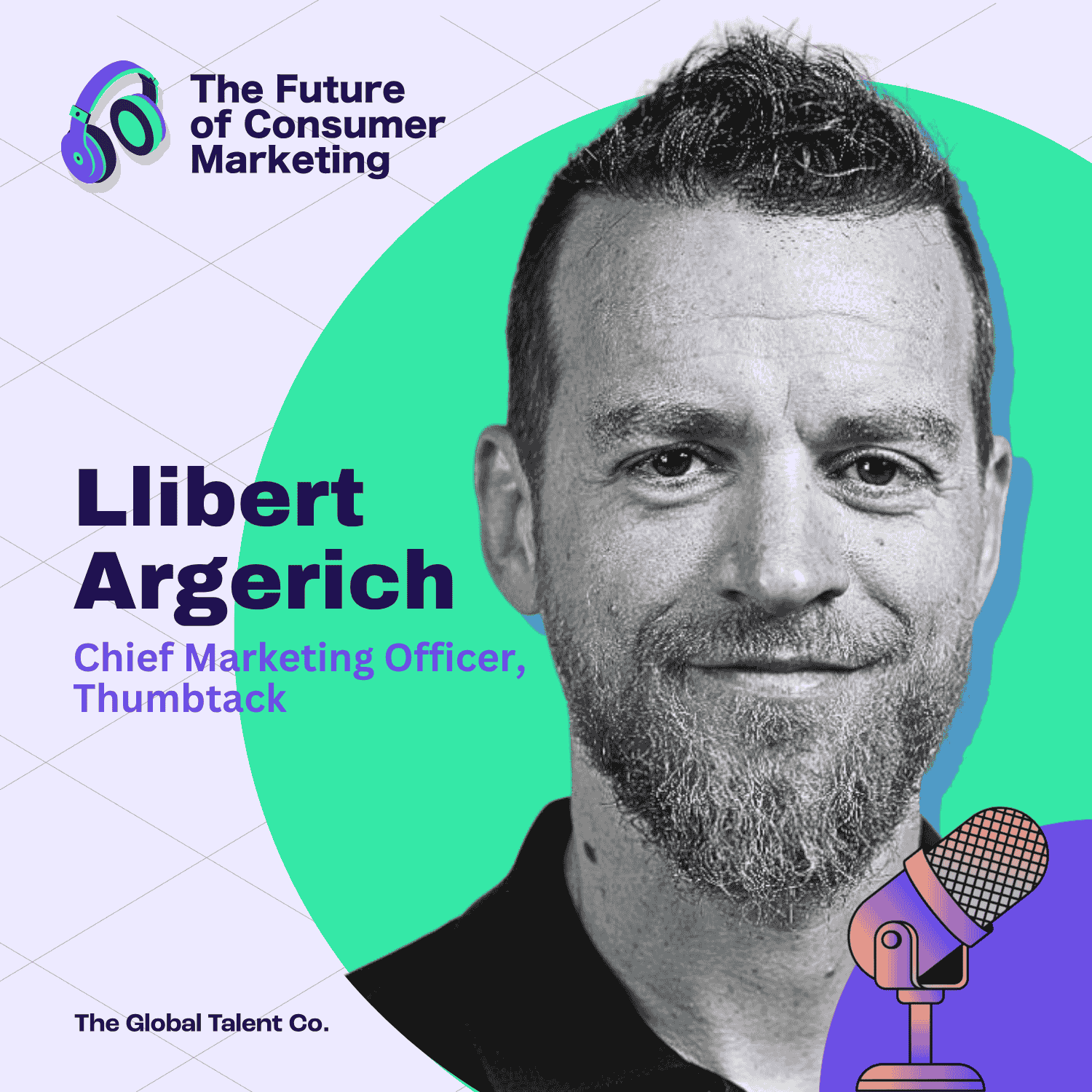
In this episode of The Future of Consumer Marketing, host Brett Stapper interviews Llibert Argerich, Chief Marketing Officer at Thumbtack. Thumbtack is a two-sided marketplace connecting homeowners with home service professionals, competing primarily against word-of-mouth referrals in an extremely fragmented market. Over the past two years, Llibert has transformed Thumbtack's marketing from a concentrated SEM strategy into a sophisticated 11-channel growth engine that balances national profit maximization with aggressive local market penetration. His approach treats marketing as a P&L driver rather than a cost center, combining performance marketing rigor with brand building to create sustainable, scalable growth in a category where frequency is low but intent and trust are everything.
Topics Discussed:- Evolving from SEM-dependent marketing to an 11-channel diversified media mix
- Building local market penetration strategies that operate at calculated losses for long-term market share gains
- Creating profit maximization frameworks that determine exact incrementality points for media spend
- Positioning against word-of-mouth as the primary competitor in home services
- Leveraging AI and LLMs for content strategy, personalization, and agentic marketing systems
- Managing marketing team productivity and efficiency without headcount expansion
- Balancing performance marketing with brand building in low-frequency, high-stakes categories
- Optimizing for emerging search behaviors including AI Overviews and LLM-based queries