In short
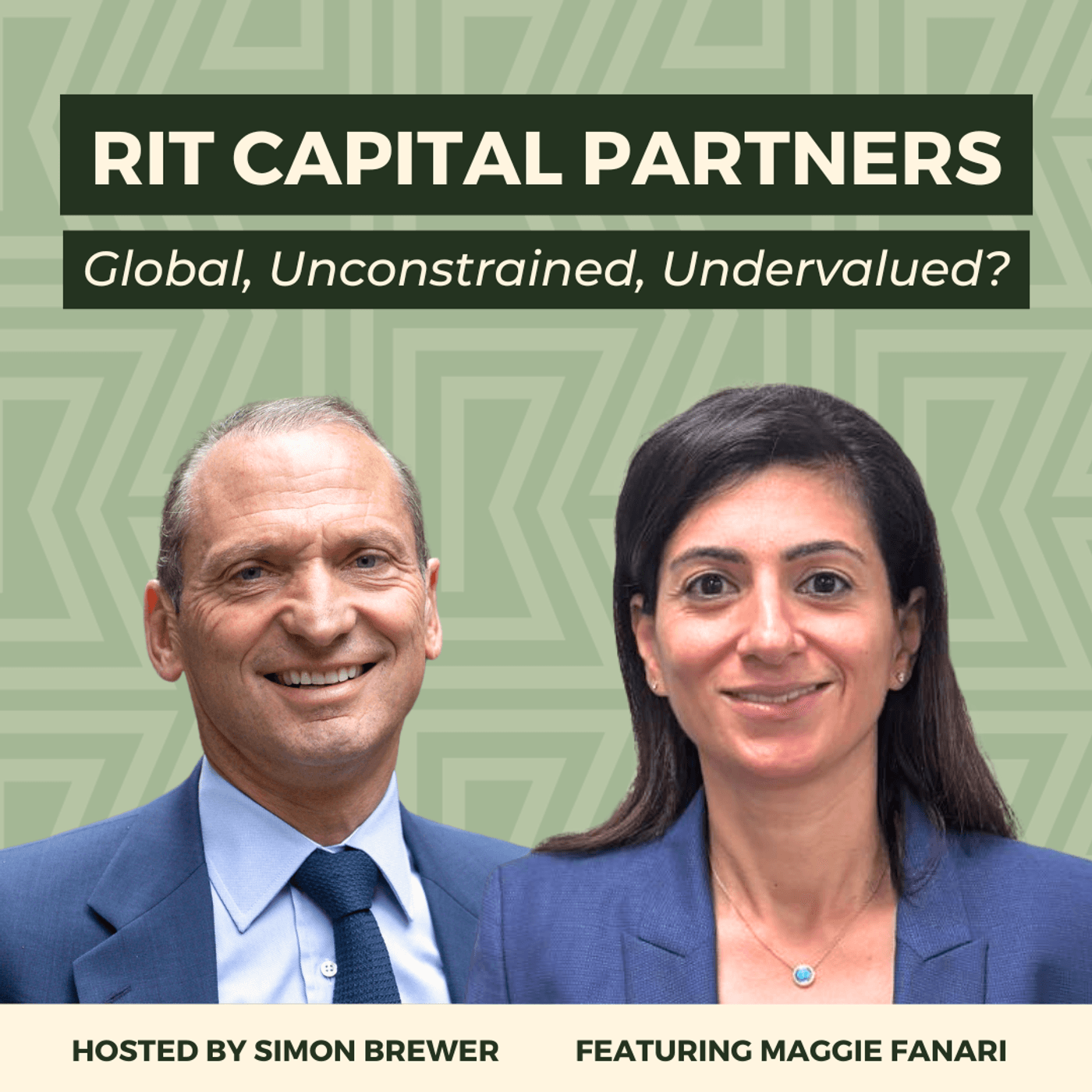
RIT Capital Partners’ strategy and discount, led by CEO Maggie Fanari of Jay Rothschild Capital Management. The discussion covers RIT’s multi-asset, global, “unconstrained” mandate; benchmarks (CPI+3% style capital preservation plus an equity growth benchmark); permanence of capital; portfolio mix (public equities, private investments, hedge funds/uncorrelated strategies, public credit); currency hedging; and how the board plans to narrow RIT’s ~30% discount via buybacks and performance.
Guest backgrounds
Maggie Fanari grew up in Ontario, studied finance/accounting, started at KPMG, then spent nearly 20 years at Ontario Teachers’ Pension Plan, leading a high-conviction equity group (concentrated <30-name global portfolio) and investing across public markets, venture/growth, private equity, and emerging markets. She moved to London ~10+ years ago and is now a British citizen.
Key claims
RIT has grown NAV over a decade by 100%+ with lower risk than equities; flexibility lets it stay invested long term and adjust tactically (e.g., more uncorrelated strategies in Q1 volatility); it hedges about half currency exposure; it prefers public credit over private credit to avoid illiquidity; and it has strong realizations (about 25% of private portfolio over 18 months).
Notable examples
SpaceX (early fintech and AI exits; SpaceX now in portfolio); Epic Systems (healthcare enterprise software); China allocation increased in Q1 last year despite divestment trends; China exposure is ~majority of ~9% emerging markets; realizations include exits tied to fintech and AI themes; share buybacks exceeded 10% over two years.
Written by AI. May contain mistakes. Listen to the episode to check what was said.
Chapters
Tap a time to open that second in VOIntroduction to RIT Capital Partners
0:00 to 1:12
Learn about RIT Capital Partners and its investment strategies.
“It's really around the Rothschild family.”
Maggie Fanari's Background
1:41 to 2:47
Maggie discusses her journey from Canada to becoming CEO at RIT.
“Originally serving as a vehicle for the Rothschild family wealth, when the late and revered Jacob Rothschild took control in 1988, he transformed RIT into a publicly listed investment trust.”
Board Role and Leadership at RIT
2:47 to 7:22
Maggie explains her board role at RIT and the philosophy behind it.
“Maggie, welcome to the Money Maze podcast.”
Board Role and Leadership at RIT
7:33 to 8:23
Maggie explains her board role at RIT and the philosophy behind it.
“And it's not just your portfolio that may benefit from gold.”
RIT's Investment Objectives and Strategies
8:23 to 11:00
Maggie shares RIT's current identity, objectives, and benchmarks for investments.
“That's what IFM Investors has built up over 30 years.”
Navigating Public and Private Investments
11:00 to 14:00
Discussion on balancing public and private investments to optimize growth.
“So I sit on a couple of investment committees.”
RIT's Investment Philosophy and Private Exits
14:00 to 16:33
Explore RIT Capital Partners' approach to investments and recent successes in private equity.
“It's really around the Rothschild family.”
Understanding RIT's China Exposure
16:33 to 18:29
Learn about RIT's long-term investments in China and strategies in emerging markets.
“And it's really been across three themes.”
Emerging Market Strategies and Diversification
18:29 to 21:13
Delve into RIT's strategy for allocating assets in emerging markets, including Vietnam.
“So let's pause on that emerging market allocation, which I see from your most recent report is circa 9%.”
Public Credit vs. Private Credit
21:13 to 21:39
Discuss the differences and RIT's preference for public credit investments over private credit.
“In part, going back to your question, we can get wonderful returns from our credit opportunities without the illiquidity that we've seen through private credit markets.”
Show all 19 chapters
Public Credit vs. Private Credit
21:53 to 22:58
Discuss the differences and RIT's preference for public credit investments over private credit.
“LSEG is where ideas meet capital, enabling sustainable growth and opportunity.”
Currency Exposure and Investment Risk
22:58 to 28:00
Examine RIT's currency strategies, hedging practices, and risk management.
“Remember, capital is at risk with investing.”
Positive Returns and Shareholder Engagement
28:00 to 29:15
Learn about the strategies leading to positive returns and increased shareholder engagement.
“returning strategies are all generating very positive returns.”
Family Capital and Investor Composition
29:15 to 31:04
Discover the impact of family capital on investments and the types of investors sought.
“We have a very rigorous process around how we value our private assets and we do that twice a year.”
Team Dynamics and Investment Strategies
31:04 to 33:44
Explore the changes in team dynamics and strategies for investment protection.
“Who else can buy it but isn't that you would like to see on your register?”
Cultural Shifts in Investment Firms
33:44 to 35:09
Understand the cultural evolution within RIT and its implications for the organization.
“you've selected the right assets, but top down that you've constructed the right portfolio that truly delivers what we want to deliver for our investors, which is the best risk adjusted returns.”
Improving Investor Engagement
35:09 to 38:25
Learn about the tools and strategies used to enhance investor engagement and transparency.
“What have you wanted to do with the culture of the organization and how have you done it?”
Advice for Young Investors
38:25 to 39:22
Gain insights on career flexibility and the importance of exploring various sectors.
“My most important daily habit is reading the news.”
Navigating Adversity in Investment
39:22 to 41:15
Hear about dealing with adversity and the importance of mentorship in investment careers.
“How have you dealt with adversity when it struck you?”
Transcript
Automatic transcript. May contain errors.0:00It's really around the Rothschild family. Jacob set up this firm to last for generations to come, as you noted, to compound wealth. SpaceX is one of the most highly coveted private investments in the world. SpaceX is now also in our portfolio. We were very early in fintech. We also were exposed to the AI theme, so we had a couple of exits there as well. And over the last 18 months, we've been able to realize about 25 % of our private's portfolio. When everyone was looking to divest or sell out of China last year, in the first quarter of last year, we increased our allocation to China, and that's done very well.
0:44The U.S. will always be a core market to us, but we are seeing interesting opportunities in places like Europe and elsewhere. where my principal piece of advice is don't assume that the job that you start with is going to be the job that you continue on with. And it's actually very important, I think, very early in your career to be able to invest or look at very different sectors and opportunities to really find out where your passion lies.
1:12Maggie Fanari:Welcome to the Money Maze podcast. If this is your first time joining, I'm your host, Simon Brewer. Quick word before we start. 95 % of viewers aren't subscribed, so miss out on future interviews with top business, finance and industry leaders. To support the show and ensure we can keep sharing high quality content, click subscribe and please drop a like. Plus, if you have any future guest ideas, do share your suggestions in the comment section below. Otherwise, thank you for watching and listening and enjoy the show. Originally serving as a vehicle for the Rothschild family wealth, when the late and revered Jacob Rothschild took control in 1988, he transformed RIT into a publicly listed investment trust.
1:56Maggie Fanari:It was rebranded as RIT Capital Partners PLC with a mandate to preserve and grow capital across generations through a multi-asset, global and unconstrained strategy. Over time, RIT evolved into a family office-style investment trust, blending public equities, private investments, hedge funds and uncorrelated strategies. But time is not always your friend in the investment business, and when the principal and luminary with immense reach and investment acumen retires, the sceptical voices can grow. When this is compounded by a 30 % discount to its net asset value, it seemed a good time to examine RIT, one of the UK's largest investment trusts, with assets of over£4 billion.
2:38Maggie Fanari:To discuss this, we welcome today Maggie Fanari, CEO of Jay Rothschild Capital Management, the investment manager of RIT Capital Partners. Maggie, welcome to the Money Maze podcast. Great. Thank you, Simon. Delighted to be here. Well, unmistakable Canadian accent I hear, and we have had a conversation ahead of this, but I think you have quite a cosmopolitan background before that. Tell us a little bit about from where you herald. Yes. So I grew up in Ontario and went to university there. I studied finance and accounting at the time. I made my way into accounting first because I actually couldn't decide if I wanted to go into finance or accounting.
3:22So I started at KPMG. I had a brilliant time there. I went into accounting. I did some corporate restructuring while I was there, but I really wanted to be an investor. I found and ultimately found my way to Ontario Teachers, which is, for those that don't know, it's a$260 billion Canadian pension plan, very much focused on the direct investing model for Canadian pensions. And it was a fabulous place for nearly 20 years where I was able to invest across public markets, venture and growth, private equity, and really also be very much an international investor, investing in places like emerging markets such as LATEM, Europe, North America and Asia.
4:18and then ultimately about more than 10 years ago, I had the opportunity to move to London, which has been great. So not only Canadian, but today a British citizen as well. I've made it home for myself and really to help them build out the European business for Ontario teachers as well.
4:38Maggie Fanari:Let's just pause on Ontario teachers. We've had Joe Taylor, the CEO on the show a couple of years ago, which was a very interesting conversation and you appear to have had a lot of exposure through the asset classes. But what I particularly focused on when I was doing my research was that you led the high conviction equity group. High conviction means different things to different managers. So that was just north of a$12 billion public markets portfolio for Ontario teachers. And high conviction is exactly what it means. That was a highly concentrated portfolio of less than 30 names in public stocks around the world.
5:17And that portfolio over time, there were actually a number of strategies within it. And it was really concentrated into one portfolio, high conviction, very long term, with the USP around that portfolio really being sector expertise.
5:32Maggie Fanari:And did you find reflecting on that, and given the immense difficulty in global equities of active outperforming passive, that it was a strategy that you felt succeeded? Yes. At the time I was there, it succeeded. It made a lot of money for Ontario teachers at the time. Got it. So in 2019, I think you get onto the, or you were asked to join the board of RIT. So you start to see the business in operation before you took over in March 2024. Why were you tempted? Well, actually, my association with RIT goes back well before joining the board. As I had noted earlier, Ontario Teachers is a pension plan.
6:20And at the time, I was running a special situations team with a very global mandate to go out and find opportunities in businesses where you were very much focused on capital preservation or downside protected transactions with asymmetric upside. And that's really what RIT is very much known for as well. And I kept bumping into them in my deal flow, whether it was interesting investment opportunities in North America or in Europe or in Asia. So I got to know the team quite well. And in 2019, they ultimately asked me to join the board, which I did. Its ethos is very similar to the investment philosophy I was used to at Ontario Teachers.
7:10And there was an opportunity in 2024 to come in and support the team and company at a time of management transition. And I was happy to do it.
7:22Maggie Fanari:So before we continue this conversation, we're going to take a short break to have a note from our sponsors. I'm thrilled to share that the Money Maze podcast is sponsored by the World Gold Council. They champion the role gold plays as a strategic asset through expert research, commentary and insights. And it's not just your portfolio that may benefit from gold. Learn how gold mining is supporting female economic empowerment and small businesses via their new documentary series called Gold, The Journey Continues. Tap the link in the show notes to start watching. IFM Investors is a global asset manager, founded and owned by pension funds with capabilities in infrastructure, equity and debt, private equity, private credit and listed equities.
8:06Maggie Fanari:They believe healthy returns depend on healthy economic, environmental and social systems. And these are evolving on a scale never experienced before. To find opportunity, build value and meet the needs of future generations, you need scale, skill and expertise. That's what IFM Investors has built up over 30 years. Just give us a sense of RIT's identity today. So its identity today is very much in the DNA of the firm that's nearly existed for more than 40 years, as you've noted. The DNA is really around being very entrepreneurial and finding the most interesting opportunities for shareholders that aren't easily accessible.
8:53So whether that's finding the best hedge fund managers, and oftentimes that's interesting and very successful individuals who are coming out of firms and were there very early to help support their businesses as one of their first investors. And oftentimes, we're one of the first calls. It could mean investing in great businesses that are very hard to access, such as our recent investments in SpaceX or in Epic Systems, which is a wonderful company. It's the leading enterprise software provider for healthcare slash hospitals in the United States. It could also mean finding the best hedge fund managers around the world.
9:42And that ethos and that DNA is very much still within our firm. And that's because of the flexibility we have in our investment mandate. But it's also because of the vehicle we have, which is permanent capital.
9:55Maggie Fanari:Yeah. So we're going to talk about all of those and more. I'd like to start with the investment objective. Many years ago, I remember sitting in a meeting with the founder of Allborn who said, if you don't have a benchmark, prepare to be hit by the arrow whose name is hindsight. Now, your benchmark is CPI plus 3%, which most people in the business thinking about preserving real wealth would accept as being legitimate. Your asset allocation is multi-asset. Do you think that's the right benchmark still? So actually, we have two benchmarks. One is more of a capital preservation benchmark, such that we earn an appropriate risk-adjusted return for our shareholders.
10:43And the other is an equity benchmark, such that we're also capturing sufficient growth for our investors. But what that ultimately ensures is that we earn an appropriate risk-adjusted return for our investors. So we've been able to grow our NAV over the last decade by more than 100%. And we've done that with lower risk than equity markets.
11:04Maggie Fanari:So I sit on a couple of investment committees. I was on one this week where Mercer's made a very credible presentation on optimizing the mix for the objective of the mandate. How do you think about that mix, given those benchmarks? And how flexible do you want to be? So we want to be flexible and that flexibility affords us, along with the permanence of our capital, affords us to be able to stay invested long term in our highest conviction opportunities. So that means that we don't have to sell them should something change in the market. But it also gives us the flexibility to be able to be a bit more tactical around our portfolio and to think about the different types of risks in the portfolio that might develop when the market changes.
11:54And then we can decide whether we want to mitigate those risks. So that could mean that we look to increase our allocation to uncorrelated strategies, such as our hedge fund program. it may mean that we choose to be more bullish in equities and add to our equities exposure, or at times we might choose a more neutral positioning like we have today. And it's really as we look over this year, where we've seen a lot of volatility, in the first quarter of the year are uncorrelated strategies, which is really designed to provide a steady return for investors. So what does that include? It includes things like credit, market neutral funds, macro funds actually looked out to outperform our equity benchmark at the time.
12:41It's just designed to provide a steady level of returns for investors.
12:48Maggie Fanari:So in talking to some people ahead of this interview who know you in the vehicle, one was Mark Wallace, who's the senior managing director over at Rothschild. the other Rothschild, Rothschild & Co, where I'm a senior advisor. And he said there's a lot to like about having privates and publics in one evergreen vehicle. How do you think about capital allocation between the publics and the privates? So it does wax and wane. I would say a couple of years ago, we probably had more privates exposure than we've had historically. So we've been actively looking to reduce our private's exposure, really anywhere between 25 % to 30 % of our portfolio.
13:30Fundamentally, I believe that that gives us the right flexibility, but also captures the appropriate amount of growth for our investors. And when we think about private assets, that part of our portfolio is really designed to capture growth.
13:47Maggie Fanari:So in reading your materials, you refer to the unrivaled network that you have. Now, a cynic would say, well, Jacob Rothschild's had an unrivaled network. Why do you think you still have an unrivaled network? So it's a great point. It's really around the Rothschild family. Jacob set up this firm to last for generations to come, as you noted, to compound wealth for generations. and as a result of that, the DNA of the team is very much that same ethos of being really good partners to our partners. And people really want to work for us. The brand opens any door for us. You know, SpaceX is one of the most highly coveted private investments in the world that was a company I knew very well from my time at Ontario Teachers and when I came to RIT, SpaceX is now also in our portfolio.
14:52We have the opportunity with our existing fund partners who are massively oversubscribed. Every time they want to raise a new fund, they are significantly oversubscribed, yet we always get our allocations with our partners and we've been investing with new partners as well. But it's really that ethos around the brand and the heritage and the way that we engage with our partners, which is really a two-way street.
15:21Maggie Fanari:So it's pausing on the privates because you obviously make these direct investments in private companies. We know there's a lot of congestion, to be euphemistic about the world of PE. Is your preference to go direct or do you blend it with a number of private equity managers who you think have the edge? We have very much a partnership driven approach. So we really look to invest alongside our partners. So we want to invest with the partners who see the best deals, are able to pick the best deals and invest in the best companies through a cycle. And then they show us some of their best opportunities.
16:01And we invest and we invest alongside them. And this year, as you noted, I mean, there's been a lot of discussion around DPI and also that private equity exits have been muted. We've actually had the opposite view. We've had one of the best years in terms of realizations this year. we've realized close to 5 % of our balance sheet in privates, nearly 175 million in realizations. And it's really been across three themes. So we were very early in fintech. So we've had a couple of exits there. We also were exposed to the AI theme. So we had a couple of exits there as well. So we've been quite fortunate from that perspective.
16:52And over the last 18 months, we've been able to realize about 25 % of our private's portfolio.
16:58Maggie Fanari:Got it. At or above valuations to our carrying values. Okay. Well, again, one of the other folks we talked to, and you know him, Nick Lawson, who's the founder of OceanWall, very impressive boutique investment bank, said you have some great China assets, you have some great space assets. And let's just talk about the Chinese or the China assets in a world that has bifurcated views about whether you can or can't or should or shouldn't or will or won't. Tell me a little bit about your China exposure. So we've been invested in China for a very long time. I mean, we were very early to think about globalization.
17:35So for us, we've been invested in China for more than 15 years. We tend to do that through specialist managers in the region such that we don't need to open offices and put boots on the ground. So we identify and we do it in a very concentrated way. In our view, we identify two of the best managers where we can also have a strong two-way dialogue with those managers. And we look to invest and benefit from their insights. And then we also look to make some direct investments on our balance sheet. And with respect to China, yes, when everyone was looking to divest or sell out of China last year, in the first quarter of last year, we increased our allocation to China.
18:25And that's done very well. That's done very well for us this year.
18:29Maggie Fanari:So let's pause on that emerging market allocation, which I see from your most recent report is circa 9%. I think at Christmas, we had the EM as an asset category trading at a 50-year low to the S &P 500. And those of us with a certain persuasion were saying, hang on a second, you know, this creates opportunity. Of the nine, how is the nine made up? The 9 %? How much is China and how much is other parts of the emerging market universe? So the majority of it is in China. Okay. And what, when we think about, because you have this fantastic playing field, potentially, which is also, you know, creates dilemmas because there is opportunity everywhere.
19:11Maggie Fanari:Talk me through what would get exposure to Vietnam, Indonesia, Singapore, you know, into the committee and then the steps that would lead to making an allocation that makes sense. So it's interesting you say Vietnam. I mean, these are the conversations that we're having in our investment committees. And if we think about markets like Vietnam, the way that we would think about our exposure more broadly in EM, maybe that we don't look at Vietnam standalone, but we think about that more broadly as part of our EM exposure. And in that case, we would really look to think about who are the top EM managers around the world, who's very specialized in that area.
20:04And then we would look to have conversations with them. The good news is over our more than, you know, close to 40 year history, we have been in places like Brazil, like EM. So we do have longstanding partners within our network that we're easily able to call up and say, look, you know, can we invest alongside you?
20:26Maggie Fanari:So as I went through your research and papers, I was nodding quite a lot. And then I came to this comment about credit. And you, maybe not you, but it was written credit is less correlated to equity. And you've obviously already mentioned that you have exposure to credit. We just did an episode with Hugh Van Steenis and Olivia Wyman on the credit boom, the private credit boom. And I'm there going, you know what, when really difficult times occur, credit behaves like equity with less liquidity. And so I just want to tease you out why you think it's sort of is helping in the diversifying camp of the portfolio.
21:03So I will clarify, our exposure is to public credit, and we have not actually gone into private credit. In part, going back to your question, we can get wonderful returns from our credit opportunities without the illiquidity that we've seen through private credit markets. And actually, as I noted earlier in the earlier part of this year and continuation of this year, our credit managers have been able to deliver uncorrelated returns to the markets.
21:39Maggie Fanari:So before we continue this conversation, we're going to take a short break to have a note from our sponsors. I'm excited to announce that the Money Maze podcast is sponsored by the London Stock Exchange Group known as LSEG. At the heart of the global economy, LSEG provides data, analytics, and infrastructure that connects investors, businesses, and economies. LSEG is where ideas meet capital, enabling sustainable growth and opportunity. Tap the link in the show notes to learn more. Schroeder's Capital is the private markets division of Schroeder's, combining the experience of specialized local teams with the scale, rigor, and resources of a global institutional platform.
22:21Maggie Fanari:Schroder's Capital provides its clients with global access to differentiated and specialized strategies encompassing all private markets' asset classes, from private equity to real estate, infrastructure, and the broad universe of private debt and credit alternatives. This approach enables Schroder's Capital to access opportunities and investments that are often difficult to find elsewhere, while also having the broad capabilities and perspectives needed to build holistic solutions and deliver tailored outcomes across private markets for both institutional and wealth clients. Discover more at schroderscapital.com.
22:58Maggie Fanari:Remember, capital is at risk with investing. The other area that, again, I paused on, this is a sterling-denominated vehicle. 53 % of your post-hedged currency exposure is in sterling. You pointed out to me the other day that you do hedge back. 32 % circa is still US dollars. Now, we know that ultimately no currency, with the exception perhaps the Swiss franc, has held its value. And right now, the collective finances of Western governments are more parlous than ever. So we should expect continued currency erosion. And the US dollar seems to have an administration as well that would quite favour that.
23:37Maggie Fanari:Is that carrying actually quite a lot of risk in a world where the Norwegian grona offers fantastic value versus purchasing power and the dollar looks pretty precarious? So we're not looking to take an active bet with our currency exposure. So we do hedge half our exposure. And that's roughly been consistent for several years now, Simon. So in some years, like this year, we will have a negative translation effect to our portfolio. And then in other years, it'll be neutral to positive. So actually, over the last few years, our currency impact to our portfolio has more or less been neutral. So it's important to take a longer term perspective around how we think about hedging our portfolio.
Read the full transcript
24:31That being said, another active discussion in our investment committee is now we do have to think about if we find a really fantastic investment in the US, how do we want to think about the potential currency impact around that? And what we have been doing, and there have been other opportunities that have really become available over the last 12 months, the U.S. will always be a core market to us. But we are seeing interesting opportunities in places like Europe and elsewhere. So we've been diversifying further away from the U.S. We've also increased our gold exposure in addition to maintaining our views on the currency, which is to hedge roughly half of our exposure.
25:16Maggie Fanari:Okay. So one of the other developments in the investment industry has been the co-investment theme. I was chatting to Sean Kapskick, who's the CEO of Counter Fitzgerald, but in a previous world had dealt with you at Ontario Teachers. And he said you were very keen and quite early in really trying to cherry pick some of the really interesting ideas a manager might have and then invest on that or with that idea. Has that been something you've carried on that you do actively? Is this the destination of travel for both you, do you think, and parts of the industry? So I can't speak to parts of the industry, but I think that partnership approach and being able to have that right dynamic with your partners is definitely very core to the way that I've invested over for more than 20 years, but also to core to the DNA of how RIT has been investing almost since inception as well.
26:20Maggie Fanari:Yes, I would say from my observations, it is happening more. I've seen it at Campion Capital, who we know very well, and I've seen it at Lansdowne have a new vehicle as well, where that's a likely way in which they expect it to expand. Let's talk about performance, which of course will bring us to the discount. You've got great long-term numbers, but that's the benefit of having some fantastic earlier years as well. We all know the performance game. and yet not alone in the UK market. And we are expecting to have Bill Ackman on at some point. He's agreed in principle, Pershing Square Trades is a 30 % discount.
27:00Maggie Fanari:You're at a 30 % discount. How do you reflect on that firstly? And secondly, how is the board thinking about everything that's in your power going forward to improve it? Well, it is a top priority for both the management team and the board. The immediate thing to do is to buy back our shares. So we have, over the last two-year period, bought back more than 10 % of our portfolio. We continue to do that. But also to performance. performance comes into play. This year, actually, we just reported our results earlier this week. Year to date, we're at a 7.5 % return. All three of our investment pillars are said differently.
27:56Our public markets investments, our private market investments, and our credit and absolute returning strategies are all generating very positive returns. And part of the discount has been impacted by private investments. But what we've been able to demonstrate is that not only do we have positive returns because of some of the recent rounds that have taken place around some interesting companies like OpenAI and so on, but we've also had very strong realizations. So if I I think about are we in the best quadrant we could be for investors, which is positive returns along with positive realizations.
28:41That's exactly where we are. And we've been able to demonstrate that over the last 18 months. But a good amount of narrowing the discount is linked to performance. But it's also linked to our ability to engage with shareholders. and we've made significant investment over the last 18 months really to engage with our shareholders through being a lot more transparent in how we present information and get information into the hands of our shareholders. We have a very rigorous process around how we value our private assets and we do that twice a year. We have a number of internal checks and balances that's on our website, that's in our audited financial statements.
29:31So everyone can openly see what our process is in and around that. And what we've actually found over time is over the last decade, we've had generally a 23 % markup to our private company valuations. And then more recently, this year, that number has been accumulatively somewhere north of 100%.
29:55Maggie Fanari:So I did actually go and look at not just your most recent monthly fact sheets, but then I went back several years and I can actually see the disclosures have improved. And for somebody who looks at these things quite a lot, it was very comprehensible and accessible. The thing that you've mentioned, which does make you very different, is this family capital that is particularly permanent, or at least would appear to be. Just tell us a little bit about, refresh us, is it 20 % of the NAV and what that means to you? So it's more than 23 % of the NAV. It is a substantial portion of family wealth, in addition to, alongside many of our other shareholders as well.
30:44Maggie Fanari:And then that begs the question of your other investors. I mean, this has been a very, it's been a largely UK audience, I imagine, over the years for all sorts of reasons. That was the investment trusts. There's a lot of global capital. We've had Bose Weinstein coming in, you know, after some of these investment trusts. We've featured Serafim and IP Group and talked about their discounts, et cetera. Who else can buy it but isn't that you would like to see on your register? So who else we'd love to see on our register is it is a multi-asset class vehicle. It's very much focused on the long term with the idea of building a portfolio that's resilient across various market cycles, Simon.
31:26So other long term investors that this vehicle is ideally suited for would really be endowments, other endowments, very long term minded investors who are looking for a similar return profile that we offer.
31:39Maggie Fanari:we haven't spoken about the team um i know you brought a number of people in as well to help you just give us a sense of you know how that team's changed and and you know how you deploy your troops so we have we have had change on the team we we also have a very the new people that i've been able to bring on to the business and i do think you know if i take a step back one one of the core one of my core priorities is always to be on the lookout for great talent and to be able to bring that into the business. So we've been able to bring on a couple of people, including by former employer and a number of very large institutions to join our firm and complement a team, in many cases, who have been there collectively for more than a decade working together.
32:30The team's job day in and day out is to ensure that we understand the nature of the investments that we have in our portfolio, but also to scour the world globally to find the next exciting investment for our investors that isn't easily accessible to everyone else.
32:53Maggie Fanari:You talked earlier on a little bit about the ethos of RIT being downside protection. protection just talk a little bit about tail protection risk about strategies that you either put on or don't put on beyond asset allocation to think about that so we do i mean we have other hedging strategies so at times we will think about tail hedging in our in our portfolio if we have a view around certain certain market market risks we'll also change our allocation as we did in the earlier part of this year to be more neutral on our equities allocation at the start at the start of this year, we will think about if we've got too much exposure, if we're too concentrated to any one name in our portfolio, we will find ways to think about how we can reduce those exposures.
33:41So it's a very active conversation. And we really want to ensure that especially that bottom up, you've selected the right assets, but top down that you've constructed the right portfolio that truly delivers what we want to deliver for our investors, which is the best risk adjusted returns.
33:59Maggie Fanari:and because you've seen the investment industry for a reasonable amount of time you cross the the playing field of assets how might the industry look in five plus years how different might it look from today's i think we're we're what we're already seeing today is um the growth of the alternatives business and more choice for private assets. And that's been ongoing for some period of time. And I think that trend will generally continue. Private credit has been ongoing for a period of time. And I think that that trend will continue. But really in the private space, you can see that that part of the market will grow.
34:47Maggie Fanari:And the other thing that we talk about with a lot of our guests is culture. Many of us who have observed RIT over the years would have said that it's probably quite established, maybe not Victoria, but it's quite an established, one would have thought, male-dominated culture that, you know, that had the signature of a principal born in a different era. You've come in, you know, very different. What have you wanted to do with the culture of the organization and how have you done it? Well, the culture of the organization, it's a great culture. So if I think about the values of our firm, I mean, it started with a very entrepreneurial founder and someone who is very forward looking.
35:32And being entrepreneurial is very much core to our values. values. The other is just that exceptional laser focus on performance. And that's exactly how we're set up as a team. And then the other one is really, when I think about values, is just collaboration and communication across the team. You never want to develop silos within your organization and we're small enough and lean enough to ensure that doesn't happen and actually that there are true synergies across the organization. Got it.
36:14Maggie Fanari:And on your LinkedIn bio and commentary, you said, I don't already see my priorities that drive returns. We discussed that. Enhance transparency. We discussed that. And drive investor engagement. And we've sort of touched on that, but I'd like to just understand a little bit more. What are the tools that are allowing you to improve investor engagement? It's really our outreach. So we've really brought in some great people in our investor relations and comms department. We've also retained an external firm to support us in external shareholder engagement through Kedarn. And it's really our focus and intent to be as visible and as accessible as possible.
36:57In about a month's time, we have a Section 793 call with retail investors. These are all things that we had not previously done before. And we've also been able to bring on some great investors onto our shareholder base as well. But it's really just being very disciplined and very consistent in our outreach.
37:18Maggie Fanari:Well, it's interesting because by the time this episode is released in October, you will have attended the Money Maze Allocated Summit at the Unstock Exchange over two days. And in fact, you are kindly joining one of the panels to talk about some of these key issues about how we think about engaging with managers and the discussions both in hiring and the difficult discussions in firing. So we will not talk about that because maybe we will repurpose that part of that particular interview. Just tell me who's not on the chessboard that you would like to be. So, I mean, what we've looked to do is really provide information in the hands of our investors to ensure that they understand our investment proposition, they understand what we own, and why we offer things that they otherwise can't easily get through more passive instruments.
38:05In terms of an RIT shareholder, as we also own private assets, we really look to people who have very much a long-term perspective. And as we're both global and diversified, RIT is very complementary to most people's portfolios. So whether that's long-term retail investors, endowments, or other institutions that are really looking to see returns compound over a long period of time in investment opportunities that they might not otherwise be able to get access to through more passive instruments.
38:44Maggie Fanari:What's your most important daily habit? My most important daily habit is reading the news. Okay. And I'm going to ask you, what are the most important? If there could be only one news source you would read every day, which would it be? The FT. Okay. We've got lots of young people listening to the show. We sponsored 10 university finance societies. I'm sure you're asked this as you travel, but what's your principal piece of advice for young folks thinking about the investment world and joining it? my principal piece of advice is don't don't don't assume that the job that you start with is going to be the job that you continue on with and it's actually very important i think very early in your career to be able to invest or or look at very different sectors and and opportunities to really find out where your passion lies right and connected with that not necessarily but often because we are lucky enough to interview lots of very successful people Most of them will have had the wind in their face at various times.
39:48Maggie Fanari:How have you dealt with adversity when it struck you? You know, it's really making progress one day, one day at a time and just tackling every issue. But just kind of taking, being grateful for the progress you make every day tackling that headwind. And did you have a particularly important mentor on your journey? And if so, what did they provide you with? I've had many, many great mentors over time. And the best piece of advice I've actually received is to trust your instincts. And that's very much carried me through my career. So I'm going to summarize because many of us who've been in the investment world, you know, understand that for all wealth, really, you know, preserving your real purchasing power and growing it is essential.
40:41Maggie Fanari:And it is difficult when you are dealing with, you know, currencies that whose governments are the architects of their continual erosion. And that may be, in my opinion, something that gets profoundly more difficult in the environment as governments deal with debt in this and they want to be reelected, which leads them down the path of least resistance, handing on problems to the next generation. This is a vehicle that is surviving, intends to survive with an extraordinarily important cohort of family wealth, doing multi-assets with, as you've explained, the ability to be both flexible in asset allocation, to use the network that is in part yours, but you know, legacy connections that give you opportunities and access, which is very valuable.
41:28Maggie Fanari:And today we have this, you know, you can view it as very, you know, very annoying 30 % discount. And there might be a lot of people out here who are listening and watching going, wow, that's an interesting opportunity. I, for one, invest globally. I do not at this point in time, you know, own RIT, but I am very intrigued. So we really look forward to speaking to you today. And thank you so much for coming and giving us your time. Great. Thank you, Simon.
From the publisher
As one of the UK’s largest investment trusts, with total assets of approximately £4bn (over 20% of which is owned by family members), RIT targets CPI + 3% as one of its benchmarks, aiming to meet those real return objectives for long-term wealth preservation.
In this conversation Maggie explains the asset allocation, where private assets represent 30% of the assets, public equities at 40%, and uncorrelated nearly 20%.
She discusses their approach to the asset classes, the network of partners that offers them unusual access, why Hedge Funds play an important role and how they look at currency exposures and hedging and to whom such an approach makes sense.
Finally, she assesses the 30% discount to NAV, which although part of a wider UK problem, might seem unusually compelling, and the actions they are taking to try to close the gap.
NOTE - This podcast was recorded in September 2025, and therefore all RIT data is provided as at 31/08/2025. Statistics cited in this description by Simon are all approximations and for general information purposes only. Please find RIT’s regulatory disclosures here. Money Maze Podcast disclaimer here.
The Money Maze Podcast is kindly sponsored by Schroders, IFM Investors, World Gold Council and LSEG.
Sign up to our Newsletter | Follow us on LinkedIn | Watch on YouTube