In short
“Tomorrow’s energy, from hope to hype to hard truths” at the Money Maze Allocator Summit 2025, covering climate/energy reality, rare earths and critical minerals, electrification, EV charging, power demand growth (including AI), and how “green agenda” investment intersects with defense, national security, affordability, and market structure changes.
Guests (backgrounds)
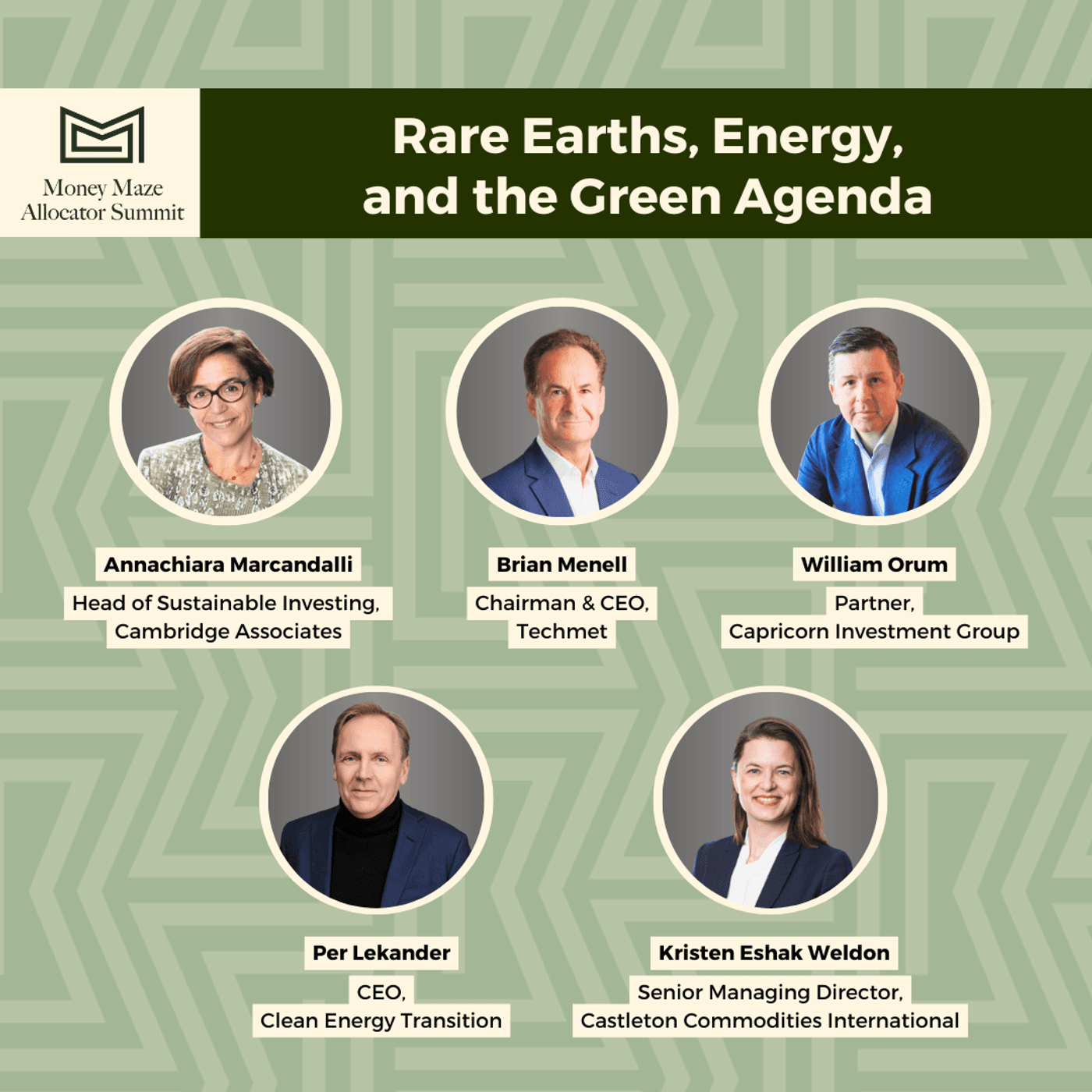
Anna Chiara Marcandale (Global Head of Sustainability, Cambridge Associates; moderator). Brian Mennell (Chairman/CEO, TechMet; critical minerals supply chain). Pair Likander (CEO, Clean Energy Fund; energy transition investing). Bill Orem (Partner, Capricorn; energy/transition investing). Kristin Ishak-Weldon (Senior Managing Director, CCI; institutional investing).
Key claims
2024 was the UK’s hottest year; ~25% of the world is water-stressed; energy demand is rising and AI could drive ~30x power demand in a decade. Critical minerals are central to batteries/wind/solar and also to geopolitical competition with China. Climate/transition risks are often underpriced due to investor time horizons and fund structures; nature/natural capital is neglected. Net zero is criticized as mathematically and practically “imprecise” without real carbon removal.
Notable examples
electricity prices up ~270% in some US regions; Germany’s evolving energy transition rationale; TechMet’s diversified “basket” across critical minerals and value chain; recycling could supply ~20–25% of battery metal needs in ~10 years.
Written by AI. May contain mistakes. Listen to the episode to check what was said.
Chapters
Tap a time to open that second in VOSetting the Stage: Tomorrow's Energy
0:40 to 1:30
Discussion about the state of the green agenda and the challenges ahead.
“The moderator was the brilliant Anna Chiara Marcandale, Global Head of Sustainability at Cambridge Associates.”
Climate Change: Facts and Statistics
1:30 to 2:40
Presentation of critical facts about climate change and energy demand growth.
“So we hope to keep you entertained enough.”
The Role of Critical Minerals in Energy Transition
2:40 to 4:30
Discussion on critical minerals and their importance in energy investments.
“Fact two, again, sort of going back to very interesting stats heard today, energy demand is growing everywhere.”
The Venn Diagram of Climate and National Security
4:30 to 7:50
Exploration of the intersection between climate investing and national security.
“this supposed Venn diagram of overlap between the people who cared about climate change and were investing in certain things.”
Energy Transition Economics and Historical Context
7:50 to 12:49
Discussion on the economics of energy transition and historical shifts in energy sources.
“but also to the argument around affordability and reliability.”
Pricing Climate and Transition Risks
14:00 to 17:49
Explore the challenges of pricing climate risks in investments and the disparities between the US and global markets.
“Well, I'm going to stay with you and ask the question.”
The Role of Nature in Investment
17:50 to 20:48
Discuss the importance of nature and natural capital in investment decisions and the current neglect by investors.
“It's like 4-5 % of GDP spent here in North America.”
Long-Term Strategies for Asset Allocation
20:49 to 25:56
Learn how long-term asset owners can strategically allocate capital to mitigate risks associated with energy transitions.
“Somebody said that you should have a climate change allocation or a energy transition allocation and across asset class.”
Infrastructure and Critical Minerals Investment
25:57 to 28:00
Analyze the need for dedicated investment in infrastructure and critical minerals for sustainable growth.
“But I think to your point about stagnating commodity demand, that's I completely agree with you with the exception of power, as you say.”
Opportunities in Critical Minerals Investment
28:00 to 31:26
Explore the pressing need for dedicated capital allocation in critical minerals and the implications for industries facing energy transition demands.
“If you can compound at 9%, you're going to ultimately be extraordinarily wealthy or very well positioned to meet your liability streams.”
Show all 16 chapters
Opportunities in Critical Minerals Investment
32:30 to 32:59
Explore the pressing need for dedicated capital allocation in critical minerals and the implications for industries facing energy transition demands.
“by the London Stock Exchange, a global leader in financial markets infrastructure.”
Navigating Climate Change and Energy Transition
33:10 to 42:06
Discuss the complexities of investments related to climate strategies and energy transition amidst the challenges of carbon emissions.
“it's been healthy to some degree in that I think for many years, folks like myself or peers would talk about climate change, as you said, as do you have a climate change strategy?”
Investing in Grid Resilience and Solar Energy
42:06 to 45:45
Discusses the importance of grid resilience and the potential of solar energy investments.
“I'm going to say three things, but they're related, so I'm not really cheating.”
The Role of AI and Energy Markets
45:45 to 46:24
Explores how AI innovation impacts energy prices and market dynamics.
“I think clearly a form of infrastructure around grid resiliency and services related to power generation.”
Energy Sources for AI Model Training
46:24 to 49:59
Examines the cost-effectiveness of different energy sources for AI training and usage.
“But this idea of grid resiliency and services related to the provision of power.”
The Future of Battery Recycling
49:59 to 51:18
Discusses the growth of battery recycling and its role in the energy transition.
“for critical minerals for a good number of years, but I'm interested in where our ability to recycle is going and is there even a time that we could be post-extraction for the energy transition?”
Transcript
Automatic transcript. May contain errors.0:00Brian Menell:In September, we held our inaugural Money Maze Allocator Summit. We gathered 120 global investors and allocators, many of whom have been previous guests, for two days of fascinating investment discussions. It proved incredibly popular, and much of that was a result of the quality of panels, moderators and topics. Over the next few weeks, we're releasing three of those sessions to share some of the perspectives. Sir Chris Holm on investing and philanthropy. We hope Todd Bowley on his investing philosophy. And today, a panel which was especially highly regarded. Tomorrow's energy, from hope to hype to hard truths, the state of the green agenda.
0:40Brian Menell:The moderator was the brilliant Anna Chiara Marcandale, Global Head of Sustainability at Cambridge Associates. The panel was Brian Mennell, Chairman and CEO of TechMed. Pair Likander, CEO of the Clean Energy Fund. Bill Orem, Partner at Capricorn. Kristin Ishak-Weldon, Senior Managing Director at CCI. The climatic changes challenging our world should not be in doubt. The responses, the consequences and the investment opportunities and risks are profound. It encompassed rare earths, electrification, power sources, uses and solutions, the EV charge, and the continued role of hydrocarbons, and much more.
1:23Brian Menell:So let's go and plug into the panel.
1:26Per Lekander:Hello, everybody. Thank you for making it to the end of the day. And we are between you and cocktails. So we take this very seriously. So we hope to keep you entertained enough. So So as ever, we're going to take everybody's bios read. There's a really impressive group of people in the planning call. We went on and on and on. I promise we won't. So we'll keep it very focused. The title of today's talk is about, you know, there's we went from hope to hype to hard truths. And as we get started, I thought, let's talk about some facts and then we can talk about opinions. But here are some facts that I thought would be useful to focus.
2:10Per Lekander:Well, one, and thank you to Professor Franco Pan this morning. It's sort of, gosh, interesting and also scared me. So fact one, 2024 was the hottest year in the UK. And the UK is the country that has the longest track record of tracking temperature. So, yes, we have a problem. And he also said 25 % of the world is already water stressed. So that's fact one. It's a fact. Fact two, again, sort of going back to very interesting stats heard today, energy demand is growing everywhere. And I think he said that AI is going to, AI's energy demand is going to be, in the next 10 years, is going to be a 30x.
2:57Per Lekander:Now, show me a private equity fund. Those sort of return, like 30x. So we are where you want to be 30 X, 30 X. And last. So climate change, real, not a hoax, real to energy demand growing at these crazy rates. Third fact, we heard a lot of talk today about market structures. And this is a place where market structures are changing like dramatically. Marginal costs of different types of energies have changed dramatically. And also, I didn't know anything about critical minerals before. I didn't even know that there were minerals that were critical. And now I'm going to pretend to know what that means.
3:43Per Lekander:so really we're learning about and that that's called a new market complete change in market structures so given that Chris Hahn told us that it's about competition market structure not really growth but I think growth matters too I think we're the best panel so you're in for a treat okay now that I hopefully got you interested I'm going to ask some questions and then ask all pounds to chip in. We got a very good dynamic going, so I'm sure they'll, and I'm going to start. Oh gosh, yes, I will. And because I just, I did talk about critical minerals. In discussions about sort of investing in energy, I heard last six months, because so much has changed, that there's this supposed Venn diagram of overlap between the people who cared about climate change and were investing in certain things.
4:40Per Lekander:And now in this new world that is all about defense and national security and different administrations doing different things, they care about these things. And there's a magical point in the middle in which these two things overlap. And here's my question. Do you think the Venn diagram, and we can go through, do you think the Venn diagram idea is a good idea, bad idea? Where's that magical center of things to invest in in which there's overlap between what we used to think about as the things that you needed to invest in for climate change and now this new world in which it's all about defense, resilience, national security.
5:19Annachiara Marcandalli:Brian. Thank you very much. I mean, from where I sit, which is purely focused on critical mineral supply chain security, luckily the overlap is very considerable, which is why we as Techmed have found it surprisingly easy to migrate to support and funding from the new administration in the US. And we are part owned by the US government from the last administration where we did a lot. You know, what we do or the critical minerals elements of the energy transition, the same metals that build out of which you build batteries and wind turbines and solar cells, happen to be the same metals which are absolutely crucial from a geopolitical balance with China point of view, from a point of view of national security and defense industries, and from a point of view more broadly of industrial competitiveness to drive growth and jobs relative to other competitors.
6:23Annachiara Marcandalli:And those other competitors are not just China, who obviously certainly in our industries have a massively dominant head start. but competition between the United States and Europe and Japan and South Korea and India and elsewhere. So we had no problem at all in terms of continuing to do what we do, which is invest in and build capacity to produce, process, refine, recycle lithium, nickel, cobalt, rare earth metals. with the outlook being both feeding climate change mitigation technologies, which are not stopping and which are continuing to drive demand growth globally, including in America, and the imperatives of national security, balancing China and industrial competitiveness and industrial protectionism in a more fractured world, which unfortunately is a reality of the environments in which we're working and investing and will be on and off with ups and downs for many years and decades to come.
7:25Per Lekander:You got to melt. Good. Kristen. Great. Well, it's the Venn diagram is something that I certainly have thought a lot about in my own personal journey, having come from BlackRock, where I was the pet of sustainable investing for alternatives to an energy merchant. And, you know, I can sit there and look at the middle of the Venn diagram and say with conviction that I still feel that I'm in the right place and a good place to invest. And as I think about all those circles, it's not just a Venn diagram, it's not just a couple of things on the page, but it's not only the focus on sustainability that we've had over the last really five years of post-COVID period, but it's also now moving not only to security and ensuring that we have access to all resources, whether critical minerals, but also to some fossil fuels still.
8:21Per Lekander:but also to the argument around affordability and reliability. And that also ties into the whole security dynamic as well. We think about the world that we're investing in. There's been a lot discussed today about AI and rising demand for power. But what hasn't happened today is a discussion on what that means for affordability of that energy. We're all focused on it from the perspective of Russia's invasion into Ukraine and what that did to our energy prices here in Europe and the UK, but no one's talking about what's happening to electricity prices, which are up 270 % in some regions in the US as a result of the state or state of demand.
9:03So I think that what that means is just
9:06Per Lekander:we're right at the centre of all the action. It is driving growth, but we have to consider all the different circles, not just the Venn diagram, to consider what's important as we make these investments.
9:18Bill Orum:I think one of the key things with investing is that you invest based on economics. You trade against politics. And it comes to my mind this with, I think it was Benjamin Graham, who said that in the short run markets are voting machines, and in the long run they are discounting machines. And the discounting machine, I would argue, has marginally changed. It has changed on the element of, of course, that kind of domestic content. We don't want to be reliant on Russia and on China. So we don't want to have a supply chain, which is entirely imported. That has changed. Otherwise, I would claim nothing has changed.
10:04Bill Orum:We are in a massive energy transition. And just to put it in context, because somehow people think that everything is political here, I would claim that we have been in energy transition for the last 250 years. The first one was 19th century from wood to coal that drove industrial revolution. Then we went from coal to oil and that drove kind of consumer economy. We could have cars and we could have delivery into shops. And for the last 30 years, we have been from oil into power. We want to consume power because power is much more flexible. It allows for IT and everything. And we are in the middle of that.
10:51Bill Orum:And that has not changed at all, in my view. That's driven by economics. And economics means that two thirds of it is roughly coming from renewables, backed up by some other stuff, but we are on the margin taking more considerations to these issues. I'll give one example. Germany has arguably been the country which has gone longest and most intense on energy transition. It was originally justified as nuclear face-out. It was then justified as climate change. And now it is justified by eliminating dependence on Russia, but it's the same thing.
11:40Brian Menell:Yeah, I mean, look, the only thing that I could add to what was said is, you know, Venn diagram implies, you know, a smaller TAM, right? A smaller investable universe. And I think, in fact, what's occurred over the last few years is a recognition of the intersectionality of a lot of these issue areas as it relates to power prices. resource scarcity, their impact on many of the most vulnerable nations and populations. And so in our world, coming from a very pure climate lens, for many years when we started the company, we felt like we were out in the desert and really only interacting within our own eco-chamber.
12:23And I think what we see today is a much more robust set of actors, much more technically capable set of actors that bring skill sets from the quote unquote traditional
12:38Brian Menell:markets and a much stronger recognition of just how broad based the impact of this energy transition will be across virtually the whole economy. So before we continue this conversation, we're going to take a short break to have a note from our sponsors. IFM Investors is a global asset manager founded and owned by pension funds with capabilities in infrastructure, equity and debt, private equity, private credit and listed equities. They believe healthy returns depend on healthy economic, environmental and social systems. And these are evolving on a scale never experienced before. To find opportunity, build value and meet the needs of future generations, you need scale, skill and expertise.
13:24Brian Menell:That's what IFM Investors has built up over 30 years. In times of economic and geopolitical volatility, investors will look to gold. Today, as the world navigates uncertainty and heightened risk, investors of all sorts will look to safeguard their wealth. We're thrilled to welcome the World Gold Council as one of our sponsors. Tap the link in the show notes to learn more or visit goldhub.org on your browser for comprehensive research, insights and analysis on the global gold market.
13:59Great.
14:00Per Lekander:Thank you. Well, I'm going to stay with you and ask the question. We talked about risk today. Do you think that there's a bunch of asset allocators here in the room? Do you think that climate risk and or transition risk is appropriately priced?
14:19Brian Menell:I think there's a there's a fundamental challenge with it being appropriately priced, which which in large part stems from the time horizon of many investors. Right. I think very long duration risks are difficult for for many asset owners to price because of incentive schemes, fund structures, et cetera. So we haven't created the right constructs for certainly fund managers, let alone asset owners, to kind of price that. I think you certainly are seeing in the U.S. insurance markets starting to price the physical risks in a much more significant manner. And that insurance does tend to have a disproportionate impact on pricing mechanisms throughout an economy.
15:02Brian Menell:And so I think for better or worse, I don't think it's a good thing that that's how it's flowing through, but it'll clearly flow through in a much more powerful way. I think investors are almost certainly underpricing the very real risks of obsolescence and disruption. We're seeing it, again, most pronounced because of what's happening in power markets and data centers and AI. But I think there are business model risks, obviously supply chain risks that only now are starting to become more widely recognized by your traditional asset owner investment manager, which really hadn't been priced for a long period of time.
15:49Fair.
15:50Bill Orum:So I think in energy space, there is a difference between the US and the rest of the world. I think it's underpriced in the US I think it actually is quite priced in the rest of the world I'll give an example if you compare Shell and Exxon historically Exxon was a much more profitable company but now if you look on operating metrics they're actually very very similar valuation difference is 2 to 1 if you just go into I think the textbook says that the share price should be the mpv of all future cash flow if you apply that approach um you uh you can't justify share price here if you have reasonable assumptions if you hold it until you die you're going to make money because it generates too much cash i think another example of it where i think it's less geographic but i think on autos is another example of it um i think it's enormously hard to justify auto valuations from the same DTF framework.
17:00Bill Orum:You have, the market is clearly assuming that this, there is a significant chance of that these companies are toast. So, so I, you know, we got this, this question sent to us, and I was thinking of it. And, and off the cuff, I would have answered the opposite. But then I started to look at it and I realized actually a lot of it is priced. But I do think that in the US energy sector is not priced at all. And that makes me want to make another comment on the side of this. That I think the real, the energy transition is proceeding globally. The laggard is North America. South America, Africa, Asia, etc.
17:53Bill Orum:It's progressing. It's like 4-5 % of GDP spent here in North America. And both US and Canada, it is way less.
18:04Per Lekander:I told Pear to be controversial. Go. And while we have the questions, we don't know what anyone's going to say. So we can react to it in real time. I think we can further segment what you said in terms of regional and also sector in terms of what aspects of the transition are being priced in. And I think one area that's neglected largely by investors is around nature and natural capital. So I know we're talking about energy here, but the role of nature and the degradation that we're seeing of nature is of significant costs to society, but also very materially to GDP. And that's not really being priced in.
18:46Per Lekander:And I do think what Bill said is absolutely spot on in terms of insurance space is starting to recognize that and seeing the interplays between nature and energy in terms of consumer products, all different parts of daily life. But broadly, investors are not adequately pricing that in.
19:05Annachiara Marcandalli:again i apologize for the narrowness of my perspective but from a purely metals mining industry point of view both climate change risk from an operational perspective be it with respect to water sources or domestic social stability in the face of desertification and other consequences of climate change is radically underappreciated and under discounted or not adequately priced into projects. From a point of view of our industry at the funding level, be it listed companies or in the private space, such as where we sit, again, utterly naive on the part of the markets with respect to risk and opportunity, both from the point of view of the valuation of large diversified listed mining companies who are conservative, unimaginative and bureaucratic and completely missing out on the value upside potential of this massive supply demand dislocation and transformation necessary transformation of industry that were the beginning of and with respect to periodic bubbles of overvaluation that we're starting to see again with some rare earth companies in the us which again are completely irrational with respect to an actual understanding of risk, value, and opportunity as this critical minerals dislocation unfolds.
20:33Per Lekander:It's not narrow at all. It's critical. Different. All right. I'm going to start with Kristen now. How do you think long-term asset owners can allocate their capital to protect themselves? If there are all these risks, what should investors do? How should they allocate? Somebody said that you should have a climate change allocation or a energy transition allocation and across asset class. I'm going to throw that idea. Somebody said that. I don't think that's unreasonable. And you certainly see that across a lot of the larger institutions. And I'm sure in your role, you specifically see that. One of the comments that resonated with me from this morning, the first panel on private markets, was the fact that you're investing for the long term.
21:20Per Lekander:So I think that the private markets allocation can be used effectively to express a view for the risks and opportunities that you see coming from the energy transition and from a changing climate. The duration is there to anticipate what might happen and be able to carry through that investment thematic. I think it's really hard to look at things from a short term tactical perspective. um there's also the um i think sort of specialist funds areas so to your point about a dedicated allocation makes some sense but also thinking about how you hedge within that allocation um one of the areas that we're spending a lot of time on is um batteries and battery energy storage and we're a large developer of assets uh here in the uk but across europe and that is a very nice hedge if you are very long renewables.
22:16Per Lekander:And I think that makes a lot of sense in terms of thinking about your long duration allocation, but thinking carefully about the asset allocation within that to ensure that your portfolio is resilient and robust in the face of the energy transition. Per.
22:33Bill Orum:So now I take a perspective of, would it be a very big long-term asset hold and not necessarily a hedge fund manager who has to close the book every end of year. I have two ideas. Number one, I would avoid commodities. Do you know what you're saying? Not your precious metals, but your normal energy commodity. Your stuff. I would avoid you.
23:04Per Lekander:I'll find you later, Per.
23:06Bill Orum:So my idea on this is that, so in these energy transitions, It's been the case in previous traditions as well. What happens is that an energy source grows and then it stagnates. It really never goes down. You know, actually globally, where are you using as much wood as we did 1800? But it hasn't grown for 200 years.
23:29Per Lekander:There isn't that much left, by the way.
23:31Bill Orum:There is growing. With climate change, it grows quicker.
Read the full transcript
23:36Per Lekander:Slow. It's kind of slow.
23:40Bill Orum:But everything stagnates. And now coal has stagnated. Unfortunately, not really gone down, but it's stagnated. I think we are enormously, enormously close to oil stagnating. Because China has clearly gone next growth now. You still have some growth from India, et cetera, but just a matter of years. So everything is happening in power. and so that brings both my ideas number one, avoid all those things which are not growing then of course you can do a tactical trade but you can't buy it and then go on holiday for five years but whereas the power system is going to expand multiple times and here you have many ideas it could be a utility, electric utility It could be someone manufacturing transformers, you know, someone doing power plants there.
24:41Bill Orum:And then you mentioned this with 30 times growth, I think you said initially. I'll give you a number which is more brutal. And I was in Kyoto 1997 because I was working at the International Energy Agency. And then, you know, that was kind of the start, really, of any sort of climate regulation. So I actually checked today. How much has wind and solar developed since 1997? Yearly wind installations are up 1 ,000 times. Yearly solar installations are up 10 ,000 times. Of course, from an enormously low base. but actually the installed solar and wind right now if you take that in power equivalence, it's equivalent to two times Saudi Arabia and for the next four years we're going to add another Saudi Arabia so clearly there is growth there so that's my two ideas, avoid your stuff and go more for your stuff
25:49Per Lekander:I'm going to get you back by letting you know that I was still in high school when you were in Kyoto but
25:58Per Lekander:But I think to your point about stagnating commodity demand, that's I completely agree with you with the exception of power, as you say. Right. And so now it's fulfilled that demand at any cost. Right. Without it doesn't necessarily have to be green as it has been over the last several years. But now it's gas is a transition of fuel and can be an ultimate source of that. And we do that. So it's OK. Yeah.
26:23Bill Orum:OK. Fine. You're half in.
26:27Brian Menell:I think what we find a bit vexing is that the vast majority of asset owners in the world are trying to address long term liability streams. And this is one of the most secular and long dated, you know, capital intensive programs that certainly, you know, we in this room will kind of experience. It's very well suited for these type of asset owners and infrastructure in particular. There was a panel on it earlier. You know, you listen to Larry Fink. I mean, infrastructure as just a as an asset class with a whole variety of expressions, you know, as Parrott mentioned, seems to be the most obvious way to express it.
27:08Brian Menell:And if you look at, you know, from the from the U.S. context, if you look at endowments and pension funds, you know, last 20 years, the top endowments have earned 10 percent, 10 to 11. And they have introduced enormous complexity to do that. They have taken on significant risk to do that. And they've paid exorbitant fees. And that's that's basically what they've earned. And that's a that's a nice return. It's 300 basis points over equities and a nice spread to inflation. But it's always confusing to me that so many asset allocators are unwilling to entertain the idea of investment into infrastructure because the perceived rates of return are too low.
27:49Brian Menell:But for a long-term asset owner, it is not how much you can earn over any given period of time. It's earning the highest rates of return for the longest period of time that you can. And asset class like infrastructure is incredibly well suited. If you can compound at 9%, you're going to ultimately be extraordinarily wealthy or very well positioned to meet your liability streams. And so figuring out what are the market structures, fund structures, fee structures that enable more asset owners to move into this asset class is probably going to take up a lot of people's time in the coming years.
28:27Per Lekander:Sorry, of course.
28:29Annachiara Marcandalli:And I just want to agree with Per that you want more of my stuff.
28:36Annachiara Marcandalli:I mean, to be serious, I mean, you know, we do need the imperative of more dedicated allocation on the part of capital providers and allocators to critical minerals is a very pressing one, not only in terms of doing your duty to your investors from a value creation point of view, because it's quite unusual to be in an industry where the drivers of demand growth are really inescapable and unstoppable, and the sources of supply are very inefficiently scalable, even with adequate funding support, given the long lead time and challenges of building mines and metal processing. So the outperformance of our metals, medium to long term, is very, very difficult to not be convinced by.
29:25Annachiara Marcandalli:That does, however, require, in terms of the global growth and supply we need to meet this climate change mitigation, energy transition demand, two years out, five years out, ten years out, several hundreds of billions of dollars that is presently not available. and that is to transform our industry in terms of volumes and in terms of standards, which we also want from an ESG and carbon footprint point of view, and in terms of independence from China, who saw this 15 years ago and did allocate$150 billion of state subsidy to build their overwhelmingly dominant positions. So from a value point of view, we're at the beginning of an enormously compelling 2, 5, 10, 15-year opportunity.
30:09Annachiara Marcandalli:and from a necessity point of view, you know, the world is going to be a very unsafe, unclean and unsustainable place to five, 10 years out if we don't do what we need to do to transform our industry. So we've got asset allocators, big financial institutions, largely appreciating what I'm saying because it's not, you know, a particularly novel story anymore than it was when we started TechMare eight years ago, but still saying that, yeah, but we kind of lost our skills and our expertise in mining and metal because it has been unfashionable for a few decades and we don't really know how to assess value and risk.
30:45Annachiara Marcandalli:And it's really a sort of ESG and PR risk, which we'd prefer other people to take because we don't know quite how to judge the PR and ESG risk and therefore best left to others, namely the Chinese for most of the last 15 or 20 years. And that's irresponsible and highly problematic and needs to be countered by government agencies in terms of government sovereign sources of funding, which we do a lot with, and de-risking by government regulatory environments and support in order to encourage, incentivize or force private sector sources of capital to do what is necessary for domestic economies, industrial competitiveness, climate change, global energy transition, which is not happening.
31:32Annachiara Marcandalli:You know, it really is not happening and it's a major, major problem.
31:36Brian Menell:schroders is an international active asset manager working with institutions intermediaries and individuals around the world to create prosperity for them and their customers over two centuries schroders has given their clients the edge by seeing things differently schroders active perspective combines rigorous research innovative thinking and deep market insight to help you see opportunities and risks in a new light whether building portfolio resilience, seeking return opportunities, generating income, or decarbonizing your portfolio, Schroeder's offers a heightened perspective to help you stay ahead.
32:13Brian Menell:Leveraging their expert capabilities across public and private markets to help clients achieve investment goals. With Schroeder's, you get the active edge. Discover the active edge at schroeder's.com. Remember, capital is at risk with investing. The Money Mates podcast is proudly sponsored by the London Stock Exchange, a global leader in financial markets infrastructure. LSEG has a rich history of facilitating capital flows, empowering businesses and connecting investors to opportunities. Today, they provide world-class technology, data and analytics, playing a critical role in shaping modern finance.
32:51Brian Menell:From their role in sustainable investing to their contributions to financial innovation, LSEG is helping to build more connected and efficient markets. Visit lseg.com via the link in the show notes to see how they're driving the future of finance.
33:09Brian Menell:Look, with this global reset on climate change and energy transition, it's been healthy to some degree in that I think for many years, folks like myself or peers would talk about climate change, as you said, as do you have a climate change strategy? And it was this thematic and it, you know, is either creative or it wasn't. And that's very simple thinking. Right. Investing is difficult, you know, in any form. And so some people will do it well. Some people will do it less well. But it also implied a monolithic bet, right? Some sort of thematic exposure. And I think what you see with Brian's strategy, Paris' strategy, these are highly idiosyncratic.
33:53And in a dynamic and volatile world, which most people kind of believe we're in or entering into, a lot of the ways to express the energy transition, climate change, agriculture, natural
34:08Brian Menell:capital, they're decentralized and they're distributed. And they're actually quite idiosyncratic in terms of how you express them in a portfolio. And I think that's healthy, right? Because it actually works in a much more robust way for long-term portfolio allocation.
34:24Bill Orum:I totally agree on that. I think this AI theme has become enormously helpful because suddenly it's something positive. It's the same thing, but it's positive. I think the problem is not the energy transition. The problem is that nothing disappears. That is the problem. Exactly. That actually last year was a record for global coal production. It was not massive, but it was up. So that is the problem from a climate perspective. And then I have to make one point to our researcher up there. I think the communication from research on climate change is terrible. because I worked on it so long and I thought, still all thought, you know, one and a half degree, it sounds like nothing.
35:17Bill Orum:And it was quite recently when I realized that, of course, we're not going to hit one and a half degree. We're going to go to three or something. But that's actually the main point is we are living on land. We are not living in water. And land hits more than water. And we are not living on the equator. we are living off the equator and off the equator it hits more so you know London hits like two and a half times and then if you realize that okay I'm going to hit six degrees then you realize it's a big difference London is getting Rome's weather I'm going to ask one of my reserve questions first
36:04Per Lekander:before we go to some last because we've got some time Net zero. Is this a good idea that needs better implementation or a really bad idea that we should have never really gone to? And I'm going to ask Perra first.
36:20Bill Orum:I think so. I think there are elements in this climate. You know, let's say Trump is bad, but he's not wrong on everything. And I think this is one of those areas where where politics have colored it. Net zero is my view about eating a cake and still having the cake because because it kind of gives an impression of that. you can emit and then you're going to remove it. But the thing is that this removal doesn't exist. And if it exists, it's so exorbitantly expensive that it's not going to be used. And so, you know, it might be that one day we can remove stuff, but right now we can't. So to me, the only true mitigation strategy in my view is you do not emit.
37:16Bill Orum:And if you emit, you have to use it as efficiently as possible so you emit as little as possible. So I think it's a terrible idea.
37:25Per Lekander:Anybody want to counter that or build on that?
37:30Brian Menell:You know, absent a carbon tax, which certainly in the US was supported by Hank Paulson and Jim Baker, and it was kind of this conservative potential solution, right, where you didn't start to pick winners and losers within industry, but kind of allowed the market to respond to a pricing mechanism. And I think most economists agree that if you actually want to reduce emissions, that is the most efficient manner. If you're not going to do that, then this idea of a net zero framework is really imprecise and theoretical at best. But I do think what it did do, if I had to take the counter argument, at least from an asset owner perspective, is it's perhaps better than ES or G.
38:22Brian Menell:It's better than than, you know, a very loose framework around environmental footprint. It forced some level of quantitative measure in a true north around which people could think about, you know, how they're being compensated for this hypothetical risk of a carbon tax to me. Right. And so some organizations I've seen use it, they've used it in that framework, which is if you were to tax the portfolio, where do you take risk and seek return net of that hypothetical carbon footprint? But that's an entirely hypothetical world. And the governance framework around it was challenging. And admittedly, I don't even really know where it stands today.
39:08Brian Menell:I mean, it clearly just disintegrated, right, very quickly.
39:11Bill Orum:The net zero?
39:12Brian Menell:Yeah.
39:13Bill Orum:I think, you know, if you look at companies, most of them have, I think, 84 % of our portfolio companies have a net zero target. But I have no idea what it means.
39:24Brian Menell:2050, right? Yes.
39:28Per Lekander:Listen, Bill, any additional thoughts? Nothing material to add. I think it's interesting to think about it as an investment framework, to Bill's point, and how you align your portfolio rather than a – the math doesn't add up to your point. And is there nothing really valuable to add there? All right. So I asked them that they should be prepared for this. So people here in the UK know Desert Island Discs. So you get stranded on an island. You've got to choose. You have to choose. At the beginning, you get eight pieces of music. You're not going to have anything else. But then you have to choose one.
40:06Per Lekander:So I ask they need to choose their one investment that they would sort of this incredible opportunity. But I'm sorry you're stranded. You only get to do one. We know what you're going to do. But no, but I'm going to push you. Like, which are the critical, because you can't say they're all important. No, no, you have to choose. So you're stuck, you know, you get one shot. What is, like, the one investment that you would do and why? Who have I not asked first, or do we go back to, I think we start from the beginning. There you go. No, I'm sorry to be boring and say take Matt, because I think, you know, while I...
40:50Annachiara Marcandalli:Can't help it. And why, you know, we do seven critical minerals. And I think -
40:56Per Lekander:That is cheating. It is cheating. That's all right.
40:58Annachiara Marcandalli:But it is not a random driver of our strategy that we have chosen diversity, not only across those key critical minerals, but across the value chain for those minerals. You know, it's really difficult to judge the evolution of battery technologies and know whether in five years time LFP relative to high nickel cathodes for automotive will be 40 percent or 60 percent or what role solid state batteries will play and how their cathode chemistries will look relative today. But we do know that across our basket, all of them will, you know, we need all of them in many multiples of present global production, regardless of how those chemistries and technologies and configurations evolve for electrification and mobility, for humanoid robotics, for AI data centers, for renewable energy systems.
41:54Annachiara Marcandalli:So, you know, which is why we did what we did in TechMet, to give a balanced basket across the key metals, key technologies and key low risk geographies in this 20 year supply demand dislocation. So I really there's nothing I'd invest in differently to that, which we're doing and investing in and spending our lives building, you know, in a diversified critical mineral supply chain security TechMet private strategy.
42:23Per Lekander:I'm going to say three things, but they're related, so I'm not really cheating. So still AI, but meeting rising power demand through developing grids and better grid resilience. It's a complex theme, right? Much more than just demand is increasing for one commodity and how are we going to get there, But how we weigh the balance between the data centers and their interaction with the grid, what that means for availability and affordability for electricity for the consumer. It's a thematic that I think is really investable, but also defensible in terms of still having a sustainability agenda to it.
43:09Per Lekander:And I think it's one that also has a moat. there's high barriers to entry to bring the power to the data centers. You also need the land, you need the water supply, and obviously you need the technology input. So I think it's a space that's multifaceted, defensible, and with a moat. Great.
43:32Bill Orum:So a security or an area?
43:35Per Lekander:You get to choose. I'm so, so curious.
43:37Bill Orum:Okay, so I'll go for security.
43:39Per Lekander:There you go.
43:39Bill Orum:You should buy first solar. I believe in Trump.
43:43Per Lekander:I'm saying you're contradicting yourself now.
43:46Bill Orum:I believe Trump means business with make America great again, building barriers on the borders. U.S. has currently 50 gigawatts of solar demand. Give it another six months, there is a couple of steps left, some 232s, etc. etc. Then there is not going to be. Essentially, you have a US, you have first solar ones, they are up and running, have 16 gigawatts of production capacity. The rest is essentially pseudo China. That pseudo China is going to go within the next six months. It's impossible that that demand is not well exceeding 16 gigawatts. It might go down to 3540 because prices go up. But this company is levered like crazy on higher prices.
44:40Bill Orum:On top of it, Biden's, this IRA actually survived in the solar area. It was, and it goes for batteries as well. It was totally crazily generous. It didn't make any sense whatsoever. So here you have a company which very easily could be on, it's net cash at the end of the year, and it's on 35 % free cash flow yield. I claim that this is going to last at least for another five, six years. They haven't done any buybacks because they thought it was a bit, they were heavily investing. And also they were a bit afraid during the Democrats to do this. Of course, with a new administration, there is nothing stopping them.
45:28Bill Orum:So they're going to announce the buyback, in my view, at the full year results, end of January. And the stock has.
45:35Per Lekander:This does not institute financial advice. I just, I'm like, it's not financial advice, right?
45:42Bill Orum:I said in my view.
45:43Per Lekander:In my, there you go.
45:48Brian Menell:I think clearly a form of infrastructure around grid resiliency and services related to power generation. I mean, I think as renewables continue to penetrate markets, I mean, these guys would know far better than I, how prices respond. But clearly, there's this narrative if you look at any forward curve on solar developers, right? It's just with prices continuing to go up and up. And that's not necessarily obvious to me. It could be the case, and we'll see how it all evolves. But AI, technology innovation, and frankly, just penetration into some of these markets may actually have a depressing effect on prices.
46:28Brian Menell:But this idea of grid resiliency and services related to the provision of power. If I had to choose one thing to own over the next 30 years, that would seem relevant.
46:44Per Lekander:The audience. A question, two questions, how much time? Or is it cocktail hour?
46:50Brian Menell:A couple of questions.
46:53Please.
46:54Per Lekander:Yeah. China and the U.S. are having this arms-racing AI, and energy is really a very fundamental necessity. Can you comment on what kind of energy is most cost-effective for AI? Training the model, usage of the model, maybe one million token usage. What kind of energy is it?
47:13Bill Orum:Nuclear, solar, or coal mining? So China has coal mining and solar, and the U.S.
47:19Per Lekander:has oil, and they're building nuclear power station. Can you give us a landscape comparison? and which energy is most effective, cost effective for training the model and the usage of the model. Anybody want to?
47:34Bill Orum:Me?
47:35Per Lekander:Yeah.
47:37Bill Orum:Thank you for the question. I understood someone in the morning here made a case for nuclear. I would say nuclear is three to five times out of the money. I did another calculation before. I'm going to ask you a question. I just have to say, If the UK wanted to replace half the current generation with a nuclear plant, and you took Hinkley Point as the base for the cost, it would cost£300 billion. The UK debt ratio would go up by 30%, and I can guarantee you that we would have at least trust on steroids. So there is a hype around nuclear. There for sure is going to be some nuclear projects because you have crazy governments which are prepared to pay an unbelievable amount of money.
48:31Bill Orum:I don't know why. But nuclear is out of the money and something which is out of the money can never be big. So it can only be marginal. And it's so far out of the money, I can never see it going in. Then on either its data center, I would actually say modern society requires stability. Because, you know, either it's a data center or this room or whatever it is, we can't have interruptions. And that is, of course, the problem with renewables, that God decides when it produces or not. So there is no question about that in reasonable environmental conditions, Now, renewables, either it's whatever renewable it is almost, is actually the cheapest form of energy, definitely in China and definitely in the US, which is contrary to what Trump thinks.
49:27Bill Orum:Not offshore wind is not there, but the rest is. So renewables are cheapest, but they are not enough because power is energy and capacity, and they do not have capacity. So I would say that you want a mix, but a lot of renewables, and probably a lot of gas turbines, which actually run at very low load factors, but just backing it up when it's winter night. Great.
49:55Per Lekander:And you, please.
49:58Brian Menell:I get the fact that we are going to be in an extraction environment for critical minerals for a good number of years,
50:05Annachiara Marcandalli:but I'm interested in where our ability to recycle is going and is there even a time that we could be post-extraction for the energy transition? Certainly lithium-ion battery recycling will grow to be a significant element of the supply equation as the energy transition or at least the battery-dependent element of the transition unfolds and progresses. Our view is that in 10 years' time with a fully developed recycling ecosystem, which has still got a way to go, but there's a lot of activity in that space, we could produce between 20 and 25 percent of the needs of battery metals, battery metal chemicals for new battery manufacturing from recycling of spent batteries, end-of-life batteries, and industrial waste from the production of new batteries, which is very considerable.
51:01Annachiara Marcandalli:So it's not a solution. And there's no post-primary resource extraction world as the energy transition progresses. But it certainly is and will become increasingly a significant contributor.
51:19Per Lekander:OK, that's a sign.
51:22Brian Menell:It's a great job. Well, I think the right word was that was electric. You didn't disappoint. It was absolutely sensational and I loved it and I'm sure we all did. So thank you very much. All content on the Money Maze podcast is for your general information and use only and is not intended to address your particular requirements. In particular, the content does not constitute any form of advice, recommendation, representation, endorsement or arrangement and is not intended to be relied upon by users in making or refraining from making any specific investment or other decisions. We try to provide content that is true and accurate as of the date of publishing.
52:02Brian Menell:However, we give no assurance or warranty regarding the accuracy, timeliness, or applicability of any of the content. Guests, presenters, and other individuals involved in the production of this podcast may have positions in any of the investments discussed.
From the publisher
It proved incredibly popular & much of that was a result of the quality of panels, moderators & topics!
The moderator was the brilliant Annachiara Marcandalli, Global Head of Sustainability at Cambridge Associates.
The panel was Brian Menell (Chairman and CEO, TechMet), Per Lekander (CEO, Clean Energy Transition), Bill Orum (Partner, Capricorn Investment Group) & Kristin Eshak Weldon (Senior Managing Director, CCI).
The climatic changes challenging our world should not be in doubt. The responses, the consequences and the investment opportunities and risks are profound.
The panel encompasses rare earths, electrification, power sources, uses and solutions, the EV charge, the continued role of hydrocarbons & much more…
--
MMAS - More Info & 2026 Event Registration - Please note that the 6th/7th October date indicated on the webpage remains provisional (as of 30/10/25).
The Money Maze Podcast is kindly sponsored by Schroders, IFM Investors, World Gold Council and LSEG.