In short
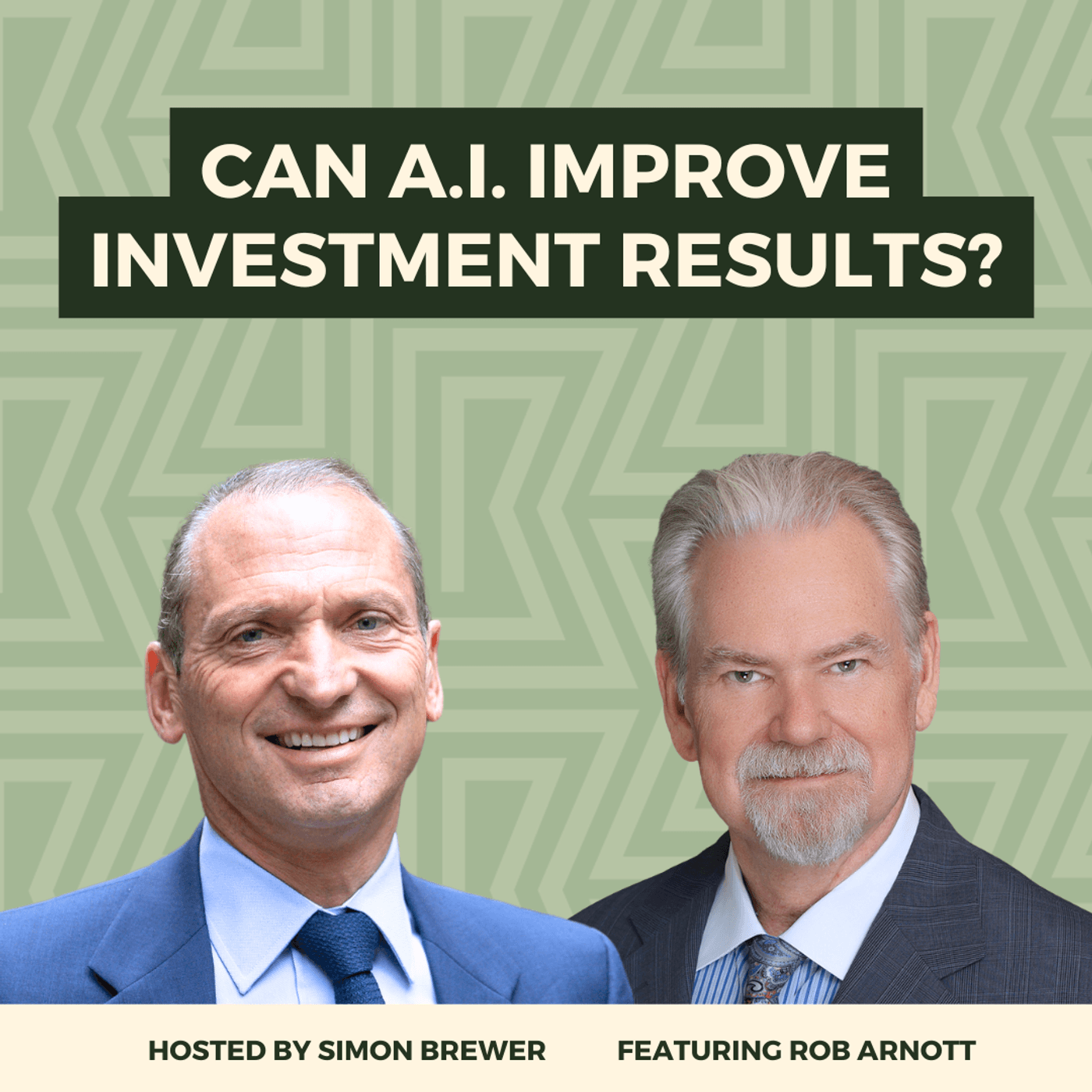
Whether AI can improve investment results, and how Research Affiliates (RA) uses AI while avoiding overreliance in long-horizon, systematic investing.
Guest
Rob Arnott, Founder & Chair of Research Affiliates; his firm runs systematic strategies grounded in theory and empirical evidence; manages about $185B. He also cites Cam Harvey (Duke) as an external advisor.
Key claims
AI is “the real deal” and already useful for productivity (editing, citations, compliance, data work, code). But AI is not ready to replace judgment or creativity for long-term investing; it hallucinates and can drive data-mining/overfitting. AI needs huge sample sizes; for monthly/quarterly/annual forecasts, simpler methods can work.
Notable examples
AI-drafted “summer reading list” included a non-existent author/book. RA used ChatGPT/DALL·E to generate paper graphics faster than hired artists. AI-assisted research writing improved summaries and found missing citations, but also produced two fake citations. Investment examples: RAFI fundamental indexes built from premises (business size, rebalancing) rather than backtest fishing; small-cap value and non-US remain “extraordinary bargains.”
Written by AI. May contain mistakes. Listen to the episode to check what was said.
Chapters
Tap a time to open that second in VOUnderstanding AI's Role in Investment
0:45 to 3:05
Discussion on how AI can impact investment strategies and the historical context of AI in finance.
“But if you go back over the last 30 years, what you find is that the small companies have actually had about 2 % per annum faster growth than the large companies.”
Rob Arnott on AI and Asset Management
3:05 to 6:28
Rob Arnott shares insights on AI's effectiveness in asset management and its limitations.
“It's been used in asset management for decades.”
AI's Practical Applications in Research
6:28 to 11:16
Exploration of how AI tools enhance productivity and research processes in finance.
“Well, firstly, we point out to everyone who works for us, don't be afraid of AI.”
Leveraging AI for Productivity
14:00 to 16:40
Discover how AI tools can enhance productivity and automate complex tasks.
“Then when ideas have solidified, I'll ask it to produce a spec document.”
The Role of AI in Investment Strategies
16:40 to 19:00
Learn how AI can impact the search for alpha in investment strategies.
“and you systematically analyze where that creates opportunities in the stuff that people love and hate.”
Age Mindset and AI Adoption
20:20 to 22:40
Explore how mindset influences the embrace of AI across different age groups.
“How are you finding older and younger employees are responding and embracing?”
Navigating the Landscape of AI and Value Investing
22:40 to 26:30
Understand the importance of a cautious approach to AI in long-term investment decisions.
“you and I lived through, 99, 2000, you know, etc.”
Current Investment Opportunities
26:30 to 28:00
Get insights into the current market landscape and investment strategies.
“Why not weight growth stocks based on the dollar magnitude of that growth?”
Evaluating Market Opportunities in Small Caps
28:00 to 30:00
Explore the valuation disparities between small and large companies and the current investment landscape.
“The stocks that are members get pushed up.”
Catalysts for Market Change
30:00 to 31:40
Discuss the potential catalysts like recessions and geopolitical events that could shift market dynamics.
“less powerful on, let's say, US high yield versus emerging markets bonds.”
Show all 13 chapters
Currency Trends and Investment Strategies
31:40 to 33:50
Delve into the effects of currency fluctuations on investment decisions and strategies.
“react to geopolitical shocks by extrapolating current events and thinking, oh, this is going to be a horrible mess forever.”
The Role of AI in Investment Decisions
33:50 to 35:50
Examine the impact of AI on investment processes and the importance of human judgment.
“And when the dollar has been strong, you get this fevered demand for, well, can we get the product on a currency hedge basis?”
Adapting to Technological Change
35:50 to 38:40
Learn about the implications of technological innovation on jobs and future opportunities.
“You know, and for people who maybe are more outgoing, sunnier dispositions, more optimistic, it's back to the Jordan via a radiator or drain in life.”
Transcript
Automatic transcript. May contain errors.0:00Rob Arnott:I view AI as a very powerful tool. I would say the willingness to embrace AI is partly correlated with Shraddivir. If you love life and love adventure, you can embrace AI. AI doesn't mean a better product. How you use AI can mean a better product. Turning it over to AI, it's not ready for that prime time. I would say the world is always changing. Technological innovations always kill millions of jobs. This will be no exception. Technological innovation creates millions of jobs. Be alert to those opportunities. But if you go back over the last 30 years, what you find is that the small companies have actually had about 2 % per annum faster growth than the large companies.
0:59Today, we're starting a interesting series of conversations with some of the world's leading investors, very specifically around what I have dubbed beyond human judgment. Can AI improve investment results? As we know, lots of people have lots of opinions and they may be worthy and well-founded, but I think we are in the fog of investment uncertainty with regard to AI. And as I looked through previous guests, one name stood out, and that was Rob Arnott, who in June 24 appeared on the Money Maze podcast and talked widely and broadly. And having listened to the show again yesterday with some degree of accuracy about what was going on in the markets, what you expected to unfold.
1:45Your firm, Research Affiliates, says on the tin that it runs systematic investment strategies based upon theory and supported by empirical evidence, which provides opportunity for improved outcomes for most investors. And I'm probably even going to be out of date when I say that your firm now manages$150 billion. You'll correct me, but these are vast numbers. 185. 185, okay. Okay. And the really interesting thing, other than you said people have forgotten that in the film, The Magnificent Seven, only three survived. And I think I have plagiarized and used that quite a lot, Rob, without quoting you.
2:24But what was really interesting is that you said, and this is, as we say, you know, back in June 2024, that you had said to your team, I want to tell you all that you, none of you will lose your job to AI. But you may be at risk to someone who knows how to use AI better than you. So start studying. So I always like to use a little bit of history, particularly since it was very appropriate. Tell us a little bit about how you and your team are feeling about this unfolding world order.
3:02Rob Arnott:Well, firstly, AI is the real deal. I mean, it is astoundingly powerful. Secondly, AI is not new. It's been used in asset management for decades. In the 1980s, I was working with neural nets to try to develop investment strategies using neural nets. They weren't very good. High frequency trading has been using AI for 30 years now, and it is now outstanding. Bit-ask spreads are tight around the world, even on assets that trade by appointment once a month. You can still get a tenth of a percent bit-ask spread. The thing about AI is it needs billions of samples to be useful. If you have thousands of samples or if you're dealing with monthly, quarterly or annual forecasts, ordinary least squares regression is probably just as powerful as AI because there's just not enough samples for AI to be useful.
3:59Rob Arnott:But be that as it may, we have found that AI has made its way into programming, investment systems, IT. It is massively helpful in editing our papers, in finding relevant citations and references, in comparing our work with past published work. It has been useful in marketing, drafting RFPs. It's been useful in creating report automation for business management. It is useful for creating first drafts of attribution commentary for our monthly index strategies reports. It is used by our chief compliance officer and our chief legal officer to find best practice for compliance and for contracts and for editing those.
4:51Rob Arnott:It's used by our CIO for finding and downloading time series data, for editing, enhancing, and amending spreadsheets. VBA, Virtual Basic, is a powerful tool within Excel, and AI is much better at writing VBA code than we humans are. It examines whether our research is breaking new ground, comparing and contrasting with others' research. It's useful for data transformations and exploratory analysis of empirical data. Shockingly, the one area that we don't use AI is in product innovation and asset management. That's a shocker because our focus is on a time horizon that's measured in years, and AI is brilliant at a time horizon measured in days or hours or minutes or seconds.
5:49Rob Arnott:The longer term, it's not that good. And it's not that creative. It's great at reading reams of information and regurgitating what's already been published. But boy, is it powerful. And, you know, 10 years from now, it might be better at creativity than human beings. Right. Well, that is a fantastic list. I think, you know, our series could stop there. And all people in the investment industry listening will go away and say, how have we processed it? But that, of course, begs one question, which is you're overseeing a large pool of assets and a large team of people. How have you either asked, expected, or encouraged them to explore and adapt?
6:33Rob Arnott:Well, firstly, we point out to everyone who works for us, don't be afraid of AI. It's a tool. Figure out how to use it to increase your productivity. It allows us to pay people better. It allows us to leverage their time and efforts. And a lot of that is due to AI. AI is, as I said at the beginning, it's the real deal. It is, I would say, as intelligent as a mid-level university professor. It won't create brand new ideas that are truly pathbreaking, but it's like an average university professor who is working 100 times as fast as a human being would. And boy, is it powerful. I love using it to edit papers that I'm writing.
7:34Rob Arnott:I'll write a paper. I'll pass it to AI and I'll say, please write a summary of this paper. Please suggest areas of improvement. Please find areas of repetition that can give us an opportunity to streamline the paper. And by the way, please look for citations we might have missed. So we have a paper that just came out in the Financial Analyst Journal of Fundamental Growth. It's a paper I'm really proud of. Taking fundamental index and applying it to growth investing. Wow, that's pathbreaking. But in any event, the summary that AI prepared of the paper was a three-page summary that was better than anything Cam Harvey or Chris Brightman or I or the other co-authors could possibly have written ourselves.
8:23Rob Arnott:It was brilliant and succinct. It suggested some ways to tighten the paper up and improve it. Great ideas. It suggested 10 citations we had missed. We looked at them. Four of them, we thought, oh, my God, I'm surprised we missed that one. Let's put it in there. Four of them were more borderline, not that exciting. And two didn't exist. Two were made up out of thin air. So there's still hallucination problems, which people who over rely on AI are making a mistake. There was a famous case, the Chicago Sun, last summer, wrote a summer reading list and handed it to their books editor. And the books editor was running out of time.
9:09Rob Arnott:So he just gave it to AI. And AI drafted this beautiful article with a list of 10 must-read books that people should look at, going into detail about what was brilliant about the books, what was brilliant about the author, the author's history of past writings, the number one book on the list and two others, incidentally, but the number one book on the list didn't exist. The author didn't exist. And the information about the author's brilliant history was all made up out of thin air. As far as I know, the book editor didn't get fired for that because he fessed up right away. He said, I was running out of time.
9:53Rob Arnott:I let AI do it. I'm sorry. This was a huge mistake. But it illustrates the problem. You can't trust it. Then again, you can't trust a human researcher not to make things up. And so you have to cross-check the same as you do with human research. But it's incredibly powerful in ways that you wouldn't expect. Our very first use of it, early 2023, was we would hire graphic artists. We'd write a paper, hire three graphic artists, ask them to put together a graphic that they think distilled the essence of the paper. So people would look at the graphic, think, oh, that's a cute graphic, read the paper, look back at the graphic and think, oh, wow, That's cool.
10:46Rob Arnott:And beginning in January of 2023, we used Dolly and ChatGPT to read our paper and draw a graphic. Three consecutive times, we chose a graphic that AI had written, had drawn, not that the graphic artists had drawn. So we used to hire three graphic artists and pay a thousand dollar bonus to the one that we chose. And OK, AI is great at that. So I have a yoga instructor who's also a graphic artist. And she said she uses AI to do the graphic arts. She says it takes me two seconds to do what used to take me two hours. IFM Investors is a global asset manager founded and owned by pension funds with capabilities in infrastructure, equity and debt, private equity, private credit and listed equities.
11:47They believe healthy returns depend on healthy economic, environmental and social systems. And these are evolving on a scale never experienced before. To find opportunity, build value and meet the needs of future generations, you need scale, skill and expertise. That's what IFM Investors has built up over 30 years. The Moneymates podcast is sponsored by J.P. Morgan Asset Management, Europe's leading active ETF provider by assets under management. J.P. Morgan's active ETFs are backed by rigorous research, a century-long commitment to active investing, and investment processes that have been tried and tested over multiple market cycles.
12:29These ETFs don't just follow the market. They're expertly managed and aim to deliver the outcomes that investors demand in today's complex markets. J.P. Morgan Asset Management is the home of active ETFs. Search J.P. Morgan active ETF or find out more by tapping the link in the episode description. When you invest, your capital is at risk. So in our discussion before we started recording, you said you'd actually spoken to your team yesterday ahead of this and sort of got some, you know, some from the cold face feedback about how they are implementing. I'd love you to share their observations with us.
13:05Rob Arnott:The list that I gave you at the beginning was that synopsis. Our programming IT and investment systems team all use agentic AI, AI that serves as an agent to do work. Clawed code and OpenAI codecs are particularly powerful. They use it to examine our code base, the whole system, and suggest ways to make it tighter and faster. They search for risk factors where we might be vulnerable to trap doors and other attacks. They do code review, running AI written code alongside human code as a required step before merging to catch bugs and coding designing consistencies. Our CTO, chief technology officer, said a common pattern I've found very productive is that I will have extended dialogues in a chat with Claude Opus about designs and features.
14:11Rob Arnott:Then when ideas have solidified, I'll ask it to produce a spec document. Then I take that spec document into a code repository and I ask Claude Code to implement it. From there, I iterate with Claude Code on features, performance, tests, and the code itself. So it's used as a tool, not as a replacement, but something that can leverage human time, anything from doubling your productivity to a hundredfold improvement, depending what you're doing. One really fun thing, I had a monster spreadsheet that compared RAFI, our fundamental index, with RAQI, our cap weight index, which is really pathbreaking work.
14:58Rob Arnott:It's really fun stuff. And RAFI growth, fundamental growth, year by year, back to 1970, 4 ,000 to 7 ,000 stocks, what their weight is fundamentally within RAFI, within cap weight, and within RAFI growth, compares the portfolios, compares the risk attributes, and the spreadsheets of over 100 megabytes. I wanted to automate it. I asked one of our systems people, can you help me automate this? And he said, I haven't used VBA macros in Excel ever, but let me give it a shot. I thought, OK, you're going to give it a shot. You're going to spend weeks learning how to do Visual Basic. He came back to me an hour later and it had shrunk to 20 megabytes.
15:56Rob Arnott:and he said, here, you click this to update a single page. You click this to update the whole thing and create a summary, and I said, how did you do that? And he said, I had Claude write me the macro. I tested it. It sort of worked. I asked it to make some tweaks. I tested it. It worked very nicely. And I said, he came back to me in an hour. I said, this was all in an hour? He said, well, actually, it was about 20 minutes. Time for coffee as well. That is extraordinary. Now, if I summarize your business, and you'll correct me if I'm wrong, is one of the great successes is that you have taken the human premise of greed and fear, and you systematically analyze where that creates opportunities in the stuff that people love and hate.
16:49Would that be a fair way, Rob, of a layman describing it? Okay. The holy grail is the search for alpha, at least when we are thinking about versus passive indices. Let's talk about how you think this whole revolution may or may not actually help the search for alpha.
17:12Rob Arnott:It'll help the search for alpha. I view AI as a very powerful tool.
17:23Rob Arnott:People have said computers are high-speed idiots. These are high-speed intelligent idiots. They aren't very creative. Coming up with a truly new idea is hard to imagine. Um, Cam Harvey is a professor at Duke, very famous in the finance community, who, um, uh, serves as an external advisor to our company. He told me just today that there's a competition for who can use AI to write a paper. And the competition will be judged by AI.
18:13And basically, the premise is you write a title and let AI write the paper, or you write a title and provide guidance and let AI take it from there.
18:34Rob Arnott:Or you provide a rough draft and let AI take it from there. So he did three papers. Two of the three were judged to be A quality papers by his academic peers. And one was judged to be A minus. The A minus was the one where he did the rough draft. Now, were these creative? No, they were empirical examinations of interesting questions. But one was written entirely by AI. Just here's your title, write a paper. Got an A rating from academic faculty. I'm thrilled to share that the Money Maze podcast is sponsored by the World Gold Council. They champion the role gold plays as a strategic asset through expert research, commentary, and insights.
19:35And it's not just your portfolio that may benefit from gold. Learn how gold mining is supporting female economic empowerment and small businesses via their new documentary series called Gold, The Journey Continues. Tap the link in the show notes to start watching. I'm excited to announce that the Money Maze podcast is sponsored by the London Stock Exchange Group, known as LSEG. At the heart of the global economy, LSEG provides data, analytics, and infrastructure that connects investors, businesses, and economies. LSEG is where ideas meet capital, enabling sustainable growth and opportunity. Tap the link in the show notes to learn more.
20:14So apart from the fact that I am already 15 minutes in feeling older than I was 15 minutes ago. How are you finding older and younger employees are responding and embracing?
20:30Rob Arnott:I don't think it's a matter of age as much as it's a matter of age mindset. That is to say, if you have a gusto for life and an enthusiasm to explore what's new. I would say the willingness to embrace AI is partly correlated with Shroa DeVivre. If you love life and love adventure, you're going to embrace AI and you'll find all kinds of uses. If you're fearful, you're probably not going to embrace it and probably have a risk of being displaced by it.
21:19Rob Arnott:That's an oversimplification, but that's my immediate blurb. And if we back up to the investment industry and the asset management industry I'm talking about here, what types of organizations might be the winners and losers in this world order? I would say those that embrace change and love exploring new ideas will embrace this change and will explore it very fruitfully. I think a healthy skepticism is important. I actually had AI look for ETFs around the world with AI in the name and asked how they'd performed. It was a random grab bag. There were two that had performed absolutely abysmally. There was one that performed pretty good.
22:16Rob Arnott:And there were three or four that had just very neutral results. So AI doesn't mean a better product. How you use AI can mean a better product. Turning it over to AI, it's not ready for that prime time. Yeah. So let's just broaden this out, because one of the points you made when we interviewed back in 24 was the AI euphoria, which, you know, which came back to your comment about the Magnificent Seven and the and the classic cycle that you and I lived through, 99, 2000, you know, etc. We've moved on. There's been a broadening of the market. There's been a return to the benefits of global asset allocation, particularly given US centricity, et cetera, et cetera.
23:07How are you thinking about that playing field, which is both global on the one hand, but it's about value versus growth on the other? And of course, those two, I know, are tied. I don't think AI is ready for long-term investment decisions where common sense is arguably more powerful than data.
23:34Rob Arnott:We are obsessive about avoiding data mining, and AI is a massively powerful data miner. And data mining will lead you to better and better and better back tests and often worse and worse live results. Because if you're anchoring on what worked in the past, you may be anchoring on what is newly expensive and poised to perform badly. And AI doesn't get that yet. The thing that I think is interesting is the whole data question. If you're dealing with long horizon results, there's just not enough data for AI to be fruitful. The other element is scientific method. Scientific method involves starting with a premise and using data to test the premise.
24:33So we didn't develop a fundamental index by sifting through data and finding what had the best backtest.
24:43Rob Arnott:We began with a simple premise. What if instead of choosing and weighting stocks on their market value, which pushes you most heavily into whatever is most expensive, what if we choose and weight companies based on how big they are as a business? And then you're going to have a contra trading. If the price soars and the fundamentals don't validate that, you're going to say, thanks for the nice gain. I'm trimming it. If it tanks and the fundamentals don't falter alongside that, you're going to say, thanks for the deep discount and top it up. And the rebalancing alpha is very powerful. RAC, we are cap weighted index, equally simple.
25:21Rob Arnott:Why on earth would we want to buy a stock, add it to our index just because it soared? Why would we want to sell a stock just because it's cratered after it's cratered? Why not add a stock after it's big enough as a business to matter, drop a stock when its business has eroded to no longer be big enough to matter, and then go ahead and cap weight? You wind up with a 99.9 % correlation with the S &P 500 and 70 basis points per annum higher return for the last 30 years. Okay, that strategy we took live in 2021. We use data to test it, not to create it. And RAFI growth, fundamental growth. Why do we have this bizarre illusion that if it's cheap, it's value.
26:14Rob Arnott:If it's expensive, it's growth. No, if it's expensive, it's expensive. That's all there is to it. Growth is growth. Expensive is expensive. They aren't the same. And so why not choose growth stocks based on how fast they're growing? Why not weight growth stocks based on the dollar magnitude of that growth? We tested those ideas. They work astonishingly well. Going back 30 years, you beat Russell growth by 4.5 % per annum, winning in three out of every four years. None of that was done by AI, but AI helped us write the articles. outlining what we'd done and how it worked. So if we talk about today's investment landscape, and I'm again going to do my synthesizing of what you said back in June 24, it was essentially go global, overweight value, own index link bonds versus ordinaries in the US.
27:15Those were the three investing principles or positions, I should say. Just give us a sense of what you particularly like and like less today.
27:28Rob Arnott:um firstly uh the non-us versus u.s has played out reasonably nicely but non-us is still a bargain secondly value is still very cheap relative to growth all over the world thirdly relatively new Small cap is now the cheapest ever in history in the US relative to large cap. And I think that's a function of indexation. Money pours into index funds. The stocks that are members get pushed up. The stocks that are not members get pushed down because you're selling these to buy these. And the result is you've got a two to one spread in valuation between members of S &P or Russell and the non-members.
28:16Well, that would make sense if the members were superior companies with superior growth prospects.
28:22Rob Arnott:But if you go back over the last 30 years, what you find is that the small companies have actually had about 2 % per annum faster growth than the large companies, which is unsurprising. It's hard to move the needle with the next new release of an iPhone, for instance. and easier for a little company to move the needle with any innovation of any sort. If you got 2 % per annum faster growth and 2 % per annum lower performance, that means the relative valuations have widened hugely. And that's exactly what's happened. So I view small cap value in the US as an extraordinary bargain. I view value outside the U.S.
Read the full transcript
29:09Rob Arnott:as an extraordinary bargain. Index-linked bonds at the long end of the spectrum, 30-year index linkers in the U.S., have a yield higher than 2.5%. Well, that's crazy. 2.5 % for default risk-free investments that are index-linked, that's a big, real yield. And US stocks are now expensive enough that they probably have a risk premium relative to the long linkers of only about 1%. That's too skinny. And so I look on the opportunity set today as being pretty similar to what it was back in 24, but a little more powerful on the small cap US side, small cap value US side. less powerful on, let's say, US high yield versus emerging markets bonds.
30:09Rob Arnott:The yield spread favors emerging markets bonds, and the quality, the default risk favors emerging markets bonds. So I think there's a very rich opportunity set. It's just not where most people have most of their money. And in fact, you also did talk about the opportunity in emerging market bonds, which has played out well. I've got a statement and then a question. The experience of that small cap is mirrored in the UK. I run the quantitative sort of numbers to the extent you have, but the data I've seen is exactly that. I've been adding personally to that small cap UK space that's very cheap. But my question, and let's go back to the US for this, is that what does it take for that to change?
30:54Is it that we need a recession in the US to slow the passive to change the equation? Or what else? Because it's the catalyst I'm looking for.
31:05Rob Arnott:Yeah, a recession or a bear market would certainly be a powerful catalyst. Without a recession, without a bear market, you can still have a gradual mean reversion. That is to say, what's cheap can become more expensive because people start to say, oh, gosh, this is cheap and I'm not getting hurt with my big mainstream stocks. I have room to diversify. So it'd be a slower catalyst. Geopolitics can be another catalyst. Geopolitics, I think, creates inefficiencies because people react to geopolitical shocks by extrapolating current events and thinking, oh, this is going to be a horrible mess forever.
31:51Rob Arnott:And instead of looking past it and asking, okay, what's the world going to look like in one year, in three years, in five years? Iran's an interesting example of that. Do we really think that the Straits of Hormuz will be blocked five years from now. I don't.
32:09Rob Arnott:If it is, the nations that rely on shipping through the Straits of Hormuz will find alternative routes to get their products to market. So it still won't matter. And people don't like to look past shocks. I have a plaque on my desk that used to be on John Templeton's desk. John Templeton had a plaque that said, trouble is opportunity. And his granddaughter gave it to me about a decade ago. And it's powerful. That was his guiding principle. And it made for rather an impressive investing career. Fantastic. Well, it did indeed. Rob, I know it's probably not your domain, but if you are making those conclusions on a global rebalancing, is it too simple to extrapolate that those overweights reflected in public, but also in private markets, or also reflect dollar overweights and five years hence, you know, a lower dollar would be a reasonable case?
33:25Rob Arnott:I think the dollar has reverted back to roughly fair value. People tend to extrapolate recent directions in currency too. So when the dollar has been weak, people think, gosh, I want unhedged exposure because that'll give me exposure to a currency that may do a lot better than the dollar. It's usually with the blessings of 2020 hindsight. And when the dollar has been strong, you get this fevered demand for, well, can we get the product on a currency hedge basis? Well, short answer is, of course you can. But do you want to do that after the dollar soared or after the dollar tanked? I would only add that there are currencies, and I'm going to name three, Norwegian kroner, Canadian dollar, Australian dollar, that are all, as a matter of fact, cheap versus purchasing power parity.
34:23Now, that doesn't lead for the total global case, you know, against the dollar, but there's definitely the market has not cared about pockets of currency values as well. But you're the antithesis of being emotionally, you know, tossed and turned when it comes to markets, which is so important because it is the enemy of us all. And I think it was, it was the quotation by the French philosopher, and now I'm going to forget which one it was, who said, you know, it was about human behavior changing. He said, you know, history rhymes, but humans always do the same thing. So, you know, we know that's where the opportunity lies, which is why I love your quotation from Templeton.
35:03So if I was to summarize about AI, you have said, be careful because it hallucinates, number one. Number two is that common sense is still extraordinarily valuable and don't get lost in the data. Number three, that for all long term investments, thank you. And that for all of its brilliance, it is not at the moment that creative.
35:35Rob Arnott:I think that's spot on. Well, in your words, I've managed to, you know, to reproduce here. So there will be a lot for people to think about. And that opening paragraph where you summarized how your colleagues are using it across the much wider than the investment decision making process to allow you to be more efficient, more productive. You know, and for people who maybe are more outgoing, sunnier dispositions, more optimistic, it's back to the Jordan via a radiator or drain in life. You know, those who are more disposed to that sort of, you know, optimism are perhaps the ones who are grabbing the opportunity and not being afraid because there's no virtue in hiding.
36:17This is happening.
36:19Rob Arnott:Exactly right. Right. I had a I had a taxi ride maybe a year ago. And I asked the guy, what was you thinking about autonomous cars and how it might affect you? And he said, what's that? And I said, taxis that drive themselves without a driver. And he said, when's that happening? And I said, probably somewhere between five and 15 years from now, probably closer to five. and he smiled and he said, I'll be doing something else by then.
36:56Rob Arnott:So keep your options open and keep your mind open to different things that you might do and keep your mind open to ways to leverage your time so that you can do 40 hours, 40 hour work week in four hours. Yeah. And if I specifically finally asked you, if you were sitting in front of Duke University giving a lecture and there are people in the room worried about AI, how would you narrow that statement? I would say the world is always changing. Technological innovations always kill millions of jobs. This will be no exception. technological innovation creates millions of jobs. Be alert to those opportunities.
37:48Rob Arnott:I had a friend, I have a friend whose son is just about to finish at MIT on a computer science master's degree. And he was fretting, he was saying, And he's trained for a job that won't exist in five years. And I said, he's trained to learn how to think and to learn how to think creatively.
38:20Rob Arnott:The takeaway from his education won't be how to program a computer. It'll be how to think about his future and how to think creatively about opportunities. It's a great way to start. Rob, it's been fantastic welcoming you back onto the Money Maze podcast. Thank you for your time. Thank you so much. This was great fun.
From the publisher
Rob Arnott, Founder & Chair of Research Affiliates, discusses where AI works well & can assist across the money management ecosystem, the risk of ‘AI hallucination’ & over-reliance, quant vs human judgement, and the future of work.
Amidst the volumes written about AI’s impact on the business and investing worlds, we wanted to ask some specific questions about adoption, learning, implementation and limitations within the investing universe.
We asked these questions of Rob Arnott, founder of Research Affiliates and a previous guest, whose firm is steeped in data, systematic disciplines and empirical evidence. In a compelling and engaging conversation, Rob discusses why common sense can beat data, how AI can hallucinate, its creative limitations, but its unequivocal potency in improving multiple areas of the investing business.
Finally, when asked for his convictions across markets, he discusses the exceptional value in US small vs large cap equity!
The Money Maze Podcast is kindly sponsored by J.P. Morgan Asset Management*, IFM Investors, World Gold Council and LSEG.
*During the episode we cite J.P. Morgan Asset Management as Europe’s leading active ETF provider by assets under management. This is sourced from J.P. Morgan Asset management and Bloomberg, data as of 30 March 2026.