In short
Whether the classic 60/40 portfolio still works; what investors need now (liquidity buffers, added diversifiers like commodities/gold/private markets, and cash paying interest); how to access retirement security via ETFs, digital/wealth platforms, and smarter diversification; outlook on valuations, U.S. equity overweight, and emerging markets; private credit/private equity risks and return expectations; and how AI and tokenization will change portfolio construction and administration.
Guest
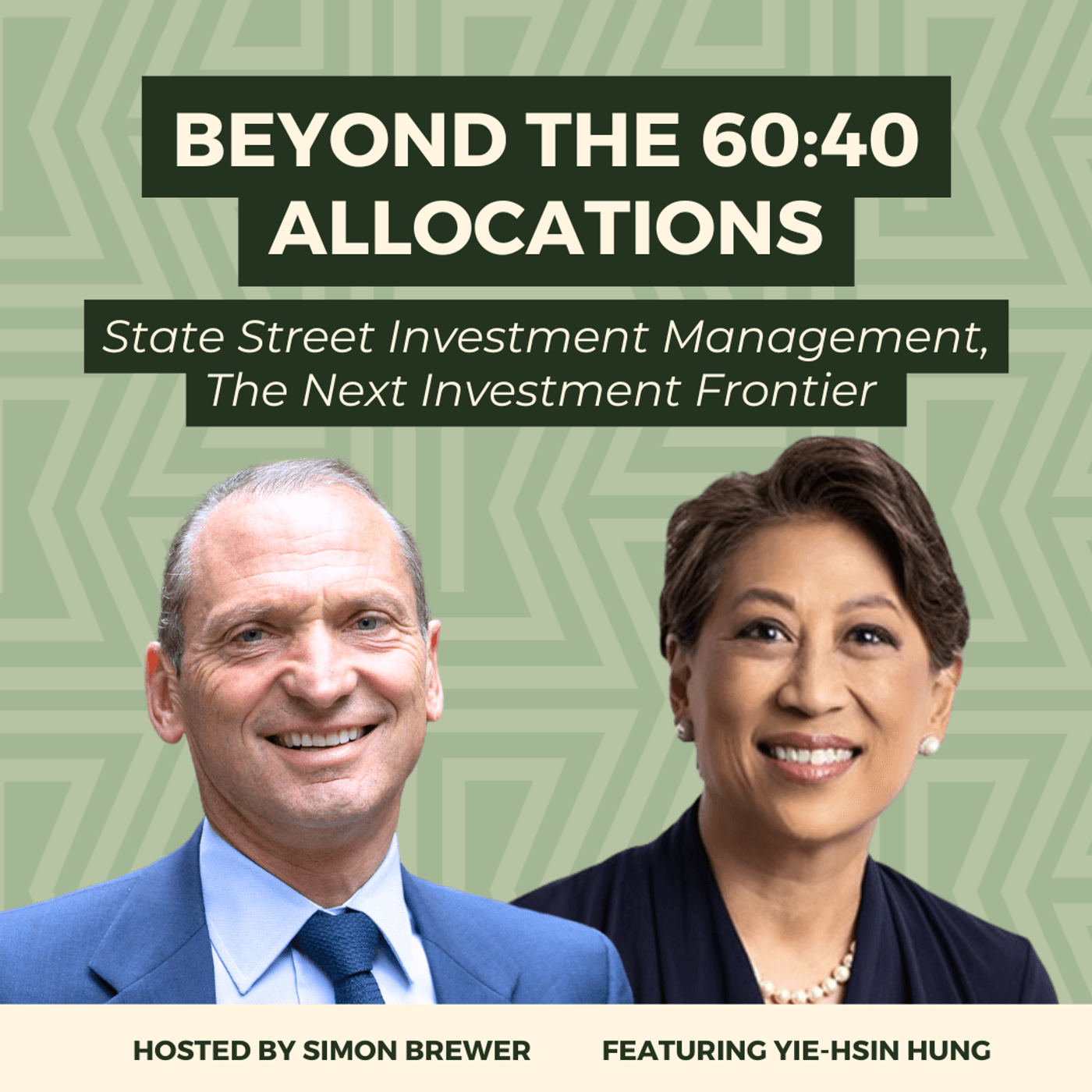
Yie Hsin Hung, CEO of State Street Investment Management. Background: mechanical engineering (undergrad), business school; worked at Wall Street firms including Morgan Stanley (10+ years), New York Life (12+ years, CEO), and earlier roles in real estate investment banking/technology intersections; Barron’s influential women in U.S. finance; UK-based since 1972.
Key claims
bonds’ return tailwind is reduced in a flat-to-rising rate world; private markets can add value but liquidity matters and manager selection is crucial; private equity’s “premium” is less reliable due to lower distributions; AI augments after allocation; tokenization enables 24/7 money-market fund access and portfolio visibility across TradFi/DeFi.
Notable examples
85% of U.S. companies over $100M revenue are privately held; private credit growth tied to bank regulatory constraints; Saudi Arabia’s first actively managed equity ETF listing; tokenizing money market funds for stablecoin interoperability; crypto not currently in SSIM strategic allocations.
Written by AI. May contain mistakes. Listen to the episode to check what was said.
Chapters
Tap a time to open that second in VOThe Evolving Need for Diversification in Portfolios
0:00 to 1:06
Explore the importance of diversifiers and liquidity buffers in modern portfolios.
“What investors need is additional diversifiers, as well as liquidity buffers.”
Yie Hsin Hung's Journey into Finance
1:56 to 3:57
Learn about Yie Hsin Hung's background and how she ventured into finance.
“Well, you're from New York, I'd like to say exclusively for this interview, but I know otherwise.”
Challenges in Retirement Security and Financial Planning
3:58 to 6:06
Understand the pressing issues surrounding retirement security and the 60-40 portfolio.
“much more interested in what these companies, what their strategy is, what their products are, how do they go to market.”
Revisiting the 60-40 Portfolio: A Modern Perspective
6:07 to 7:28
Examine how the traditional 60-40 portfolio has been affected by current market conditions.
“And I'm going to just quote a piece of trivia here about aging.”
The Role of Private Markets in Today's Economy
7:29 to 14:01
Discover the significance of private markets and their growing relevance in investment portfolios.
“And so our idea has always been about democratizing investing.”
Alternative Investment Allocations
14:01 to 14:22
Explore the rationale for increasing allocations to alternative investments.
“and data centers, that's difficult to replicate, but is only available in the private markets.”
Evaluating Private Equity Returns
15:32 to 16:42
Assess the challenges and expectations around private equity returns compared to public markets.
“I still have several investment committees and we often have this discussion, we get this series of private equity returns, but they're a fraction of that.”
US and Emerging Market Dynamics
16:42 to 19:05
Analyze the asset allocation models focusing on US equities and emerging markets.
“And oftentimes the best returns are basically if an investor is very consistent in their allocation, that they have vintage-year diversification over time.”
Emerging Markets Debt and Equity Analysis
19:05 to 20:06
Discuss the performance of emerging market debt and equity, and their future potential.
“And so from both, whether it's equities or fixed income, that's another sector that we find quite interesting.”
Investment Opportunities in Saudi Arabia
20:06 to 21:14
Explore the investment potential in Saudi Arabia's equity and fixed income markets.
“And one of the reasons why I'm actually here in London today is that we announced the listing of the very first actively managed Saudi Arabia equity ETF this morning.”
Show all 22 chapters
Understanding China's Investment Landscape
21:14 to 22:25
Evaluate the Chinese investment landscape amidst geopolitical tensions and valuations.
“So there's different stories going on across the emerging markets.”
Active vs. Passive Investment Strategies
22:25 to 23:23
Delve into the effectiveness of active versus passive investment strategies in various markets.
“what over-allocation, under-allocation are investors interested in having as they participate in emerging markets.”
State Street's Investment Approach
23:23 to 24:40
Discuss State Street Investment Management's philosophy and client-focused mission.
“Yeah, we just interviewed Rob Arna from Research Affiliates and he was at pains to point out that small cap has never been cheaper related to large cap in US history, which is striking.”
AI's Role in Investment Management
26:23 to 28:00
Discuss how AI is enhancing investment processes and human collaboration.
“Today, as the world navigates uncertainty and heightened risk, investors of all sorts will look to safeguard their wealth.”
AI's Role in Investment Strategies
28:00 to 29:15
Explore how AI enhances investment strategies and portfolio management.
“But I am intrigued about the ability for the AI universe to be as contrarian in some terms as it requires.”
Tokenization Disrupting Traditional Finance
29:15 to 30:52
Discuss the potential of tokenization in transforming money market funds.
“The other benefit of AI is mass customization at scale, which I think is a really, really exciting arena because it means that the customization that very large investors have is now afforded to everyday investors.”
Personalization in Investment Portfolios
30:52 to 32:15
Learn about the importance of customized investment portfolios for clients.
“I'm a client and I'm a sufficient size to have something tailored.”
The Role of Crypto in Investment
32:15 to 33:25
Understand the current stance of cryptocurrency in investment portfolios.
“How do you come down in terms of, you know, does it have a role in portfolios?”
Future of Financial Services Landscape
33:25 to 34:41
Insights on the banking sector's evolution post-economic challenges.
“Because if you looked at our strategic asset allocation portfolio, we do not today have an allocation to cryptocurrency.”
Advice for Women in Investment Management
34:41 to 35:56
Discover valuable advice for women entering the investment management field.
“And what I love about what we do is that we are ultimately helping millions and millions of people around the world achieve their financial aspirations for themselves, for their families.”
Improving Financial Literacy Worldwide
35:56 to 36:44
Discuss ways to enhance financial education across different demographics.
“What would you like to see to improve financial literacy?”
Favorite Travel Destinations and Influential Reads
36:44 to 37:44
Hear about personal travel favorites and impactful books read recently.
“And what irritates you most about our industry?”
Transcript
Automatic transcript. May contain errors.0:00What investors need is additional diversifiers, as well as liquidity buffers. There's a real value to having cash in a portfolio today that is actually paying a decent amount of interest. But other allocations, whether it's commodities or gold or private markets, they will add to the overall portfolio. In the U.S., for example, 85 % of all companies with more than$100 million in revenues are privately held. And we all know that the regulatory environment for banks has had them really not be in a position to extend credit, and that's led to the growth in private credit. Because in some cases, you just can't get the access in the public markets.
0:44You think about AI and the impact on infrastructure and data centers. that's difficult to replicate, but is only available in the private markets.
0:54Yie Hsin Hung:A few weeks back, we were asked if we'd like to interview State Street Investment Management. After six years of building the Money Maze podcast, we're incredibly lucky that we get approached by lots of interesting organizations. And in fact, we turned down over 300 approaches last year. Since size is not a requirement to be a guest, we typically do quite a lot of research ahead of a potential interview. And having been in this business for over four decades, my initial reaction when State Street was mentioned was this was an organization largely in the safekeeping and asset servicing business.
1:28Yie Hsin Hung:Then I went and took a closer look and I'll confess to being surprised and educated to learn that in fact it's the fourth largest asset manager globally, with circa six trillion. So updated, re-educated and intrigued as size offers opportunity, but also it can be the enemy of agility. We said, yes, please. So it's a pleasure to welcome Yi Xin here, the CEO of State Streets Investment Management into our offices. Welcome. Thank you. It's great to be with you. Well, you're from New York, I'd like to say exclusively for this interview, but I know otherwise. And hopefully we're going to cover a lot of ground.
2:04Yie Hsin Hung:and you've written some really interesting things about the future of asset management, about the savings gap, active versus passive, and we'll touch on a number of those. But two particular points intrigue me as I started my research. One is State Street is the second oldest US bank, 1792. So there'll be some going, well, I wonder which is the oldest bank. Well, I gather it's Bank of New York by a year. I might be corrected. And in the last year, the group as a whole produced over$14 billion of revenue, you of which your business was over 20%. And you've been in the UK since 1972. So that was the first thing.
2:40Yie Hsin Hung:And the second thing was you've been named as one of Barron's most influential women in US and finance. And like me, that is not that you're like me, but like me, you're also a Morgan Stanley alumni. So I thought those were quite interesting things. So I want to jump in. But just before we talk about investment management, I read that your father was an engineer. There was this engineering sort of, I think, culture in your family. Did markets and finance get discussed around the dinner table? You know, markets and finance weren't a big topic around the dinner table, although I do remember vividly my father was an investor in the stock market.
3:18And having advised him when the market had gone down, I caught that bit of news and told him he should sell everything. And now with the benefit of hindsight, I realized what a big mistake that was. Unfortunately, he didn't take any of my advice.
3:33Yie Hsin Hung:And at what point in your education did you start to think, hang on a second, I'm drawn potentially to this world of finance? Yeah. So it was after my undergraduate, I had studied mechanical engineering. And I did follow my father's footsteps. He was a civil engineer. I love math and science and solving problems. Although I find myself working during the summers and thinking to myself, I'm much more interested in what these companies, what their strategy is, what their products are, how do they go to market. And so when I had the opportunity to go to business school right after undergraduate, that's where I got introduced to the whole world of finance.
4:12And my first step coming out of business school was really to go to Wall Street.
4:18Yie Hsin Hung:So you have spent time at Bridgewater. We had a very enjoyable interview a few years back with Ray Dalio. You were at New York Life for over 12 years as CEO, and as we discussed, Morgan Stanley for over 10. And I wondered if any one of those institutions particularly prepared you for your current role. You know, they all contributed greatly. I mentioned going into real estate investment banking or lease investment banking at the outset. And it was the part of my career where it was pretty much coming in as an associate and moving my way up with greater amounts of responsibility. But having been in the real estate sector, it was an area that had undergone tremendous change, a lot of private companies going public.
5:06But at the same time, the internet was taking off. And so I found myself in a group that was, call it a little bit top heavy, and my ability to just continue to advance was more limited. And fortunately, my boss sat me down and said, this doesn't look like it's happening here. let's explore something else. And so I moved into this area that was the intersection between investment banking and technology. And I remember the first six months not understanding anything anybody was saying. And then one day it sort of clicked. And it started me on this path for a good part of the middle part of my career where I had a different responsibility, a different job, a different function, almost every two to three years.
5:48At times that was challenging other times. It was really exciting. But I would say the totality of all of that, when I look back, it was the best training possible for the leadership positions I've had at New York Life and now at State Street.
6:02Yie Hsin Hung:Great. So let's laser in on the world of investment management. Longer lives demand increased retirement security. And I'm going to just quote a piece of trivia here about aging. And that was, I was reading a piece which was talking about the late Queen of England. And, of course, she sent out notes when people were 100 years old, the telegrams originally. When she started doing that, she was sending 385 a year. When she died, it was 16 ,000. I thought that encapsulated ageing quite well. But retirement security, it's a big deal. There's a big gap. What have been your observations about this whole issue?
6:43Well, it's unfortunately a very significant issue. And I think there are a variety of factors we can go and look at, whether it's income levels, access to capital markets, the amount that people are investing early on in their careers. And so I think the answer today is not necessarily for investors to take greater risk, but to think about smarter diversification. And then for firms like us, to be able to provide easier access to the capital markets, less frictional costs. And I think what I see today is there's a lot of really good developments on that front. We're one of the largest ETF players among the asset managers.
7:27And frankly, I'd say it's been just over 30 years now that sort of the ETF industry grew up around the very first that we launched. following the S &P 500. And so our idea has always been about democratizing investing. How do you take strategies that are available to ultra high net worth, large institutions that make them easy for people who have maybe 100 pounds to invest? And so we've partnered with other asset managers like Bridgewater, we talked about. Ray Dalio's family office was invested in their all-weather strategy. And so last year, we took that and made that available as an ETF. And so that's what I mean by taking some of these strategies that are diversifiers that might enable people to help bridge that gap.
8:22And the other piece for us has been, we've seen how the next generation of investors are starting to lean much more towards wealth tag digital access to investing. And those partnerships around the world is something that we've been focused on, delivering our model portfolios, our building blocks, if you will, to give everyday people the opportunity to access the capital markets to do so in a more frictionless way. So we're going to tease a few of those out, but let's just step back up to the foundation of a
8:57Yie Hsin Hung:lot of financial planning, which was the 60-40, the 60 equity, 40 dead, and every optimizer that's ever been run has had some variation, you know, thereof. And then we came to this sort of, you know, extended period of zero rates. Some can argue like I would central bank, you know, negligence. And the 40 started to, you know, to morph and so did the 60. Just give us a snapshot right now of how, in your mind, that 60-40 has been reconfigured. You know, you raise a very good point because the 60-40 traditional model worked for a very, very long time. But it was also a period of time when we saw declining interest rates for multiple decades.
9:38And so under that scenario, bonds actually delivered pretty compelling total returns. We're now in an environment where we're sort of flat to increasing interest rates. And so the likelihood of bonds delivering that kind of total return is much reduced. And so the 60-40 portfolio would suggest that it's reasonably balanced, but the issue is because of the volatility and the return on the equity side, it's really heavily weighted in that direction. And so it's created much more volatility and the correlations between equities and fixed income hasn't been as uncorrelated as it has in the past. If you think about inflationary environments, typically those are environments that neither fixed income or equities do all that well.
10:29And so our view is that what investors need is additional diversifiers, as well as liquidity buffers. There's a real value to having cash in a portfolio today that is actually paying a decent amount of interest. But other allocations, whether it's commodities or gold or private markets, they will add to the overall portfolio and get the broader diversification that we had come to expect the 60-40 portfolio to deliver really needs those elements today.
11:04Yie Hsin Hung:So let's just talk about those private markets. As sort of an old-time investor, I've been somewhat cynical about the substitution of some of the traditionals for private equity and debt. We know that there's already been a retracement from the likes of, you know, the origins of the Swenson approach at Yale. And, you know, you only need to pick up the, you know, the paper every day, even if it's being slightly alarmist to know that, you know, the tsunami of private equity and private credit deals and their interconnection is beginning to show up a number of flags. I mean, I suppose I was really surprised when, you know, I think it was in BlackRock's infinite commerce goes from 100 cents mark three months later to zero.
11:48Yie Hsin Hung:And that had followed from Renova Home Partners. So, you know, private credit, private equity. How do you assess their, you know, their vulnerability right now? Well, to step back, I do think that there is still a lot of value creation in the private markets. In the U.S., for example, 85 % of all companies with more than$100 million in revenues are privately held. And we all know that the regulatory environment for banks has had them really not be in a position to extend credit, and that's led to the growth in private credit. So importantly, I do think individual investors should have access to these asset classes.
12:33But they're not the same as David Swenson and Yale, which had the benefit of huge scale, the ability to access some of the top tier asset managers. And their horizon was incredibly long. And so their very substantial allocation, I think it was close to 50 % to private equity, venture capital, real estate. They also didn't have tremendous needs for liquidity. You sort of fast forward to where we are today, and I think there is a true premium placed on liquidity. And people's horizons probably aren't the same as what Yale's is. And again, this is an area that is really active management. And so it's important not only to think about the asset classes, but also to think about who are the managers that you're electing to put into your portfolio.
13:27on things like underwriting quality, the amount of diversification. Those sorts of things matter when you're choosing a private credit manager, for instance. Same would hold on the private equity side, where there is a disparity between sort of the top manager and the bottom quartile manager. That all said, I do think it's an interesting asset class. I think it belongs in portfolios, because in some cases, you just can't get the access in the public markets. You think about AI and the impact on infrastructure and data centers, that's difficult to replicate, but is only available in the private markets.
14:07But because of some of these other factors, you know, having 5%, 15%, 20 % allocation to alternatives probably makes more sense for the average investor.
14:18Yie Hsin Hung:Does your investment portfolio need an active boost? The Money Mears podcast is sponsored by JPMorgan Asset Management, Europe's leading active ETF provider by assets under management. JPMorgan's ETFs are powered by a century-long commitment to active investing and a truly global investment platform. They're designed to be active, not reactive, so investors can target enhanced returns and achieve better long-term outcomes. Discover why JPMorgan Asset Management is the home of active ETFs. Search JPMorgan Active ETF or tap on the link in the notes to this episode to find out more when you invest your capital is at risk.
14:58Yie Hsin Hung:IFM Investors is a global asset manager founded and owned by pension funds with capabilities in infrastructure equity and debt, private equity, private credit and listed equities. They believe healthy returns depend on healthy economic, environmental and social systems and these are evolving on a scale never experienced before. To find opportunity, build value, and meet the needs of future generations, you need scale, skill, and expertise. That's what IFM Investors has built up over 30 years. I just want to pause on returns because we've got 125 years data on the S &P 500, 9.5 % nominal returns.
15:41Yie Hsin Hung:I still have several investment committees and we often have this discussion, we get this series of private equity returns, but they're a fraction of that. There's all sorts of problems with the data as well. Is it realistic to expect private equity to deliver superior returns to public equities over time? It's a very good question. I think the, you know, the thinking has been, yes, that private equity should be able to deliver a return premium to the public markets by virtue of, you know, the illiquidity premium. Now, I think in recent years, that has not been the case. The level of distributions that have come back from private equity investments has been much less than most investors expect.
16:26I don't have a crystal ball, but I do think that there should be excess return coming from the private allocation. But again, it needs to be the case that investors are able to stay invested over that right horizon and to realize the benefits of that. And oftentimes the best returns are basically if an investor is very consistent in their allocation, that they have vintage-year diversification over time.
16:59Yie Hsin Hung:Yeah, and of course, ultimately return is a function of your entry point in so many cases. And so this disruption, et cetera, might well be affording that. The other side of the 60 is you take this enormous weight in the World Index of the US stock market for all the reasons with which we're familiar. We also look at the valuations, which by any measures are expensive, and a starting point from which returns disappointed. So it's not Japan 1989, but you can see the big dispersion globally in stock markets around the world creating sort of opportunity. How are you, as you design product, as you think about that, solving that equation, thinking about US U.S.
17:43Yie Hsin Hung:overweight, dollar fragility, et cetera? Well, today, if you look at our asset allocation model, we are overweight slightly to U.S. equities and then secondarily to emerging markets because we see the fundamentals on corporate earnings very strong. And even throughout the first quarter of this year, we've seen earnings revisions to the upside, where likely EPS year over year is going to be sort of mid-teens, if you will, in the U.S. And then you add to that the one big beautiful bill that has also encouraged companies to invest in CapEx. It provides tax relief to individuals. And then, of course, the effort of AI investment all around, which is just creating a number of tailwinds for the U.S.
18:32That said, we do see investors broadening out their holdings. not nearly as concentrated as it has been over the last several years. More ownership across the broader equity markets and increased diversification, where the emerging markets for us is the other place that we think is really quite interesting because you have those strong fundamentals. But also, as you mentioned, probably a weakening dollar as we head forward. And inflation has largely been at bay. And so from both, whether it's equities or fixed income, that's another sector that we find quite interesting.
19:12Yie Hsin Hung:So let's talk about emerging markets, both debt and equity. And the debt side has been intriguing how well the emerging market debt indices have performed, which reflects, you know, healing. You know, whilst at the same time you've had deterioration in Western balance sheets and consequent sort of debt levels. How do you think about that, you know, that mix of emerging market debt and equity going forward? And is it simply that you want to be overweighted, both of them, or do you have a strong view to the contrary? No, we like both, actually, because many of the macro factors, you know, whether it is a strength of balance sheets, falling or contained inflation, weakening dollar.
19:57All of this bodes well for, frankly, both equities and emerging markets debt. So we tend to be pretty favorable about that. And one of the reasons why I'm actually here in London today is that we announced the listing of the very first actively managed Saudi Arabia equity ETF this morning. And it reflects Saudi Arabia's also very great story. It's one of the strongest credits among the emerging markets countries, as well as a very vibrant equity marketplace where we think applying more quantitative approach is interesting and gives investors an opportunity. If they like emerging markets and like the story that they see coming out of Saudi Arabia, a way to add to it.
20:47And then you think about broader themes. And Saudi is a focus around technology and AI. That's been very prevalent in the Korean and Taiwanese story. You think about near-shoring, friend-shoring, that's benefited Brazil and Mexico. India is a really great structural growth story. And then China, I think from a valuation perspective, it's very, very attractive. So there's different stories going on across the emerging markets. But on balance, we think it's pretty favorable.
21:20Yie Hsin Hung:And I had noticed that in addition to the Saudi equity fund, you have a Saudi fixed income fund as well. But just for a second, staying with that, China, because a lot of U.S. allocators withdrew from China investing for all the reasons that have been well documented. The valuations, as you say, are pretty compelling on a global basis, notwithstanding, or whilst at the same time we have those geopolitical tensions that are simmering. Are U.S. investors willing to reenter sort of the Chinese asset pool? I think they are selectively. The conversations that we're having with some of our largest institutional clients, I would say going back several years, there's a big focus around investing in EMX China.
22:14That's not necessarily the conversation that we're having today. And as I alluded to, you have different dynamics in each of the countries that comprise the emerging markets. And so we're actually having more conversations around what over-allocation, under-allocation are investors interested in having as they participate in emerging markets.
22:36Yie Hsin Hung:Now, your routes, of course, are active or passive. You know, we all know the tailwinds that have pushed, you know, passive. But where in your thinking do you absolutely not want to be passive? You know, I think the key thing to focus on is the efficiency of the markets. And typically we've seen, take the U.S. large cap market. It's very difficult for an active manager to really truly differentiate relative to the index. It's an incredibly efficient market. Other areas that may not be as efficient, emerging markets oftentimes, small cap, mid cap, those are kinds of strategies that lend itself to more active.
23:22And then if you think further about private markets, I mean, for the most part, we don't have index in private equity or private credit. and I'd say that we've seen so many investors really take much more of a barbell approach to investing where they'll have a core that's really index-oriented, wide river categories that are very efficient and then reserve their risk budget for different areas, but typically in more of the private markets arena.
23:53Yie Hsin Hung:Yeah, we just interviewed Rob Arna from Research Affiliates and he was at pains to point out that small cap has never been cheaper related to large cap in US history, which is striking. It's mirrored here in the UK and I suspect globally or I've not looked at all of the data. Size, as I said earlier on, bestows advantage and safety and all of the virtues that come with being as large as you are, but also can be an element of agility. And certainly if you are just managing money and an enemy of alpha, How do you try and manage those tensions? Well, we are a very large firm. And I think we're very clear on what our mission and purpose is.
24:40So for State Street Investment Management, we really seek to be the world's best partner and provider of innovative investment solutions and tailored solutions for our clients. And so having that sort of objective, but also being very clear on what's our culture, what are the values we hold dear, collaboration, really focusing on our clients first. I think those provide that sort of North Star, if you will. But at the same time, the pace of change is quickening as we speak. And so it's really important for us to take advantage of our size, frankly, and to put the research and the effort into understanding what are those different exposures clients need us to develop?
Read the full transcript
25:25What additional insights can we provide for them? And so it is asking our team to move with greater speed and urgency and to move with a level of agility. but staying within, you know, the framework of what are we trying to accomplish and then how do we want to show up for our clients.
25:46Yie Hsin Hung:The Moneymates podcast is proudly sponsored by the London Stock Exchange Group, a global leader in financial markets infrastructure. LSAC has a rich history of facilitating capital flows, empowering businesses and connecting investors to opportunities. Today, they provide world-class technology, data and analytics, playing a critical role in shaping modern finance. From their role in sustainable investing to their contributions to financial innovation, LSEG is helping to build a more connected and efficient market. Visit lseg.com via the link in the show notes to see how they're driving the future of finance.
26:22Yie Hsin Hung:In times of economic and geopolitical volatility, investors will look to gold. Today, as the world navigates uncertainty and heightened risk, investors of all sorts will look to safeguard their wealth. we're thrilled to welcome the world gold council as one of our sponsors tap the link in the show notes to learn more or visit goldhub.org on your browser for comprehensive research insights and analysis on the global gold market so overarching all of these investment discussions is what role a i may or may not have we're doing a series as we speak right now on one of the specific ways in which AI is changing investment process.
27:02Yie Hsin Hung:And that was the reason that we had the conversation again with Rob Arnott. And in our conversations, you know, before this, we talked a little bit about, you know, discussing digital assets as well, which we're going to do. But at the sort of the higher level, human machine collaboration in portfolio construction and management. Give me your thoughts. Well, I think there is a place for both human judgment and AI in the investment process. When I think about portfolio asset allocation, I do think that is a human-oriented activity. Really understanding our clients' objectives, what are their constraints, applying judgment when there's not perfect information or there's a regime change.
27:49But once the allocation is really set, there's so much that comes after that that can be really automated and leverage AI, whether that's portfolio rebalancing, trading, client reporting, performance attribution, applying all the risk controls. all of those can benefit as does you know the research work that might underpin a new investment strategy being able to ingest huge amounts of information to identify insights or trends but I don't necessarily think the core of investing and allocating for our clients gets taken away by AI, it's really more being augmented by it.
28:34Yie Hsin Hung:Great. I would probably agree. But I am intrigued about the ability for the AI universe to be as contrarian in some terms as it requires. Howard Marks have been on the show and has said, if everybody does the same thing, don't expect our performance. We know that. Now, digital assets, I'm intrigued. We've featured them in conversations over the last few years here. How do you weigh their risk versus return profile? Well, digital to me goes beyond cryptocurrencies, but into tokenization where we see enormous opportunity. Just like AI, I've talked about at least some of the efficiencies from portfolio management.
29:20The other benefit of AI is mass customization at scale, which I think is a really, really exciting arena because it means that the customization that very large investors have is now afforded to everyday investors. And tokenization, to me, is another disruption, if you will. If you think about ETS, effectively disrupted mutual funds, tokenization has that aspect to it. Today, a lot of the activity and focus is around tokenizing money market funds. We're doing the exact same thing. Because in large part, whether it's an institution that wants to post collateral and do that in a frictionless way, otherwise they're having to redeem from a money market fund, post cash, not very efficient.
30:11But increasingly, you have investors basically investing on chain, right, in their digital wallets. In the U.S., we've had the passage of the Genius Act. Stablecoins are not permitted to pay yield. And so by tokenizing a money market fund, providing some allocation to stablecoin to provide that 24 by 7 interoperability, we're meeting clients where they are. So they don't necessarily have to leave the DeFi world to move into the TradFi world, but the TradFi world meets them where they are.
30:47Yie Hsin Hung:What does that look like in a portfolio? You know, how I'm trying to get to the representation. I'm a client and I'm a sufficient size to have something tailored. I look at my portfolio statement, but I won't be looking at it physically. I'll be looking at it, you know, or it'll be telling me in a way. Just help me understand that. Well, I think there is the personalization, which probably at its core has a strategic asset allocation. But giving you and me the chance to say, well, I want to tilt it in one way or the other because I have certain preferences. I think that's how customization occurs.
31:19Now, within that asset allocation, you could have traditional investments and you could have decentralized investments. And it's really being able to provide that visibility across the board. So SSIM is owned by State Street. It's one of the largest custody banks in the world. And we're launching a digital asset platform because our view is that most investors are going to have investments in the TradFi arena. as well as in the DeFi arena. And they're going to want to be able to see the totality of those investments and analyze those, just as you would any portfolio, for understanding what kind of concentration risk you might have, how well diversified is that portfolio.
32:05Yie Hsin Hung:So, thank you. And I think that the only piece that maybe I just want to go back to is crypto itself. We know this is a divided world of the lovers and the believers and the non-believers. How do you come down in terms of, you know, does it have a role in portfolios? This is crypto specific. Yeah. Well, at the end of the day, look, you know, we are here to serve our clients. And if our clients are desirous of having crypto in their portfolios, State Street is going to be in a position to provide the accounting and administration around those. Today at SSIM, we don't have a product that enables investors to get access to Bitcoin or other cryptocurrencies.
32:53But we are watching this very closely. We're writing a lot of research around it. It does seem like it is maturing as an allocation and has some diversifying benefits for portfolios.
33:08Yie Hsin Hung:Right. So if I, just to be clear, if I was the CIO of a asset manager coming to you and my question was, should I own crypto in the portfolio? I think what you're saying is not right now. I think that's probably right. Because if you looked at our strategic asset allocation portfolio, we do not today have an allocation to cryptocurrency. Got it. I'm going to move to some closing questions. As you correctly observed, no crystal ball, you know, in your lap or mine. But in looking at the financial services landscape, what might surprise us in a handful of years about its evolution? That's a really good question.
33:54I think that today, you know, the banking sector in particular, I think, is pretty well capitalized. It seems to be a very good time because the regulatory agenda has lightened up and bank balance sheets are very strong. You know, we've talked a little bit about the fact that banks are no longer lending, right, the growth of private credit as a result. So inevitably, credit cycles come and go. I don't know if this will be necessarily surprising but it'll play out probably quite differently than the GFC where it was so concentrated with the banks and with RMBS it's likely to be much more dispersed
34:41Yie Hsin Hung:So we always finish with a few closing questions and we support Gay and Girls are Investors in the UK the charity is really trying to help more women get into the investment management industry what's your advice to young women in thinking about the investment management industry? Well, one, it's a tremendous career. And what I love about what we do is that we are ultimately helping millions and millions of people around the world achieve their financial aspirations for themselves, for their families. And so there is such a good reason to be getting up every day and focusing on what we do. And it tends to attract people that are very curious and interested in the markets.
35:23And it's a very stimulating career from that standpoint. And so, you know, I think it offers such a wide variety of experiences. My own career probably is a good indication of that, that I've moved around in so many different areas and know that every day I'm having an impact.
35:43Yie Hsin Hung:Now, financial education, financial literacy in so many parts of the world is poor, even if educational standards may be generally in the West better than they were, although some would debate that. What would you like to see to improve financial literacy? I would like to see more education at all ages because as we know, the earlier you invest, the better you'll be set for retirement, for all of those things that you want to have in life. And so I think some of that basic education would be incredibly valuable for people to understand how much in cash should they have, how much should they be investing, what does that portfolio look like.
36:28Those are really, really important things that hopefully over the course of time as we leverage AI and all of these next generation wealth platforms are able to provide that education at the point at which people need to make decisions will help them make better decisions going forward.
36:46Yie Hsin Hung:And what irritates you most about our industry? You know, I think it can come across as incredibly technical. A lot of acronyms. that can be a little bit off-putting to your question about, you know, why shouldn't more people come into the industry? Because it is, it sort of seems much more complicated than it really should be or is once you get into it. So my final two lighter questions is, if there's only one place you could take a holiday for the rest of your life, anywhere in the world, where would it be? Some of my favorite places are Croatia. Lake Como, out west in the U.S., skiing, whether that's Colorado or Utah.
37:34Yie Hsin Hung:Well, you ducked the one and gave me the three, but that's okay. And finally, what's the most compelling book you've read in the last year? Oh, I just finished Outliers by Malcolm Gladwell, which is a great read. It really focuses on geniuses, but it makes us all realize we're a product of our community, our village, where we came from. That explains a lot of that. Great. Well, Isshin, it's been terrific to have this conversation with you and to understand more about your business. We always take away a few things, and that is that one stands out, which is tokenization is to be taken seriously, And it is changing a large part of the investment thinking process, you know, just as AI is helping to reshape much of the way in which things are done beyond the decision whether to buy stock A and sell stock B.
38:30Yie Hsin Hung:That the, and I do agree, the 40 as represented of the 40 in fixed income had that 38-year tailwind and extraordinary returns. in it. Whilst it's been disappointing for some, and not surprisingly in the last few years, it is in a world where perhaps inflation just proves to be more stubborn, it isn't going to be the source of return. So these other components of the portfolio are here to stay. And I think you hinted at it, and it is back to that time in the market, whether it's equities, or maybe indeed whether it's private credit as well, is that you've got to have that time arise. And otherwise, you'll be you know you'll be pushed out of stuff that you shouldn't be you know at the wrong time and financial education you know and uh underpins so much of the better decision making that you know is needed for everybody so it's been great having you here today thank you so much for stopping by thank you
From the publisher
We were surprised, when researching for this interview, to learn that State Street Investment Management are the fourth largest asset manager globally, with circa $6 Trillion of assets.
Size confers both opportunity and challenges, however, and in this conversation Yie-Hsin talks about the global savings gap and the evolution of Asset Management. She addresses the place of the historic 60/40 allocations in a world where bonds may not deliver, and inflation is stubborn.
She reflects on the turbulence in private markets, the emerging market debt and equity opportunities and why tokenisation is becoming an increasingly potent force.
In January 2026, State Street launched its own Digital Asset Platform, which includes wallet management, custodial, and cash capabilities to support tokenized asset development.
The Money Maze Podcast is kindly sponsored by J.P. Morgan Asset Management*, IFM Investors, World Gold Council and LSEG.
*During the episode we cite J.P. Morgan Asset Management as Europe’s leading active ETF provider by assets under management. This is sourced from J.P. Morgan Asset management and Bloomberg, data as of 30 March 2026.