In short
Long-term, constructive active equity ownership (“active stewardship”) by Sevian Capital—how to create value in public companies without headline-driven activism.
Guest
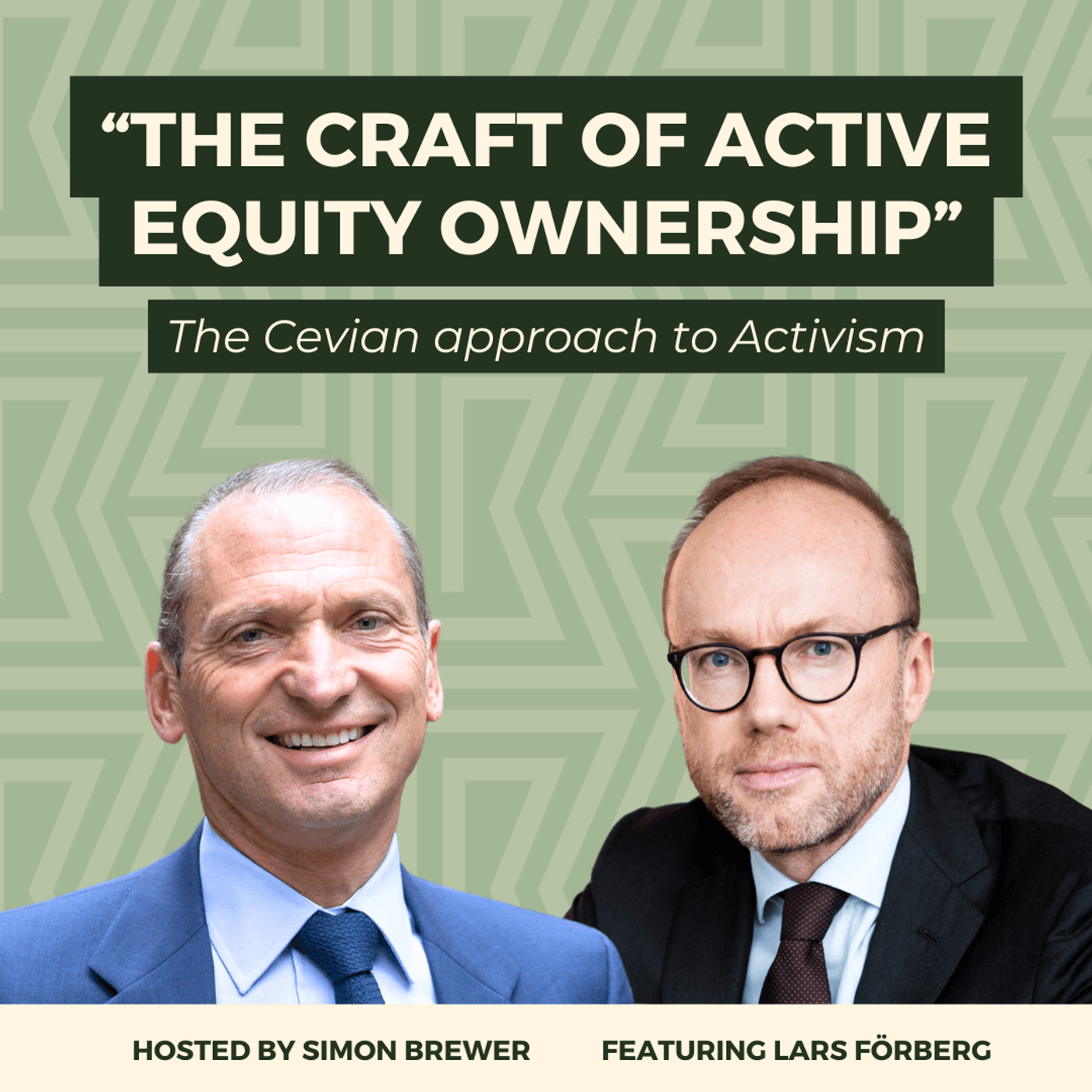
Lars Förberg, Managing Partner & Co-Founder of Sevian Capital. Background: studied at Stockholm School of Economics; exchange at Ross; read Michael Jensen’s 1990 paper “The Eclipse of the Public Corporation.” Began career in management buyouts/leverage buyouts (joined a firm as first employee). Previously worked at Nordic Capital; later co-founded Sevian (2002). Has interacted with Carl Icahn (tennis-court introduction via partner; Icahn invested and became an early fund investor).
Key claims
Public-market investors are passive, myopic, and under-informed, creating an “owner” opportunity. Sevian concentrates (avg ~12 holdings), invests only after deep research (often 5–15 years of monitoring), and targets 5–7 years for operational change. They avoid industries where forecasting is impossible (e.g., biotech) or where exogenous shocks dominate.
Notable examples
ABB board engagement (board member asked to act “as if owning 20%”); early investments referenced: Panalpina and Munich Re. They claim no proxy fights; exit “takes care of itself” when companies become great.
Written by AI. May contain mistakes. Listen to the episode to check what was said.
Chapters
Tap a time to open that second in VOMarket Flaws and Active Ownership Strategy
0:00 to 1:05
Learn how the flaws in public market behavior can be leveraged for active equity ownership.
“The investors in the public markets are typically very passive, myopic and under-informed.”
Sevian Capital's Unique Approach to Activism
1:05 to 2:19
Discover how Sevian Capital differentiates its activism from others in the market.
“Activism might be one of the less helpful terms in modern investing a label that conjures up everything from border and bust-ups to terse exchanges between shareholders who are disgruntled and incumbent managements.”
Lars Förberg's Journey to Active Investing
2:25 to 3:37
Explore Lars Förberg's career path and his insights from studying corporate governance.
“Just give us the highlights of your journey.”
Influences of Carl Icahn on Lars Förberg
3:37 to 6:18
Learn about Lars's experiences with Carl Icahn and the lessons he gained.
“So you and I had a conversation at iConnections in Miami.”
The Role of Activism in Corporate Change
6:18 to 7:45
Understand the impact of activism on corporate governance and its benefits.
“And I wondered, you know, the extent to which academic papers are now being written about this, whether it surprises you and whether you've had any thoughts as you read them.”
Sevian's Strategy: Long-Term Value Creation
7:45 to 9:14
Examine how Sevian aims for long-term value creation through ownership.
“You can come back to why I say that if you want to.”
Insights into Sevian Capital's Structure
9:14 to 10:12
Get an overview of Sevian Capital's operations, team, and size.
“that means that our intention is, and the outcome is, that the companies become better.”
Identifying and Filtering Investment Opportunities
10:12 to 14:00
Discover how Sevian Capital identifies and filters potential investment targets.
“Let's talk about one of my bugbears of the industry, which is short-termism.”
Identifying Attractive Investment Opportunities
14:00 to 15:19
Learn how to spot underperforming companies in attractive industries for investment.
“So it could be companies that have, let's say the average of the players in an industry have a 15 % EBIT margin and the company we look at has an 8 % margin.”
Navigating Industry Changes
15:19 to 17:14
Understand the types of industries to avoid and those to pursue for investment.
“Can we find a value creation plan that's going to work?”
Show all 26 chapters
The Process of Monitoring Potential Investments
17:14 to 19:38
Discover how companies are monitored over time to identify the right investment opportunities.
“So staying without screening, the industry identification, I understand.”
Engaging with Management Before Investment
19:38 to 22:33
Explore the importance of understanding a company before making an investment decision.
“Because then you're like, when you always have an alternative where to put the money, you become a better investor, I think.”
Conversations with Company CEOs
22:33 to 26:04
Learn about the dynamics of discussions between activist investors and company management.
“You know that company as well as probably anybody else sitting in the boardroom, probably better.”
Leveraging Boardroom Dynamics
26:04 to 28:00
Understand how investor involvement in boardrooms can influence company strategy.
“Can you give us an example of maybe something that's in your portfolio currently where this process has been going on and where it's relevant?”
Understanding Resistance in Active Equity Ownership
28:00 to 29:39
Learn how resistance in equity ownership is addressed and the importance of constructive dialogue.
“Also because, you know, for me it's super important that ABB is going to be a great success.”
The Importance of Governance and Reputation
29:40 to 31:24
Explore how governance and reputation influence the approach to active equity ownership.
“but I'm not going to try and avoid your question here.”
Navigating Challenges and Lessons Learned
31:25 to 35:08
Discuss the challenges faced in investments and the lessons learned from past mistakes.
“That gives us a lot of credibility, which is important.”
Strategies for Successful Exits in Equity Investments
35:09 to 37:55
Understand the mechanisms and considerations involved in exiting equity investments.
“We haven't had to thereafter, but it can happen, of course, in the future.”
The Role of Private Equity in Governance
37:56 to 41:41
Analyze the governance model in private equity and how it compares to public equity strategies.
“seven years from now and sort of really go for that target.”
Investment Environments: Europe vs. the US
41:42 to 42:00
Evaluate the investment climate in Europe compared to the US, focusing on valuation and governance.
“In reading some of your papers, although you do not invest in the US, you were quite clear that Europe appears quite fertile and probably more fertile than the US.”
Valuation and Governance in European Markets
42:00 to 43:30
Learn about the valuation differences in European equities and the governance environment for activism.
“when you are discussing change with management?”
Private Equity vs. Public Markets
43:30 to 46:15
Explore the shifting dynamics between private equity and public markets and the complexities of investment stability.
“I mean, I left the private equity industry in 97.”
The Challenges of Activism
46:15 to 48:30
Discover the difficulties and strategies for successful activism in public companies.
“I suppose my question would be, why aren't more people doing it?”
The Role of AI in Investment Strategies
48:30 to 52:30
Understand the limitations and potential of AI in diagnosing company problems compared to active ownership.
“Yes, we were experienced in some ways in private equity and consulting and other things, but not in that role.”
Future Vision for Active Equity Ownership
52:30 to 54:58
Hear about the long-term goals and the continued importance of active equity ownership.
“So these are not sort of, so the difficulties, of course, to identifying what exactly should be done with the business.”
The Need for Active Equity Ownership
56:01 to 57:21
Explore the importance of active ownership in public markets and the impact of investor behavior.
“and have to perform in a relative world, you really think about the absolute requirement and expectation when you make these investments.”
Transcript
Automatic transcript. May contain errors.0:00Lars Förberg:The investors in the public markets are typically very passive, myopic and under-informed. That means that what we can utilize is exactly that. Our strategy is designed to use those flaws of the market, if you wish, where we can act as an owner, where the market is myopic, we can think in five, ten year perspectives, and where the market is highly diversified and is owning lots of companies so nothing is important to them. private equity is now an incredibly competitive business where almost everyone in private equity is acting the same way. They look the same. They talk the way they think the same way.
0:36Lars Förberg:They have the same advisors and so on and so forth. Everything is similar, which means, I mean, if you've studied microeconomics, everyone knows that if you have full competition and everyone, there's no edge anywhere, then you won't be able to outperform. And I think that's a little bit where private equity is going. Of course, there will be some private equity funds that are better than others. but we have the benefit that we have not only a high value added strategy but also with very limited competition. Activism might be one of the less helpful terms in modern investing a label that conjures up everything from border and bust-ups to terse exchanges between shareholders who are disgruntled and incumbent managements.
1:18However not all activism is equal and both at our own Money Maze Allocator Summit last year, and this year at iConnections in Miami, I've had the chance to observe, understand and listen to Sevian Capital, Europe's largest dedicated active ownership fund. Their approach has appeared to us to be neither opportunistic nor headline-driven. In fact, publicity shy and long-term. It appears to be methodical, deeply researched, relentlessly operational. Today, we wanted to test that thesis and understand what activism actually looks like when it's long-term constructive and executed with discipline. How does Sevian decide where it can create value?
2:00Who do they work with, not against? What does effective stewardship mean in a world where corporate complexity, governance expectations, and capital allocation pressures are rising at once? To help us understand these strands, we'd like to welcome Lars Forberg, co-founder and managing partner of Sevian. Lars, welcome to the Money Makes podcast.
2:20Lars Förberg:Thanks, Simon. Right. A voyage from Sweden to Sevian. Just give us the highlights of your journey. Of my journey. I think maybe a key thing in my life in terms of where I ended up in my work was I studied at the Stockholm School of Economics and I had an exchange in the US at the Ross School of Business. and I read a class called Corporate Governance and Control. And I read a seminal paper by a professor at Harvard called Michael Jensen. He had just written it the year before. This is in 1990. I was reading it. And the headline was, or the name of the paper was, The Eclipse of the Public Corporation.
3:04Lars Förberg:And he basically foresaw the growth of private equity. And I read a lot about private equity at the time. Well, actually, it wasn't called private equity at the time. That word didn't exist. it was called Management Buyouts and Leverage Buyouts. I read about that. And then when I came back to Sweden in 1990, end of 1990, I looked for jobs. And I saw that there was a firm that had started within Management Buyouts. And I called them up and asked them to, if they needed someone, and I joined. Just as the first employee, there were two founders. There was me and there was an assistant. And that's how my investment journey started.
3:37So you and I had a conversation at iConnections in Miami. And you mentioned that when you had got going or early in your career, you'd got to know and you had exchanges with Carl Icahn. Now, for those who are not familiar, probably Carl Icahn is one of the most successful hedge fund managers of all time. Just give us a little context as to why you happened to be talking to him and what you learned from him.
4:04Lars Förberg:That was probably eight, nine years later. This is now the end of the 90s in 97, 98, 99, something like that. And my partner, Krister Gardell, and I were running a listed holding company in Sweden where we started the strategy of Sevian. We had not heard the terminology activism at the time. Basically, how we saw it was private equity in public companies. I'm going to answer your question about Carl, but I want to give this background a bit because when we ran that company, we had both worked together at Nordic Capital in Sweden, a private equity firm. And we had looked at a number of listed companies as private equity guys and looked at taking them private.
4:49Lars Förberg:They were sort of good sound companies, but undermanaged to where they could or should be in terms of their operations. So maybe a margin of 10%, whereas competitors were at 20 % and lower growth than others and so on. So we wanted to take them private. The problem was that in order to do that, to get 90 % and squeeze out the minority, you need to pay a very high premium, which is difficult. You have to pay a high price, or the company was not for sale at all. So then when we were managing Kustos in the mid-late 90s, we said, why don't we, instead of taking a company private, we go in, build a position of 5%, 10%, 15 % in a company and run it the way we would have done with a private company.
5:35Lars Förberg:I think about how do we make this company much better over, say, a period of five, seven years. So that's sort of the start of our strategy, the activism, as you call it. We didn't know that was activism at the time that it was. To get to your question, Carl, actually it was Krister, my partner, who met him on the tennis court through another friend. They got to know each other personally. And we had some great investment ideas that we broached with Carl. And he invested and he made some money. And he then also became one of the first investors into our fund when we started Savian in 2002. I've got a couple of high-level observations questions before we get into the engine room.
6:23One is in some of the academic papers that have been written about activism, there have been the observation that it's highly supported by the investment community, number one, And there is this spillover effect as well, that it helps other companies in the sector. And I wondered, you know, the extent to which academic papers are now being written about this, whether it surprises you and whether you've had any thoughts as you read them.
6:49Lars Förberg:It doesn't surprise me. There is, in the public markets, there's a lack of owners, right? I think this is one of the problems with the public markets that when you go to business school, what you learn is that if you're an investor, you should diversify your portfolio. You should be on the, I don't know what it's called, the capital asset pricing model. You should sort of diversify it and hundreds of whole things and do something. And this is what pension funds do. This is what mutual funds do, most private family offices and so on and so forth, which is understandable from their perspective. But what it means is that there's a lack of owners of listed companies, right?
7:26Lars Förberg:And that means that everything is fine as long as management board are going in the right direction. But once that's not happening, there is the correction mechanism on making sure that the company, from an owner's perspective, making sure that the company is going direction that sort of long term going to be beneficial for owners. That mechanism is not really working because the investors in the public markets are typically very passive, myopic and under-informed. You can come back to why I say that if you want to. But not everyone, of course, but most of them are. And that means that what we can utilize is exactly that.
8:06Lars Förberg:Our strategy is designed to use those flaws of the market, if you wish, where the market is not as an actor and an owner. We can act as an owner. Where the market is myopic, we can think in five, ten-year perspectives. and where the market is highly diversified, in instance, owning lots of companies, so nothing is important to them. Our strategy is set up that we only make a few investments. We have an average 12 companies in our portfolio and maybe hold them for five, six years on average, making two investments a year, which means that everything we do is important to us, right? So we're taking those negatives of the market and turn them in our favor.
8:46Lars Förberg:And of course, that means that we can be that, that entity, that owner that comes into a company that is not really doing that well, being the catalyst for change in the right direction, which creates, of course, money for our investors, but for all the shareholders of that company. And since our perspective is that what we want to do is we want to make the companies we invest in sustainably better for the long term, for all the shareholders and all the stakeholders, that means that our intention is, and the outcome is, that the companies become better. So I'm going to explore a number of those items in two seconds.
9:26But talking about Sevian Capital, give us the high level, genesis, growth, locations, assets, employees.
9:37Locations, Stockholm, Zurich, London are the key locations.
9:41Lars Förberg:We invest in northern and western companies in northern and western Europe. The fund size is 16 billion. We are close to 60 people in the firm, out of which half, 20, 27 people are on the investment team. Quite unusual is that 13 of those are partners with an average tenure at 17 years. So we're a pretty broad, wide team that has worked together for a very long time. Okay. Let's talk about one of my bugbears of the industry, which is short-termism. And I know you've written about it. So obviously I smiled when I did because, read it that is, because, you know, research reports are put out there by investment banks with six-month targets.
10:26And, you know, in some ways you go, really? You know, and just as I like to look back a long way, particularly through charts, to understand, you know, I'm conscious there was Winston Churchill who said, you know, the further back you look, the further ahead you can see. Although somebody reminded me, John Paul Getty, and said at times of great change, memory is unhelpful. However, just let's think about timeframes. You know, when you're asked that question is what do you expect when you invest? We're going to talk about how you get to the investment. How do you think about timeframes?
10:59Lars Förberg:certainly not six months i mean the the the six months question is like as you say investment banks and others think about it's like to me it's like how do i forecast a share price of a company six months ahead that's that's close to 100 psychology of the market and anything like that and you will not you will be if you try to do something like that you would part you will be thinking more about what other people think than what you think yourself we're doing exactly the opposite. We're getting to our own conviction about the future, but we apply that to, say, five, 10 years. We want to invest in a company with at least a 10-year horizon in terms of understanding what's going to happen to this company and its industry, right?
11:40Lars Förberg:And I think, actually, that question is much easier to answer what the true value of a company is going to be, say, five, seven years from now, rather than, or that kind of timeframe, rather than saying what the share price will be. And we know in the long run, in the long run, the share price will reflect the true value of a company, not in the short run, but in the long run. So if we're looking for not the share price, but we're looking for the true value, we know at one point in time, that's going to be reflected in the share price. So it's an easy, it's an easier thing to do. But the second thing, of course, is combined with our strategy, because we're a change agent, we want to change companies, that does not happen within six months, it doesn't normally doesn't happen within three years, it normally takes five to seven years to truly change a company from being good to being great or from being okay to being good.
12:29So that's classic Benjamin Graham without the activism in terms of the voting and the weighing and the two different approaches that
12:35Lars Förberg:describe defined markets. Let's get to the identification and filtering. Low turnover, a concentrated portfolio long term. Just talk me through how names get onto your radar screen and how they're filtered. So we look at companies in, as I said, Western and Northern Europe, where we are, there's our home markets, where we know how things work, governance works, we know people and so on and so forth, which is quite important since we are, after all, we're an activist, we want to change companies, right? And then you need to be really good working with people and work with people. You need to know people well.
13:16Lars Förberg:So that is sort of the geographical area we look for in terms of where the company is based, but mostly they're global companies. We look for industries that we want to own. So we avoid industries where we don't think long term are attractive for shareholders. We are also very risk averse. We want to make sure that we have a tailwind in our investments rather than a headwind when we do our change program. That means that many industries fall away because we can't forecast them or because they might change too much because of technological change or new competitive dynamics and things like that.
13:51Lars Förberg:So industry selection is incredibly important, both in terms of downside protection, but also an ability to, as an owner, make good returns over time. In those industries that we identify as attractive to invest in, we look for companies that are underperforming, even though they might have good products and services, good market global reach, but they're underperforming, typically because of some bad decisions that have been made over the last five to 10 years in terms of how they organize themselves, what the kind of business they do, or they're just not good enough on executing their business.
14:28Lars Förberg:So it could be companies that have, let's say the average of the players in an industry have a 15 % EBIT margin and the company we look at has an 8 % margin. Then, of course, we're looking, okay, it's an attractive industry. The company has a good, actually, products that the customers want and are going to want over the next 5, 10 years, 15 years, but they're underperforming. And then that company is also normally trading at a low price, right? Because the laggard in an industry is normally trading at a lower price, both in terms of even on a multiple basis, even though there's sort of potential on the upside.
15:07Lars Förberg:So we then have a company in an attractive industry trading at a low price. And then the question is for us, can we do something about the problems of the company? Can we find a value creation plan that's going to work? And will we be able to implement it? And if that's the case, attractive industry, low initial price, and a broad change program that we can implement, then it's really an investment for us. Okay, so let's just stay with the industry level. There is disintermediation all around us. There is, you know, more change perhaps than we, any of us have experienced as investors. Give us a sense of the industries that are not ones you want to do any work on and those that you feel pretty comfortable have these characteristics you talked about?
15:56Lars Förberg:Yeah, I mean, we could start with an extreme, like a biotech company, right? Either they find the protein for the molecule for the drug or not, right? We can't forecast it. We're not better than anyone in forecast. We cannot do anything about it. We cannot price it. We don't know what's going to happen. That's not for us. It's a clear extreme. But there are other companies that would be, you know, industries that are going through a change where the competitive dynamics are going to change. we don't want to be it's it's too and where they might change to the worst right if they might change to the better totally fine but whether they might change for the worst for the entire industry or for the player we're looking at we'll stay away from it um and we stay away from companies that are too dependent on exogenous factors like we're talking now you know like say swings in raw material prices or maybe companies that have too high many times companies with too high fixed cost base is problematic and and and capital investing uh where if there's a downturn you often have to fight for volumes through lowering your prices we want to make sure that we invest in companies and industries that where our company will have uh through a cycle through whatever happens good pricing power i.e selling something that the customers are willing to pay for a good price for so i want to test a thesis on you sir chris home spoke at the money maze allocation somebody's been a guest twice he said and i'll quote him good companies stay good and bad companies stay bad and i'm just going to say please comment um i i understand where he's coming from and it's it's uh it's a general proposition that's normally correct right but on the other hand what we're what we're doing and what we have been successful in doing is taking companies that are not that great and make them great and be part of making them great of course it's sort of the management team and and the chairman that are the that are going to do the the main job right but we're the catalyst of that change and laying out the direction of what's going to happen so i've seen many situations many companies in my life that have gone from uh that i've been active in where i went on the board they've gone from a okay company to a great company so i um i think as a passive investor i think that's probably correct and that's how i would also think as a passive investor because i wouldn't be be able to change it right but we are um we are going into companies where other people say we would invest in this if they change but there but other people are not that catalyst for that we're the catalyst for that change right we're master of our own destiny and we can make companies better so um it doesn't mean it's easy it also means that there are many situations that we shy away from there can be that we see okay this company could become much better but But the process to get there is way too tough and way too risky.
18:46Lars Förberg:And we don't want to take on that risk. So staying without screening, the industry identification, I understand. The thesis you've just alluded to, I also understand. How many companies would you typically, as new potential candidates, would you look at each year? We monitor a couple of hundred companies. We do that over many years. typically when we invest in company, we have looked at it in depth over maybe a five or 15 year period. So it's not that one day we wake up and three months later or six months later, we have made an investment. We track our, we know, you know, as I said, through the funnel, we know which industry and what companies we are monitoring and we should monitor.
19:28Lars Förberg:And so there's a pretty big group of companies that we monitor. And I think one of the key things to be, for us, part of our strategy is to always make sure that we have a pipeline of new investments that are sort of knocking on the door to become better than the investments we have in the portfolio already. Because then you're like, when you always have an alternative where to put the money, you become a better investor, I think. so we we do that through a uh process oriented force rank every force ranking process where we force rank the portfolios we now have in the portfolio against the pipeline we have and when i say the pipeline i'm not talking about these couple hundred companies i'm talking about those companies that have those um characteristics we talked about like right industry but also in terms of underperforming where we have a change change program when the price is low so you're You're comfortable with the industry.
20:29You've done the screening. You've narrowed the names. There's a name that you're really interested in, a company that you know well. Take me through what happens next.
20:40Lars Förberg:Are you talking about the time where we're basically buying into it? Yep, yep, yep, yep, yep. Is it buying the shares first, then having a conversation? Is it just, I'd like to understand practically what happens? And it may happen. When we start buying into a company, we have spoken to, you know, 100, 150 people in that industry, deep sessions with various players so if we invest in company a we have by with a very high probability spoken with the CEO of competitor B competitor C competitor D across the globe with the most important customers of the company with suppliers of the company of course with the incumbent management team but also the management team we invest in but also previous management team members, divisional head members and so on.
21:28Lars Förberg:So we've done over many years, done that sort of homework, which means also that the management team of the company we invest in, they know us because they've seen us, they met us a number of times and we know them before we start buying a single share. So we don't want to buy a share in a company before we have done all of our homework and we feel that, I want to be able to feel that I know what I would do if I were the chairman of the company. You know, activists sometimes to some people mean that, okay, we do one thing in the company and it's fine, you know, spin out a division or something else.
22:06Lars Förberg:I, you know, I don't know. We don't think that way. We think that we want to have a broad plan of various things, various levers we can do in terms of governance, strategy. Governance is sort of a euphemism for changing border management, basically, or it could be structure, It could be strategy, operations, and have a view of the entire company. What would we do? Unless we can answer that question, we're not going to invest in the company. Take me into the CEO's office. Yes. You now have bought stock. They'll be aware. You're going to have that conversation. You know that company as well as probably anybody else sitting in the boardroom, probably better.
22:47How does that conversation flow?
22:50Lars Förberg:It flows quite well. It flows well. First of all, we met the CEO a number of times before, typically. We will tell the CEO, you know, and he or she has sort of an understanding how we operate. Typically, such a CEO and the chairman of a company, they have spoken to other chairmen and CEOs that we have as sort of running companies where we were the anchor shareholder in the past. So they have probably done their homework as well to understand who are we, how do we act. which I think is good. That means that we can have a very factual, non-emotional discussion about where the company should go. We talk about what are the issues we see and what are the things that couldn't be done about them.
23:40Lars Förberg:But, you know, those meetings include a lot of listening rather than talking from our side. It's not that we're getting into the room and saying or sending a letter or posting a letter on the Internet or something. We've never done that, you know, saying this is what the company should do. It's a dialogue, right? And I think it's the listening cannot be overestimated how important it is. As an aside, I know you're quite private because I couldn't find anything about you on LinkedIn, which is unusual and, you know, perhaps a virtue. But you will listen and you will hear things that may or may not surprise you.
24:20but you will also have in your mind the levers that you would like to have pulled.
24:26Lars Förberg:Sure. You're going to meet resistance at some point, I imagine, because those suggestions may not be new to the incumbent management. Just flesh out how that, I'm using the word tension in a loose sense, how that typically evolves. Sometimes there's resistance, sometimes not. And then what we want to do is we focus on the issue at hand, not at the personal issues or personal characteristics or something like that. It's really talking about, you know, identifying, first agreeing on, you know, what are the issues? What are the problems, right? And is this company performing as well as it should or not?
25:12Lars Förberg:And that's a very important starting point before you start talking about the solutions. But normally we would join the board of the company and we would work from the inside of the company, collegially with the other board members to pursue our agenda, the agenda that makes sense for the company to embark on that we think. But again, that would be as a board member. Yes, we would have an advantage in the sense that we have more information. We would have an advantage or at least much more skin in the game because we have a big ownership position. But of course, it typically works mostly through the boardroom or in the boardroom.
Read the full transcript
25:54Lars Förberg:In parallel, there's a discussion. Our board member in the company would have a dialogue, a very close dialogue with the CEO primarily, but also with the chairman often. Can you give us an example of maybe something that's in your portfolio currently where this process has been going on and where it's relevant? I'll give you an example in ABB. I of course want to get to know all the other board members that I'm going to work with so I was sitting down with one of the board members after I had joined the board we're sitting in a vegan restaurant in a simple restaurant in Zurich and he's a great person a CEO of a big listed company global company out of the US and he said to me Lars what do you want me to do for the company and i said hey i want you to think about your board role here as if you're if you as if you own 20 of the company and you were the chairman of the company what would you do what would you do and then push for that and he looked at me and he's like wow you know and sadly thought for a while it was a pause of maybe 30 seconds or one minute and said like i would do x i would do y i would do z i said great i think that's exactly what we should do and we should i think there's some other things as well but then he looked at me and said like but lars i have a day job this is uh this is a transformation i can you know i can i can i can if you want to do this he said i want i'm going to support you i will support you but don't expect me to drive this and i think this shows how you know there's a lot of great people on boards of listed companies really really good people they're ceos that have great experience achieved a lot of things in their life or cfos or similar but it is their day job right they it's not their day job they have other things they want to do they fly in for meetings maybe six times a year they can spend a couple of days ahead of every meeting at best don't understand things i can spend this is my day job i have a team of two people following abb on a daily basis traveling the world meeting with the competitors with customers understanding technology development and so on giving me that information so it's like we have an upper hand in the boardroom but it should not be construed as an upper hand that we can sort of use in a, what should I say,
28:28Lars Förberg:in pushing our wish on others, but we can contribute in a different way. Also because, you know, for me it's super important that ABB is going to be a great success. It's maybe a 2 billion investment, 15 % of my fund. I'm really going to make sure that this company is going to thrive, right? Does private equity have an advantage in that it owns the entity typically outright and therefore its powers of execution are simpler? I think so, yes. Because you have a private equity approach to a portfolio of listed companies, even though your timelines are, you know, maybe they're similar, I don't know, maybe they're longer actually than the private equity world.
29:20But what I suppose intrigues me is when you meet resistance. And I'd like you just to talk a little bit about how you deal with it. And then there's a secondary issue where for whatever reason, it hasn't worked.
29:39Lars Förberg:Let's come back to private equity as well, because I think that comparison is interesting, but I'm not going to try and avoid your question here. If we meet resistance and it cannot be overcome by normal discussions, we think then there's something wrong. Something wrong with the people. That doesn't come up right, right? But that there's, and, you know, that's after a lot of discussion. We might think that, no, there should be a change of board. There should be a change of CEO. There should be a change of other people, right? And then we try to move ahead with that.
30:20Lars Förberg:But again, we do that not in this sort of American activist way of screaming and shouting and embarrassing people, right? It's done in a constructive way. It's behind closed doors. It's done. If it is change of management team, it's done collegially in the boardroom normally. if it's change of board members, it's something that we bring up with the governance committee of the company and move that forward. And we've been able to do these things without ever having a proxy fight. We have been on the board of the vast majority of the companies we've invested in. And without having a proxy fight, we've made changes to other board members without having a proxy fight or coming into the public domain.
31:07Lars Förberg:And I think that's a testament to partly our style and how we want to operate. It's a testament also to that the governance environment in most parts of Europe is actually quite conducive to our strategy. And it's a pretty good environment. But it's also a testament, I think, to our reputation that we've built since 1997 of always doing what we think is right for the company rather than something that's good short term for shareholders. That gives us a lot of credibility, which is important. So the situations where either you're deeply frustrated or your calculations haven't been right, talk a little bit about how you've responded.
31:56Lars Förberg:Well, I think the not being right happens. And this is a reason why when we think about our value creation plan, it should consist of say, you know, eight to 12 different important things, because we know that all of them will not be implemented. We might be wrong. It might be various barriers to doing something, but often we find a couple of other things we can do as well. So we sort of, but but that happens and that, you know, that, that, that, that will, that will be, that fact finding happens sort of with the dialogue in the boardroom or with the management team and, and the chairman But that means that we will not invest in a company with just one big idea.
32:39Lars Förberg:And if it works, it's great. If it doesn't work, it's not great. So it's like that's how we operate with the change program. So, of course, there are, you know, this is difficult. You know, it takes a lot of research. It takes a lot of work. And we don't always get things right. but we get our batting average in terms of our value creation plans is very high. And I think it's because of our research but also because we, I see other people that try to emulate us, trying to raise funds and maybe raising funds and I look at their change programs and sort of like hear about them and they sound like, you know, some things that would be great on a PowerPoint, in a PowerPoint presentation, but when that PowerPoint presentation hits the real world, it won't work.
33:33Lars Förberg:And I think this is one of the core secret sources of what we're doing. That is sort of implementable. It's practical. So you've had this terrifically high success rate, but where it has occasionally not worked, how long do you think you might give the opportunity before you say, okay, we have to you know move on we don't really do that uh we are incredibly determined um to to make it work and uh that has been a great benefit or we don't give up um and uh that culture is very strong in what we're doing it it might mean we we sort of compromise on something or we delay something or we do something else but we don't give up um that has actually been uh been in one situation a negative and the one investment we made that turned that sour um 13 40 years ago to St.
34:32Lars Förberg:Krupp in Germany we should have given up uh we should have given up and sold our shares actually at a gain we we lost money in that in that investment and um with too much tenacity in a sense in in and there was resistant political issues governance issues and other things that made it possible to drive through the chain programs at the speed and with the right measures. And a lesson learned for me from that situation was that, okay, our determination is great, but we should sometimes be, also be able to walk away from something. We haven't had to thereafter, but it can happen, of course, in the future.
35:18So I want to talk about exits, and this might give you your opportunity to come back to the PE issue that we haven't completely finished on. You own an asset at a company for a number of years. The change program is working. The market is recognizing. The valuation uplift is happening. What are the typical triggers for the exits? and I mentioned the private equity because of course one of the criticisms might be that a good company sits in a PE fund and then it's time to wind up the PE fund. Now we know we have all sorts of other mechanisms that are going on for continuation but primarily how do you think about exits?
35:59Lars Förberg:Mechanically, if you wish, the way it happens is through the forced ranking process I talked about where we have sort of new potential investments that knocking on the door and wanting to come into the new investments So it means that we don't have a set target in terms of time or share price or something like that. It's an ongoing process, that forced ranking process. And typically, the selling process is not problematic. And the reason is, and should be, that when we enter a company, we play a role. Like we're the catalyst. And that's also reflected in when we announce a position or a flag for us that the share price always goes up more than the market sale on average.
36:39Lars Förberg:around five, 6%. When we sell out, that doesn't happen. The same price effect in the other direction because we are and we should be superfluous at that time. We should, if we've done our job, we should be unimportant for the company. The company should have a great strategy, great management team, great board, great prospects. And that's our ultimate goal, of course. And then exit takes care. The exit takes care of itself if we're successful with the value creation plan. Okay. And the bearishness that perhaps presided in the beginning has now become bullishness. And, you know, bullishness stays until it doesn't work.
37:21Lars Förberg:Yeah, yeah, yeah. And of course, there's timing involved in terms of that, you know, the market might, you know, the market goes in, you know, there's a lot of herd mentality in the market. So it's not only this sort of value, the value creation is one driver, but the other thing is also sort of the overview of the capital markets of the company and industries we're in. Have I given you the chance to come back on private equity? You asked me about if that's a better governance model. In a sense, it is a great governance model because you can really, as an owner, you can influence the company. I think the, but, and we try to emulate that in the sense that we, you know, get the board together to, in a company's way to try and think less about quarterly reports, think about how the company's perceived and think about more what we want to be five, seven years from now and sort of really go for that target.
38:11Lars Förberg:But I think the advantage we have is that to private equity lies in another area is that private equity is now an incredibly competitive business where almost everyone in private equity is acting the same way. They look the same. They talk the way they think the same way. They have the same advisors and so on and so forth. Everything is similar. which means I mean if you've studied microeconomics everyone knows that if you have full competition and everyone there's no edge anywhere then you know you won't be able to outperform and I think that's a little bit where private equity is going of course there will be some private equity funds that are better than others but we have the benefit that we have not only a high value added strategy but also with very limited competition so bull and bear markets are part of the natural topography of the world in which we live.
39:02And so my question is about alpha and beta. You're trying to find the companies that you describe that will deliver material outperformance versus cash risk-free, the world index. What do you say to the question of how should you be benchmarked or judged?
39:25Good question. I think the way we think is absolute returns.
39:31Lars Förberg:That's how we operate, right? And I think it's a great way of working in the public markets. I, you know, as we talked about, there's a herd mentality out there. Sometimes one industry is in vogue, some kind of company is in vogue, and others are like, so we can use that to get into companies and industries at a time where they're out of fashion, if you wish. That can be used. But over time, of course, we need to beat the index, the market index. Otherwise, we're not adding value to our investors. But that is not, if we were thinking, how do we beat the market this year or next year or three years from now, we would be a Laos investor.
40:21Lars Förberg:I learned this very clearly in 1999 when, you know, 1999, and we had a Swedish-centric investment strategy then. The Stockholm Stock Exchange was up 60 % that year. And I remember walking through the city of Stockholm in the fall of 1999, I was thinking, like, how should I think about this? we were underperforming. I don't know how much. We were up quite a bit, but I mean, way below those 60 % maybe. And I got to the conclusion that we've been doing a good job. If we had been performing according to market, we would have done a bad job because we would have been highly speculative. So it was a great understanding in the middle of that underperformance to recognize that it's important not to have FOMO when you're an investor.
41:21Lars Förberg:And then, of course, we outperformed many, you know, the year, many, many years thereafter, all the years thereafter. And I'm betting that the reason you underperformed the index was you didn't have Ericsson, just as people in the UK who didn't have Vodafone. That's what I think. But it was the overall intimate problem, but that's true. Ericsson was one of them. But there were many other things in the market that sort of led to those 60%. In reading some of your papers, although you do not invest in the US, you were quite clear that Europe appears quite fertile and probably more fertile than the US.
41:54Can you explain if that is the case? And also, is it an easier climate in which to operate when you are discussing change with management?
42:07Lars Förberg:There's very parts of this question. One is valuation. I think it's, of course, great that European equities are under, you know, are cheaper than the US. If you look like for like, maybe a discount of 30 % or something, which is great. As an investor, if you buy something, you want to buy it cheaper. If you have a 33 % discount, that means if you can close that gap, it's a 50 % upside. That's an amazing amount of money. So it's attractive at this time for that reason. But the other part of your question was more, I think, governance related, if I understood correctly. I think Europe provides all the markets we're in in Western Northern Europe, with the exception of Germany, provide a very good governance environment for an engaged owner, for an activist to be involved.
42:55Lars Förberg:there's like true shareholder democracy in the sense that decisions are made at the shareholders meeting by way typically you know 50 50 majority which is also true for electing board members and they're typically elected on an annual basis not a staggered basis so it gives us the governance tools in in europe are very uh conducive to what we're doing when we started this conversation you gave quite a good description of the problems of the public markets which are not exclusively but in some, to some large degree, have not been helped by passive and the lack of investor interest. Just look forward.
43:33This is a non-Sevium question, but how might the, with the euphoria that surrounded private equity that is now being checked and the disappointment in some, you know, listed stock markets outside of the US, how might we roll forward here in the, I suppose, the influence of private versus public markets?
43:59Lars Förberg:I mean, I left the private equity industry in 97. I was a bit too early to think that it was going to be coming to a competitive, right? It's like, it's been up until maybe 10 years ago, quite an attractive market. I think it's less attractive now for sure because of the amount of competition. I also think maybe investors in private equity fool themselves when they think it's a more stable asset class because it's sort of marked in a different way than the public market especially since actually the private equity investments are typically geared much more than the public companies and so it's much more volatile and therefore can also but but it can sort of continue to do well for longer before problems are really seen because of of how things are marked.
44:48Lars Förberg:So I think it's a, it's, I would be a bit vigilant or close to paranoid if I invested in private equity and think about, you know, what's really underlying in terms of assets. We are, you know, we have no leverage. We have no shorting, no funny financial instruments. the companies we invest in we actually they're typically over time become better capitalized the net debt to ebda today of our portfolio is about 1.3 much more much better capitalized than the overall market we are as a firm very risk averse we want our return to come from astute investment decisions but primarily from the change programs of our companies right and we don't we want to be strong when others are weak that has helped us in many situations in the past as you say there's uh there are bull and bear markets and we survived many bear marks actually we thrived through those and made very good investment decisions in the bear markets and can utilize them and if you're if you're levered that's very difficult if you have money that's short term in your fund that's also very difficult so we sort of put our structure up in a way where we can be utilize those times when the markets are down.
46:13If I'd been in a lecture room and I'd listened to you reflect on your business, I suppose my question would be, why aren't more people doing it?
46:23Lars Förberg:Yeah, if you'd asked me 20 years ago, I would think we would have many competitors. I'm a bit surprised myself. I mean, every year there are some people that start funds or try to start funds that are similar to us. But, you know, there's an issue, a little bit of chicken and an egg issue. To be successful in what we do, you need to have a lot of capital and you need to have it tied up. And you need to have a reputation, sort of good reputation, a solid track record, both in order to raise money, but also especially to raise long-term money. And it's a chicken and egg thing. It's very difficult to get there.
47:02So Lars, I'm going to move towards some concluding questions, but two things have sort of stayed with me is that you've been at this for 20 years. The environment's changed, as evidenced by that survey I mentioned early on. Activism, as you practice it, would have been quite alien when you started out. How would you describe the landscape and the responsiveness of investors since you began?
47:27Lars Förberg:It's changed quite a bit. for sure. I mean, we were talking, actually when we started with the strategy, this was a few years before Sevian even, so this is 96, 97. It's almost 30 years ago. And we were the new kids on the block. We were coming into public companies. This was started in Sweden. And these guys are coming in and saying that this is not good enough. Things should change. And of course we had to prepare immensely for this in order to win those battles win those discussions and have people support us because if you're a minority investor as we are you have five ten fifteen percent in the company um you basically the power comes from three different things right one is you have to identify the problem of a company there has to be a problem but you also have to have a solution that works and that means that for and then you have to have credibility these things you need to have in power i mean it's politics it's but for our strategy as well as so we had to do very very deep research on identifying the problem of a company and very very deep research on making sure that we found the solutions that would really work because we We were, as I said, we were new to the game.
48:58Lars Förberg:Yes, we were experienced in some ways in private equity and consulting and other things, but not in that role. And I think that was great for us to have this sort of very tough bar to get to because it made us really work incredibly hard to find answers to these questions, the problem and the solution. And the credibility came then as a consequence of our handle too. And over time, of course, 70 investments since, the credibility part is much easier. It doesn't mean we become sloppy with the other research, but the credibility is easier because we've been working for the benefit of all stakeholders, as we talked about the entire time.
49:38Lars Förberg:But it was tough at the outset. And, you know, I remember there's also, of course, working. I remember a couple of the first investments we made in continental Europe. And one was Panalpina. Another one was Munich Reef. Panopina, Freight Ford in Switzerland and Munich Re, the leader in reinsurance in the world in Munich. And in both these cases, and we had, you know, as we talked about, I interacted with management a lot beforehand and so on and so forth. And then our stake was announced. And then in the case of Panopina, the CFO, Marco Godola, a really good guy, he called me and said, Lars, it's very interesting.
50:19Lars Förberg:I'm getting all these investment banks calling me and they're sending me a lot of presentations on you guys and how problematic you are and why they need a defense advisor. But he said, we know each other. We don't need a defense advisor, do we? And I said, no, of course you don't. And they said, actually, Lars, I'm going to send you these reports. And so he sent me those reports that the defense advisors had sent to the company to try and get their business, right? And of course, painting us as a, you know, problematic or short term or something like that, in order to sort of try to create some tension, the same way that journalists did at the outset of our business as well, saying that there's tension, the interests are not aligned, and so on and so forth.
51:01Lars Förberg:But we're past that phase. Actually, the same thing happened with Jörg Schneider, the CFO, also a very good guy at Munich Re. He said, I have all these defense advisor talking to me do can we talk about some things and then we flew to uh zurich the same day we met we had dinner together and we hashed some things out and and fine we had a very good cooperation so the final question uh that i want to ask you is uh thinking and listening to what you said today and if i just jogged back to the case of abb i remember reading the essentially the case study i think you took their margins and over that period you know helped them get their margins doubled, evaluation followed, and it was a terrific uplift, you know, across the board.
51:43There would be an argument that some of what was done and can be done can be helped courtesy of AI. To what extent is AI useful or even a competitor to your approach?
51:59Lars Förberg:How would it be done by AI, do you mean? Yes, because if you're diagnosing the problem of a company, you know, if I put it into Claw, well, my margins are 11%, I need to get them up to the industry standards. Yes, yes. But I mean, that's the very superficial thing that anyone can see. I mean, actually, this is interesting. The companies we identify, other people also see that they're underperforming, that things should be done, that strategies should be different. It's just that they don't have the business model or the bandwidth to do the work or to get into it or be the catalyst. That's not part of the strategy.
52:31Lars Förberg:So these are not sort of, so the difficulties, of course, to identifying what exactly should be done with the business. What is the root cause of the underperformance? It's not sufficient to understand that there's underperformance. You have to understand the root cause and what are the operational, strategic and structural things, people things that you should change in order to make that a great company. And AI is not going to be a competitor in that. AI will help us and help many of our companies, but will not be a competitor of what we're doing. Very clear. And we're doing a series right now on how AI is changing investment process.
53:05So we may be extracting those two sentences and fusing them. So thank you very much indeed. A couple of general questions. Sweden, the great sporting nation, as well as a sort of a producer of so many extraordinary entrepreneurs. What's the one sporting event that you haven't been to in the world that you would love to attend?
53:26Lars Förberg:A sporting event I'd like to attend? hey, I think that's probably going to be something where I participate. I was thinking about starting doing trail running. So maybe I should do trail running this summer in the mountains of Switzerland. And I'd rather do it than watch. Right, right. Well, we just did an interview with the head of Saudi sports and they're backing all sorts of sports like triathlons. Trail running wasn't one of them, but who knows? And finally, how would you in 10 years time like to be judged? Business wise. Yes. Okay. I think if I look forward, it's quite interesting. I mean, it's quite amazing.
54:15Lars Förberg:We've been able to have the same strategy for 25 years. The same kind of team setup, the same geographical area, the same kind of companies. And we still have a situation where we have a lot of high value added and low competition in the business we do. And I think that's going to continue that way. So I think over the next 10 years is continue to refine, do the same thing. And if we can continue to help catalyze changes in companies and help them to become better, that will be a great benefit for we'll continue to make very good returns. But it will also be good for society and the companies.
54:54Lars Förberg:That's what I want to achieve. Well, I typically sum up, and one of the things that struck me as I've gone through the research process or listening to you now for a while is that with the caveat that past performance is no guide to future performance, is that if I'm an allocator, our industry has sort of driven us into thinking about public equity and private equity and there's certain buckets and, you know, nomenclages. and you probably sit between buckets, which shouldn't matter if after all as an allocator what you really care about is return. And so I'm struck that your unorthodoxy is a bad reflection on our industry that wants to badge things.
55:37Lars Förberg:It was a horror when we tried to raise our first fund. It was like, I tell you, that was a lot of hard work and very difficult to get it done. But we're quite happy that we're between buckets because it makes it more difficult to copy what we're doing. And normally we speak on a CIO level to get with our investors and get them where they decide, even though we don't fit one of their buckets, they want to invest. And the other two conclusions is that whilst we all exist and have to perform in a relative world, you really think about the absolute requirement and expectation when you make these investments.
56:14And that secondly, that the lack of, and it's not the lack of owners in the public market space, it's the lack of voice of those owners so often is doing a disservice to other shareholders. And when we talked about that secondary effect at the beginning is that firms like yours that are going to work, there are further benefits that come from the flywheel when it works.
56:41Lars Förberg:Yeah, I think there's the other shareholders of companies are investors. They're not owners. I mean, technically, it's the same thing, right? You own shares, but they're not acting as owners. And that creates a void. And that void is even getting bigger, you know, with the index funds and other things that are happening in the market. So actually, the environment for us is just getting better and better in terms of there's this void we can fill as a real owner, where there are very few that act that way in the public markets. The second thing is that we can build on the reputation, the network, the contacts we have to be better, faster in implementing the changes we want in implementing companies.
57:21Great. Well, Lars, it's taken us a little while to get you over from Switzerland into our studio. You've been somewhat elusive, I have to say, but I've been looking forward to it. And thank you very much for being here today.
57:29Lars Förberg:Thank you so much, Simon.
From the publisher
“Activism” might be one of the less helpful terms in modern investing, a label that conjures everything from boardroom bust-ups, to terse exchanges between disgruntled shareholders and incumbent managements.
However, in this conversation, Lars explains the early insights gained from collaborations with the great Carl Icahn, to building Cevian, and creating a long-term, extremely successful fund, investing in a small number of listed European and UK companies to help bring about significant, value-creating change.
He explains the voyage from identification to ownership; from constructive engagement to taking a place on the board; to working to bring about change and improving the business’ execution to driving improved shareholder returns through operational improvements.
He contrasts their approach to that of private equity, discusses investing as they did to bring about change at ABB, to pondering on the question of “why more people don’t do this?”
The Money Maze Podcast is kindly sponsored by J.P. Morgan Asset Management*, IFM Investors, World Gold Council and LSEG.
*During the episode we cite J.P. Morgan Asset Management as Europe’s leading active ETF provider by assets under management. This is sourced from J.P. Morgan Asset management and Bloomberg, data as of 30 March 2026.