In short
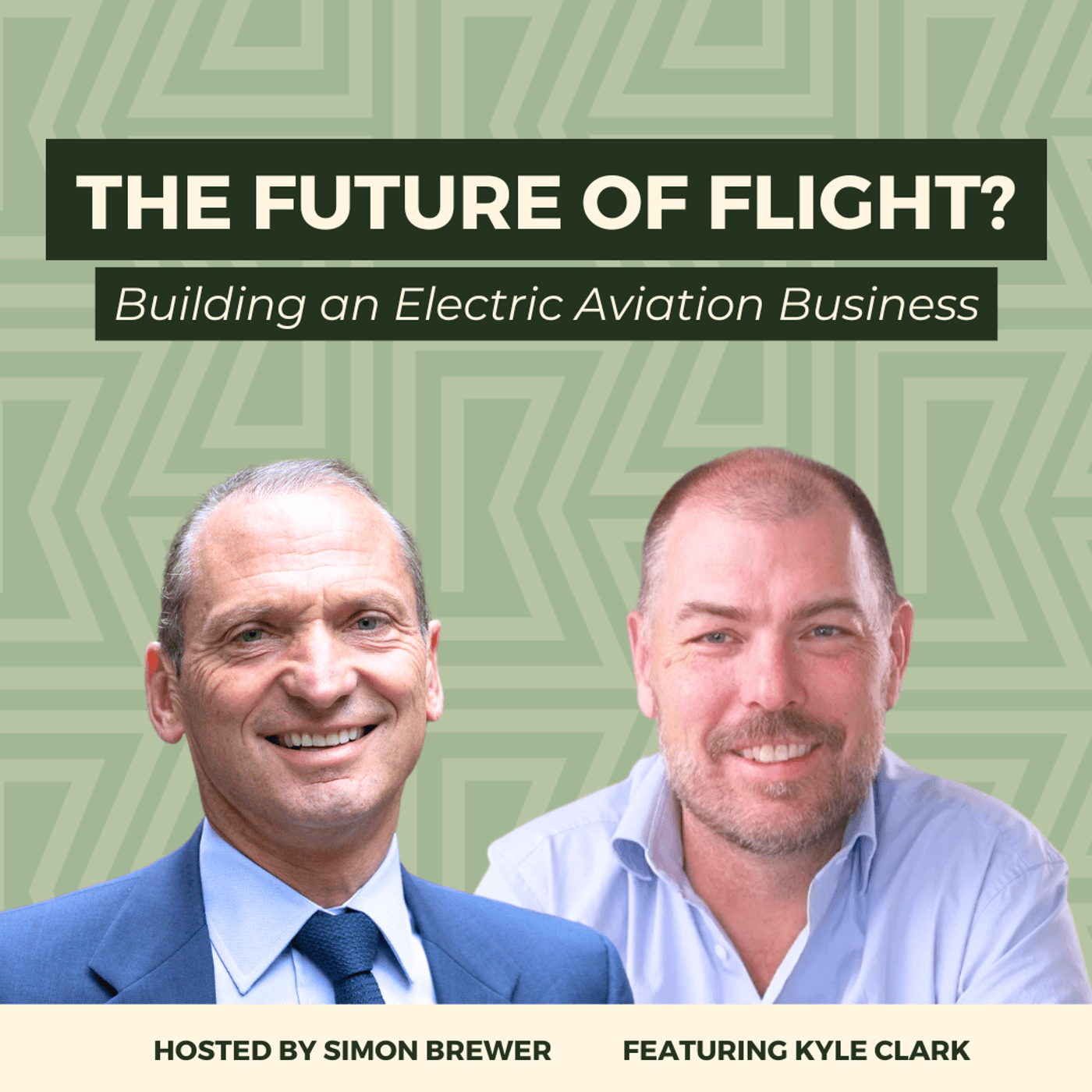
Kyle Clark, CEO/founder of BETA Technologies, explains why electric aviation’s “aftermarket” economics (energy, maintenance, batteries) matter more than aircraft sticker price, and how BETA is building a vertically integrated, FAA-certified electric aircraft business with a long-term, regulation-aware approach.
Guest backgrounds
Kyle Clark studied material sciences/engineering at Harvard, played U.S. ice hockey (Under-18 national team; recruited to Harvard; later pro with the Washington Capitals), then built power electronics/power systems at iTherm and Dynapower (including high-reliability energy management for Tesla industrial power supplies and defense/wind/solar). He later founded BETA; it is publicly listed (NASDAQ) with a reported ~$3.5B+ valuation. He also mentions meeting SiriusXM founder Martine Rothblatt as a turning point.
Key claims
Electric aircraft reduce operating cost roughly by half; electricity charging cost is “de minimis” versus jet fuel. BETA sells aircraft at ~4–5M with <20% margin, but expects high-margin battery revenue over ~15 years. Aerospace requires simplicity for reliability; BETA avoids liquid cooling, gearboxes, and complex thrust vectoring.
Notable examples
336 nautical-mile longest-range battery-electric flight record; aircraft designed for cargo/logistics first (UPS/Amazon-style missions) then passenger; battery certification requires statistically significant FAA reliability data (failure per billion hours). He contrasts Europe’s restrictive SCVTOL approach with the U.S. “safety continuum” and notes BETA’s Vermont net-zero facility and vertical integration (motors, inverters, safety-critical computers).
Written by AI. May contain mistakes. Listen to the episode to check what was said.
Chapters
Tap a time to open that second in VOElectric Aviation Market Overview
0:00 to 1:24
Learn about the current state and challenges of the electric aviation industry.
“Seven, eight years ago, there were 300 companies in this space because everybody realized we had crossed the threshold of electric propulsion and energy storage to create flight and do something commercially viable.”
Kyle Clark's Background and Journey
1:24 to 2:44
Discover Kyle Clark's early life and how his experiences shaped his career.
“But there was one particular guest who stood out to me.”
Sports Influence on Kyle's Career
2:44 to 4:48
Understand how Kyle's passion for sports influenced his academic and career choices.
“And, you know, talking to people who have built these great businesses is always a treat for us.”
The Birth of Beta Technologies
4:48 to 7:22
Explore how Kyle transitioned from his education and jobs to founding Beta Technologies.
“I mean, look, when I was little, I had three passions.”
The Evolution of Electric Aircraft Design
7:22 to 9:20
Learn about the technological shifts and innovations in electric aircraft design.
“So started building high reliability power systems at Dynapower, which was really a an entrepreneurial venture because we started a company within the company called Energy Management Systems.”
Manufacturing Challenges in Electric Aviation
9:20 to 13:56
Examine the unique manufacturing processes and regulatory challenges in electric aviation.
“Well, the, the, the, for skiing, cross-country skiing and riding, I used to have a whole bunch of Strava segments that I would, I would compete with people.”
Manufacturing Challenges in Electric Aviation
14:06 to 14:39
Examine the unique manufacturing processes and regulatory challenges in electric aviation.
“They believe healthy returns depend on healthy economic, environmental and social systems.”
Manufacturing Challenges in Electric Aviation
14:55 to 15:14
Examine the unique manufacturing processes and regulatory challenges in electric aviation.
“Whether you're navigating market volatility, in need of an income upgrade, or targeting long-term capital growth, JPMorgan Asset Management is the home of active ETFs.”
Reflections on Concorde and Electric Aviation Economics
15:17 to 17:02
Discover insights on aviation economics and the transition to electric flight.
“Well, as an aside, and if you haven't read it, I was lucky enough to fly Concorde a long time ago.”
Understanding the Business Model of Electric Aviation
17:03 to 19:26
Learn how electric aviation can significantly reduce operational costs.
“We sell it at something like, you know, four or five million bucks with a sub 20 % margin.”
Show all 29 chapters
The Landscape of Battery Technology in Aviation
19:27 to 22:06
Explore the advancements in battery technology and their impact on aviation.
“in the car space, we all know what's going on.”
Beta Technologies' Competitive Edge in Aviation
22:07 to 26:06
Understand Beta Technologies' approach and competitive advantages in the aviation sector.
“Like our, we have like the formal competition.”
Beta Technologies' Competitive Edge in Aviation
27:06 to 27:20
Understand Beta Technologies' approach and competitive advantages in the aviation sector.
“LSEG provides data, analytics, and infrastructure that connects investors, businesses, and economies.”
Funding Challenges and Strategy in Aviation
27:22 to 28:00
Learn about the funding strategies and challenges faced by electric aviation companies.
“Tell us a little bit about, because I've read that you rejected the Silicon Valley playbook.”
Long-Term Vision and Investment Strategy
28:00 to 30:28
Kyle Clark discusses BETA Technologies' approach to capital investment and long-term strategies in the aerospace industry.
“or the Fidelity has been behind us from day one and more recently the Alliance Birdstein and of course, General Electric.”
Path to Profitability and Regulatory Challenges
30:28 to 33:59
The conversation shifts to BETA's runway to profitability and the impact of regulatory frameworks on their operations.
“So, of course, the next question is, I've read about your backlogs, which we'll come back to in a minute.”
U.S. Leadership in Electric Aviation
33:59 to 36:51
Kyle Clark explains the U.S. position in electric aviation compared to other countries and the role of regulatory bodies.
“regulated environment if you're going to invest in this, but you have to see that it can be done and that our track record is getting these things done in this incremental way.”
Current Capabilities and Future Plans
36:51 to 40:01
Discussion about BETA's current aircraft capabilities, including range and passenger capacity, and future expansion plans.
“has three of the top five companies in this space, just over half of them.”
The Vision for Electric Aviation's Future
40:01 to 42:04
Kyle outlines the vision for the development of larger aircraft and the evolution of electric aviation over the next decade.
“So now what we're doing is we're adding payload capacity and volume to the aircraft to be able to move the right amount of packages.”
The Future of Electric Aviation
42:04 to 43:51
Discover the future of electric aviation and its economic viability.
“So if to answer your question bluntly, fast forward a year or two, you're flying six people.”
Key Man Risk and Leadership
43:51 to 45:50
Learn about key man risk and the importance of leadership in aviation.
“However, the biggest risk to a business like ours is failing.”
The Board's Role and Commitment
45:50 to 48:41
Understand the dynamics and commitment of the board at BETA Technologies.
“Everybody shows up to the board meetings.”
Recruiting Challenges and Strategies
48:41 to 50:03
Explore the recruitment strategies for engineers and technicians in Vermont.
“And they come and visit, they see the place and they show up here.”
Lessons from Sports Applied to Business
50:03 to 52:08
Hear how persistence and mental toughness from sports translate into business success.
“No, I mean, your research was awesome, first of all.”
Advice for Young Professionals
52:08 to 54:48
Gain insights on essential skills for the future workforce amidst AI advancements.
“I I've always wanted to go into the pits of formula one and, and talk to the people who are behind the scenes doing the engineering data analytics and tuning.”
Reflections on Personal Peaks and Challenges
54:48 to 56:01
Reflect on personal peaks in aviation and the significance of hard-earned success.
“Penultimate question, what's the unclimbed peak for you?”
From Hockey to Aviation: A Personal Journey
56:01 to 58:24
Learn about Kyle Clark's unique transition from professional hockey to the aviation industry.
“world that most people don't get to really enjoy because they're stuck in a tube with a tiny window.”
Insights into Electric Flight and Business Models
58:24 to 59:32
Discover the intricacies of electric flight and its implications for future business models.
“back to school did beta air and looked forward to this I don't regret it for a second it was a wonderful experience but but it wasn't something that I wanted to build a entire career around Got it.”
The Future of Electric Flight
59:32 to 59:59
Kyle reveals the practical and scalable nature of electric flight, which is just beginning to take off.
“You've talked about the barriers to entry, the number of people who are no longer in the business, the global threats, the enlargement of the planes.”
Transcript
Automatic transcript. May contain errors.0:00The aftermarket dominated by energy, and I'm going to say why I say that's part of the aftermarket in a second, is so much larger than the cost of the aircraft that really a more sophisticated buyer looks at what is the operational cost of this aircraft, not what is the cost of this aircraft. Seven, eight years ago, there were 300 companies in this space because everybody realized we had crossed the threshold of electric propulsion and energy storage to create flight and do something commercially viable. We're down to like five or six viable companies now. Aerospace demands a long view. We can't get short-term sugar highs and be excited about them.
0:36We need to be steady and consistent in our deliverables. Cost is going down. The access is going up constantly. It really comes down to the economic viability of flying these things with the one little nuance that when you get to vertical takeoff and landing aircraft, you can go to so many more places because you're divesting yourselves of the three most annoying things in aviation. You got rid of the fuel, got rid of the noise, and then you get rid of the airport.
1:03Kyle Clark:As I sat at a small dinner in February in Miami whilst attending the iConnections conference, I realized I had some pretty interesting dinner companions. I actually thought I was in the wrong place. Sitting around the table with Dan Lowe with Third Point, A-Rod, baseball star, business builder, and former guest, and Todd Bowley, who I'd interviewed at the Money Maze Allocator Summit October. But there was one particular guest who stood out to me. And it wasn't because he's six foot six. He was actually sitting down when I met him. Or that he'd played on the US National Junior Ice Hockey team and apparently received a record 171 penalty minutes in a season.
1:41Kyle Clark:It was his journey thereafter. He studied material sciences and engineering at Harvard, helped build power Electronics companies, spent thousands of hours in the areas of TestPython, and has been building an electric aircraft company. It's not your usual venture. It's called Beta Technologies, today listed on the NASDAQ with a$3.5 billion plus valuation. And in front of me today, Viralink is the man in question, CEO and founder Kyle Clark. Kyle, a very warm welcome to the MoneyMays podcast. It's great to be here, Simon. Are you in Vermont? I am in Vermont. I'm at our production facility in Vermont.
2:18I'm looking at a line of airplanes that are going out the door here to further our test flight campaigns.
2:26Kyle Clark:Well, we have only had one person who worked briefly in Vermont, and that is Mike Horvath, who built Strava. And as you may know, Strava has become this fantastic entity. And not only do I use it, but we're lucky enough to have him as a shareholder and on our advisory board right now. And, you know, talking to people who have built these great businesses is always a treat for us. But just flying backwards, often a family interest have a strong influence on their subsequent journey. And I wondered how you'd characterize the conversations around the dinner table for you. You know, that's funny. First of all, I love Strava.
3:05But going back to the family and influence, My dad ran a machine shop in town and I was always tinkering in it. In fact, I built my first airplane parts in that shop and my mother was an art teacher. So she was always creating things and she built all of our houses. And that played forward to what I think is one of my biggest attachments to flying and doing what I think is the most technologically unforgiving pursuit in engineering, which is aerospace. There's very little room for our off-point designs. And that's something I learned from my father who, you know, he says about three or four words a day.
3:43He doesn't say a lot. He's an extremely hard worker and is incredibly persistent. And that's, you know, in a highly regulated engineering environment, that's important. But at the same time, because you asked about the family, I have an extremely creative mother who certainly fills the room with the balance of the words. and we'll look at any problem and say, oh, I can do that. Whether it's make clothes, build houses, build furniture. You know, I built soapbox derby cars and ice boat racers, ice racing boats, like all kinds of crazy stuff because she saw no bounds in anything. So that's the world I came from, a very structured engineer running a machine shop and a crazy old art teacher.
4:28Kyle Clark:So at some point, you are clearly have a talent for sport. Ice hockey might have been other sports as well. Just help us understand before we get to the aircraft business, you know, at what point you either were or weren't going to be a sports person or how it was influencing your life or how you were even thinking about options. Yeah. I mean, look, when I was little, I had three passions. It was building things. It was flying. And it was ice hockey. and they were equally pulling at me. But the magical thing about hockey is it really enabled the academic work. Like I played on the U.S. Under 18 national team and then got recruited to play at Harvard and a bunch of other schools.
5:13But I chose Harvard because of the academics. And when I got there, they didn't have aerospace engineering. So as you mentioned, I leaned really hard into material science because the materials and the structures are a really important part of aerospace. or so I thought at the time. And then when I signed with the capitals, the very first thing I did with my signing bonus, I went to the airport and I said, now I want to properly get a pilot's license. I may have been flying other things without a proper pilot's license in the past. And I had built a number of airplanes at that time. And so they were interdependent with each other.
5:46One was enabling the other. And then playing professional hockey, you know, you work out for five or six hours a day and the rest of the day you can do whatever you want. And I Ironically, that's where the name Beta came from, because on the bus, I was always designing airplanes and writing new code and trying new things out. And in the movie The Matrix, there was a nerd in the back of the box named Beta. So my nickname on the hockey team was Beta. And so when I started Beta in college, I immediately said, you know what, kind of as a screw you to the guys that were kind of making fun of me for being the nerd on the bus, I called it Beta Air.
6:21And here we are.
6:22Kyle Clark:Well, we might come back to what's in her name later on, because I've actually jotted it down on my notes. But again, pre-beta, you work at two companies, as I've researched, iThirm and Dynapower. And I believe you are creating managing engineering teams that designed and manufactured power systems. Just help me understand a little bit about what it was you were doing and how it was preparing for the next flight. Because what I'm getting at is all the way along, was there this inner entrepreneur wanting to escape? Well, absolutely there was. So beta was my senior thesis in college. So as I went back to college, I focused on beta and I pitched it to everybody that would listen.
7:05And there was a gentleman who came to me and said, I'm not going to invest in that airplane thing, but I'll invest in this other company you've worked on, which was some power systems development called iTherm. But I continued to fly all the time and behind the scenes work on beta. And when we sold iTherm, I tried to start beta again. Couldn't get anybody to invest in it. So started building high reliability power systems at Dynapower, which was really a an entrepreneurial venture because we started a company within the company called Energy Management Systems. And we built Tesla's commercial industrial power supplies.
7:41We did Patriot missile system electrification. We did wind farms and solar farms. And it really taught me the rigor and discipline of doing high power, high reliability power systems. And then when we sold Dynapower, I tried to start beta again, and I couldn't get anybody to invest in it. But I started an investment bank. So I went and got my Series 7, 24. I went all the way and got my Series 79 to be able to underwrite deals in an effort to understand how to get people to invest in beta. And after a couple years of doing that, I met Martine Rothblatt, the founder of SiriusXM Radio. And I was pitching beta in Philadelphia.
8:21and she came up to me and she said who are you and where are you from and by the following Friday we had a deal and we were going to design airplanes for her now behind the scenes I had been teaching at the university and sponsoring students to build pieces of the aircraft company it was always always my passion under all the work I was doing elsewhere beta and the flying and uh and and Martine opened that door for me. And that was really how the company went from a concept in my garage to something that had a customer, a specification, and a small amount of funding. Gosh.
9:01Kyle Clark:Well, the parallel with Mike Horvath is that he came out of Harvard as well, having captained the boats, and wanted to create what eventually became Strava. But everybody looked at him and said, nobody's going to share their social media data, et cetera. And then he went off to Vermont and was involved in that building a biotech company, et cetera. But anyway, is awesome. And I'm addicted to it by the way. Okay. Well, the, the, the, for skiing, cross-country skiing and riding, I used to have a whole bunch of Strava segments that I would, I would compete with people. I didn't even know to hold the title on.
9:32Kyle Clark:Well, he's just gone on the board of track man, the golf simulating company out of Denmark and says that's also an extraordinary business. So we'll connect you because I think you might have a lot to talk about. Um, now the famous Wright brothers allegedly said it's possible to fly without motors, but not without knowledge and skill. So let's talk about 500 feet, the aircraft manufacturing industry today. Yeah. You know, it's just reflecting on that comment, like aerospace engineering, and I'll get back to the manufacturing, is technologically unforgiving in a way that all of the systems have to work together in harmony.
10:14What's interesting about that is when you move to electrification from fuel burning engines, the fundamental architecture of the airplane has to change because the existing aircraft are built around their engines. They have to aspirate, they have to breathe, they have to carry fuel, they have to produce a ton of cooling to cool down the inefficiency of converting that fuel to thrust. And you architect the pirate tire airplane around this philosophy. Electric airplanes, they don't need much cooling. They certainly don't need to breed. They don't carry any fuel. They have a battery that doesn't change its mass over the course of the flight.
10:54And so the rules of the game change. And people ask me, why did you design a pusher aircraft with twin V-tails and a wing that looks like the gull of a bird or the wing of a bird? And the answer is because the center of mass is different. You don't pump fuel anywhere. Your engine doesn't need cooling. So we're going to take advantage of things like boundary layer ingestion and wake filling, which basically improves the efficiency by replacing the air behind the airplane. All these little aerodynamic tricks that are only enabled by electrification allow us to set the world record in the longest range electric aircraft.
11:31And that's like just to break into the market to say we can do something utilitarian for the UPSs and the Amazons and the Bristows. You have to go out and show that these things are technologically sound. So pulling that all together, you actually start to think about the manufacturing differently. And you go from a traditional manufacturer like a Boeing and Airbus and Embraer, which says, I'm going to build the airframe and I'm going to buy all these legacy pieces and shove them into the tube in the wing and have a beautiful machine. We said electric motors don't exist. Fly-by-wire systems or computer-flown aircraft don't exist for small aircraft.
12:10Certainly, batteries that propel aircraft at high voltages don't exist. So we ended up completely vertically integrating. We wind right down the hallway here in the clean rooms. We wind our own motors. We build our own inverters. We make our own computers. We have no operating system on that computer because it's called a safety critical device, a design assurance level A computer. It can't fail. It's like going to the moon, right? And you put all these things together. And at the end of the day, like we buy raw materials and push an electric airplane out the other side. Very few things do we buy as completed assemblies, and it's because the rules and the physics change when you move from fuel-burning aircraft to electric aircraft.
12:56So thus, the manufacturing has to change drastically. And, like, we built this facility I'm sitting in. It is, to my knowledge, the largest net zero building east of the Mississippi, which is important to the philosophy of how we're building things. But also, it looks like no other manufacturing facility for aerospace. You know, you don't have clean rooms, you don't have winding machines and vacuum pressure impregnation tanks for dipping high voltage coils and battery lines and power electronic lines, all these things coming together to the airplane in a traditional production facility. So you had to rethink how you do this.
13:36And then you've got to work in this regulated space of the FAA for part 21 for production and part 23 for certification. And you're making new rules. You're literally writing new rules, putting them into the federal register, getting public comment on it while you're working physics and technology and regulation all at once. It's a pretty awesome space to work in, but it is really, really codependent, interdependent, and it's all burdened by regulation.
14:05Kyle Clark:IFM Investors is a global asset manager founded and owned by pension funds with capabilities in infrastructure, equity and debt, private equity, private credit and listed equities. They believe healthy returns depend on healthy economic, environmental and social systems. And these are evolving on a scale never experienced before. To find opportunity, build value and meet the needs of future generations, you need scale, skill and expertise. That's what IFM Investors has built up over 30 years. Money Mates podcast is sponsored by JP Morgan Asset Management, Europe's leading active ETF provider by Assets Under Management.
14:47Kyle Clark:With over 40 ETFs powered by active research covering all major equity and fixed income markets, JPMorgan's ETF solutions are designed to meet the needs of today's investors. Whether you're navigating market volatility, in need of an income upgrade, or targeting long-term capital growth, JPMorgan Asset Management is the home of active ETFs. Search JPMorgan Active ETF or find out more by tapping the link in the episode description. When you invest, your capital is at risk. Well, as an aside, and if you haven't read it, I was lucky enough to fly Concorde a long time ago. And if you read the book by, I think it's Captain Bannister on the last flight, that I think the Concorde had 14 different fuel tanks around the plane and they've shuffled the fuel around.
15:32Kyle Clark:I mean, the thing should never have flown. And I know I'm as far from being a scientist or engineer as possible. But it's an extraordinary sort of story of patching this thing together. And it worked. I know. Now, take us to the cockpit of electric aviation. And I'm talking here the economics. And it's timely we're having this conversation because for those who haven't been following it, what's known as the jet fuel crack spread, so oil versus aviation fuel, has really widened out, I'm told, but I haven't seen a lot of hedge funds have really lost a lot of money. I may be wrong, but I think Lufthansa may have recorded a billion loss on their book.
16:09Kyle Clark:But this is a timely point to ask the question, just help us understand the economics. Yeah, this is the fundamental unlock that people tend to not understand, which is when somebody buys an airplane from Airbus, Boeing, Gulfstream, whoever, they're going to spend a lot more on engine, engine maintenance, and fuel than they ever spent on the airframe. The aftermarket, dominated by energy, and I'm going to say why I say that's part of the aftermarket in a second, is so much larger than the cost of the aircraft that really a more sophisticated buyer looks at what is the operational cost of this aircraft, not what is the cost of this aircraft.
16:52They ask uptime, serviceability, dispatch rate, and operational cost. That is the financial unlock of our business, Simon. We sell an airplane at a reasonable margin. We sell it at something like, you know, four or five million bucks with a sub 20 % margin. over the life of that aircraft, there will be approximately$13 million of batteries sold at upwards of 50 % margin for the aircraft. Because batteries will have, let's say, between 1 ,000 and 2 ,000 cycles at a reasonable range, and then they're replaced. Now, instead of buying that fuel from Exxon, they're now buying it from Beta, right? Now, it's a fuel storage device.
17:37It's not the fuel itself. But the cost of the fuel, the cost of the electricity that you use to charge that battery is like one fortieth of the cost of jet fuel, even if they both move up, which they have, or they both move down because they tend to move generally together. You end up with like a de minimis, almost irrelevant cost of fuel and now a reasonable cost of batteries. When you sum it all together, the cost to fly a package a mile or move a person a mile is about half of what it is with a fuel powered airplane. So the customer wins by cutting their costs in half. We win because instead of having Exxon taking the bulk of the profits or BP in your case, taking the bulk of the profits, we get the profits and we get an extremely high margin on it.
18:27Now that changes the way we think about our business. We invest in developing an airplane, but quietly behind the scenes, we've made a major investment in the machine to certify batteries. And every time a new cell comes out, we incorporate it into these validated models. We took over an old Energizer plant just north of here to do the battery validation. It's got all the primary lithium safety systems and power. And we do it over and over again. I can tell you three and five years from now what the energy density those batteries are going to be. And the reason is, is there's a phase lag between introduction of chemistry and when it's certified with the FAA or conformed then certified.
19:05So it's an entirely new business model where if you look at the cash of our business on any particular asset sale, it's pretty low on the upfront sale of the airplane, but it sticks with it for 15 years at extremely high margin. And because we're in a regulated environment that's hard to break into, we get a guarantee on that revenue.
19:26Kyle Clark:You don't know that my next question said battery technology, but I want to expand on that because in the car space, we all know what's going on. And one reads, again, with caveats, CATL in China has been doing some extraordinary things in battery. Where are we in the world of the potency and the duration and the applicability of these batteries? Yeah, great, great question. Look, As a small aerospace company and an industry, we are not going to push this tidal wave of basic chemical research in battery energy density, cycle life and power density, the three major parameters of the battery, rolling up to cost, of course.
20:07But what we get to do is we ride that massive wave driven by automotive consumer electronics and other electrical devices. Our part of that continuum is to get extremely high quality cells based on this chemistry, use an FAA validated process to conform them and then inspect them and then design. We design the pack. So the battery balancing, monitoring, thermal management, structural, all of those things that make it applicable to be in an airplane. But that's where the value is. Like if we sell a battery, our costed bill of material is only comprised of about 10 percent battery cells. The rest is actually thermal management.
20:51We have dual redundant battery balancing and monitoring systems. We've got all kinds of branch circuit protection in there because you can never have a battery failure take an airplane out. It has to be protected, contained, aware, forecasted, all of those things all at once. And so what that does, Simon, back to your original question is you introduce a battery to aviation three to five years after the battery becomes real. is always a phase lag because you have to create a statistically relevant data set to prove to the FAA or EASA or CAA, in the case of the UK, that you have a safe, reliable battery that hits an extremely high fit rate, which is a failure per billion hours, per billion hours of operation.
21:43and i'm not sure if you can contemplate that but it is a massive threshold of reliability so we take control of all of that but it takes time so the batteries we're flying on now we received three years ago in a conforming state and i can tell you three years from now how high the energy density is going to be and it keeps going up so that's the part of the continuum that beta and aerospace sit in on the batteries got it so i want you to give us the equivalent to
22:13Kyle Clark:the boarding pass to understand, you know, the beta vertical integration, you know, you appear from the outside to be doing, and you've alluded to this almost everything, you know, yourself, who's your competition and what are they doing? Yeah, it's interesting. Like our, we have like the formal competition. We got a couple of people doing air taxis, really solid companies, thoughtful, high technology, Jobys, Archers, Embraer Eve, who's also one of our customers. They buy motors from us, a company in the UK called Vertical. You know, about, I would say, seven, eight years ago, there were 300 companies in this space because everybody realized we had crossed the threshold of electric propulsion, energy storage to create flight and do something commercially viable.
22:57We're down to like five or six viable companies now. That's a pretty, pretty high attrition rate, right? And several public companies went upside down because it's a hard task. Now, Now, some of the differences in the way that Beta went about it versus those companies have failed and versus our competition is that we have an extremely simple design. We didn't do liquid cooling, no gearboxes, no thrust vectoring like the V-22 Osprey, you know, where the propellers start up and go forward. We have what we call a lift plus cruise where the airplane lifts itself up with one set of propellers and then they shut off and then you cruise.
23:35And so, sorry if you hear that, that's the F-35s launching in front of me here. So it's a very simple, simple aircraft. And the software control algorithms are very simple. This is kind of at the core of our business. I'm an engineer. We have a lot of engineers here at the company. As you know, I'm a flight test pilot, a flight instructor, and fly electric airplanes and all kinds of airplanes all the time. Simplicity and reliability are king in aerospace. And when you get at it with this move fast and break things kind of Silicon Valley mentality, it doesn't always work. And if you try to shove every latest technology into it without saying aerospace is interesting.
24:21It creates a strategic moat to all your competition to get in because it's a highly regulated environment. But that moat also demands that the technology you introduce has to be really, really valuable. The juice has to be worth the squeeze. That means you don't get to shove in every latest blue LED to the cockpit and say, hey, it looks cool. Let's put it in. It's got to have a definitive, actual, practical purpose. Our company has taken that to the extreme. And we have a simple, reliable aircraft. And what's interesting, what's come out over the last decade is that that simplicity actually equals performance.
Read the full transcript
24:56because when you add complexity, it snowballs into this impossibly complex system of redundancy. Like if you have a system on an airplane, you usually need a second system to back up that system. And then you've got to bring both of those systems to the air, which means you've got to have the structure to carry both those systems. And it starts snowballing. So the simplicity is how we've differentiated the technical aspects of our business. And we've mirrored that on our market entry strategy. where we said, you know, our biggest orders with UPS, cargo medical logistics first, and then passenger.
25:33Why? Because people are problems, like picking up passengers, people poking windows, pulling on door handles, packages are along for the ride, right? So our first version of our aircraft was a cargo and logistics aircraft. And then we built a passenger aircraft. And we are certifying and commercializing in that order as well. And I could go on and on about this simplicity of the way that we introduce market, but it's really the fundamental design of our physical airplane and our software, dead simple. And our market entry strategy is extremely thoughtful, I think. And it doesn't mean we're not about passenger urban air mobility or air taxis.
26:13I happen to believe that flying thousands of airplanes, millions of flight hours with packages on it will give the confidence to the flying public to fly in our airplane at a higher rate, and we will win at that game as well, over the people who try to jump to the top of the stairs in one leap. We're taking it step by step.
26:32Kyle Clark:I'm thrilled to share that the Money Maze podcast is sponsored by the World Gold Council. They champion the role gold plays as a strategic asset through expert research, commentary, and insights. And it's not just your portfolio that may benefit from gold. Learn how gold mining is supporting female economic empowerment and small businesses via their new documentary series called Gold, The Journey Continues. Tap the link in the show notes to start watching. I'm excited to announce that the Money Maze podcast is sponsored by the London Stock Exchange Group, known as LSEG. At the heart of the global economy, LSEG provides data, analytics, and infrastructure that connects investors, businesses, and economies.
27:14Kyle Clark:LSEG is where ideas meet capital, enabling sustainable growth and opportunity. Tap the link in the show notes to learn more. Now, your aircraft may be oil-free, but the essential lubricant is capital. Tell us a little bit about, because I've read that you rejected the Silicon Valley playbook. Talk a little bit about how you've gone about financing. What is no mean feat? Yeah. So, yeah, we brought several billion dollars into the company, I think 2, 2.7, and something like that. And we did an IPO last fall that landed about$1.2 billion in the IPO and about$500 million in the months before that.
27:54So we have been just extremely fortunate with the people who have stepped up to fund our business, whether it be the Amazons or the TPGs or the Fidelity has been behind us from day one and more recently the Alliance Birdstein and of course, General Electric. We have class A institutional investors on the book who have stuck with us post IPO. We're there before the IPO. But our capital stack and our structure has also been very, very simple and clear. You know, we are a controlled company. I have all the, you know, I have the voting majority of the company and control the board. That's public information, but it's not done because I think Kyle's always right.
28:38It's done so that we can take a long strategic view on an industry that demands it. Aerospace demands a long view. We can't get short-term sugar highs and be excited about them. We need to be steady and consistent in our deliverables through a decade of certifications and entry strategy. So we chose investors that are along for that long-term ride with us. And it's interesting. At first, I was told, hey, you know, that whole control provision, that's going to cause some problems in the markets. It's going to give you a discount. It did just the opposite. The more sophisticated investors are like, no, no, we want that consistency and vision.
29:21And I have a high bar to cross because I have to prove I can only wear one shirt at a time. I love flying. I love aviation. I love engineering, you could pay me zero and I would be here, except I'd be a little bit starved for airplanes because I really like airplanes. But everything I do and everything I care about is focused on the success of this business. And when people start to understand that, they lean in and they say, okay, I'm going to align that with the long-term view and the control. And we have had, and I don't want to jinx ourselves, very little problems getting access to capital.
29:56People believe in what we're doing. We keep our promises. We have a simple approach to the business. And it's easy to understand. We're tucked up here in Vermont. That causes some friction with people because they're like, I don't even know where that is. I don't know what state it's in. We're like, we're our own state. We happen to be the smallest state, but we're a real state. But anyway, it hasn't been a problem. And I'm happy to talk about some of those nuances on consistency and control. But it all comes down to being mission focused. Okay.
30:28Kyle Clark:So, of course, the next question is, I've read about your backlogs, which we'll come back to in a minute. I've seen recent reports and know you're in this early stage losing money at the moment. But what's your runway to profitability? And what's the capital requirement to get you there? Yeah. I mean, there's a lot of different ways to answer that question. On the day we went public, we had enough money if we kept our burn rate exactly the same for like 80 months, which is an insane runway. It's too long. It means you're not making the investments you need. So, of course, we said we're going to further investments in vertical integration, in deploying aircraft, and that reduces our runway.
31:07At the same time, we're starting to produce a trickling of revenue. And, you know, from, from 24 to 25, we doubled our revenue. We added our merchant supply. We are, we are, and it's still an insignificant amount of revenue, but it's organic revenue from the products that we've developed, which gives it a huge potential to continue in the upward trend. So, so what's our runway is an interesting question. It all depends on whether we focus on selling motors, batteries, inverters today or developing the aircraft. And we have a mix of that. What's been really fortunate recently is we've gotten pretty much all the defense primes come to us and say, you have a high reliability propulsion, energy storage, and flight control system.
31:52We want to buy that. And now we've sold it to multiple other aircraft programs and undersea vehicles. So now we're in a place where we're making a trickling of revenue, high margin, low volume on organic products that we've developed. All the while, we're continuing the development of the CTOLE and the VTOL aircraft, conventional takeoff and landing, vertical takeoff and landing aircraft. Our runway is a daily conversation, Simon. It is a daily conversation as we determine how we fit into the budget and how we manage opportunities as they're presented to us. One of the biggest ones that just came up is the Trump administration issued two executive orders, one about a year ago, called American Drone Dominance, where they kicked the door open for pre-certification operations in the U.S.
32:45We went and did all the work to apply for those in December, worked with the federal government. We are on seven out of eight of the selected programs, seven out of eight of them. We crushed it. And now we're starting to deliver on those things. We bought the materials. We're building the airplanes. That was an unexpected opportunity that reduces our runway, but it accelerates our path to profitability and the market. There is one thing that we don't have control over, which is the staffing and investment by the FAA. So we're hedging a little bit with some military opportunities. We're selling the components internally.
33:25But it's hard to forecast that break even time because, you know, the level of effort that the FAA puts into our business and our industry, it will determine our pace of development. We have airplanes flying all over the world. They're safe. They're reliable. I fly them. I fly my family in them. You know, my daughter's a pilot. She flies them. Like, we care a lot about safety. They're ready to go. But there's a process of validation and verification that takes a lot of time with the FAA. Okay. And that's really the uncertainty of this business. So you got to have a stomach for a regulated environment if you're going to invest in this, but you have to see that it can be done and that our track record is getting these things done in this incremental way.
34:08So I didn't mean to not give you a number, but it's a complex answer.
34:11Kyle Clark:I understand. Let's go from the apron back to the hanger because you talked about regulation and it struck me that the US is positioning itself to be a global leader in electric aviation, but, you know, it's a big radar of operators around the world who may want to be in that space, understandably. Just give us a sense of how important is it to the US, you know, strategically, and who else is sort of is right there doing really interesting things. The equivalent of the FAA in Europe got after this very early, and they started writing some rules called SCVTOL. They were extremely restrictive, And they made it so that the businesses like the Volocopters and the Liliums, they had to get basically to safety levels of transport category aircraft, like you're carrying 300 people on an aircraft that was carrying four, which is not aligned with the safety continuum.
35:03And then they added all these really, really restrictive things. And they precluded operations, for example, in IFR and all weather. That torpedoed the commercial viability of the aircraft. In the U.S., we actually applied something called the safety continuum, which is, hey, if you're carrying less people, you get to take credit for that when you think about the overall engineering that needs to be dumped into this thing. You will kill innovation if everything has to be a 747. It's just unviable. It's like there's a reason that buses have different safety standards than motorcycles. You're carrying 60 people on it.
35:41You've got to be safer. It only makes sense. It's kind of a morbid thing to talk about, but it's the reality of any type of safety critical system that you develop. So the FAA has come about this pretty thoughtfully. However, the FAA has been a bit of a state of flux. And fortunately, recently, with Brian Bedford coming in at the helm, he's gotten it stabilized and focused. And you're absolutely right, Simon. They opened up a new office focused on advanced air mobility. They opened up the EIPP and we have gotten more certifications and approvals in the last six months than we did in the prior six years.
36:20And we are knocking these things down very quickly. It doesn't mean that they're not holding us to a very high safety standard. It's just that those things become clear and we start banging them down. So the regulator has a massive effect on whether the UK, the US, Asia, EASA and Europe, somebody in India can get through to win at the future of aerospace. We aren't perfect in the US. I've got a whole litany of complaints I can throw at the screen. But we're doing pretty good. And yes, the U.S. has three of the top five companies in this space, just over half of them. It's a damn good one in the U.K.
37:04called Vertical and a really good one in Brazil called EVE. Here in the U.S., we've got Archer, Joby, we've got Wisk, and we've got Beta, all doing really, really good things. And they're doing it under the FAA's guidance.
37:18Kyle Clark:And China's got to be all over this as well, presumably. Oh, yeah. I mean, China's got three major things, minerals, AI and the low altitude economy. A lot of smart people in China working really, really hard. I will say that I have audited what they've done. I've looked closely at the designs, seen some of these machines. There's going to be a big learning curve in safety-critical and mission-critical high-reliability systems. And it comes down to the little nuances of design that we've learned in aerospace over many, many years. We call them best practices. And it's things that you don't immediately expose with engineering analysis that you have to put things into the field to get right.
37:59And it's hard to build high-reliability power electronics and electromagnetics. China's doing good work. The people in China are smart engineers, but I happen to think that that environment is not one for innovation and really pushing the envelope the way that we do in the US.
38:20Kyle Clark:So when I was researching this interview and coming from a background of being, as I said earlier, the least scientific person ever to have sat in the podcast chair, the questions were, how far do these planes fly and how many people do they carry? So I know you're going to tell me there's a trajectory, but help us understand that. Well, there's a trajectory. I don't want to let you down. So now, look, we at Beta, we set the world record for the longest battery electric flights in the world, 336 nautical miles. So just under 390 statute miles. So you're in the seat for three hours. That's too long to be in a small plane, right?
38:59They're not designed to do that. But we had to show that you could do a meaningful range. So then you say, okay, load it up with cargo, load it up with people. Our airplane carries six people or eight people, depending on the variant. It carries 200 cubic feet of cargo, which is about equivalent to a sprinter van. that that uh mission range that we target is between 100 and 200 nautical miles because that's the mission the void that needs to be filled by an aircraft of that size right the jets can fly further and faster they're more expensive but when they get to the regional distribution and you're flying around new england or the mid-atlantic you're flying in florida you know we we just won an awesome deal down in Florida, put chargers all throughout the state.
39:49Once you get the packages to Jacksonville and you want to distribute them through the entire state, you're only flying a couple hundred miles at a time. So the ranges that we're posting are way beyond what's needed. So now what we're doing is we're adding payload capacity and volume to the aircraft to be able to move the right amount of packages. It's interesting. People are really worried about the range of electric aircraft. And then I'll go flying with them and we'll be sitting in the seat for an hour. And they're like, okay, I get it. I'm done. Okay. We're going for another 30 minutes. And they're finally like, okay, I get that.
40:26Like this is for moving from state to state, not transcontinental yet. And there's a need for that type of flying, Simon.
40:33Kyle Clark:So let's fly forward. You know, people often, you know, try and extrapolate too much, but take us five plus years and what does somebody see on the runways? Yeah. I mean, we are working on larger and larger aircraft. 19 passenger, 30 passenger, 70 passenger aircraft are all in our sights. There's a funny little relationship between the number of people you put on an aircraft and how far it's expected to go. You don't spend 20 minutes loading an aircraft to fly 20 minutes. You may spend five minutes loading an aircraft to fly 20 minutes when you're flying with four or five people. We have to get to like 400 miles of effective range to justify a 70-person aircraft.
41:17That means you're flying from DC down to Charlotte, Charlotte to Jacksonville. You're flying, you know, San Francisco to LA. Like those types of routes are coming in the next, or that type of design is coming in the next decade. And then there'll be another decade of phasing it in. On the heels of that, we'll go to 150 passengers, but we got to get to 800 to 1000 miles to justify that scale of aircraft. And meanwhile, we have this parallel track of hybrid propulsion, where we have 20-30 % fuel savings by going hybrid, that allows us to integrate electrification to those larger and larger aircraft, not in a single step of all electric, but in a progressive step of different levels of power forward or energy forward hybridization.
42:05So if to answer your question bluntly, fast forward a year or two, you're flying six people. Fast forward five to 10 years, you're flying 19 to 30 people. Fast forward more than a decade, 150 or more people. And the cost and the access to aviation, cost is going down, the access is going up constantly. It really comes down to the economic viability of flying these things with the one little nuance that when you get to vertical takeoff and landing aircraft, you can go to so many more places, right? Because you're divesting yourselves of the three most annoying things in aviation. You got rid of the fuel, got rid of the noise, and then you get rid of the airport.
42:45Kyle Clark:So people would say that Tesla would never got off the ground if Elon Musk had been hit by one of his cars. You know, you are the visionary and you're the executor here. I'm going to come to your board in a minute, but how do you think about key man risk? It's funny. I, every one of my businesses, even the power systems business, they told me I couldn't fly. They're like, you can't fly yourself. We're going to get you a safety fly. You can't fly your own planes. You can't fly aerobatics. And in any case where it came to a head, I said, peace guys, I'm out. Because I think you suck the soul out of this business.
43:18If you tell me I can't test fly our planes, you, you destroy the mission and the vision. If you take that away. So hard and fast is I'm going to continue flying the airplanes, engineering the airplanes and participating in test flight. It's really important to the culture of the business. It actually drives us to a higher standard when the team here for a first flight sees their CEO step into an airplane. Without question. How do we think about key man risk? Look, I recognize that there's a risk in everything we do. However, the biggest risk to a business like ours is failing. It's not killing your CEO.
43:59It is a risk, but it's not the biggest risk. And we have done more with less people and less money than anybody else in this industry. And we've done it because we have an extremely strong mission, focus, and culture. Everybody here flies. Everybody here flies. We have a flight school. We've got 50-odd airplanes. And I think it's really important that every technician, salesperson, engineer, you wouldn't sell bicycles. You wouldn't launch a Strava app if you didn't use a mobile phone and you didn't ride a bike, right? It is, you just don't get it unless you really live it and have passion for it.
44:37So everybody here does. Is it a risk? For sure. But guess what? I think the biggest risks to our company are addressed at a much higher rate by engaging people in these activities. And we do it with an extremely high rigor of safety and technical aptitude and pilotage aptitude. And so it's a real thing. It comes up almost every board meeting. It comes up with every investment round. But it's something I'm not willing to compromise on because I love it.
45:09Kyle Clark:So that's very clear. Now, when I met you at that dinner, there was a former senior partner from Goldman's who's obviously been involved with you and I might be chair of your board. And when I was doing my research, I went on to have a look at your board. And I spent quite a lot of time on that board because I was struck by what an extraordinary collection of people who have run Embraer and GE and Boston Scientific and the rest of it. But I was reminded by a former colleague who said, I'd never want Henry Kissinger on my board because the board needs to really have time capacity capability to help.
45:42Kyle Clark:So how do you think about that board working for beta? Yeah. Well, so everybody on the board cares deeply about beta. Everybody shows up to the board meetings. People on the board have bought houses in Vermont because they love this company. They also fly. and and like martin rothblatt is one of the most busy people in the world i could pick up my phone right now and said martin i need to see you tonight and she'd say we're on i'm in wherever i'll fly to you you fly to me they make the time for beta they care deeply about it um chuck davis the gentleman from goldman that you mentioned he is one of the he he is extremely successful his company stone point owns tons of companies but he loves beta he he's he also restarted flying he started flying in the 70s now he's flying again he just bought another seaplane and he's uh he's flying he loves it there's i i gotta tell you simon there's a magnetism about aviation when people love it they just gravitate to it and even john abley he's got an airstrip at his house and i fly down there to meet him, the founder of Boston Scientific.
46:54He is a wealth of knowledge in a highly regulated environment, introducing technical things. And he loves beta and he loves aviation. Like I, we are so fortunate and lucky with the people who have stepped into this company, on the board, in the company and the board meetings. Like we introduced John Slattery, for example, the gentleman who was running Embraer commercial. And prior to that, GE commercial engines, or no, after that, GE commercial engines. And he comes into the first board meeting. He's like, I have never seen anything like this. And the board was both critical and real and invested.
47:34They weren't there by obligation. They're there because they love it and they want to be there. And this is a guy who was presented to many, many, many, many, many boards. I get a high talking about the board just because they care so much. It kind of blows me away, man.
47:50Kyle Clark:Well, I was struck, and that's why I wanted to bring it up. Two opposite questions. Can you find the engineers and technicians you need? We read about China produces 200 times the amount of engineers, et cetera. So that's question one. And question two is, when won't you need a pilot? Yeah, great question. I mean, we've been flying autonomously for a while. We have a number of aircraft specifically targeted at the military initially that don't need a pilot. It doesn't mean you don't need people who understand aviation, by the way. It just means somebody's not in the cockpit when you're going to high risk missions and delivering cargo medical bullets over the hill.
48:28break back to your first question do we get all the engineers and uh and folks we need we we overemphasize training here um we recognize tucked up here in vermont there is a nucleus of really really good power electronics people ibm was the biggest employer just across the river here um my former companies had a lot of there's a ton of people here who worked at my former companies the our standard recruiting goes like this anybody who's been to vermont which by the way is the happiest state in the country it's most educated state it's the healthiest state and it's the greenest state in the country it has a lot going for it it's a beautiful place to be when when somebody has touched vermont they went to school here they vacationed here whatever and they work at boeing or tesla or spacex you say hey you can come work on an electric aerospace company in Vermont that's mission driven and we're kicking ass, setting world records and doing all kinds of good stuff.
49:25They're like, no way. And they come and visit, they see the place and they show up here. There is about, I think, between 20 and 30 percent and the number changes depending on direct labor or staff of people that we've imported to Vermont. And it is not an it's not it's not a hard ask once you cross that threshold. So our LinkedIn in recruiting strategy is find somebody with a prior association in Vermont that's really good at what they do and talk to them. Wow. And we usually get them, Simon. It's amazing.
49:56Kyle Clark:Fantastic. I have three friends who all who studied at Middlebury. So, you know, and then I had to look up when I had that years ago, where's Middlebury. So, um, so I have some, I have seven closing questions, which are short questions for short answers, but is there anything I haven't asked you about your business that you are, you think I, you know, I failed in my research? No, I mean, your research was awesome, first of all. I mean, the component stuff, military mixed with civil, the market entry strategy. But I think most importantly, your question right out of the gates, the simplicity and technical philosophy here, vertical integration and simplicity is what sets us apart.
50:33You hit the really key things.
50:36Kyle Clark:So these are the questions you can't avoid. Where are the lessons you took from the world of sport and applied to business? persistence it's like you know the training and persistence so Sang Martin says persistence is omnipotence and in this world of aviation you know the the the lessons you learn in sports you don't get good playing in games by the time you get to the game you have two things in control how hard you work and how focused you are you don't get to get any stronger your training doesn't get any better. That is also true in aviation. By the time you get to pushing that airplane out the door, the thing that matters is the thing you did five years ago.
51:23And that persistence is key. The other one is that, you know, getting through hard things. And there's another quote by Voltaire, it says, no problem can withstand the assault of sustained thinking. It is like, it is, it goes back to persistence, but it's also like the season is long. you may have lost this game we're going to win the championship we just got to stick with it and I think that's the biggest learning from running marathons playing hockey playing football riding the bike looking at the Strava app it's like it takes mental toughness focus and persistence
51:58Kyle Clark:if I could give you a sports ticket right now for an event any event around the world what would be the one sporting event you'd like to attend? wow that's a great question I I've always wanted to go into the pits of formula one and, and talk to the people who are behind the scenes doing the engineering data analytics and tuning. There we go. That may be something that we have a little link into. Where's the one place in the world you'd like to fly one of your planes to? Oh man, I want to fly around the world in the wrong direction, up over the poles and down around, you know, studying Shackleton and others that were these pioneers in adventuring through the world.
52:41I want to see those places and feel the size of the earth, not where all the humans are, but where they're not. I want to fly around the world the wrong way.
52:49Kyle Clark:What's your most important daily habit? it?
52:55I would say it's, I get up very early and I construct the day in my head. And it's funny because my wife, she works here as well. She knows that I don't like it when she rides in the car with me. I take that, if I fly to work or ride in the car, I take that time to really focus on all the things that need to happen through the day. And then when I get here, I open up my little black notebook here and I write down those things and I check them at the end of the day. And it's not like a, I don't write it down to check it off. I write it down so I get clarity because there's so many distractions, like getting in the way of clarity.
53:40I would say that that's probably the most important daily habit. Construct it in my head in the drive, write it down and check it at the end of the day.
53:47Kyle Clark:You mentioned your daughter. I have children. Our listeners are both young and old, and we've done a lot of work with interns in universities here in the UK. One piece of advice for youth thinking about their jobs and their future. Yeah. I think with the advent of AI and all the tools that we have access to, getting into the physical world, be really good at communicating and instructing because the busy work and the spreadsheets and the programming, that's going to go away. Be really good at instructing and thinking critical and shaking your brain, like shaking your brain to say, how should we think about this differently?
54:27And then using the tools as a sounding board for this. Those jobs aren't going to go away. And that's how we get the most out of the newest tools.
54:38Kyle Clark:Well, our mutual friend, Jen Prosek, when I interviewed her last, we talked about the power of oracy. Nobody can take away that invaluable skill of being able to articulate, lead, drive, you know, just do the stuff that is so important and uncomfortable for some. Penultimate question, what's the unclimbed peak for you?
55:02um the unclimbed peak i you know it's interesting i have dreamed and dreamed about where we're at right now people ask me all the time did you ever think you'd be producing airplanes i'm like yeah i've been telling you that for 20 years this is this is what i feel like i am i am at the peak looking forward to seeing more alia aircraft in the air than any other aircraft and and and the The results of that are moving aviation forward, getting more access to aviation for people. And every peak, you know, these little peaks as we as we go along, the first flight of a new aircraft design is a high that's impossible to explain to anybody.
55:42Sitting in a plane that yourself and other engineers designed, built every piece of is amazing. So I look forward to doing that on larger aircraft, Simon. I look forward to more people experiencing the quiet, peacefulness of electric flight. and coming down with just a feeling and a smile and a reintroduction to a vantage point on the world that most people don't get to really enjoy because they're stuck in a tube with a tiny window. It's a high when you see people in the machine that you built. So I feel like I'm on a peak right now. I'm grateful every single day for the people I get to work with and what we get to do, but looking forward first flights and seeing other people fly the airplane.
56:24Kyle Clark:So my last question is, of course, the one that people who were listening to that opening paragraph might still be thinking, which is anyone who gets a record 171 penalty points in a season presumably isn't just unlucky. Can you explain what was going on? You know, I'll give you the very short version. I was a crappy hockey player and, uh, and I wanted more than anything to make the U S team. And, and in the first tournament of the year, I fought everybody that stepped up and all of a sudden I got a record as a fighter and then everybody wanted to fight you. And so I wasn't good enough to play real hockey.
57:02And then I started to really training in jujitsu and golden gloves and like getting good at fighting. And then I got drafted. And then when you get to the, to the, uh, to the pros, you have a role. And, and my role was fighting and I still wasn't a very good hockey player. I was slowly getting better. But here's the thing, man, the, the, I was a different kind of fighter. I was very patient and, and I did well because I, I was able to not get emotionally wrapped up in the fight. I was able to study. I studied a lot, a lot of film, a lot of reports, a lot of scouting reports on the opponents. I knew when they were going to do something And I'll tell you, the guys that I would always go after would be the ones with the long hair and the tattoos and the missing teeth and the gold chain because they had this public display of toughness.
57:50And it always looked good when you kicked their butt. They were actually the weakest ones, right? They were the weakest ones. The ones that showed up quiet, reserved, and calculated. And I put myself in that category, quiet, reserved, and calculated. And they were the ones that you would have to fear. so hockey and fighting it was an engineered process for me to get into the opportunities that I wanted and ultimately I decided that I really wanted to design and build airplanes and after a couple years of pro hockey I said you know what I'm going to focus on this went back to school did beta air and looked forward to this I don't regret it for a second it was a wonderful experience but but it wasn't something that I wanted to build a entire career around Got it.
58:39Kyle Clark:Well, we interviewed Ray Dalio. I got him to admit that he had punched his boss, which did end his job. That's a good way to end your job, man. So, Carl, I'm going to wrap up. I had been looking forward to this so much because I met you briefly. I was inspired genuinely by the story you told and which you have in part sort of, you know, reproduced today, you know, courtesy of the questions asked. but everybody's fascinated with flying you're right that amelia urquhart film about her flying solo around the world was just you know brutal tragic you know and inspiring and there are things today that i hadn't thought about about the peacefulness of electric flight about the the business model that you know that where you are the ecosystem of batteries and all the other stuff that's going to you know repeat and repeat and repeat and let's face it that was the old printer cartridge business and all those others, you know, repeat cycles businesses.
59:32Kyle Clark:You've talked about the barriers to entry, the number of people who are no longer in the business, the global threats, the enlargement of the planes. I'm not going to say what you said, but what I think, if I summarise it in four words, you have, and it's not going to be four, is it? It's me, so it's going to be 14, is that you have proved that electric flight is practical, scalable, and commercially available and is only just taking off. That's a good one. I love it. So, Carl, I hope we get to meet again. In fact, maybe send you an invitation to our Money Maze Allocator Summit because we're going to have some entrepreneurs there talking about building businesses.
1:00:08Kyle Clark:And, you know, well done and just the best of luck for the future. Thank you for having me. It's been a pleasure for me as well.
From the publisher
BETA Technologies is a Nasdaq-listed aircraft manufacturer breaking new ground with its advanced pursuit of building world-beating electric planes.
Kyle Clark, Founder and CEO, explains the economic advantages of electric aircraft.
He discusses assembly to operating systems, and then explains how oil majors are the beneficiaries of planes constantly refuelling, but those who own and make the electric airplanes & their batteries have a much greater continued advantage.
He describes how the US wants to lead in electric aviation, the military demand, why regulation can help as it creates barriers to entry, why for their roll out, cargo, medical & logistics are coming before people.
However, longer flights, more people, and the peace of flying electric, are all part of a fascinating new chapter in flight.
The Money Maze Podcast is kindly sponsored by J.P. Morgan Asset Management*, IFM Investors, World Gold Council and LSEG.
*During the episode we cite J.P. Morgan Asset Management as Europe’s leading active ETF provider by assets under management. This is sourced from J.P. Morgan Asset management and Bloomberg, data as of 30 March 2026.