
In short
How retailers waste training investment by measuring completion instead of capability, leading to high turnover and lost talent; contrasts “Company A” (completion-focused) vs “Company B” (development-focused).
Guests
No named guests. Narrator is Ron Thurston. The episode centers on a composite retailer story about “Deshaun” (a frontline associate).
Key claims
Completion dashboards can look healthy while confidence and retention collapse. Only 24% of frontline workers feel their training is right; 40% aren’t clear on expectations. People forget up to 90% of training without application.
Notable examples
Deshaun trains new hires, is told “keep doing great work” with no next step, then leaves for a competitor’s team lead role (+$2/hour). Company B uses check-ins, internal mobility tracking, and coaching (captured as development) so the associate stays and grows into leadership.
Written by AI. May contain mistakes. Listen to the episode to check what was said.
Chapters
Tap a time to open that second in VODeshaun's Retail Journey
0:45 to 1:45
Exploration of Deshaun's experience and challenges in his retail job.
“And he took with him two years of customer knowledge, product instinct, and floor credibility.”
Training vs. Retention
1:45 to 3:48
Discussion on the lack of effective training leading to employee turnover.
“about the people caught in between, because that's where the real story lives.”
Company A vs. Company B
3:48 to 6:16
Comparison of two companies' approaches to training and employee growth.
“But in that same region, three stores have turnover rates above 70%.”
The Importance of Belief in Training
6:16 to 8:16
Insights on how belief and engagement affect employee retention over mere completion of training.
“Same person, two companies, two potential very different outcomes.”
Transcript
Automatic transcript. May contain errors.0:00Welcome back to the new Retail in America podcast studio in Miami. And thanks for listening and staying with me for the real stories. His name is Deshaun. Four years in retail, two with his current employer. He knows the stockroom better than anyone on the floor. He trains the new hires because no one else really has time. He's asked twice about moving into a team lead role. Both times he was told, keep doing great work. He's completed every training module his company has made available to him. The system says he's fully developed, but there are no more modules to complete. There's really no next step.
0:44So a competitor comes along, offers Deshaun a team lead role in a$2 an hour raise, and he takes it. And he took with him two years of customer knowledge, product instinct, and floor credibility. His company spent real money building this, but they spent zero money retaining him. And that loss never shows up as a line item on the P &L, but it shows up everywhere else. And Deshaun's story is not unusual. It's the default in our industry. And today I'm going to show you two versions of it, the retailer that lost him and the retailer that wouldn't have. This is Ron Thurston. This is Retail in America.
1:28This is the show about what's really happening in retail, not the press release, not the earnings call, but the space between strategy and the person expected to execute it. Every episode, I break down into three human truths about retail, about technology, and about the people caught in between, because that's where the real story lives. And as always, every stat I reference is linked in the show notes. And if you want these episodes delivered right to your inbox, you can subscribe at ronthurston.com. But today's episode is built a little bit differently, and I'm not going to give you a framework.
2:08I'm going to show you two
2:10Ron Thurston:retailers making the same decision in opposite directions and letting the contrast do the work. So let's talk about company A and company B as composites, but built from real patterns, real data, real outcomes, and they could be any two retailers that you probably know. And one of them might be yours. But both of these companies invest in training. both have platforms, both have dashboards and onboarding programs, and on paper they look similar. But in reality, they're producing completely different outcomes. The difference is not a budget, it's not technology, it's the questions they are asking.
2:55Ron Thurston:Company A asks, did the associate complete the training? Company B asks, did the associate get better? Can they grow here. And that sounds like a small difference, but it really isn't because only 24 % of frontline workers feel confident they have the right training to do their jobs. And 40 % aren't even clear of what's expected of them. And yet most companies report completion rates that are above 90%. High confidence on the dashboard, low confidence on the sales floor. And those two numbers should never coexist. But they do. And let me make this real. Company A runs a weekly report. Completion rates are green across the board.
3:46Ron Thurston:Everything looks healthy. But in that same region, three stores have turnover rates above 70%. And the exit interviews all say the same thing. No growth. No path. No future that I can see. no one has connected those two things because the system was never built to ask that question. Now, company B runs a different report, completion and capability, manager check-ins, internal mobility, who's ready, who's stuck, maybe who hasn't moved in six months, and who has no visible next steps. They don't just track activity, they track the momentum. Now, company A proves that training happened, but company B proves it mattered and the difference between going through the motions and actually growing.
4:42Ron Thurston:It's exactly what I wrote about in Retail Pride six years ago. The work matters, but only if people can see where it leads. And both companies bought platforms. They've spent money, same tools, same capabilities, different intention. Now, company A has 22 modules in two weeks, all completed. And on day 15, a real customer situation happens, something that was messy, something unexpected, and the associate freezes. Because training told her what to do in theory, but no one really ever asked her how to apply it in reality. And the system shows completion, but it has no idea what just happened. In Company B, there are fewer modules, but more conversation.
5:34Ron Thurston:Questions like, what did you learn? What would you do? And where are you stuck? Day 15, same situation, not perfect, but she stays in it. And she feels confident. And she tries. And afterward, a three-minute conversation with her manager. And that moment gets captured as coaching. not as completion, but as development. And people forget up to 90 % of what they learn within a month if it's not applied. Company A is losing most of its training investment where company B is interrupting that loss with conversations, with work application, and with leadership skills. The technology is not the gap.
6:21Ron Thurston:The intention behind it is. So let's go back to Deshaun. Same person, two companies, two potential very different outcomes. Company A would say he completes everything. He trains others. He asks about growth. He's told just keep doing great work. But there's no path, no timeline, and no real conversation. Six weeks later, he's gone. Company A calls it turnover. But it wasn't really turnover. It was neglect without a completion certificate. And Company B says, same conversation at 90 days. Where do you want to go? What are the skills that this role requires? Where are you today? And how do we close that gap?
7:12Ron Thurston:Six months later, he's a team lead. But more importantly, this company sees him, and that changes everything. He believes there's a future here. And because of that, he shows up differently. He starts bringing people with him. That's not just retention. That's multiplying the outcome because most retailers listening to this are company A, not because they don't care, but because completion is easy. It's easy to measure, easy to report, it's easy to defend, but the harder question is whether any of this is actually working. And you already know the answer because from completion to capability, from compliance to confidence, from training to development, because training that measures completion is just compliance, but development that builds capability is belief.
8:12Ron Thurston:Most retailers don't have a training problem. They have a belief problem. And your frontline already knows the difference. And your company may have a belief problem. And your frontline already knows the difference. Sooner or later, every organization does. The only question is how much it loses before it does. I'm Ron Thurston. This is Retail in America. If this episode gave you a conversation to start, please share it. And until next time, invest in your people because they are your strategy.
From the publisher
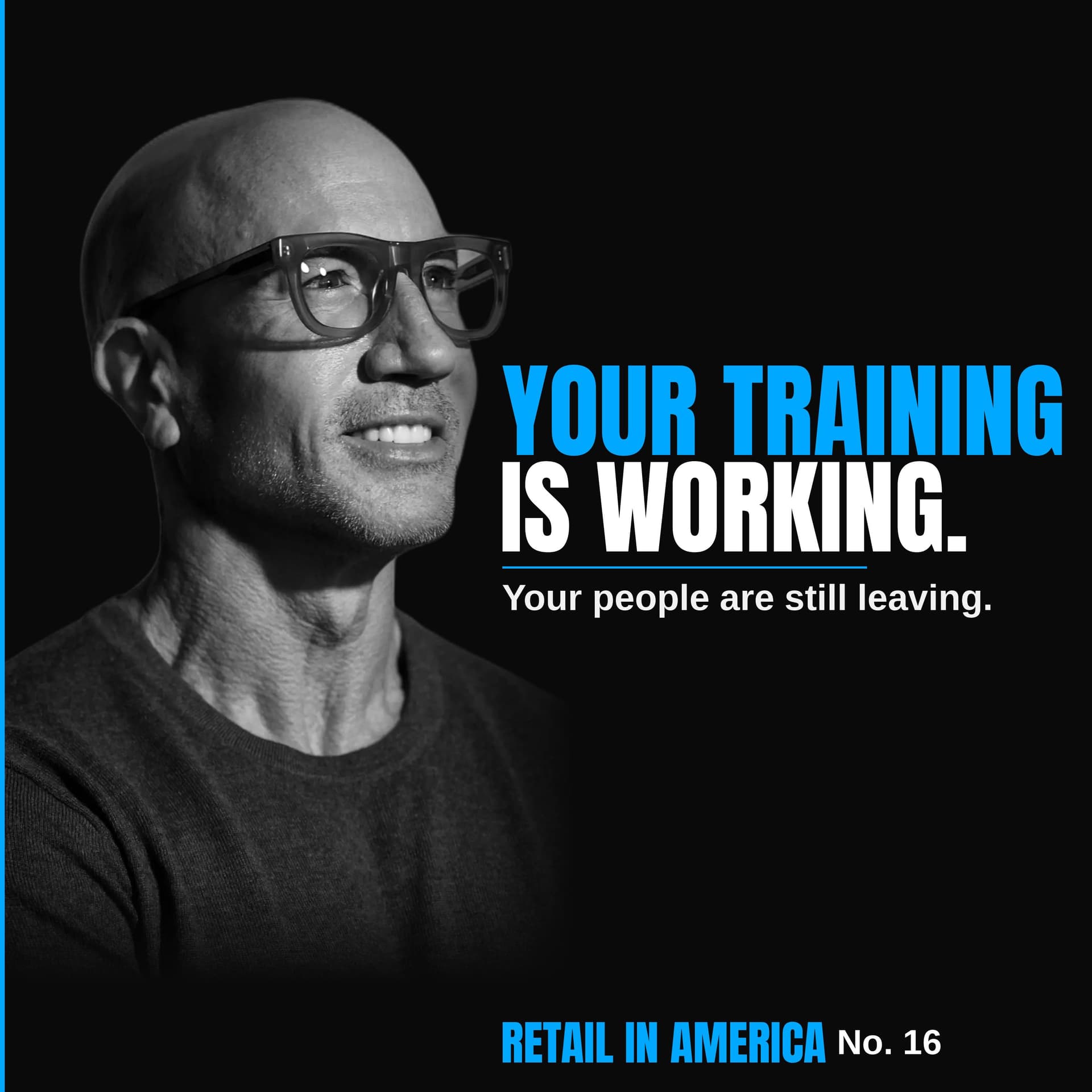
Episode 16: Compliance Is Not Development
Your training is working. Your people are still leaving.
In this episode of Retail in America, Ron Thurston breaks down the critical difference between completing a training module and actually developing a frontline worker.
Through the story of DeShawn — a high-performing associate who left for a two-dollar raise because he couldn't see a path forward — Ron contrasts two types of retailers. Company A measures compliance. Company B measures capability. One is losing its investment; the other is multiplying it.
If your dashboard says training is at 90% but your stores are bleeding talent, this episode is for you.
What you'll hear in this episode:
Only 24% of frontline workers feel confident they have the right training to do their jobs — and 40% aren't even clear on what's expected of them. Yet most companies report completion rates above 90%. The dashboard and the frontline worker are living in two completely different realities.
Harvard Business Review is clear: training embedded in daily workflow is what actually drives performance. And the Forgetting Curve shows that people forget up to 90% of what they learn within a month if it's not applied.
The data on what's at stake: frontline workers who feel properly trained are 3x more likely to stay. 94% say they would stay longer if a company invested in their development. And 85% want another role inside their company — if they can see the path.
The desire to grow is not the problem. The visibility of the path is.
Connect with Ron:
- Subscribe for weekly insights: ronthurston.com
- Read RETAIL PRIDE: Amazon
- Read HUMAN PRIDE: Amazon
- Retail in America is the show about what's really happening inside retail — the space between the strategy and the person expected to execute it.