Ask ChatGPT

 Shopify Masters
12 Oct 2026 · 30m · 15 chapters
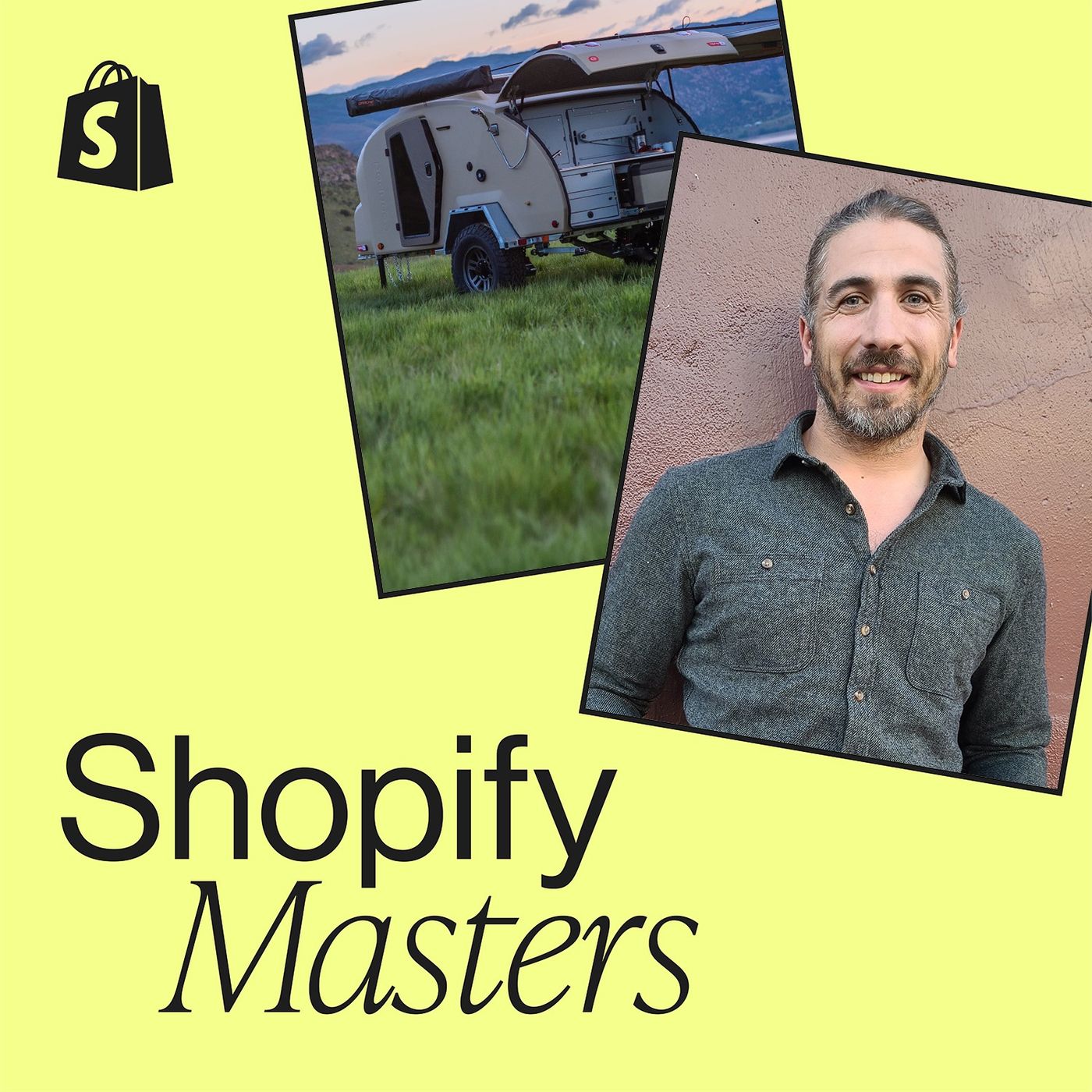
The episode with Shopify Masters features Escapod founder Chris discussing how his off-road “small house on wheels” camper idea grew into a high-tech aerospace-style manufacturing business, and how AI helps manage scaling and customer experience during downturns.
Chris (Escapod co-founder; hospitality background including Michelin-star restaurants and fixing struggling restaurants) and host Serena Smith.
expectations stay high even for ~$50,000 campers; founders must build community and process before automation; agentic AI can provide “AI employees” for instant customer updates and guidance; AI helps founders “clone” themselves by offloading non-value-add tasks.
Moab friend’s request to buy three trailers; scaling from 4 employees to ~80 and ~24,000 sq ft; COVID/RV crash forcing contraction; vertical integration into composite manufacturing (decision June 2025, productionized by Dec 2025) to restore cash flow and profitability.
Written by AI. May contain mistakes.
Discussing the excitement of founders and the high expectations of customers.
“We never have problems getting things started, but maybe we have problems keeping things going.”
Explaining the concept and features of Escapod campers.
“For those of us who aren't steeped in knowledge around this stuff, what is an Escapod?”
The story of how the idea for Escapod came about from personal needs.
“Initially, when you decide to build this, your mindset is not, I'm starting a company, is it?”
Discussing the transition from building trailers for friends to considering a business.
“During that two months, are you still thinking, I'm going to go back to this job and my career and my identity is still as a hospitality guy?”
Exploring customer expectations and the challenges of manufacturing a niche product.
“It's building a community the whole time.”
Discussing how new technologies are being used to manage customer communication.
“I decided to do all four for some strange reason.”
Exploring how AI can fill knowledge gaps and enhance employee capabilities.
“So customer emails in 24 hours later, you respond, they responded 24 hours later.”
The importance of building strong processes for effective automation in small businesses.
“I think that what AI can do really well is fill in knowledge base gaps, right?”
Learn how AI can help small business founders offload tasks and improve processes.
“Now I get to go, well, can I go manage my staff?”
Discover the challenges and successes Escapod faced during its rapid growth phase.
“And I think at the level, you know, yes, you can, you can go into Claude or chat today and type in your email and it'll clean it up and make it more professional.”
Understand the impact of economic downturns on business operations and strategy.
“and I think that it worked out perfectly.”
Explore the personal challenges founders face and the importance of maintaining identity.
“Interest rates are terrible or tariffs are going up.”
Reflect on how success has changed and the importance of teamwork in overcoming challenges.
“Ultimately, are you then saying that it's in our best interest to divorce our identity from the thing that we're doing?”
Learn about the journey from initial ideas to creating an advanced aerospace product.
“employees, partners, families, and we all get to reap that reward.”
Learn how effective communication and support can enhance business relationships.
“she knows that sometimes I just need somebody to listen.”

Get the gist, explore an idea or ask about something said.
 Claude
On Shopify Masters, what are the key points of this episode?
Searching your listeningAutomatic transcript. May contain errors.
0:00Chris Hudak: Founders are excited. We love to move fast. We have ideas. We never have problems getting things started, but maybe we have problems keeping things going. And AI can fill in that kind of gap.
0:10Shopify Masters Host: When you're going through that moment of contraction and your staff are real human beings who you know, you know they're reliant on you, how are you leading in that moment?
0:21Chris Hudak: People always have a high level expectation where they're at. Very rarely are they like, man, I'm getting this good deal, so I expect subpar service, right? Right, right.
0:31Shopify Masters Host: Expectations are always high.
0:32Chris Hudak: The rocket ship is great, and it's fun, and it's exciting, and you can do everything. I think that the forge and fire moments are the moments of downturn. It's going to be okay if this doesn't make it, but I'm going to put myself on the line to make sure it does.
0:48Shopify Masters Host: Welcome to Shopify Masters, your companion for starting and scaling your business. I'm your host, Serena Smith. Chris, thank you so much for being here.
0:55Chris Hudak: For sure.
0:55Shopify Masters Host: For those of us who aren't steeped in knowledge around this stuff, what is an Escapod?
1:02Chris Hudak: Yeah, so an Escapod is an off-road camper. It's very small and very lightweight, so you can most likely pull it with any vehicle that you have. Insulated, heat, air conditioner, full kitchen, it's all set up always and ready to go. With an Escapod, you have a place off the ground, a warm place that's temperature controlled, and a place that's quiet and safe.
1:22Shopify Masters Host: This is a true back of the napkin story, isn't it?
1:26Chris Hudak: Yeah, it truly is.
1:26Shopify Masters Host: How did the idea for Ask a Pod come to be?
1:28Chris Hudak: My wife, my then girlfriend, and I were racing mountain bikes, camping every weekend, loading up the car. And it just became a lot, right? We had two dogs. We're like trying to put everything in this small vehicle. And we realized we needed some sort of camping trailer. And after looking at what was on the market and kind of doing a lot of that research was like, I can build this. Like this is pretty easy, right? It's like just a little small house on wheels.
1:54Shopify Masters Host: Initially, when you decide to build this, your mindset is not, I'm starting a company, is it? It's just, I want to build this thing for me and my wife.
2:03Chris Hudak: Yeah, it was a need for us, you know, and what we were doing and traveling at the time. I think that was quickly seen by friends and people that we were around traveling. Cause like I said, we're going to bike races. And so we were always camping with other people that were still camping in tents. And so I found myself being asked to build, Hey, can you build one for us? And it started just as like after work, you know, I put in a few hours.
2:24Shopify Masters Host: It starts to get some attention invariably as you're taking it out. Right. And you said like you start to build one for a friend here and there. It's very organic growth.
2:36Chris Hudak: Absolutely. At what point does it strike you like, oh, this might be a business that we're talking about here? We had a friend in Moab that wanted to start a small business, renting trailers down in Moab. She had a place down there. and she said, hey, listen, I'd love to buy three trailers so we can start this little business. How fast can you get them to me? And I said, well, shoot, you know, like three trailers, I don't know, three years, right? Like at the pace that we were building was very slow at the time. And just at that moment, the place that I was working was going under renovation. I found myself with plenty of time over a two month period.
3:14Chris Hudak: I said, how's two months? And she said, you can do it. And I said, yeah, I could do it. I spent about six weeks building those three trailers And at that time I said, this could be a business.
3:22Shopify Masters Host: You had spent your career working in hospitality. During that two months, are you still thinking, I'm going to go back to this job and my career and my identity is still as a hospitality guy? Or are you feeling it shifting?
3:35Chris Hudak: I knew I had to for a short time because we were in the middle of building a house. So we were like building this beautiful dream house in the mountains, log cabin, 8 ,100 feet. We snowmobile there for the first like three years. Right. So until she got pregnant and then was like, we're not doing that anymore. And then I got a tractor. But again, another story for another day. I knew I had to stay there long enough to basically build that house, to sign the mortgage. And then the moment I did, I was like, now's my chance.
4:07Shopify Masters Host: Figuring out how and when to go all in is, I think, more art than science often. Yeah. What did you know had to be aligned for you? You knew you needed to have a mortgage. What else did you need to see was working for you to feel comfortable?
4:27Chris Hudak: I had to have a supportive partner. I personally needed somebody to be able to say it's going to be okay along with me and like someone to stand next to me through that adventure. And it was hard.
4:37Shopify Masters Host: So often we think about the business of building a company as this sort of like solo task. But it really requires the help of the people around you.
4:48Chris Hudak: It's building a community the whole time. I mean, whether it's a supportive partner inside the organization, a supportive partner outside the organization, your staff, you know, it's like everyone has to be involved. And you're really building community, not just the solo like expedition by yourself.
5:03Shopify Masters Host: You come from this hospitality background. You, correct me if I'm wrong, you were a guy who was brought in to fix struggling restaurants. That's right.
5:11Chris Hudak: It's a tough job. Yeah, it is a tough job. But it was really my favorite part of it. It was like how to reimagine what was wrong, how to identify areas of opportunity. I spent some time in some Michelin-starred restaurants and really did the high-end thing for a long time. It's all exciting for somebody like a founder, an entrepreneur, where things are moving really fast and you get an opportunity to have an impact or mark every day. And that was a lot of fun.
5:36Shopify Masters Host: Working in hospitality at sometimes at least the highest level, right? You're in these Michelin-starred restaurants. the expectations of the customers there is a very different game than going to your favorite neighborhood haunt, right? Similarly, an Escapod is expensive. They're often around$50 ,000. It's a huge expenditure for a lot of people you said they save up. How does that change the expectations of the customer? What kind of expectations are you answering to and what is important for you to be serving when you're dealing with people at that level?
6:08Chris Hudak: I think that people always have a high level expectation where they're at, right? Very rarely are they like, man, I'm getting this good deal. So I expect, you know, subpar service, right? Like expectations are always high and people are always stretching to get that thing that they desire. It doesn't matter what the price tag is on the sheet. And I think that you should always try to give that level of service whenever possible. Now that said is you don't always make it. And sometimes you let people down and that's tough and it's tough for a founder to hear for sure. But how do you recover? What do you change?
6:44Chris Hudak: How do you invest more in the experience? And how do you take a look at your internal process to say maybe they're broken here or maybe there's an opportunity there?
6:53Shopify Masters Host: But when you are let down and something is cheaper, you're more likely to let it go, right?
6:58Chris Hudak: Totally.
6:58Shopify Masters Host: You've spoken to there being times where you have let the customer down. Can you give me an example and like how you dealt with that?
7:05Chris Hudak: We're in a very complex space. Not only do we manufacture the product, but we market the product, we sell the product, and then we also distribute the product.
7:13Shopify Masters Host: Right. This is very rare.
7:15Chris Hudak: This is extremely rare. Usually you choose one of those things. I decided to do all four for some strange reason.
7:21Shopify Masters Host: I think it's probably because I'm out of gathering one.
7:24Chris Hudak: It's maybe because I'm a slightly controlling of the experience, but it's hard. The communication is a balance. You communicate too little or you communicate too much, right? And it's a balance with the customer. In our line of work, we only build trailers that are pre-sold, oftentimes many, many months in advance. And nothing moves in manufacturing until maybe like the last eight weeks. And so a lot of that time is waiting. And how do you keep the customer excited? We're still figuring that out today. We're still building new process, using new technologies that are coming out to help us manage that customer experience better through the journey.
8:03Chris Hudak: Because many times, you know, we're sitting there going, yeah, you're in the queue, you're in the queue or in the process of waiting to be built. But for the customer, it's exciting from the moment they put the deposit down.
8:15Shopify Masters Host: What kind of technologies are you using to help with the customer experience?
8:18Chris Hudak: Basically how this all gets managed just through an inbox. Think of the experience of not only being proactive about communication, but also responding to communication as well. This is kind of like a slow process in an email form, because let's say even you're doing pretty good and you're a 24 hour turn time. So customer emails in 24 hours later, you respond, they responded 24 hours later. It's like to have a simple conversation could take a week or two weeks over just 14 communications. And so we're building and releasing some really cool technologies that allow the consumer to have immediate feedback on questions using AI.
9:02Chris Hudak: And so what we'll have is we have AI employees that are able to identify where the customer is in the build process to know what kind of vehicle they drive so they can help prep the customer for that journey of picking up or how to maybe back up a trailer. And so we're really leaning into those technologies where the information is more readily available. And then also to identify where that customer is in the journey each time, which is a lot. Which you have to scale also as you scale.
9:31Shopify Masters Host: Has this allowed you to reduce your workforce or is it about something else?
9:37Chris Hudak: I have a theory. I don't know if it's a theory, but more a thought on this, which is like these technologies, what we're talking about, AI, is applied in a few different ways. You have a mature company that's maybe saying, hey, how can we drop more to the bottom line using these technologies? And what you have is a reduction in workforce a lot of times. You have a company who is maybe on a fast track and they just can't keep up, right? So imagine a fast-growing supplement company maybe, and they're going to invest in AI technologies to maybe do more, release more product or market better or find their people, right?
10:11Chris Hudak: And so they're investing in AI to do more. And then you have a company like Escapod, which is a very niche product with a very small workforce. And it's all of the people there wear so many hats. And so how do you, with a small company, maintain this leanness and this ability to move like a lean company does, but do more at the employee level, right? And so that's where we are. And I think that, yes, there are some companies that will reduce workforce from AI services, but there's also companies that are empowering each employee to do more and to learn more and to leverage more.
10:51Shopify Masters Host: Then what's been the upshot for your employees?
10:54Chris Hudak: I think that what AI can do really well is fill in knowledge base gaps, right? I can build composite parts from scratch, I can weld, I can do all of those manual things, I can design, you know, but for me, I'm not a great, somebody who's great at spelling, right? And so AI is simple for me, right? It's like, hey, help me write this email. Help me put it in these words. It's going to be to a customer. And that might be part of it, but it also might help me step into a CEO role that's more apt for becoming a CEO from a founder. Founders are excited. We love to move fast. We have ideas. We never have problem like getting things started, but maybe we have problems keeping things going.
11:40Chris Hudak: And AI can fill in that kind of gap. Like, here's the path for the next 18 months, right? So like, draw it out, like, work through it, build it. And then it's like, okay, how do I stay on this path? When I see like the little thing off in the distance that I find exciting or shiny, how do I say, is this part of the path or not? And specifically with agentic AI, it's capable now of saying, hey, here's my path. Here's all the information. Here's what our company does. And then I can say, I have this opportunity. What do you think of it? And then you can talk about it and decide if it's on the path, right?
12:19Chris Hudak: And so I think it's becoming a tool that allows me as a CEO to maintain this focus, this laser vision 10 years after starting, to say this is where we're going and this is how we're going to get there.
12:33Shopify Masters Host: Is there a shiny thing you wanted to pursue that it deterred you from pursuing?
12:38Chris Hudak: Probably every day.
12:39Shopify Masters Host: Really?
12:40Chris Hudak: Yeah. I am always looking at the world around me with an eye of opportunity. And it's opportunity is costly, right? And especially when your company is on a very specific trajectory, all these opportunities are bandwidth suckers or things that really take up your time or your money or some sort of resource, maintaining the focus on the goal is the most important thing.
13:08Shopify Masters Host: Ultimately, a business has to make money also and hopefully a little bit more money every year than the last one. Has it had an impact on your bottom line?
13:17Chris Hudak: It definitely has. And it allows me to act like four of me, right? I know that everybody has been in that situation. It's like, oh my God, I wish I could just clone me. that very much is what you can do in today's world, right? So think of the non-value add time stuff that you do, right? So think of a presentation to investors or crunching the numbers on financials. The actual building of the spreadsheet is non-value add, right? Like you're just building a spreadsheet or you're just building your presentation. That's non-value add time. But But if you can get rid of that and just focus on the message and let something else build for you, then that's the time you get back.
14:03Chris Hudak: Now I get to go, well, can I go manage my staff? Can I go manage the financials in this way? Can I go have an investor conversation rather than building investor conversation? And those are the moments that I see that is making a huge, huge leap in what we do.
14:18Shopify Masters Host: For other founders out there, what's something that you would say you could very readily offload to AI today that they might not be thinking about?
14:28Chris Hudak: The biggest thing and the thing that I think in small business is the most effective is that in order to offload anything and what you talk about, I think what you're talking about offloading is automation. You have to build strong process because if something is in your head or if something is not replicatable every time or something is hidden or something is, you know, lives with Timmy in the mailroom, you cannot automate. And so what it does in business at my level is to say, there's a gap in my process here. And I am a process-driven person. I can see process from beginning to end. And what it allows you to do is say, there's an opportunity here to automate.
15:12Chris Hudak: But in order to do that, I have to do X, Y, and Z first. And then you end up with stronger process, which is more efficient and more replicatable. And then you can automate. So I'd say there's nothing you can't automate, but you just need to be able to build the process around it first.
15:28Shopify Masters Host: We often are looking at AI as like this huge time saver, right? And we want to supercharge our workflows. But it sounds like there is sometimes an investment of more time and energy in the beginning part to get to the place where then the AI can take things off your plate.
15:45Chris Hudak: A hundred percent. And I think at the level, you know, yes, you can, you can go into Claude or chat today and type in your email and it'll clean it up and make it more professional. What I think I'm talking about is like truly agentic systems that, that know what you're doing and, and, and have a factor of automation to them.
16:06Shopify Masters Host: Every company has its inflection points, right? There's periods of steady growth and then there are spikes.
16:13Chris Hudak: Yeah. Yeah.
16:15Shopify Masters Host: Where was that moment for you, that first big moment?
16:17Chris Hudak: You know, when we hit the market, it was just the right time, man. And when we dove in too, right, went full time, it was just the right time. And immediately it was like 18 month wait for our trailers. Like we were just sold out, bang, immediately. As fast as we could build them, we would sell them and faster. And so I was like, shoot, like build, build, build, sell, sell, sell. And quickly realized in the following year that we needed a bigger space. We were in like a four car kind of like old auto body shop or old auto shop. And I realized that I was like, hey, we need a bigger space. And so we bought a old car dealership 10 times the size.
16:57Shopify Masters Host: It's a big bet.
16:57Chris Hudak: Right. And that time went from like four employees to the height of it of 80 employees.
17:03Shopify Masters Host: Wow.
17:03Chris Hudak: And then we built an additional 10 ,000 square feet on top of that. So we're like 24 ,000 square feet ish, you know, at that time and still today, 80 employees, two models, we're building almost two trailers a day.
17:18Shopify Masters Host: I mean, think about this, right?
17:19Chris Hudak: Like, and I'm talking about it in a short time. And I think every founder dreams of that. Like we went on a rocket ship.
17:29Shopify Masters Host: Too fast?
17:30Chris Hudak: I think that it's impossible to focus on the foundation when you're moving that fast, yeah. Now too fast? No, I think the path is the path we should have been on. and I think that it worked out perfectly. What happened is obviously COVID and then post-COVID and the RV industry, you know, took a nosedive and now you work on the foundation, right? And I think that is the other inflection point, which is like, yeah, the rocket ship is great. The rocket ship's wonderful and it's fun and it's exciting and you can do everything and you make new models and you do all this fun stuff. I think that the forged and fire moments are the moments of downturn, right?
18:11Chris Hudak: How do you adjust to the industry changing, right? Like interest rates skyrocketing, tariffs, post-COVID, everyone had a trailer already. Like, I mean, think about it all. And that was the tough time.
18:24Shopify Masters Host: You had ratcheted up the size of your team sizably.
18:29Chris Hudak: Yep.
18:30Shopify Masters Host: You had invested in this much larger space. Your overhead is in a very different place than it was maybe even a year prior. and then there's a contraction in the industry. That's right. So -
18:40Chris Hudak: And you built that process in that meantime that required that overhead, right? So imagine, you know, we've talked a little bit about automation, but imagine in 2022 and 21 is that you're just building as fast as possible. And you're just saying, well, if I do X, then in order to double, I need to do 2X, right? And everything is just growing at the same rate and then you have to contract, right? And how do you, like, you still have to do the same process. You still have to manufacture the product. You still have to sell the product. You still have to distribute. You still have to market it.
19:11Shopify Masters Host: You're a guy who's trained to come in and fix struggling restaurants. Are you mentally like, yeah, okay, this is a crisis. I'm good in a crisis. I can do this.
19:21Chris Hudak: I'm somebody who, as long as can see the path forward, never has a problem with the work that has to be done. When I get on my lows is when if I don't see a path forward, right? Like if you can't, I don't feel like, how does this work? Or how do I get through this? Or what does this look like? but just give a glimmer of light and you're like, that's the way.
19:38Shopify Masters Host: It sounds like maybe there were times where you thought maybe you couldn't see a path forward.
19:44Chris Hudak: Oh, absolutely. Yeah. Think of the overhead that's required to build at the rate that we were, right? So you're talking about 80 employees. You're talking about all of that square footage, right? In a business that's built on a thin margin, but a volume that carries it, right? And that's the business we built, a premium product, but with a relatively thin margin, trying to sell as many as we could to cover that overhead. Well, when the market crashes, what inevitably happens is that your overhead stays the same, but your revenue drops. And then when you're in manufacturing, we're not selling to dealers.
20:25Chris Hudak: We're not saying, okay, we're going to load up these 20 trailers. The problem gets shifted to the dealer. And in that meantime, we'll figure out our house. And that's what, you know, kind of big RV is dealing with now is that they just kept shipping to dealers. Well, for us, it happened much faster. It was like.
20:41Shopify Masters Host: Because you are the dealer.
20:43Chris Hudak: We are the dealer. And so that is almost doubly hits us, which is how do you how do you scale down fast enough? The realization was that, well, we this is a macroeconomic problem. We have the best trailer in the world. There's no question about that. Like we had the product. We had the interest. You know, if you looked at like our, our marketing and sales funnels, like people are like, yeah, yeah, yeah, we love the product, but now it's not the right time. Right. Interest rates are terrible or tariffs are going up. It's like hitting you on both sides. And so, well, we had the square footage, but we couldn't increase sales.
21:19Chris Hudak: So what do you do with the square footage is you vertically integrate. We took on more, you know, we do everything from, from the weld through the composites, through the final construction, through, you know, it's like we do every piece of it. And so we made a insanely big bet that said, okay, we can't work at the rate that we're working at. And so in order to get through, we have to double down and take on the composite manufacturing of the trailer. A highly, highly technical process that takes up a ton of square footage and capital expense to get into. And so in the middle of the worst of it, you like double down.
21:55Chris Hudak: You're like, okay, we're going for it.
21:58Shopify Masters Host: How fundamentally in a moment when there just isn't as much cash coming into the business, do you, can you make a capital investment like that?
22:05Chris Hudak: Yeah, that's tough. There were some, there were some conversations with, with the wife. There was some moments of, of blood and that's true blood for myself. You know, just like you, you, you do it as a founder, you do it. It doesn't matter if you like, if, if you stay up all day, all night. Like if there's something to do, you do it. And that's the mentality that we had. And it was, it was insane. I mean, we started the process of taking on composites. I think I made the decision in like June 1st, like 2025. It took us all the way through to December to have a fully production, like fully productionized line.
22:44Shopify Masters Host: Did you feel it paying off quickly?
22:46Chris Hudak: No, no. It, it was the focus on that little light in the distance, that little vision. And I said, remember I said, it's like, as long as I have that, I'll work. And I think it was like, it was focusing on that. And once it, once it kicked, then you're like, okay, now we're cash flowing in the positive direction. We're bringing profit to the bottom line at the rates that we need to be at, which is, you know, what the need is for today's demand.
23:15Shopify Masters Host: Did AI play any role in helping you find that point on the horizon?
23:20Chris Hudak: Yeah, it's, it's helped me in so many ways, steer the ship, right? You're gonna, you know, at this point, right, it's like, you're building a new production line, you need capital to do that, you need the backs of your investors, you need to keep your staff engaged. And so through this time, all of those things I normally would do, which is acting as the CEO, but now I'm, I'm building a new production line, I'm able to lean on AI and to really have an assistant to help me produce more.
23:52Shopify Masters Host: On a personal level, when you're going through that moment of contraction and, you know, your staff are, they're real human beings who you know, you know, they're reliant on you. How are you metabolizing what's going on? And how are you leading in that moment?
24:10Chris Hudak: I think the first thing you're going to deal with that I had to deal with was the identity part of it was like, how do you how do you identify as this person and what happens if it goes wrong? And all of that stuff is tied up into us founders of like, this is me. Right. And I had to deal with that first before I could take on those other things. And like that took a lot of work and like a lot of understanding to say, hey, it's going to be okay if this doesn't make it. But I'm going to put myself on the line to make sure it does. And then like that took a lot of self-work. And then once you do that, you can show up for others.
24:46Shopify Masters Host: Ultimately, are you then saying that it's in our best interest to divorce our identity from the thing that we're doing?
24:54Chris Hudak: I would be lying to you if I said that I have completely divorced that successfully. But I know that it is not the entirety of my self-worth. And like that, I couldn't have told you a year ago.
25:05Shopify Masters Host: Was there anything in particular that proved to be a catalyst for that transformation?
25:10Chris Hudak: There was no other choice, right? It was like facing it, like right. Back against the wall. Right, back against the wall. Like, you know, just like you had to deal with that. Otherwise, you couldn't go forward. You know, it was crippling.
25:22Shopify Masters Host: I really appreciate your candor about this. I think so often, you know, it's like we have the feeling or, you know, as human beings, we just have the desire to see that something is just sort of like a story of linear growth. Right. In actuality, it's like there's ebbs and flows to everything in life. You live through this period of just like skyrocketing, right? And the intoxication of that, you go through the contraction.
25:48Chris Hudak: Right.
25:49Shopify Masters Host: Have you stabilized today?
25:51Chris Hudak: Yeah, I mean, the craziest thing is that we are more profitable not only in a percentage base, but in a true monetary sense than we ever have been in the past. Even when we were like 80 employees and doing all this big thing, right? Like the focus and the work that we have done has brought more to the bottom line than ever before. And that is the base building. That is the foundation. That is a lot of times this like the technologies that we're leaning on like AI and automations. So the overhead is a lot smaller.
26:21Shopify Masters Host: Are you bringing in less top line revenue? Yeah. But your profits are higher?
26:28Chris Hudak: Higher, correct.
26:28Shopify Masters Host: Wow, that is.
26:29Chris Hudak: Not only percentage based, but actually true dollar based.
26:32Shopify Masters Host: Dollars and cents. Wow. How does that make you feel?
26:36Chris Hudak: Well, it's still a lot of work. So it's still, you know, it's like we're, we're in it still like in the trenches and still like struggling through it. But it makes you feel really good. I like to say is like last year was the year of the snake. It was like shedding the skin. It was like regrowth. And this year is year of the horse. And we are as a team jumping onto that belief and we're charging forward and looking forward to like reaping the rewards of all of that work we've done. And because the people that have done it with me, like I'm sitting up here, but there are many people that have supported that vision that have been along with this journey as well.
27:18Chris Hudak: employees, partners, families, and we all get to reap that reward.
27:22Shopify Masters Host: Has it changed the way you think about success?
27:25Chris Hudak: It has. I still need to do some work to define what that truly means, I think, at the end of the day. I have felt in the last six months, more moments of success than I felt a long time before that, which has been great.
27:38Shopify Masters Host: You founded this company originally with your wife.
27:42Chris Hudak: Yeah.
27:43Shopify Masters Host: that's a great degree of enmeshment. Are there also any hard and fast boundaries you've set for yourself? Or is it everything everywhere all at once?
27:51Chris Hudak: I'm living and breathing it, yeah. And I think that she's done an amazing job of like, if we talk and I've like had a rough day, she knows that sometimes I just need somebody to listen. And she's like, she knows the business, right? Like she's a founder as well. Although she's not in the daily business today, she sometimes just like knows that I need to vent without going in to fix it, right? And it's like being able to listen to your partner and have that space and hold that space for them is so important, so important.
28:21Shopify Masters Host: When you look around at your factory today, what's something that just like blows your mind when you think back to that, back of the napkin?
28:30Chris Hudak: Yeah, I think it's the product that we create. I mean, the fact that we're doing an aerospace technology through, you know, composite infusion all the way to this beautiful product at the end of the day and then handing it off to the customer. And I think that I still get to do some of those handoffs. And those are my most special moments, right? Because they're seeing it maybe for the first time in real life, right? They've bought this online. They've dreamt about it. They've done all the research they can, but they've never actually seen and touched one. And they're just falling in love with it.
29:06Chris Hudak: And they're just so excited about the things they're going to achieve with that product.
29:10Shopify Masters Host: It's gratifying.
29:10Chris Hudak: Yeah, it is amazing.
29:12Shopify Masters Host: Chris, thank you for being here.
29:13Chris Hudak: Thank you.
29:13Shopify Masters Host: Appreciate it.
29:14Chris Hudak: Thank you.
29:15Shopify Masters Host: And thank you for tuning in. Ready for your business adventures to begin? Check out the Shopify trial in the description and we'll see you next time.
Chris Hudak launched Escapod to solve his own outdoor camping frustrations, building it from a garage project into a multimillion-dollar off-road camper company. By skipping traditional dealerships, vertically integrating production, and leveraging AI tools, he navigated major industry shifts to build a lean, highly profitable direct-to-consumer brand.
For more on Escapod in show notes, click here