Ask ChatGPT

 Shopify Masters
3 Nov 2026 · 30m · 20 chapters
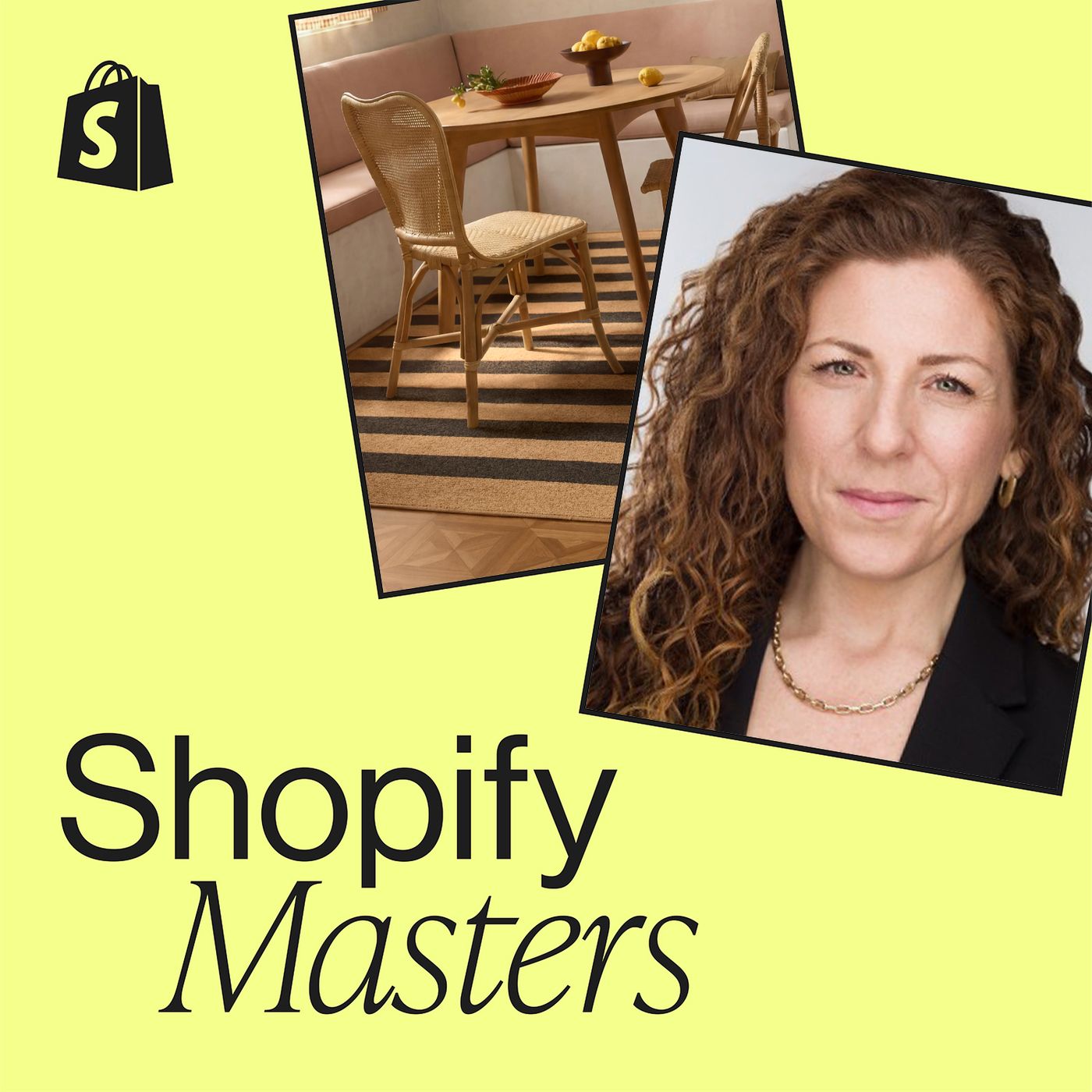
Ruggable’s turnaround from complaint-driven stagnation to renewed growth by listening to customers online, rebuilding product and design, and reshaping its retail calendar; the episode also connects this approach to agentic AI “guided commerce.”
Sarah Kleinman, Chief Commercial Officer at Ruggable. Background includes e-commerce and growth leadership at North Face, Gap, and Vans; she studied philosophy at Berkeley and frames retail as emotional/psychological.
Leaders must monitor Reddit and social comments; dissatisfaction came from unmet expectations (not brand love). Ruggable over-indexed on operations and media while underinvesting in product/brand storytelling. Product innovation and design drove conversion; “Project Second Chance” re-engaged past detractors. Agentic AI outcomes depend on real customer experiences, not brand gaming.
Fixing the two-piece rug system; launching all-in-one rugs and new Performance Weave material (replacing jute; “no shedding”). Summer spend productivity rise explained by moving homes (5–6% of moves in winter months vs 17–20% in summer).
Written by AI. May contain mistakes.
Leaders must engage with customer feedback to drive business success.
“Any leader who isn't spending huge amounts of time in the Reddits of the world, in the comments across all of the social universe, is really missing the forest for the trees.”
Exploring how philosophy informs understanding of consumer behavior.
“And I remember entering my first philosophy of mind course.”
Sarah discusses the challenges she faced upon joining Ruggable.
“And so for us to get that right and to feel like we're being additive in the mom's, you know, home is just really important.”
Uncovering stagnation causes and focusing on critical growth functions.
“The company sold 14 million rugs globally.”
How Ruggable leveraged customer feedback to innovate products.
“You spoke to the pieces that were working and then making investment in the pieces that weren't working as well.”
Identifying Ruggable's core customer base and their needs.
“There's a big community in Reddit and we had a very vocal audience there.”
Tips for understanding and engaging with your customer effectively.
“And, you know, we got really crystal clear on who we were serving.”
Shaping Ruggable's retail calendar around customer life moments.
“Was there an unlock of this ride at Ruggable?”
Discussing recent product innovations and improvements at Ruggable.
“And it's also really relevant to audiences.”
Learn about Ruggable's new material, Performance Weave, and its benefits.
“And we were able to go to the product innovation teams and see some of what was coming and say, oh, my goodness, this is a treasure trove.”
Discover the changes Ruggable made from a two-piece to a more user-friendly one-piece rug design.
“Just to put some more specifics on it, what were some of the actual changes that you were making to the product?”
Explore how Ruggable tackled customer complaints and enhanced their image.
“But one of the things that was really exciting for us when we went to go and make the new change, And we, of course, respect and love our historical consumer that really loves our two-piece substrate.”
Understand the significance of design in driving customer conversion for Ruggable.
“What have you found has worked, has resonated with people, has brought them back to Ruggable?”
Learn about the importance of transparent communication and personal engagement with customers.
“And you have to understand that life cycle and understand the role a product plays in your assortment, which I think is just a sophistication that hadn't been there previously.”
Gain insights into how agentic AI shapes customer decision-making in retail.
“And just to level set, you have a great phrase that helps describe what agentic AI is.”
Explore how consumer feedback influences brand accountability in the digital age.
“And everybody is trying to figure out how they can show up in these results.”
Hear how Ruggable's product innovation has positively affected customer experiences.
“I had a moment, my daughter is, she's five, and so she's in a real potion making era.”
Discover how Ruggable integrates AI technology with foundational business strategies.
“and going back to customers and engaging with them has had an impact on the way that you show up in Agentec AI?”
Discover how personalized engagement strategies enhance results.
“who engage with us get smarter and smarter results that are really personalized to where you are in the world, who you are, where you came from, what ad you came from.”
Wrap-up of the conversation and thanks to the audience.
“Subscribe and come back every week for brand new episodes.”

Get the gist, explore an idea or ask about something said.
 Claude
On Shopify Masters, what are the key points of this episode?
Searching your listeningAutomatic transcript. May contain errors.
0:00Sarah Kleinman: Any leader who isn't spending huge amounts of time in the Reddits of the world, in the comments across all of the social universe, is really missing the forest for the trees. You know, internally, we're in a better place now, but communicating that outwardly is a different beast. All you have is your reputation. Our one-piece material made up more than 70 % of our revenue in less than eight weeks. Oh my God, rapid validation. We use AI in really, really incredible ways. Any tool, any technology that helps me, I welcome.
0:37Ruggable turned washable rugs into a nine-figure D2C business and is still finding new ways to grow. Sarah Kleinman is here today to talk about how established brands can keep their ears to the ground and use what they hear to grow. I'm Serena Smith and this is Shopify Masters. Welcome to the show, Sarah.
0:52Sarah Kleinman: Thank you. So you have a long, impressive career with deep experience in e-com and a track record for driving growth for brands. And fascinatingly, you were a philosophy major at Berkeley. I was. Explain that trajectory to me. I know. It's really funny. I really just wanted to be challenged. And I remember entering my first philosophy of mind course. It was actually about this philosopher named Wittgenstein. And I, it was just one of those things that was like mind bending to me. And in the end, what's really ironic about the whole thing is, you know, philosophy is really understanding people and how we think and how we behave.
1:31Sarah Kleinman: And so much of what we do in retail and brands is ultimately about serving consumers and really understanding them and understanding what satisfaction looks like with a brand engagement. And so I do, I do honestly use it all the time. That human psychology and relatedly the philosophy piece is so enormous. We can speak in the data points in the operational language, but ultimately it's like it's human beings who are making the purchases. A thousand percent. It's a deeply emotional thing often. I love that you just called out emotionality. I always say that, that, you know, the relationships we have with brands, the products that we put on our bodies and our homes, it's so emotional.
2:12Sarah Kleinman: It's such an emotional choice. Totally. And, you know, I think about this a lot. I'm a mom and the spaces that we make for our families, it really is a very emotional choice. That's the backdrop of your life. And so for us to get that right and to feel like we're being additive in the mom's, you know, home is just really important. And so we take it seriously. Totally. We take it very seriously to the tune of, you know, sometimes endless, what feels like endless hours of research and deep internet rabbit holes, which relates a little bit to the story that we're going to be talking about. But, you know, you're chief commercial officer.
2:51How do you describe what you do if you were like at a dinner party?
2:54Sarah Kleinman: I always say that I run the business portions of Ruggable. So I lead our websites. I lead our wholesale teams. I really lead the strategy that we take to go to market with our consumers. And so that's sort of the backdrop of what I do. You are pedigreed. You've been at North Face, at Gap, at Vans. You clearly like a challenge. What made Ruggable a challenge that you wanted to sink your teeth into? It's true. I love a challenge. And really one of the things that I've also gotten quite good at is turnaround moments in brands. Those moments where either growth is decelerating or stagnating and really figuring out what does lead to sustainable, scalable growth.
3:39Sarah Kleinman: You're a fixer. I am. I'm a fixer. And Ruggable is such an interesting organization, partially because of its size. Ruggable is right at that interval where what got you here won't get you there. It really is big enough now. The company sold 14 million rugs globally. It really is big enough that to get to that next level of growth, it needed to really re-examine how it existed in the market and reconnect with audiences and really redefine the retail basics. And so setting up that trajectory for growth is, it's just really fun. When you got brought into Ruggable, was that, what was at the top of your to-do list?
4:21Sarah Kleinman: A hundred percent. And you know, it wasn't just, you know, I should just say, it wasn't just me. First of all, I joined to join our incredible CEO, Nicole Otto, who is an amazing retail leader. And, you know, when we got into the business, it was really first and foremost understanding what was causing the stagnation, right? And one of the things that we figured out right away was the business had really been over-indexed in two core areas. So it had incredible operational rigor. Every product at Ruggable is made to order, which is an amazing business model and creates a lot of retail flexibility and freedom, which is awesome.
5:00Sarah Kleinman: And on top of that, it had really used media to grow. I don't know anybody who hasn't seen a million ruggable ads. But the spaces around those two disciplines were really underdeveloped. And so we knew right away we had to take so many of the foundational retail practices and bring them to the brand. So for me, some of those are, number one, building out those other critical functions that drive growth, right? So really investing in product, which hadn't happened in a long time. So we really invested in product innovation. We really invested in design, which at the end of the day, that's why you buy a rug, right?
5:41Sarah Kleinman: So we tripled our design team. We built some of the first ever commercial functions. So people that really are experienced and experts in running websites and running wholesale practices. And then last but not least, all the other aspects of marketing that aren't media. You know, getting to tell the story of the products, getting to tell the story of the brand, that was something that just hadn't been taking place. You spoke to the pieces that were working and then making investment in the pieces that weren't working as well. But how did you turn over that stone to begin with, right? Like there was some customer sentiment.
6:20Yes. Elements.
6:21Sarah Kleinman: Yes. So as any retail leader should, you go to the universe of the customers to understand what's happening. And we looked and we found that there was some really valid and really important feedback that customers were giving us. And we saw very, you know, in a loud way in the marketplace that there was dissatisfaction and that it was really our job that customers loved the brand, but it was our job to meet their expectation. Right. And I think that any leader who isn't spending huge amounts of time in the Reddits of the world, in the comments across all of the social universe is really missing the forest for the trees.
7:01Sarah Kleinman: And so we took all of that commentary really, really, really seriously and invested heavily into fixing those core concerns in the new products that we were bringing to market. Okay, get specific with me for a second. You're essentially playing internet detective, right? What corners of the internet are you going into specifically and what's proving to be most valuable? Yeah, I think Reddit was home decor. There's a big community in Reddit and we had a very vocal audience there. So I would say Reddit was our goldmine, honestly. And the brand, you know, beyond not taking the feedback, the brand also wasn't present and engaging with those audiences either.
7:45Sarah Kleinman: They weren't saying, hey, we hear your concerns. Hey, we want to address them. And so, you know, what we really did is we took some of those core concerns, frustration with the two-piece system that was the backbone of the historical brand, frustration with some of the elements of the wash process. And we took those and we truly have launched new products to address the concerns. So we embarked on this journey of product innovation that is the backbone of our retail calendar now. And I think it's what excites me most is about hearing the needs of our audience and, you know, really being clear about who that audience is and now having both great design and great product innovation that meets those needs.
8:28You really went back to brass tacks. It was like, okay, let's go make some changes to the product that people are actually buying. We as human beings also have a bit of a negativity bias, as you know. So how, as you guys were aggregating all of this data and all of these comments, were you able to assess like what was worth listening to versus what was just kind of like loudest voice in the room?
8:56Sarah Kleinman: I'm a real data-driven leader. And so I do think that you have to look at the pieces of input that have the material impact, Right. And usually what you can see is that the comments that make up the lion's share of the engagement that you have and also making sure that you're taking into consideration comments from your core audience. Right. You know, the brand had not been clear about who their customer was. And so in some ways, the brand historically had been chasing all kinds of decorators. And, you know, we got really crystal clear on who we were serving. And once we did that, it was very clear to us what feedback we had to listen to because we just knew who our core audience was going to be.
9:39Was there anything surprising about who it turned out your core customer is?
9:43Sarah Kleinman: For me, no. I fall right squarely in the group. You know, we really believe that our core customer is, you know, the helm of the home. It's the person that's creating that space, that's creating the beauty. and that really we were also serving real life, middle-class families, right? We weren't chasing that high-end luxury design. We were really fitting in the lives of real people living beautiful, busy, messy lives. For smaller companies, which is, you know, what makes up the lion's share of our audience. Yeah. Do you have any tips in terms of figuring out, turning over those stones and figuring out who your customer truly is and isn't?
10:26without the sophisticated systems?
10:29Sarah Kleinman: Before you think about who your customer is, you know, I would urge everyone to really think about what is that right structure within a year to really insert yourself into your customers' lives, right? You're talking about the moments when they might actually be most apt to buy the thing that you're selling. Right product, right time, right audience. And it really is all three that you have to get right. And so even at a really small organization, understanding that, oh, actually, women buy beauty products on weekdays and not on weekends because on weekends they're out with their friends and families, right?
11:08Sarah Kleinman: Understanding those little cadences, no matter what category you're in, is so important. And I think if you can triangulate those three things, you already are starting to have a leg up without the sophisticated systems that exist. Was there an unlock of this ride at Ruggable? Yeah. Again, you mentioned I've been in retail for a very, very long time. And when I started to look at some of our metrics, I was completely perplexed. I was so bamboozled. I had one of those moments and, you know, everyone in larger businesses, people start to look at things like spend productivity. How much return do you get for your investment?
11:48Sarah Kleinman: And at Ruggable, our spend productivity went up in the summer. And I was like, it made no sense to me. It was actually driving me crazy because everyone knows that retail is dead in the summer. And you don't, if there's an extra dollar to spend, you never spend it there. We figured out the attribute that correlated to the productivity was the amount of moves that took place in the summer. And the second I knew that, everything made sense, right? You mean people actually moving from one home to another? People moving from one home to another. Because of course, you don't move your family when kids are in school.
12:29Sarah Kleinman: You don't move your family when it's snowing. Most months, 5 % or 6 % of the moves take place in the summer. It's like 17 % to 20 % of the moves take place in each of those months. And so it really makes sense for us to shape our calendar against those moments in time where people are poised to redecorate. People are poised to put in new furniture and refresh. And, you know, of course, the same is true of collegiate moves, of first apartments. And so we've really created a retail calendar that focuses on all those moments, right? Hosting, New Year's refresh, summer. But we've moved away from that traditional calendar centered more on holidays.
13:09Did that feel like a eureka moment to you?
13:11Sarah Kleinman: It did, honestly. Yeah. It's also a place where we are able to distort and it's really fun. And, you know, when you're filling white space in the market, it's so much more fun than just joining the fray. If you can find those moments that are really poised for you to participate in a conversation and participate in customers' lives, it's awesome. And it's also really relevant to audiences. So, you know, when you're engaging through influencers or directly, there's just a lot of joy and relevancy there. You take in all this feedback from the customers. You really take it to heart. You essentially, you know, go into the workshop and tinker and work to elevate the product.
13:52In this moment, I would imagine that, you know, that took some time, right?
13:57Sarah Kleinman: Luckily, there had been some really great product innovation work sort of in the pipeline. And we were able to go to the product innovation teams and see some of what was coming and say, oh, my goodness, this is a treasure trove. And we were able to put resources and energy into accelerating a lot of great work that was already there, candidly. And now we were able not only to, you know, launch our all-in-one innovation that took place beginning of October last year. We just launched a really incredible new innovation to sort of replace Jute. We call it Performance Weave. It's an amazing new material.
14:32Sarah Kleinman: And, you know, now we're really in this journey where every quarter we have really fun, exciting new product coming out. And that's, I think, what excites me most. Oh, my God. Jute that doesn't shed. It's super soft. No shedding. Oh, my God. Yes, it's awesome. That's a real game changer. Just to put some more specifics on it, what were some of the actual changes that you were making to the product? The first thing was that we moved from, you know, Ruggable had always been known as this two-piece system. You know, I always joke that like if you wanted to get a divorce, you could set up a ruggable rug because it was I mean, it was insane lining the two pieces.
15:09Sarah Kleinman: I was like, I would never do this with my husband. Are you kidding? And we really created a rug that not only is, you know, so much softer and so much more flexible and so much more welcoming. But we also created a one piece that you can just truly roll out in your living room and you can stay married and redecorate at the same time. Oh, my God. Saving marriages left and right. I'm telling you, it's the work of the work. When you come into an organization and there are elements like that that have just been true to the brand for so long, do you sometimes run into any preciousness around changing it?
15:49Sarah Kleinman: Yeah, I think humans do not like change. I'll be honest. I have historically been the change agent and especially coming from a digital background. Digital leaders have historically over the last, you know, 15, 20 years have had to be the change agents at every organization. And we're always pushing something kind of scary on organizations that are hard to evolve. And, you know, candidly, I don't really like change either. So I get it. But one of the things that was really exciting for us when we went to go and make the new change, And we, of course, respect and love our historical consumer that really loves our two-piece substrate.
16:29Sarah Kleinman: But when we went to make the change, our one-piece material that we really knew was taking into consideration that voice of our customer made up more than 70 % of our revenue in less than eight weeks. Oh, wow. So it turned on a dime. And it was clear how much appetite there was. And so if you think of making such a huge and dramatic shift in such a short amount of time, and then again at scale, the market was really hungry for it. Oh my God, rapid validation. That's got to feel good. It was great. They say that all you have is your reputation, right? You're dealing with taking a look at this problematic customer sentiment.
17:11You go and you make the changes. You know, internally, we're in a better place now, but communicating that outwardly is a different beast. How did you guys tackle that?
17:21Sarah Kleinman: I really have to credit our incredible CMO, Lauren Sherman, for this. She launched an amazing offense that we had called Project Second Chance. And we really went out tirelessly across the Internet and really responded to customers and said, hey, I know you left this comment two years ago. We have addressed your concerns. Please come back. We'd love to show you our new innovation. And we really worked so tirelessly in combination between really our marketing organization and our customer service organization that we've put a lot of energy into as well. I think customer service is one of those underrated functions at every organization.
18:01Sarah Kleinman: And honestly, we're still in the middle of it. You know, when if you are reintroducing yourself to a big market, it takes time. And so we're still revalidating with audiences. We're still winning people back to retrial and to show that we're evolving and that we'll continue to evolve with them. What have you found has worked, has resonated with people, has brought them back to Ruggable? Obviously, the product innovation is a big piece of it. And so we're really proud of that. But I also can't underestimate, you know, we've really invested in design. I did a ton of research just in terms of what actually convinces someone to convert on an item.
18:42Sarah Kleinman: What's that, you know, and we look at the whole universe of ads. And at the end of the day, what causes the conversion? Is it, you know, washability? Is it durability? What's that attribute that is most important? And at the end of the day, it's design. Right. They want it to look good. Yeah. You want it to look good and you want it to feel great in your home. and you want to feel like you made a space for your friends and family you can be proud of. And really design is that emotional connection that is most important. And so we have an amazing design team that we've really built out. And, you know, we are launching design newness at a pace that the brand has never seen before.
19:20Sarah Kleinman: And our growth is really tied to newness in our product architecture and really understanding that newness and that products, you know, product lines, especially big product lines, require newness. And, you know, we've also learned that products have life cycles, right? And you have to understand that life cycle and understand the role a product plays in your assortment, which I think is just a sophistication that hadn't been there previously. From a communication perspective, what did you find worked? I'm sort of speaking to the human psychology piece that we were talking about in the beginning of the episode, right?
19:58It's like, what's the key to a good apology? And how do you adequately communicate that we've changed in a way that actually resonates with the person that you're talking to?
20:10Sarah Kleinman: Yeah. Did that take some trial and error? I think for candor, I think we're still always learning and ideating on this. I think we, you know, ideating on creative is something we'll probably do forever. But I find that same within the organization as externally, that just being transparent and saying, hey, we heard you. You asked and we listened. That was really what our marketing teams found resonated most, right? And also doing the hard work to have one-to-one conversations with customers, getting in the feeds, responding to people one-to-one. It's important. And, you know, I always say with every transaction, you either have a detractor or an advocate, and it's up to you how that goes.
20:56Sarah Kleinman: And it's about every aspect of the life cycle. And oftentimes with a product that you live with and then you wash and then you experience, that's a long period that you have to gauge. And so we are consistently responsible to it today. And we try to get better at it all the time. Right. With something that should be as long-lasting as a rug, your concern is not just are they happy with it for the first six weeks or six months. It could be six years. Yeah. It's a long relationship with a customer. Exactly. There's an agentic AI tie-in here. And just to level set, you have a great phrase that helps describe what agentic AI is.
21:39Sarah Kleinman: Yeah. For us, it's really getting to a place of guided commerce. It's really helping customers make what is a very challenging decision much easier as we guide you through the process using agentic tools and what they make possible. Having lived in digital disciplines for a long time now, there's a buzzword that comes up every few years. A few years ago it was personalization. Now it's agentic everything. And I think we have to be really careful. Each of these technologies or opportunities with audiences, they're all incredible tools. But you have to apply them to your business in ways that fit foundational strategies.
22:22Sarah Kleinman: And that is something that I think can go awry pretty quickly. And so we are really excited about AI and we use AI in incredible ways. But everything, that application had to start with our business strategy first. And so we try to ground it in the areas that we know are most important to, you know, how we want to grow in the market. Insofar as the agentic piece is concerned, we're referring to agentic AI as basically like the shopping recommendations that you can get from a chat GPT or a Claude or whatever, right? And everybody is trying to figure out how they can show up in these results. Yeah.
23:08Sarah Kleinman: Well, the irony is much of what we were just talking about is the answer to this question, right? Go do the real work. Go do the real work. I think what's been so interesting to see as agentic shopping has taken place is the landscape of what dictates outcomes has moved from being brand owned to really being democratic, right? The voice of those results sits in the broader universe of consumer feedback. And if you look at what will really turn your authentic results, again, you can look at the Reddits of the world. You can look at the TikToks of the world. You can see where that sentiment really shines and sings.
23:49Sarah Kleinman: And so it's forcing brands in a way that I think is really wonderful, honestly, to be super accountable to the experiences that people have because the playing field has been so leveled towards consumers with this technology. And I appreciate it. What you're essentially saying is that a company's own website, their own owned channels is only contributing so much to what might show up in the recommendations versus there's more weight going towards people talking about that product on Reddit or in some other corner of the universe, the places where the consumers are actually communicating. meaning that the company alone, no matter the size, can't really game that system.
24:38Sarah Kleinman: Exactly. It's much harder to game the system. And so it forces brands to make great products and create great experiences. And that's really one of the few ways that you can reliably get great results in agentic platforms. And what have been the results for Ruggable? With our outreach, we continue to find that the more people that we can get to trial in our new product and the more people that we can get to experience it and live with it. I had a moment, my daughter is, she's five, and so she's in a real potion making era. And I have one of our new performance weave rugs in our kitchen and said potion made it all over the rug.
25:20Sarah Kleinman: And I had the experience myself where I was like, you know, had an oh boy moment and threw it in the washer. And like the day had not been ruined. The evening had not been ruined. It wasn't a catastrophe. It wasn't a catastrophe. No one got divorced. Exactly. Like it was one of those moments where I was like, wait, this is what we do. And, you know, I think in our work today, we want more people to have that authentic experience and then authentically share it with their friends and families and communities on and offline. And I think we worry less about gaming the system and we worry more about creating great products and great value for people in their lives.
26:01That said, have you found that going and doing the hard work of product innovation and going back to customers and engaging with them has had an impact on the way that you show up in Agentec AI?
26:15Sarah Kleinman: Absolutely. The value with you being out there with a branded voice, having one-to-one engagements with customers is inordinate. It is the most, one of the more powerful tools you have. And so I really encourage people to do that. And, you know, the question becomes, how do you have the resources to do that? Right. And so one of the answers to that is, well, that's also where you can start to leverage AI technology internally for those easy, low lift transactions. and that you can leverage your energy towards the high value interactions that really matter. You were talking about, you know, these sort of buzzy phenomena that come up in retail every couple of years.
26:58There's always something like new to grab onto. With your level of expertise, have you garnered a sense for what has staying power versus what is just like a flash in the pan?
27:12Sarah Kleinman: anything that creates a more informed, more specific customer experience has staying power. So, you know, people talk about like, oh, you know, AI shopping, you know, even on a website. And in some ways, I think it has real staying. I think that has real staying power for me. I'll give you an example. So I talked about design and design being the most important thing. But, you know, you can think about all across the United States, the average design aesthetic in Maine is different than the average aesthetic in Tampa or San Francisco. And even within that, you know, there's generational preferences and architectural preferences.
27:54Sarah Kleinman: And so nailing, you know, getting the nail on the head for design is really hard. And so we have moved to a agentic driven merchandising tool that really does deliver personalized results and results that become smarter through interactions so that customers who engage with us get smarter and smarter results that are really personalized to where you are in the world, who you are, where you came from, what ad you came from. And that to me is not a fad. Me showing you things that are more relevant to you is just a job well done. And any tool, any technology that helps me, I welcome. The job stays the same.
28:37Sarah Kleinman: The tools get a little better every year. Less time spent down the rabbit hole. More time for doing other things in real life. That's a win for sure. What do you think your X factor is professionally? What's your superpower? I really believe that strategic rigor, really making sure that everyone in the organization understands the who, what, what, where, when, why of what growth looks like for us and being really focused. It's the thing I'm best at. You know, I always tell my teams it's my job to make them successful, right? Like it's my job to clear all the noise so that each of my leaders can shine.
29:18Sarah Kleinman: And I think that clarity is what helps the whole organization win, right? That's what I do. I love it. Sarah, thank you for being here. So great. Thank you. Such a fun conversation. And thanks to all of you for watching. Subscribe and come back every week for brand new episodes. And we'll catch you next time.
Ruggable had millions of customers and a product problem hiding in plain sight—on Reddit. Chief Commercial Officer Sarah Kleinman found it, fixed it, and launched an innovation that made up 70% of revenue in eight weeks. Here’s how they turned public complaints into a brand comeback.
For more on Ruggable and show notes click here