In short
The Fractional CMO Podcast - Episode S2 Ep9 Summary
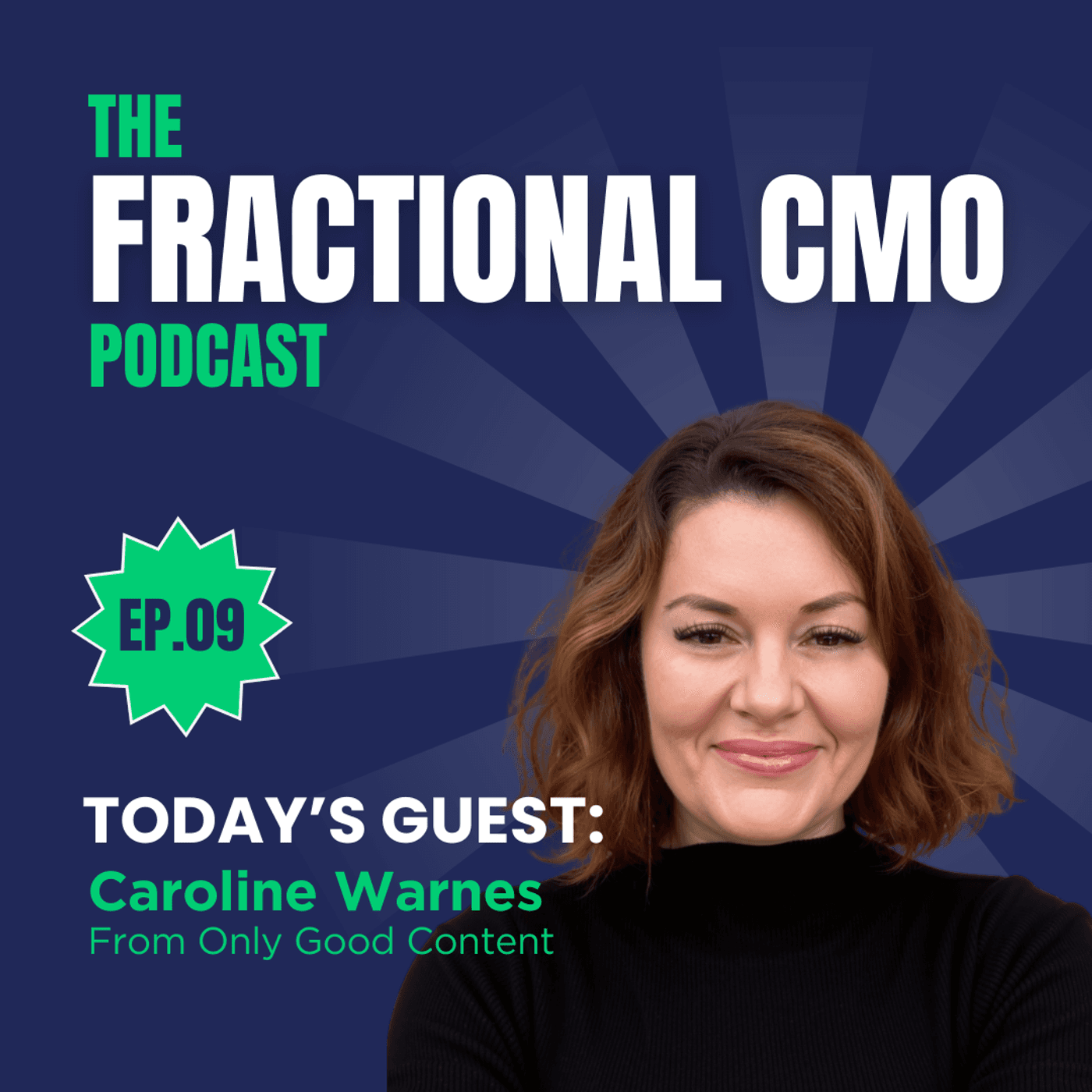
Episode Overview In this episode of *The Fractional CMO Podcast*, Simon Dell interviews Caroline Warnes, founder of *Only Good Content* and a B2B marketing content expert. The discussion revolves around leveraging content marketing to build personal brands, attract clients, and enhance engagement, especially for fractional CMOs, consultants, and service-based business owners.
Key Themes and Insights
Introduction to Guests and Context
- Host: Simon Dell, CEO of Cemoh.
- Guest: Caroline Warnes, founder of Only Good Content, with extensive experience in in-house marketing and communications.
Caroline's Background
- Caroline started her agency during the COVID pandemic after years in marketing roles to gain flexibility and fill a gap for quality content.
- She primarily supports B2B companies, especially ASX-listed firms, but has diversified to include startups and personal branding.
The Importance of Content
- Content as a Tool: Content is essential not just for marketing but as a means to communicate complex ideas simply.
- Writing Skills in Marketing: Simon emphasizes that good writing is critical in marketing roles, especially for fractional CMOs.
Building a Personal Brand
- Visibility: It's essential for fractional CMOs to establish a personal brand to attract clients. Caroline emphasizes that visibility can come through various formats (writing, video, etc.).
- Utilizing LinkedIn: This platform is vital for B2B marketing. A simple website is also recommended for establishing a brand.
Content Creation Strategies
- Repurposing Content: Writing for external channels and repurposing content can extend reach and improve visibility.
- Personal Storytelling and Authenticity: Personal stories resonate more than generic content, especially in a world saturated with AI-generated text.
Engaging with Target Audiences
- Understanding the Audience: Knowing who to target is crucial. Content should be tailored to different stakeholders (e.g., CFOs, CIOs) within an organization.
- Consistency is Key: Regular content posting builds trust and keeps the audience engaged.
Overcoming Content Saturation
- Standing Out: With content saturation, the focus should be on quality and relevance rather than just quantity.
- Human Touch: Authenticity in content creation enhances trust, especially important in the current landscape where buyers seek genuine engagement.
Practical Tips for Content Creation
- Start Small: Begin with manageable content goals (e.g., posting once a week) and gradually scale.
- Engage on Social Media: Interact with others on platforms like LinkedIn to build connections and visibility.
- Use Simple Tools: For those averse to writing, recording conversations or using tools like ChatGPT can streamline content creation.
Final Notes
- The episode concludes with a strong encouragement to just get started with content creation, emphasizing that visibility is crucial for success.
Important Links
- Connect with Caroline Warnes on LinkedIn: [Caroline Warnes LinkedIn](https://www.linkedin.com/in/carolinewarnes/)
- Visit Only Good Content: [Only Good Content Website](https://www.onlygoodcontent.com/)
Conclusion This episode highlights the vital role of content marketing in building personal brands and attracting clients, particularly for fractional CMOs. Caroline's insights provide practical advice for engaging various audiences and standing out in a crowded marketplace.
Written by AI. May contain mistakes. Listen to the episode to check what was said.
Transcript
Automatic transcript. May contain errors.0:06So welcome to the fractional CMO podcast. My name is Simon Dell. I'm the CEO of CIMO. I'm going to say we're the world's biggest fractional marketing network because I don't think anyone can argue with me on that one. And quite frankly, if they do, I'm more than happy to have that argument. We are here with Caroline Warnes. So before I do a few more sort of housekeeping, Caroline, welcome to the podcast. How are you today? I'm so good. How are you, Simon? I'm excellent. I'm excellent. It's good. If anyone enjoys listening to us today, and hopefully they do, then please go and rate us or review us either on wherever you're listening to your podcasts, Spotify, Apple Podcasts, whatever other channels that you get your podcasts that we're listed on.
1:00Please give us a review and hopefully a five-star rating. If you want to find out anything more about us, CMO, it's CMO.com. That's spelled C-E-M-O-H.com. We are based in Australia. There's a few people who do listen to us from overseas, so thank you. And, yeah, if you want to email me, Simon at CMO.com, or find me, Simon Dell, on LinkedIn. Pretty much the same for Caroline Warnes. I don't know whether there's that many Caroline Warneses out there. There is. There's one in the UK who is a vet and writes children's books. I don't know if it's the same person, but there's at least one more. I'm not the vet, yeah.
1:39I've said this many times. There's a Simon Dell in the UK as well who takes photos of small animals like mice. Something about the animals. Weird setting. Weird setting. There's one in Southeast Asia who runs Hotel Chain. He's doing very well for himself. I sometimes think I might pretend to be him one day. Perfect scan, yeah. And there's another one who actually lives in Brisbane who bizarrely is the boyfriend of an ex-client of ours. And I have met him a couple of times and he's a lovely guy. Could get awkward though. I said to my ex-client, don't send the wrong text message to me. Recall email.
2:20Talk to us a little bit about your background and what you're currently doing now, just so everyone understands why the hell you're here today. Good question. So I run a very small agency called Only Good Content. We're based in Sydney. I started it way back in the heady days of the COVID pandemic when I had been working in-house in marketing, comms, brand, media, tight roles for a couple of decades at that point. And decided I needed, wanted more flexibility in my life. And there was also a gap in the market for at that time. This was pre-CHAPGPT, if you can remember those times. There was a real gap in the market for good content at the time.
3:05So I decided I can do good content. So I'm going to leave my secure in-house senior role in the federal government and start my own agency and help B2B agencies say better things more clearly, which is our tagline. And here we are nearly five years later and have survived the chat GPT disruption, still helping B2B companies say better things more clearly. Awesome. So what sort of clients are you working on at the moment? What's the, you know, obviously you can't tell me. Name drop, yep. What sort of stuff are you doing? I have a really diverse client book. So I started out focusing more on sort of like ASX listed companies because they've always got a need for extra support.
3:51So I have a good solid base of ASX 100, ASX 200 clients. But I also diversified over the last couple of years in particular more to working with sort of smaller companies, founders, startups, and even some, you know, leaders who are looking for help with their personal brand. So I do a big range of work and it keeps things pretty interesting for me. Okay. What do you like the most? Like, I mean, it's great doing a range and I think we've all done a range in our time. But what's the stuff that when it comes across your desk, you go, oh, I'm excited by this? So I'm actually quite nerdy. So I was trained as a writer.
4:41I was originally a journalist. I've always loved writing, but now I love solving problems with writing. So I get really excited about stuff like other people would just laugh at it, like, you know, supply chain logistics and digital infrastructure and stuff that's really quite complex. And I like being able to turn that for a customer into one of my clients for something that will land with their customers. So it's not about writing the technical specifications. It's about creating a journey and a story that will land with someone who is going to buy those very complicated products and solutions.
5:17Okay. So, look, we're going to talk about content from two perspectives today. I think the first one from – well, dude, I think the first one would be the easiest one from the fractional CMO perspective. um i've always said that you if you're you're if you can't write you shouldn't be in marketing um that doesn't necessarily mean you enjoy writing because some people enjoy it some people find it incredibly incredibly laborious um but if you're starting out on that fractional CMO journey, are you looking, are you suggesting, or do you suggest that they're using copywriting, telling stories to promote who they are?
6:05And how are they doing that? What's the, you know, I think a lot of people want to do that, but they don't really know where to start. It's, you know, you've touched on something that I've been thinking about a lot recently, which is the whole question of personal brand. And that matters whether you're starting out as a fractional resource or whether you're more sort of developed in your leadership journey. You do need to have your personal brand that you're presenting to the market. And, you know, written content is one way to do that, but it's not the only way to do it. You know, some people prefer video, some people prefer different ways of presenting to the market.
6:43And thankfully these days, you know, you don't actually, if you're a marketer with some skills, you may not be an expert writer, but you've probably got enough to work with if you can tap into ChatGPT and use that as a base to start developing some content to promote yourself. So particularly in the fractional space, you've got to be on LinkedIn and you've got to be visible and providing something to your prospective clients, whether that be videos or written content or whatever feels comfortable for you. But you do have to be visible in some way for sure. And where are you suggesting that? I mean, obviously LinkedIn, you know, we, everyone has this love-hate relationship with.
7:28Yeah, me too. But you, where else? I mean, what are the other options sort of beyond LinkedIn? I mean, if you're pitching for work as a fractional and you're in the B2B space, LinkedIn is the platform to be on from a social perspective. I also strongly believe that you really need your own website as well. So I know some people skip this step and they just don't treat themselves as a brand. And that can make things a little bit difficult down the track because social platforms, the algorithm changes all the time. You have no control over what's going to happen. So you have to have a space for your own media.
8:09I was quite clear when I started my journey that I was going to present as a brand from the start rather than just being a freelancer kicking around or, you know, a resource for hire kind of thing. So I think if you want to take yourself seriously in this space, it's worth developing. It doesn't have to be a really complicated website with lots of bells and whistles. It just needs to be something that expresses who you are and what you can do and the value that you present to the market for sure. Look, one of the other channels that I think is vastly underrated, maybe not underrated, underutilized, I think is probably the right word, is writing for other people's channels as well.
8:50So, you know, you mentioned about having your own blog, that if you're building up a network of contacts and friends and things like that in the business space, That's one, I think, a powerful opportunity is to sort of say to your, you know, your good, you know, work contacts, hey, can I post a blog on your website? 100%. Yep. As long as it's related to, you know, if you're in marketing, you're going to go, well, I'm not going to write a marketing blog about and put it on a law firm's website. No. It's right channel for the right content. Yeah. Yeah. Unless you can write something where you go, how can I write about marketing on a law firm's website so that the people looking at the website will find it useful and validate its reason for being there?
9:42So, yeah, I think if you can not just other people's websites, but third party media channels, anywhere you can sit there and go, hey, this is going to give me some visibility. Yeah. Yeah, beyond my normal visibility. Correct, which is actually what we're doing now, right? So it's, yeah, and so it is, it's absolutely, it's credibility, it's reach. So when someone who has a credible presence in the space that you're operating in, such as yourself, when I come on to your show and talk to you, then the people that you're connected to go, oh, okay. So if Simon thinks Caroline's credible, then she must be credible.
10:20It really is just, you know, kind of that kind of tapping into human psychology in that way. And you do have to be very careful, I think, and you sort of touched on it, making sure that the content is appropriate for what you're trying to do. So you don't want to be on every channel. That's like a fool's errand and you'll spend all your time pumping content out into a universe that's not even listening to you. You know, identify where you need to be and who needs to see it and then match the content to that. And if you're short on time and resources, be very targeted about it. Yeah. There's a couple of good examples where we've produced content for other channels and I think has helped us massively.
11:05Well, certainly the first one, we were approached, I think I was approached a good eight, nine years ago to write for Myob, the accounting software. and they said hey we want some someone who's willing to submit some articles about marketing in our sort of they they had an area for business owners that would you know advice and all that sort of stuff so we did that and of course the the knock-on effect was obviously a lot of people got to see who I was and who we were at the time but the other important thing was um it was fantastic from a search engine optimization perspective because we got a link back from their website to our website.
11:46And then also around about the same time, I got approached by a magazine in the jewellery industry, imaginatively kind of. Man of many talents. Jewellery magazine. And they came to me and actually said, we really like your content. Would we be allowed to use some of your blogs and repurpose them for our print magazine? And I was like, go for your life. Did they pay you for it? no they didn't they were just basically you know I get I get I get an email once a quarter they say can we use this can we use this and I go yeah go for you but my profile's on there there's a yeah about a little bit about the company and a link to the website so I'm like for the sake of you know for the sake of me saying yes or no I'm just like all of a sudden we've got thousands of other people looking at our content that we didn't have yeah and it's an easy win right it's an easy win it's not like you're producing new content so yeah i mean yeah like not every outcome has to be a financial outcome that was a a different type of commercial outcome around visibility and reach yeah yeah if you're working in that fractional cmo space what you know i guess the next question is like you know obviously there's all these channels and things like that what are you what are you writing about because the two-part question slightly loaded the first part for the second part um hasn't we were having this discussion the other day hasn't everything already been written are we just regurgitating something someone else has already written yeah well they say there's only like 12 original plots in the world in terms of fiction so every fiction book that has been written is just a rehash of romeo and juliet or othello or whatever but um look there is a lot of and we are in absolutely because of ai we're in the age of just content saturation.
13:39Like there is so much content out there on every single topic you can imagine. So what we try and do, like what my job is specifically in the space that I work in, it's often about, rather than it being about just producing content for content's sake, it's about supporting a process for buyers. So when you're in a, have a complex buying process, which a lot of my type of clients do, like it takes a while to get from here to here, it can take 12 to 18 months. You can't just like make them aware of you up here and then do nothing for 18 months and expect them to buy your products and services down here.
14:14It could be like, you know, six or seven figure purchase. So you've got to support them for that 12 to 18 months on a, we call it the, you know, the customer journey. And the way that that works is with like rich content that is increasingly more targeted to them and more tailored to them, which we can do more of because we have the tools to personalise that content more. So these days, we're able to produce insights that are, you know, really targeted to the different people on the buying committee. So there might be content that's specific for the CFO in the organisation, there might be content that's specific for the CIO, and then you can make that personalised across a range of organisations.
14:52So it's not just about having new ideas, it's about having ideas that are targeted towards different types of people at that point in time too. So it's a combination of timeliness, relevance, all those sorts of factors. I think that's a massively important thing for people to remember, for fractional CMOs to remember is that, you know, often your employment or your engagement is governed by decisions from maybe two or three people. It's not just the CEO, you know. Minimum, yeah, yeah. Yeah, we're doing a podcast soon about how we think our accountants are enemies. Yeah. But I'd ask you the same question, is the CFO our enemy?
15:37They often frequently are because marketing is a cost centre and it's always the first one to be cut when times are lean. So even though arguably it shouldn't be because that's when you need to invest in a function that fuels the growth engine of the business. But, I mean, the way you mitigate that risk is exactly what you said. you have to be able to speak to them about the benefits that you can bring. But you only do that by speaking their language. Like CFOs don't want to hear things in really general terms. They want to hear about things they care about, you know, like cash conversion cycles and forecasts and all that sort of thing.
16:10So you don't have to give them an annual report, but you do have to give them something that's relevant. Yeah. They always, yeah, I mean, their question, I mean, we just had a client sort of cut their budget because the accountant turned around and said, you're spending too much money on marketing. You know? Yeah. And we turned around and said, pardon my friendship, but what the fuck does the accountant know about what marketing is going on? It's just they only see a number and they see an expense number on the expense line or on a couple of lines. It's not a profit centre. They see it as a cost centre.
16:48But rather than being a cost centre, let's call it an investment centre and have clear metrics about what the activity is that you're doing and how it links to the commercial outcomes. You're never going to be out there generating direct sales, but you are contributing to a pipeline. So you've got to find ways to be creative to demonstrate that for sure.
17:08So now let's look at this from a CEO perspective, right? So maybe writing is not your forte here, But one of the things we spoke about in previous podcasts is this idea that the CEOs or the leaders of businesses are becoming the brands themselves. Yeah, for sure. also that you are your own brand and that your success and, you know, and failures will be governed by your ability to present your own brand to the world, which we've been taught, you know, which we've been told in the last four or five years, especially with the growth of sort of influencers and things like that. But now this is, I think this is much more seeping into the business world, the B2B space, the corporate space.
18:01The enterprise world where as a CEO, it's important that you have, you know, your own brand. Brand, yeah. The company. So from a CEO's perspective, how are you growing your brand using copywriting, using content? Yeah, it's a really good question. I think there's a specific reason why this is happening at the moment. And again, it comes back to the discussion around AI and oversaturation of content. So there's a big discussion happening in a lot of quarters at the moment about trust and what you can and can't trust in the world. And I think when people are picking up on content that is very obviously machine generated, it has no human touch points or fingerprints that raises questions around, is it fundamentally trustworthy?
18:53worthy. So if your brand is pumping out just faceless content at scale and there's no human involved in it, you might get some initial, you will definitely get the initial results around interactions at the top level. The other bots will like that content, they will interact with that content, but the humans who are making buying decisions are going to probably take a step back and say what's actually happening here. So I think you're right from a leadership perspective, and this includes all sizes of companies. It includes small consultancies like me and it includes big companies as well. You need to have, you need to be able to present your face in the world.
19:32It doesn't mean that you need to be showing everything that you're doing. You don't need to be showing what you have for breakfast on social media. That's not what this is. But you do need to be able to, you know, in some way, show that you are able to authentically engage in the public space. So whether that's regular posting on LinkedIn, it might be some photos. If you're brave enough to do videos, please try videos. You know, I'm all about doing videos in different formats at the moment. But if it's just endless reams of faceless content, trust me on this, your buyers will be turned off during a very long process.
20:04Yeah, yeah. And that's hard because, look, I think the two important things I always take out of this and I say to, you know, other business leaders is number one is that, yeah, that brand, your own personal brand, build that. And for God's sake, try and make it individual. Use, you know, as you said, use video, use copy, whatever. But just try and make it individual. I mean, I keep getting told to, you know, to cut my hair and stop wearing T-shirts in meetings. That we wouldn't know who you were. Exactly. I go, but that's defining me as, you know, as who I am. but the other thing I think I always say to people be interested to see where you think this how important this is is consistency yes it is it is so important whatever you define as being consistent just being consistent consistent doesn't have to mean that you're spamming people or being overwhelming you just have to have a regular cadence and once you start showing up don't suddenly stop showing up because that's just as weird.
21:13Like, you know, I'm going to post every day for three weeks and then suddenly I'm not there anymore. It looks really suspicious. So I think it's best to start with something that, you know, you can manage. So, you know, potentially, you know, you go, I can manage once a week on LinkedIn, do that, start with that, see how that goes. And then you can scale up rather than starting out big bang and having to pull it back and looking like you've completely failed on something. Yeah. And I know we're talking content more from a copy perspective, but let's talk about content from a video perspective.
21:45I think there's also a danger that people expect polish in corporate videos. and I sort of
22:02there's to me I don't think the quality of the video the video is is that important what's important is the genuine how genuine you appear on the video correct and it depends again on the channel and the purpose as well so I do a bit of video for LinkedIn and that is not super polished at all like it's just me. I have a tripod. I just sit down and I talk like we're talking now. No production values going into it or whatever. But if I was working for a client and we needed to make something that was really important going out to investors, then we'd probably need to invest in something with a little bit more polish.
22:40So it's just thinking about what's appropriate for the channel and for what you're trying to do. If I had to produce polished LinkedIn videos every couple of weeks, which I'm doing at the moment, it wouldn't happen. I just do not have the time or the budget for it. So, and like on something like LinkedIn, which is a social channel, people don't want polish. They want just to hear what you have to say. Yeah. Yeah, absolutely. And I think once again, I sort of say to people, just start doing something. Just start doing it. Just start. And do you have a huge amount of planning? Like, you know, just post once a week on LinkedIn, commit to a day.
23:15And then the actually important thing on LinkedIn as well is that you're engaging with other people on LinkedIn. in. So connect with people you need to be connected with and like their posts, comment on their posts, give a little to get a little. That's all, you know, pretty straightforward. And it takes a little bit of time for, you know, to get traction on social platforms in particular. So you might not see results on LinkedIn for three weeks, but don't stop because you're not getting results. Like a lot of people stop just before they hit that critical mass. Keep going. Yeah. Even if it feels like you're shouting it into the void, keep going.
23:45That's one of the problems with marketing per se is that you know you don't start doing something on a Tuesday and start getting more leads on a Wednesday that's not how it's it takes a while to train any algorithm it's a machine so whether you're on Instagram or LinkedIn or you know whatever it takes it can take weeks or months to train the algorithm that requires consistency and it requires relevance and all those good things that we know about I tell you the other thing I think about content and the short story on this one was that I do some videos on TikTok and they're fun videos. I can't touch TikTok.
24:26I can't touch TikTok. They're what I would call brand awareness videos, right? So what I do is I'll record them and then I'll promote them. I'll put like 30 bucks into promoting them, but I'll only promote them in the Australian marketplace. I won't bother. There's no point in me promoting them overseas and things like that. So I'll promote them just so that then there's, you know, people might see me, follow me. I'm starting now. I've got about 3 ,000 followers on TikTok. I'm starting to get people connecting with me who are genuine business owners. And I've only had two or three, but they're actually asking me business-related questions through TikTok now.
25:06And I'm like, all right, that's good. That's where I wanted it to get to. And then what was happening was I was taking the videos that I was putting on TikTok and then putting them on LinkedIn because I'm like, as you would know, repurposing content, you know, that's half of the game. It is, yes. And then I bumped into a guy who I hadn't seen for a couple of years and I bumped into him in the street in Brisbane. And he said to me, he looked at me, we were having a conversation about where he was going and all this kind of thing, you know, the usual, how's your wife, blah, blah, blah. um and just before we sort of separated and he went off to his meeting and i went off to my meeting he turned around and said he goes hey keep the videos up i think they're really good he'd never liked one he'd never commented on one you know he'd never made any acknowledgement through linkedin or any other channel that he was watching my videos yeah that was his that was his message for me.
26:05Do you find that there's this, you know, 5 % who are perhaps actively engaging with your content and maybe another 95 % who are lurking? Yes. I think as marketers and as human beings, we're trained to sort of chase the dopamine effect. So you see a like on your content, you're like, oh my God, job done. I've been successful. But the thing that you come to learn is that likes on social media posts don't actually get you paid at the end of the day. What gets you paid is the business opportunity at the end of it. So yes, it's nice and gratifying to see all the likes, but what you really actually want is that pattern of consistency that leads to conversations and business opportunities, because I'm all about getting paid at the end of the day.
26:50It's not just about having likes and shares on Instagram or TikTok. So, you know, and what you talks about is a perfect example of, you know, you build an audience, then you nurture the audience, then eventually you monetize the audience as well. It's a classic three-step process. So, you know, once you've done that, you're laughing. Look, I was looking at exactly the same content that, you know, your three-stage process there, it's the blueprint for pretty much every business. I was watching a video earlier about Uber. You know, you create the demand, you create the audience you grow the audience you know you then next step is not nurture them nurture them and then you monetize them the last one is to monetize them i mean yeah there's an argument when you monetize them you know uber have done a terrible job in terms of um you know the fact that now it's the same price as a taxi that the cars are dirty and blah blah blah blah but you know the principle holds holds sway so um but i know i think that's a that's a that's a great insight Right.
27:49Just to sort of finish up today, just take it right back is that you're sitting there going, I know I need to be – I suspect people watch this and go, I know I need to be more active with content. I know I need to be producing more. And, you know, Caroline's just told me I have to do it once a week and I better do it once a week. Otherwise, I'm a failure and all those kind of things, right? So how do you change that behaviour so you are actually being consistent and delivering something? Well, I think, like, you've got to then take it back from the activity. So the activity is posting once a week.
28:31The steps before that is working out what you're trying to do. So why are you posting once a week? Like, who are you trying to reach? Like, there's no point posting on LinkedIn once a week if you're not connected to the people on LinkedIn that you want to reach. So to get started, like I'm not the biggest write a 20-page plan type person. I actually hate that kind of stuff. But just give yourself a simple one-pager of like who you need to reach, what you want them to do, what's the action you want them to do and how realistically you can get there. Is it, you know, maybe the first step is not to start posting on LinkedIn.
Read the full transcript
29:04Maybe it's actually to connect with people on LinkedIn that you need to be connected with and then just start posting a little bit of valuable content once a week. Like it doesn't have to, you don't have to do it all at once. Just, you know, do it in steps that are going to be manageable for you. But it always helps to know first what you're trying to do and why, rather than just jumping into activity for the sake of it. Look, my tip for that is that I find a lot of people will find it a lot easier to talk about things and actually sit down and write things. So I think your idea about video is great.
29:32But even if you don't like being on video and you want to produce content, That doesn't mean to say you can't use video. I think to me the opportunity is record yourself talking about a subject that you are interested in. Yeah. Take that recording, transcribe it, put it through ChatGPT to maybe refine it or expand it a little bit, then rewrite it, reread it, make sure it's, you know. You can do all those things without having to be on video and without actually having to write a lot of copy yourself. You could record a conversation of yourself with a colleague or, you know, a peer, just like what we're doing now and have a conversation about something you're both interested in and then go and transcribe the conversation and get six months' worth of content out of that.
30:22Like, you know, LinkedIn posts aren't essays, they're insights, short, sharp insights. Yeah, yeah. Look, thank you for your time today. Just give, let's have the sort of, let's have the plug. the website and the LinkedIn address and all those kind of bits and pieces? For sure. Onlygoodcontent.com. It's a bit of a mouthful. That's my website. And if you look up Caroline Mornes on LinkedIn, I'm there. I'm not the vet. I'm not the children's book author. I'm the marketing content person in Australia. Yeah, well, there's only one. I think there's only one of you in Sydney, Australia. There is, yes.
31:00There definitely is. Unless you've got a sick dog, you're the one that people should be looking at. Don't do that to me. Thank you very much for your time. Thanks for having me. Hopefully people have found some, you know, important, interesting tips out of that. And I think, you know, if nothing else, I think the thing that everyone should take from your advice today is just get started. Start doing something. Just get started. Don't overthink it. Just get out there and do it because you have to. you have to be visible if you want to be successful. Awesome. Caroline, thank you very much. Thank you so much, Simon.
31:36I appreciate it. Thank you.
From the publisher
Caroline dives into topics like writing for LinkedIn, creating content that supports long sales cycles, repurposing content for third-party channels, and maintaining visibility in an age of AI-generated content. She also shares practical advice on how to get started with content, the importance of authenticity, and how to create visibility without overcomplicating the process.
🔗 Connect with Caroline on LinkedIn:
https://www.linkedin.com/in/carolinewarnes/
Only Good Content: https://www.onlygoodcontent.com/
We would love to know what you think so give us a rating and review on Apple Podcast and Spotify.
🌟SUBSCRIBE to our YouTube channel to learn weekly expert marketing tips and ideas. If you think you have a great story for the podcast, contact our producer at podcast@cemoh.com.
🚀If you need help growing your business, visit cemoh.com to find an experienced marketing consultant to help you.
#FractionalCMO #MarketingConsultant #CMO #MarketingStrategy #BusinessGrowth #Entrepreneurship