In short
The Fractional CMO Podcast - Episode Summary
Episode Title
S2 Ep10: Are Accountants Our Enemy?
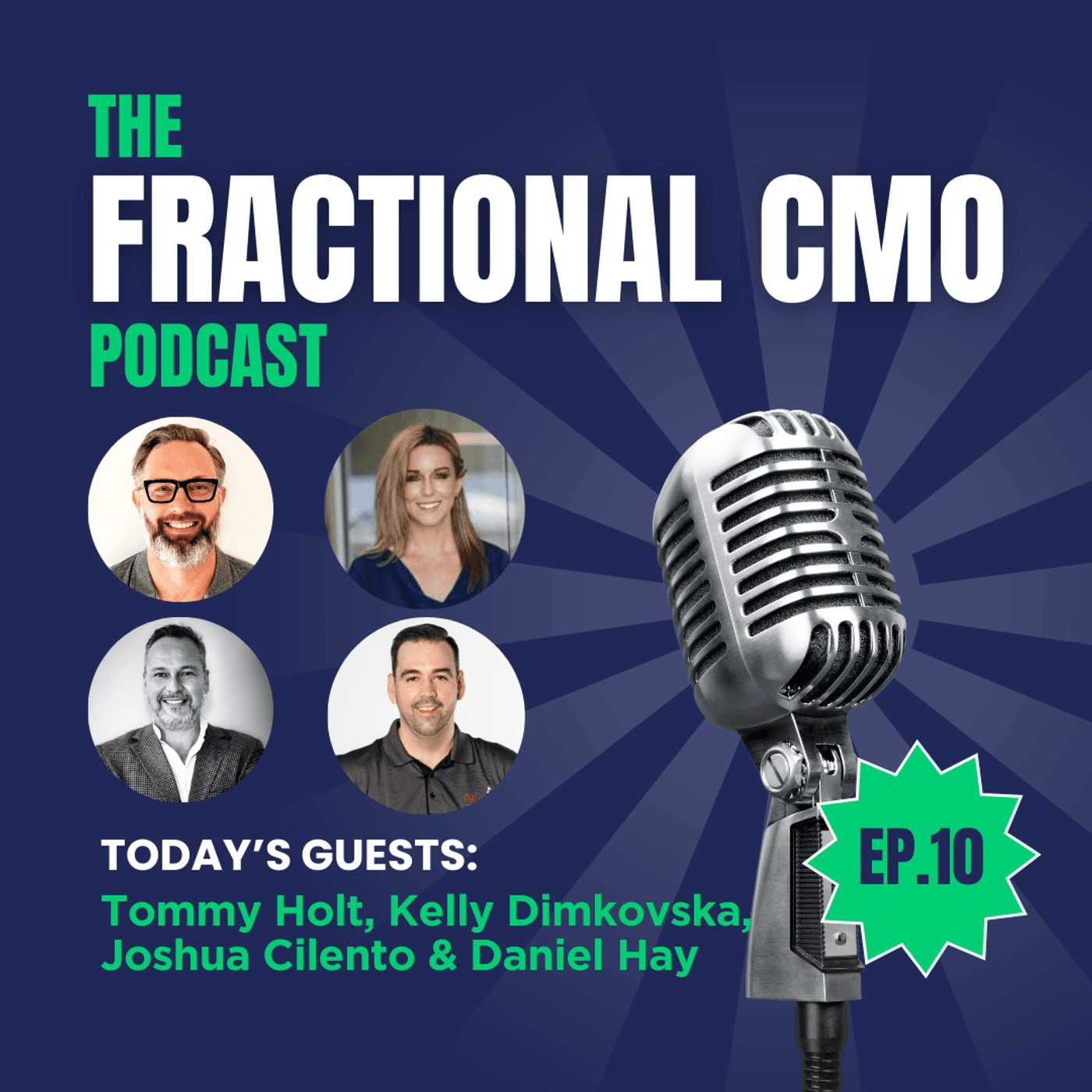
Episode Description In this episode, host Simon Dell engages with experts including accountant Daniel Hay, fractional CMOs Kelly Dimkovska and Joshua “JC” Cilento, and marketing strategist Tommy Holt. The discussion focuses on the perceived tension between marketing and finance teams, questioning whether accountants hinder marketing success or if marketers overspend.
Key Concepts Discussed
- Accountants vs. Marketers: A philosophical clash exists where accountants focus on past performance while marketers aim to create future value.
- Impact of Cutting Marketing Budgets: Reducing marketing spend can destroy long-term revenue, making it crucial to evaluate the effectiveness of marketing investments properly.
- Brand-Building vs. Performance Marketing: Differentiating between short-term sales strategies and long-term brand-building efforts is essential for sustained success.
- Communication of ROI: Marketers need to articulate the return on investment (ROI) of marketing initiatives to finance teams effectively.
- Collaboration Importance: Both finance and marketing teams should work together to align their strategies for mutual benefit.
Guests Introductions
- Daniel Hay: An accountant with over 20 years of experience, focusing on various clients and emphasizing the disconnect between marketing and accounting.
- Kelly Dimkovska: A fractional CMO with extensive experience in digital marketing, particularly in healthcare.
- Joshua “JC” Cilento: Transformed from a creative background into consultancy and fractional CMO roles, advocating for the importance of understanding marketing’s impact on revenue.
- Tommy Holt: A marketing and reputation strategist with experience across multiple industries, emphasizing the need for collaboration between marketing and finance.
Key Takeaways
- Accountants' Perspective
- Accountants often view marketing expenses as fluffy and may push to reduce budgets without understanding their long-term value.
- Many accountants lack experience in marketing, leading to misconceptions about effective spending.
- Marketers' Challenges
- Marketers must work to bridge the gap in communication with finance teams regarding marketing expenditures and expected outcomes.
- There is a need to present marketing budgets in a way that aligns with financial expectations and demonstrates potential ROI.
- Building Relationships
- Engaging fractional CMOs in discussions with financial teams can foster better understanding and collaboration.
- Marketing needs to be seen as a long-term investment rather than a short-term expense to gain the support of finance.
- Shared Accountability for Revenue Growth
- All departments must collaborate to ensure revenue growth, breaking down silos within organizations.
- Both finance and marketing should take responsibility for understanding each other's functions for optimal performance.
Final Thoughts
- The episode concludes with a consensus on the importance of collaboration between marketing and finance, emphasizing that both sides should work together for the greater good of the organization.
Recommended Actions
- For Marketers: Improve communication with finance teams and articulate the value of marketing initiatives clearly.
- For Accountants: Engage with marketing teams to understand the strategic value of marketing investments and support long-term growth initiatives.
---
Connect with Guests
- Tommy Holt: [LinkedIn](https://www.linkedin.com/in/tommyjholt/)
- Kelly Dimkovska: [LinkedIn](https://www.linkedin.com/in/kelly-dimkovska-55ba5636/)
- Joshua Cilento: [LinkedIn](https://www.linkedin.com/in/joshuacilento/)
- Daniel Hay: [LinkedIn](https://www.linkedin.com/in/daniel-hay-fipa-ffa-b29b126b/)
For more insights, subscribe to the podcast on platforms like Apple Podcasts and Spotify.
Written by AI. May contain mistakes. Listen to the episode to check what was said.
Transcript
Automatic transcript. May contain errors.0:07Good start let's try that oh here we go yes we're recording fantastic oh thank god we got there my name is Simon Dell I am the CEO of CMO we've got a absolutely bumper-packed show today with some very special guests, including one poor gentleman who we have likened to being thrown to the lions. So I'm going to get everyone to introduce themselves, but the core focus for today was this kind of title that we came up for this episode, which is Our Accountants, Our Enemies. And by our, I mean marketing people. So we're going to try and answer that question. So first of all we'll do some quick introductions.
0:54Firstly our sacrificial lamb for today, Daniel Hay who is in Brisbane. Tell us a little bit about yourself. I suppose accounting for over 20 years now. So four partner firm, so off three office locations in Brisbane. So look after a range of clients, individuals, super funds to medium to large businesses so been in business for about nearly 14 years so sort of had a bit to do with the marketing side of things we spent a lot of money lost a lot of money but i think you know sort of not understanding and i think it's sort of taken us a bit of time to to realize what uh what's what we want and what's required awesome thank you now uh second appearance i think on the podcast kelly dimkowska uh do you want to give us a little bit about uh give us a bit of the kelly story Absolutely, Simon.
1:44So I am a fractional CMO and I own the business Tuesday Logic. Tuesday Logic really just specializes in the healthcare space. I've had over 15 years of digital marketing experience and 11 of those have been in the healthcare sector. Awesome. Thank you. Joshua Cilento or JC, as I found out, he is known to his friends. Tell us about you. I originally come from rock and roll and then into production and television production, film and TV production. And then that became Agency Land. Outrageous. People trying to get me. And yeah, then Agency from creative on to suit side. And then it became consultancy and now fractional with CMO.
2:34Okay. Awesome. And last but certainly not least, brand new to the show, Tommy Holt. Please introduce yourself. Yeah, thanks so much for having me, Simon, and great to be sitting with such esteemed colleagues. So I've been working in marketing, brand, and reputation for about 20 years, primarily in-house, but more recently have been a hired gun for a number of different organizations. I consider myself a marketer first and foremost and have had the pleasure of using my skills across a number of industries including healthcare, FMCG, e-com and most recently was part of the team over at Woolies where I was there for around seven years.
3:18So really passionate about the connection between marketing, reputation, corporate affairs and all those things. And I've had the pleasure at various times of dealing with the finance teams under those banners as well. Awesome. Thank you, Tommy. Now, look, before we start, I'm going to frame this because this subject matter was something that came out of a conversation with my business partner, Matt Clarkson. We have a client that we've worked with for many, many years. Matt works with them directly, which is unusual in itself because that doesn't normally happen. But we've worked with them for a long time and they're in the travel space.
3:55Over the years, they have grown and grown and grown to the point now where they are making lots of money. The owners get to go on long holidays without having to worry about too much of what's going on in the business. But that has been a consequence of them investing and investing and investing in marketing, largely digital marketing. and largely expanding their footprint in the number of products that they sell and things like that. About two months ago, their accountant had had a conversation with the business owner and said, and I'm going to paraphrase this, you're spending too much money on marketing.
4:32Now, the challenge for us was that the accountant had never sat in any of the meetings, never been in the marketing meetings, didn't know anything about marketing, we assume he didn't know that much about marketing, but had simply seen a number on a line on a P &L and gone that too much. Now, how they got to that conclusion, not entirely sure. But that sort of brought around this conversation where we were like, everything we'd done over the past four or five years and growing this business and growing this business and growing this business was suddenly undone by an accountant going, you're just spending too much money.
5:15So that's where this conversation had come from. And I think what we wanted to do was take a deeper dive into that statement and try and understand the relationship between finance and marketing. Are we going to fix anything today? Probably not. but I think we can perhaps help understand what the challenges are now with that I've got four sort of key questions and I'm going to go to Josh first because he's the he I'm sure and I'm sure Tommy and Kelly could as well but he's the most likely to be able to talk off the top of his head my first standing from right um what do you the first question is is we wanted to talk about the philosophical clash between marketers and accountants um where do you see that happening in businesses i see it in the in the textbook as the as the adversary um they are they measure what has happened and make sense of what has happened and we are responsible for creating what is going to happen when you just talked about your guy coming and saying there's been an incredible spend there you know$35 ,000 for a golf membership okay 1.5 of last year came from the guy that I play golf with you know there's a that intangible quantum call between what it is that the spend and the budget is um it is is a is a constant fight and they say that it's the same sport but it's different codes or you can call it checkers and chess but it's not checkers and chess it's checkers and a burning fighter aircraft taking friendly fire at the same time daniel right of reply there on the other side how do you how do you see that it's sort of i think as accountants i think unless they've actually dived in it and done it themselves i don't think they truly understand it so again yeah as we've spent a lot of money i reckon 10 years i reckon probably spent maybe two to three hundred thousand on marketing okay that could have ranged from we actually did a bit of a co thing with some other businesses where we you know hired a film person we had a writer we're doing youtube we did facebook we did everything and i think at the end we've got an uber driver out of that spin so i think and true story so i think but we've learned from that and i think as i said up until recently probably the last 18 months i think it's probably understanding who we are what our values are what clients we want um so i think we just wanted anyone where i think we're we like tradies but specifically there's the type of tradies that we like doing so instead of only now that we've probably really uh realized who we want and how to get them potentially so it's taken us a bit of time um traditionally i think accountants think marketing is quite fluffy um but yeah i think let's let's yeah i mean let's let's dive into that a little bit more because that's not the first time i suspect the four of us have heard that that accusation um you know when you look at that and let's put your experience aside because i presume you you would see this be with other potential clients of yours who are running businesses.
8:37Do you ever look at that and think, how much are you guys spending here? Are you sort of drilling down to those numbers at all? Particularly, yeah, the type of businesses, like there's one that they do cruises. So they do spend a fair bit of marketing. But I've seen, I follow them on Facebook and whatever, Instagram and whatnot. But I can see they've gone through quite a few providers, but it's probably only recently where they've sort of got that niche one that sort of understands their needs and they're actually focusing on the clientele that they need for the business to be successful so again i think it's that misunderstanding or potentially not tracking things properly or understanding the full you know their demographics what they need to focus on so i think again they've taken a few times but they've seem to have got the right marketing person now who understands them and maybe that's the thing maybe in the marketing world maybe it's a misunderstanding i don't know um again that's sort of what i've seen but like a lot of clients you see the marketing they'll spend you know a lot on seo and and again i think it's that they've been sold um they don't really understand it um and they're probably you know focusing on wrong keywords and things like that so again that's a bit of an art so I guess it's a matter of that understanding what they need so so I would say back to that that I would not do that spend without having an accountant one that I trusted and I knew and I guarantee you you didn't have a fractional CMO when you did that spend as accountants yeah no no well yeah again we thought we knew what we're doing but you know Well, yes.
10:23Do you think, I'll ask this one of Tommy, do you think there's a challenge between perhaps marketers thinking more long-term and, you know, an accountant's thinking not even just short-term, but post-event? Do you think there's that fundamental, you know, philosophical difference between the two? Yeah, well, I mean, by its very nature, you know, marketing is about building future value for the organization. and that necessitates some level of speculation. You know, we always talk about brand building being an investment in future revenue stream, and there will always be a component of marketing which is about immediacy and, you know, return on investment.
11:07So in organisations I've worked with, you know, we've been as explicit as, you know, splitting spend between brand building initiatives, building trust and engagement with future customers and today's customers in order to try and win a larger share of their future value and driving campaigns that are about driving you know delivering immediacy you know product and price you know what have we got on on sale or what's our service offering of the day and how can we convert that and i see how that becomes an existential challenge for uh for accountants because you want to be able to attribute a spend on a return.
11:47You know, there is, when you look at a capital investment, when you're having conversations about CapEx, there is a facility that you are investing in. And on the day that it opens up, you're able to attribute, you know, a component part of your future revenue to that. Whereas marketing is more about a feel-good factor. You know, we always talk about the art and science of marketing and the best relationships I've ever had with finance and accounting teams have been the ones who recognize that there is value, intrinsic value, often hard to measure value in creating a brand engagement and a brand awareness almost at a fundamental level.
12:29So I can completely appreciate how those people, not just in finance, but in many other areas of business, including operations and the like, find it really hard to attribute a future value to a cost that they are incurring today. I have had those conversations. And as a quick aside, often I've seen organizations fall into the trap of relying on last click attribution as the measure of performance. You know, if you're selling, you know, pairs of pants online and someone clicks on an ad and goes to their basket or your website, adds a product to basket, You think to yourself, well, didn't that advert work really well?
13:12It got clicked through. But the reality is that the preference of that consumer, the awareness of your range of products, that may not have existed if it weren't for those brand building, awareness building activities. And again, that's very hard. And there are a range of organizations and agencies and tech providers that have been trying to unravel that. But at the end of the day, very hard to put a price on the value of creating awareness and creating brand affinity with someone well before the point where they decide to buy that pair of jeans. Yeah. And that's a really challenging kind of, you know, that's a really challenging intellectual model to be able to get your head around when you're just like, tell me what got them to click on that ad to buy that pair of jeans.
14:00Yeah, I'll come to Kelly in a minute to ask about your experience in that with those challenges. But I think Tommy's much more eloquent expression of the challenge there, I often call the plumber's van theory. and I'd say to everybody, I say to an accountant, if I said to you, if a plumber came to you and said, I need$5 ,000 to sign right my van and I'm going to drive around and go to all of my jobs in my van, I don't think there's a single person in any room that would say, hey, that's a bad idea. You know, that's wasting money because we know that the plumber's van is going to drive all through the city and people are going to see the side of the van and they're going to see the name and they're going to see the phone number and they're going to see the website but to tommy's point the last attribute to actually contacting the plumber would be his website and not the van so that's my my plumber's van theory is that we we all still have to have our vans driving about the city but we can't assume that um that the the website the website was the thing that actually generated the call and interestingly this this came from an actual plumber who I was working with and he couldn't understand why all of these traffic to his website had dropped and I met him for a coffee one day and I said to him where's your van he said I got rid of it I didn't really need it and it used to have this bright yellow thing he's with logos all over it and everything and and he was like yeah my traffic to the website's dropped and I said Jimmy you've got rid of your van and he was like well yeah just he said I just wanted a new van and this and the other one didn't have anything on it so to him he hadn't he hadn't worked that out that that was actually there was a cause and effect there of actually driving his business so um Kelly what are your sort of challenges being in that that space where you've you've had those maybe knock some heads with people in finance yeah sure so um actually it was a fairly recent one uh with a client of mine um in the health care space and for a year or so the accountant had been telling her that she needed to reduce marketing spend but every time we did that we saw results and therefore all the bookings drop.
16:25It was actually when the accountant went away and started his own firm that he actually came back to her later and said no double down on the marketing spend because he suddenly understood the marketing function and how valuable it had been to his new firm and generating business. So that was sort of one of the more recent ones. But in terms of what I like to do, if it's the business owner that's speaking with the accountant directly, I normally like to sit down and really arm them with all the information before they see their accountant. So they're able to clearly articulate what we're doing, why we're doing it.
17:04and to Tommy's point, exactly what phase in the funnel that's attacking, so to speak, and what the marketing goal out the other end is. Yeah. Actually, a funny story just quickly about the plumber van. Well, I have a ute because I have a race car. I usually tow it around, so it's got the business all over it. And I've actually picked up a heap of clients from Bunnings. Come in. I've got five years of returns I haven't done. I saw your ute and I thought I'd come and get my tax returns done by you. So it does work. Yeah, yeah, look, absolutely. But if, and I think, I think our point is, is if you said, if someone had said that to you right at the start, Dan, like I'm going to, I'm going to sign right this, what would you, as accountant, what would your reaction have been?
17:53Oh, I think from, I guess my background, family business, so not accounting, but refrigerations, I guess I understand that a bit earlier that, you know, always had sign writing. That's particularly in a smaller town back in the day with, you know, Refidexes. Effectively, that was how people got you. So they saw the number on the side of the ute. They gave you calls. I sort of understand that a bit better. Maybe that might be the accounting thing where they've only just done accounting. That's all they've done. They haven't actually experienced any other type of being in business before in any other sort of industry.
18:27So maybe that's a thing I don't know. Okay. Um, when, when we sort of present budgets, um, I, I wanted to sort of get an understanding of whether there's a right way of presenting it so that, you know, the, the accountants can make more sense of it. Because if we're sitting in front of people asking for a big chunk of money and whether that's, you know, what I've done with small and medium sized businesses or whether that's potentially Tommy who sat in front of, you know, potentially boards of people asking for, you know, lots and lots of cash. Do you think there's a way that we should be doing that?
19:03And I'll ask that for both sides of it. I'll ask that to Josh first and then ask Dan. Would it be easier if to reframe it for you? if all that time ago when you spent all that money, it had been presented to you in a different way. So I'll ask Josh that question first, how he would do that if he was pitching that to a room of non-marketing people. Yeah, I'm still doing it. And it's kind of that, it is, it's the dark arts. And if you don't understand it, there's also trying to educate in it doesn't give you the win it just creates different um uh goal posts inside the dark arts that don't they're not they're not related or that they're still not the relationship between what it is you're trying to do what it is that you want to do and i'm literally seeing that here now a friend not a client because he doesn't pay me he literally said how's your black friday going tie this in you're a great guy i love you your business is amazing they're doing 9 10 um he's just said we're up 41 because i said you've got to show that you are the business he's the only guy he is the main core person and it was just one line authenticity yeah yeah quantify that in explaining that in a budget that is required for doing iphone content to support your your your business 41 points in their highest this that black friday window is they make 70 of their year um so i i'm still doing it i am still trying to explain and i'm still realizing that there's no point in explaining there is what you do and what works because it's inside the black box the what cable goes in and the cable goes out stuff happens inside the black box we all know what happens inside the black box and what levers to pull but trying to explain trying to do trying to show there's very little benefit yeah there's performance yeah tell me have the account and show you what the numbers are yeah yeah look i mean marketing is you know sort of an outcome based discipline isn't it um just one of the things that i have always found really interesting about marketing is and maybe it is you know it's compliment to you know others on the call and and marketers more broadly, but also I think an outcome of the discipline itself.
21:35It's such an accessible thing. You can see adverts, you can pick up a magazine, you can click on a link, you've all seen your Instagram feed. And so therefore, it sort of democratizes the discipline. And I know that I could never go to a finance team or a legal team and say to them, hey, I read a contract or two, I signed up for something on, I signed up for a subscription service so i know i know contracts so why don't you leave it to me i've got quite a strong view on how we should set up this professional partnership we or you know motor you know any sort of documentation we might have with a with a third party whereas marketing seems to attract that perspective uh this is probably a little bit dismissive um and maybe as a result a little bit unhelpful but part of me that has never shown its face in a professional environment feels like saying, would you have a similar conversation with your legal team?
22:30Would you go to your legal team and say, actually, guys, you know, I'm going to take over here because, you know, I once saw, you know, law and order. And therefore, I'm well abreast of how, you know, legal expertise works. So it's a really funny discipline in that regard in that it is so accessible. And it's funny you say that because maybe it's, you know, Dan pretty much said that earlier in the conversation where I think, Dan, you said something like we thought we knew what we were doing. Yep. I don't think any of us, Tommy, Josh, Kelly, myself, would go into anything from an accounting perspective or a legal perspective, which is a perfect example, and go, yeah, we did it because we thought we knew what we were doing.
23:18Tommy said democratizing. i say dunning kruger it's the other way it's exposure to so little information that they become an immediate expert because yeah and again if you pull one lever you don't see the other three move in the other direction but it's yeah dunning kruger not democracy dan sorry you're right tommy go please down after you know i guess probably from our experience like it's Sort of like if we, recently we've actually had a firm actually review our business operations completely. So they've given us a bit of a plan as to, you know, this is what you should do. CRMs, marketing, yada, yada, yada.
24:01Go on to an external marketing firm. They've sort of given us a bit of a budget and sort of which way to go. But probably what I've liked in this case, where not in previous, where previously we've sort of just been given, you know, this is what you've got to do. lump sum where I guess these guys have done a little bit different. They've sort of done short term, medium and long term sort of strategies and they've sort of actually, you know, you might do medium, a bit of short term now, which will sort of get a bit of sort of movement and then it's sort of the medium and long term. So I have actually liked how they're presented at this time where I guess previously we've never had that before and I think from an accounting point of view marketing is an expense they see it they see it in the balance sheet straight away they're sort of like you know when am I going to get a return but I think yeah they need to understand it is a long-term strategy it's not something instant in most cases so I guess that's from my experience and what I've generally seen so look we've we've picked on Daniel a lot Kelly I was going to ask you the question if if if there's things that accountants and finance people don't understand about marketing.
25:09What do you think, and as an honesty as your opinion, what is it that you don't understand potentially about accounting and finance and the money side of things? I think generally it is just how that is broken down. So when a business owner goes to an accountant, it was exactly what we were bringing up before. What metrics? What are you actually looking for? If we can show revenue growth, then I suppose the struggle is to understand if we're proving revenue growth, why then marketing is sort of first off the list to almost go. It's quite an unusual thing to come across. I guess, to be honest, with accountants, I guess, we've structured ourselves a little bit differently where we're sort of able to just do more than the usual standard compliance.
26:03clients where I think a lot of accountants with all the extra compliance and everything else, they're too bogged down to do anything else. They'll just see a number and they'll tell a client, oh, you're spending too much. And I think they just move on. So I think it's just an observation. It's probably not an understanding or they've got time to actually interpret it more, where I guess probably we've freed ourselves up a bit where we can do more of that with clients. And I think that's generally, in most cases, you'll find accountants are just too busy. they see it as a number and just make a comment on it so there's probably no measurements at all to be honest with you yeah yeah sure so yeah because i was even thinking like with digital marketing obviously you can scale so you could sort of launch with a google ads campaign or whatever it might be and sort of show progression and then as we're proving revenue growth start doubling down on on the spend but are you saying that that wouldn't even sort of i think i think Generally, with all our clients, I guess, there's only a probably select few that probably bring us on board with their marketing team.
27:06Generally speaking, it's probably they've spent the money. We've only seen it when we're doing the account. So I guess probably I think there's not that introduction. So we probably don't even know what they're doing. So, again, I think if there was more interaction with the marketing and things like that, I think generally it would probably have more success. As the accountant's on board, they probably at least can see what the money's being spent on and understand where I guess you guys are coming from. Yeah. Do you think that's an interesting point? Do you think it would be worth more marketing people asking for accountants?
27:42Oh, definitely. I think 100%. Sit in the room with them? Yep. Yeah. Just a quick thought for me, an observation from what I've seen. You do hear a lot of businesses at various stages of growth. they go to an area of specialization in marketing looking for a solution so you often find let's use seo or sem as an example you know if i were if i had a problem with my car and i just went to an auto electrician the only thing they would look at is the electronics in my car and they would try and fix that you know um if i had a a medical problem and and you know i only went to an orthopedic surgeon, they would probably only look through one lens at what it was that was making me unwell.
28:28Now, there's a reason we go to a general practitioner. Likewise, there should be a reason why you go to a marketing generalist, because we know all the tools that you can leverage. Sometimes you've got a severe brand problem, right? Sometimes you've got a digital problem. Sometimes it may be that your competitors, you know, have a much more active in an offline means. If you go to an SEO expert, you are only ever going to get an SEO result and you're only ever going to get an SEO solution. And that can be a challenge. And I think that's why generalists like us can be really important because the level of engagement you can talk about, the level of sophistication of the business, the investment, that sort of thing.
29:10But what you are going to get is an outcome which is designed fit for purpose for the organization rather than being channel or execution specific. And I think that can make a big difference in that organizations start to get an appreciation of the breadth of marketing tools that are at their disposal rather than isolating one out. And a lot of those other skill sets, they don't have that strategic capability that sometimes is needed to define whether their solution is the right one. If I was an SEO agent or agency and someone came up to me and said, I've got a marketing problem, the first thing I'd do is propose an SEO solution.
29:47You know, it's as simple as that. regardless of whether it's actually the solution that was needed at that moment i agree absolutely especially with that the stretch metaphor of the auto electrician who's going to come in and say only two of these wheels are working and then it's a motorbike it's not even a car it's not that like the relationship you do need that gp to be able to give you a basic diagnosis and then we all have specialists just down the hallway in our suite that we always go We go to the SEO guy. We have lunch with them because each of those is a tool or a weapon to solve that or cure that disease.
30:26But yeah, I agree. If you go to the podiatrist, you're going to get that result. I think we've diagnosed, well, back to the medical metaphors here, but I think we will diagnose the problem here. That's not accountants. If you could redesign that relationship, if it was a blank piece of paper, how would that look? Josh? I would say accountants know that there is a fight going on. They know that it needs to be done, but they usually want you to go to that gunfight with a knife made out of unsigned permission slips. it's of no merit to them they win when you do less and they win when you do more with less there is a very very um you need to have them engaged um again democratically not done in kruger in the process and understanding what each of those different elements are that are required to do that when they do you've got a chance to win the fight but otherwise you're just going into a room to get punched.
31:40Dan, knowing what you know now about what you spent in marketing, if a client came to you and said, you know, you're my accountant, you've helped me run the business for all these years, am I spending too much on marketing or where should I save some money? You know, maybe a broader question like that. How would you rebuild that? How would you rebuild that relationship? Would it simply be, yeah, cut some costs here? How would you approach that well i think theoretically depending on the type of business industry i think there is some cost savings generally speaking but i think from a marketing point of view i think it is probably introducing them to someone probably who that is i guess for the industry i guess like a lot of clients i see might get seo but they don't really have a proper landing page or there's no um no sort of other um whether it's facebook or google there's no other they're paying for it but there's no uh the traffic isn't going in proper places so i guess i'm trying to get a uh i guess it's a bit of a hard one there yeah what about tommy what are you thinking to i was going to say i'll jump to tommy whilst you have a think about that yeah go tommy yeah what do you how would you how would you redesign this from scratch oh look i i think that there's a lot to be said for you know that that fundamental understanding of the benefit that marketing can provide um and and how do you you know upskill very different and diverse um leaders around how how that might happen you know likewise we all have to have a broad understanding of you know contract law when we're putting in place you know partnerships we have to have a broad understanding of hr when you're in large organizations you know we know we have to know how to operate in those spheres um i do think that finance can sometimes be very binary and saying hey i'm finance and uh and and i i don't interpret or understand um anything in the marketing world well you know my challenge would be to say well you kind of do need to understand that um so so that's the first bit um the the second element i think is that frankly you know here we are as a bunch of marketers and and dan you're our punching bag in a way we're all saying well you should do a better job and you should understand it more but there's a lot to be said for how marketers you know what our literacy is like around finance um i you know take great enjoyment and and generate a lot of pleasure by being able to coherently hold a conversation with operational teams with hr teams with finance teams with legal teams and those sorts of things now i'm not an expert but i can at least interpret what's being said and and hopefully interpret my needs from a marketing perspective into their area of expertise so you know i hate to wheel out words like collaboration and the like because that's you know they sometimes become these buzzwords that lose any meaning but it is being it is that literacy right like we need to be able to understand okay well dan what are you trying to achieve you want increased revenues you want to be able to zero out every every cost line let's find a point somewhere here where we can come up with you know a bilateral agreement around where there is benefit i've got to validate you know my existence and the benefit of what i do but i want to be able to do it in a way where you're feeling comfortable when you do see that line item you're like actually that's a worthwhile investment i understand now what the return is that's generating and maybe it's not just a default case of but how can i reduce that number But maybe, who knows, you'll have a conversation with the finance team one day who are like, we're seeing the return.
35:15What would it look like if we increase it by 10%, 20%, 30 % in terms of that investment? Because we are feeling the organizational and business benefit. So there's a job for both sides of the conversation to be done. But I do think that I benefited hugely from doing tertiary education and some postgraduate stuff because I was able to understand more about finance. and I think finance professionals appreciate that because whilst I'm not a finance specialist, I can converse with them in terms that they can understand and interpret rather than perhaps falling into this mindset of being a marketer first and foremost and I hope you can understand what I'm saying because I'm not going to kind of walk over to your side to try and teach you.
35:59I guess as accountants, the only marketing course we do is probably, I did one, it was the first year of my bachelor's degree 25 years ago So I think there's no, again, it's through our experience, our own exposure that we've probably learned a bit there. So whether there, maybe there is a collaboration with the likings of the IPAs and the CPAs or something like that to sort of better understand marketing and how that can help clients. Like I think maybe that is something that could potentially maybe look at. We used to have a relationship with somebody who ran a training organisation called Marketing for CEOs.
36:38And it did exactly what it said on the tin. It took CEOs in and taught them how marketing worked. Because, again, as we would all know, for every CFO out there that doesn't understand marketing, there's a CEO that doesn't as well. That's come up through a trade and just simply doesn't quite understand how the company got there. But maybe there's an argument that there's marketing for CEOs, CFOs. Maybe that's, you know, teaching them how that, you know, sensible investment or even speculative investment can deliver results in the future. Because I think that's where they really struggle. Kelly, the question for you about in terms of rebuilding that, how would you sort of rebuild that approach?
37:27So I would love to see fractional CMOs or CMOs in general being invited into those discussions with accountants. What I normally find is sort of your small to medium businesses, they don't normally loop the CMO in until it's too late. So it'd be great to be involved and brought in on that journey, develop the relationship with the accountant, and to be able to, I suppose, educate them along the way. and then that way you don't need to do additional courses. You're actually working with the CMO and the business. I think it's a really important piece of this puzzle because in the instance where I talked about earlier, cutting marketing budget, it was terrible for their revenue.
38:11So I feel like these are big decisions. But the challenge is, Kelly, is that revenue drop won't appear straight away. It was three to six months' time. and then the owner in the account will be scratching their heads going, well, what happened here? Yeah, exactly. So, yeah, I think just being brought along on the journey is really important. I think simply the fact that I see so many companies working with a senior finance person, be that a fractional CFO or a full-time CFO or whatever, but so few companies doing the same from a marketing perspective, I think is the big challenge. and one of the last things I wanted to make just to sort of step back a couple of bits, sorry, Josh, I come to you in a sec.
38:57One of the last things I was, is that one of the challenges with our industry from a marketing perspective is that the barrier to entry is low. I could sit there and say tomorrow, hey, I'm a social media manager, I'm a marketing expert. You know, yes, there are qualifications we can get, but you can't sit there tomorrow and go, hey, I'm an accountant, give me your books. I mean, you probably could, but you're not going to last long without being locked. You could get locked up for that. Whereas if you sit there and purport to be a social media expert, ain't no one arresting you for terrible results.
39:33So, Josh, you were going to say there? Just as you were talking about how would we rephrase that, And every aggressive, sensible current business has a direct attribution, which is a known, depending on the industry or the product range or market, a percentage that needs to go into R &D. They have an R &D team, depending on where they are and what they're doing. It's anywhere from 5 % to 12%, depending on what you're doing and what you're trying to achieve. I'm working with some of those teams and the understanding of we're making this product but for who for what it's not going to help with the business so that's why they've been speaking to marketing and it's like okay well hang on a second let's do the same thing there there is an attribution required of the country's GDP that needs to go into this infrastructure development for the country and that's what happens every year then Dan steps in and says there are cheaper ways to do it we get we don't need the twenty thousand dollar mr plow commercial we just need the five hundred dollar guy we can still do all of those steps from there so yeah physician heal thyself look i i think i'm going to ask one last question today which we'll sort of have as a as a final you know maybe one sentence two sentence close out and i was and i was going to say that we we had two options here that we sort of put together earlier.
Read the full transcript
41:05And I think one of them is really, really pretty poignant given everything we we've said here at the end of the day, who should own revenue growth in a business marketing or finance, or I will give you a, a, another that we haven't discussed today. And, uh, go on, Tommy, you can go first on that one. my experience has always been marketing take the platitudes when things go up and if things go down uh it's obviously the finance have dropped the ball somewhere so that's generally been my experience perhaps it's because of where i've sat in organizations but all jokes aside you know every marketer every single marketer should be able to in some way directly or indirectly attribute their activities to some level of business benefit we just often that gets lost you know i feel really passionately about that you must be able to tie your activities into business upside that is the language that finance teams and everyone else understands so i of course as a marketer i would say we should be accountable for growth and trajectory of an organization we want money for long-term growth that's what building brand is about so we should be held accountable to that awesome josh um oh look i agree if it goes well then you know finance should have given us more money to do it better um and that's always been the way that i um i yeah i look i agree on this i'm this the same this is um marketing is the future accounting is the assessment of what is occurring i understand um the risk mitigation and the requirements that are of that however take the word marketing out call it the business how does what is the business um all you're doing is showing that to market If there's a disconnect there, then we find that internally with finance and marketing and then present the business better.
43:19It's not how does the marketing team find us new customers. It's, as you say, how does the business find us new customers? So you don't need to use the word marketing in there. They're already looking at the businesses. Why choose us? Because it looks like this because we show the business as that. Kelly, your thoughts? Yeah, I think you hit the nail on the head for me right at the end. For me, it's about making sure that different departments actually aren't working in silos. I think everybody needs to be talking to each other, marketing, sales, the finance team. I think it's actually a joint effort that all does actually contribute to business or commercial outcomes at the end of the day.
44:04I don't like the siloed approach. Dan it's uh you get the final right of reply here after we've told you that we we control I think unequivocally we've all the destiny we control business growth here we should be rewarded but I just want to frame that last quick I want to frame that last question a little bit different for you you've called you've called somebody new in to help you with the business right and and you're saying it's a different approach this time let's say your business grows by 20 percent in in 2026, do you go back and thank the marketing team? And I know you might turn around and say, yes, I do.
44:44But honestly, do you sit there and give them a call and say this is all thanks to you? Well, I think like from, I suppose from marketing, I guess it is an investment. I think making both sides accountable, I think, can drive it, but it is long-term. I think that's where accountants get a bit, they're sort of looking for the short-term returns, but it is a long term strategy really at the end of the day. So particularly in this case, we're actually making each other accountable. So we're doing weekly check-ins, going through what's each process and everything else. Funny enough, one of our growth strategies, we're actually buying a marketing firm.
45:22So we're not good at sales. Accountants aren't traditionally good at sales. So I think from what we've been through, we see the benefit. So I think it's just how we get that out to other accountants because that's another story. So I was going to say not to put any words in your mouth, but any accountants listening to this, they should definitely call up a fractional CMO and get them in their business. That's definitely what you're saying here, yeah? Yeah, that's right. That's what I'm hearing too, Simon. How much your pay mouth was? I've got to say the whole argument is about Daniel gets the last word.
45:55Yeah, yeah, okay. Go JC.
46:02I just want to thank you all. I'm sure we could have had this discussion, could have gone on for a lot longer. I think there's some really good insights there. I have written down some timestamps when I think there were some really good snapshots out of everything that people said. So I really want to appreciate that. I really want to say, sorry, really appreciate that and say thank you to all Tommy, Josh, Kelly, Dan. um and um yeah look if there's maybe maybe we will give down the last the last thing but the last word but maybe just maybe one sentence one sentence for everybody out there josh that you can that you can frame the challenge here for everyone that we've spoken about today um they're not evil they're just no that's all right stop there that's good they're not evil I like that one.
46:54Tommy, what about yourself? Look, it's got to be win-win for everyone, right? Everyone is there at the behest of the business. That means that finance, marketing, and all the other disciplines have a role to play in success. So let's operate like that rather than being adversaries inside an organisation seemingly looking at different outcomes. Kelly, what about you? What's your final word for today? I think it's important that we all speak the same language. Excellent. And I'm going to add into that, pretty much paraphrase what you guys have said. I think we all need to learn about the other functions within the business.
47:34I think that is super important, that we can all take some time to sit down and learn what those functions do. So, Dan, I'm going to press the stop button right after this so that we're not going to talk over you afterwards and let you as the poor sole accountant here have the final word. So go for it. I guess from our experience, branding is undervalued. So it's taken us a while to get our branding. So I think a lot of accountants or any business in general, I think it's understanding your branding, what targets you want. And I think at the end of the day, marketing is about spending a bit of money in the hope that you do get returns.
48:11But it is a long-term strategy. It's not something you're going to get instant. so I think give it a go I can't let you have the last word not in my nature Dan, I just want to say thank you to everyone, it's much appreciated for you to be on so have a good rest of your Wednesday guys thanks Simon thanks everyone, see ya
From the publisher
This episode breaks down the real tension between marketing and finance teams, why marketing budgets get cut too early, and how businesses can align brand growth with financial strategy.
What You’ll Learn
✔️ Why accountants often push to reduce marketing spend
✔️ How cutting marketing destroys revenue in the long term
✔️ The difference between brand-building vs performance marketing
✔️ How marketers can better communicate ROI to finance teams
✔️ How accountants should interpret marketing numbers
✔️ The role of fractional CMOs in scaling growing businesses
✔️ Who REALLY owns revenue growth: Marketing, Sales, or Finance?
Packed with expert insights, real client stories, and practical frameworks, this episode is essential for business owners, CFOs, CMOs, digital marketers, accountants, and anyone trying to scale sustainably.
🔗 Connect with Tommy on LinkedIn:
https://www.linkedin.com/in/tommyjholt/
https://cemoh.com/marketers/tommy-holt/
🔗 Connect with kelly on LinkedIn:
https://www.linkedin.com/in/kelly-dimkovska-55ba5636/
Tuesday Logic: https://www.tuesdaylogic.com.au
🔗 Connect with Joshua on LinkedIn:
https://www.linkedin.com/in/joshuacilento/
https://www.visualacoustics.com.au/
🔗 Connect with Daniel on LinkedIn:
https://www.linkedin.com/in/daniel-hay-fipa-ffa-b29b126b/
https://www.power2brisbane.com.au/
We would love to know what you think so give us a rating and review on Apple Podcast and Spotify.
🌟SUBSCRIBE to our YouTube channel to learn weekly expert marketing tips and ideas. If you think you have a great story for the podcast, contact our producer at podcast@cemoh.com.
🚀If you need help growing your business, visit cemoh.com to find an experienced marketing consultant to help you.
#FractionalCMO #MarketingConsultant #CMO #MarketingStrategy #BusinessGrowth #Entrepreneurship