In short
The Fractional CMO Podcast: Episode S2 Ep12 Summary
Episode Overview
- Host: Simon Dell, CEO of Cemoh
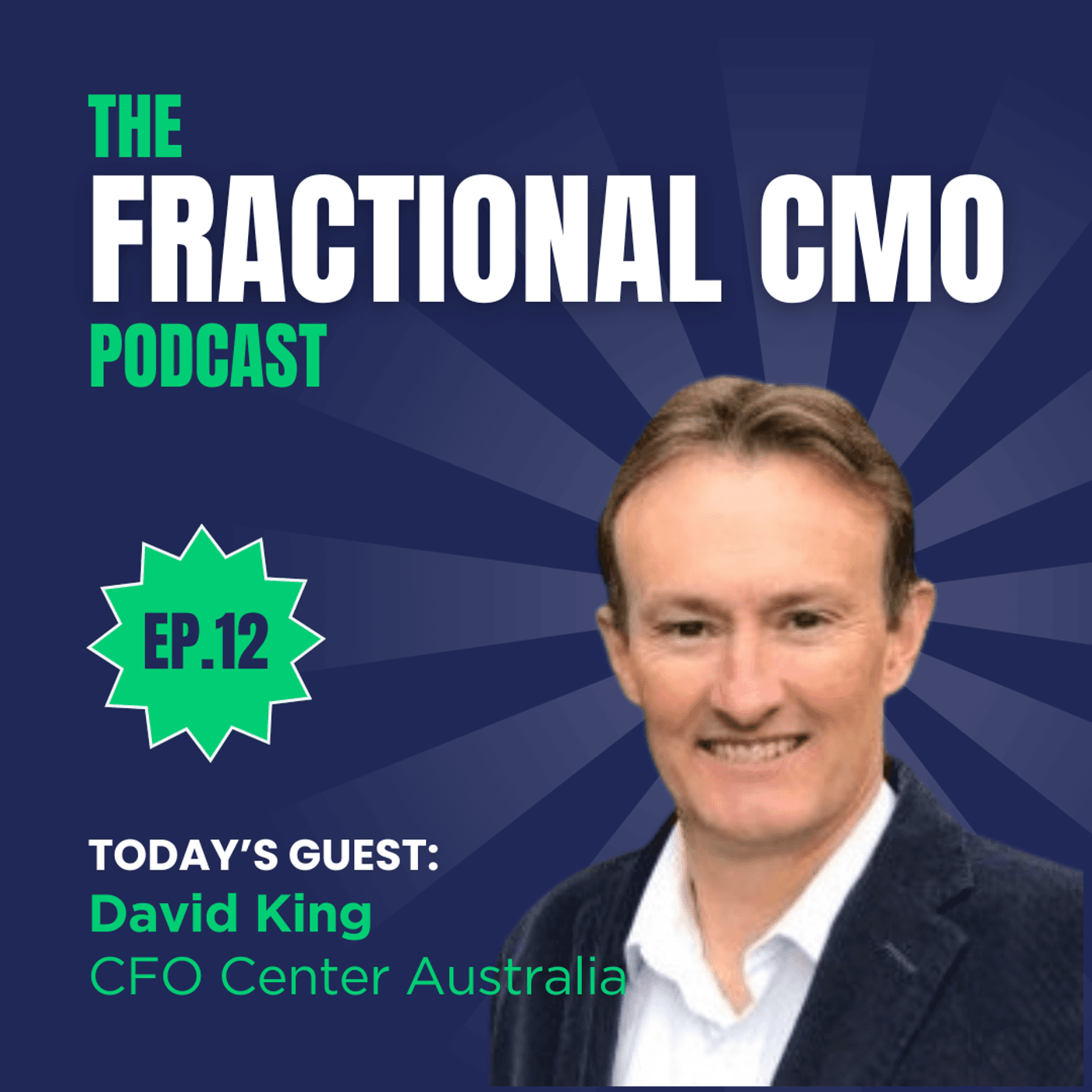
- Guest: David King, CEO for Eastern Australia and New Zealand at the CFO Centre Australia
- Focus: The accelerating trend of fractional leadership and the essentials for success as a fractional executive.
Key Insights from the Episode The Rise of Fractional Leadership
- The fractional leadership model is gaining traction, particularly in Australia, influenced by trends observed in the U.S.
- Fractional roles differ from part-time positions in that they provide a more objective and flexible leadership option without the full-time commitment.
Role and Impact of Fractional CFOs
- Fractional CFOs help SMEs stabilize, scale, and transition through growth phases while managing costs effectively.
- They provide in-depth financial analysis, strategic insights, and support to business owners, often filling the gaps left by bookkeepers and external accountants.
Importance of Relationship Building
- Establishing strong, trusting relationships with clients is vital for fractional executives to deliver long-term value and build deeper engagement.
- Successful fractional CFOs often evolve into long-term partners rather than merely project-based consultants.
Collaboration of Fractional CMOs and CFOs
- There is significant value in the collaboration between fractional CMOs and CFOs, as both can offer complementary insights and strategies to drive business growth.
- Businesses that recognize the value of fractional leadership in finance and marketing are better positioned for success.
Key Discussions The Transition to Fractional Roles
- The transition from corporate to fractional can be challenging, requiring a shift in mindset focused on building relationships and being proactive in client engagements.
- Fractional executives must be prepared for the unpredictability of consulting work, including fluctuating income and the need for constant networking.
The Challenges of Initial Client Engagement
- Understanding client dynamics and existing team structures is crucial; fractional executives must be sensitive to existing personnel and their potential apprehensions regarding change.
- Financial assessments often reveal deeper issues that need to be addressed, which can be intimidating for existing teams.
Advice for Aspiring Fractional Executives
- Mindset Shift: Embrace the change from employee to consultant, focusing on networking and building a personal brand.
- Financial Preparedness: Establish a financial buffer to manage income variability inherent in consulting work.
- Building Relationships: Network actively, cultivate connections, and maintain relationships even when immediate opportunities are not apparent.
Conclusion David King emphasizes the importance of building a network of trusted relationships, both among clients and peers. The fractional model not only allows businesses to access high-level expertise but fosters collaboration between marketing and finance, ultimately supporting sustainable growth for SMEs.
Contact Information
- David King LinkedIn: [View Profile](https://www.linkedin.com/in/davidcharlesking/)
- CFO Centre Website: [CFO Centre](http://cfocentre.com)
Final Thoughts The fractional leadership model represents a significant shift in how businesses can leverage external expertise to navigate growth and operational challenges effectively. The synergy between fractional CFOs and CMOs offers a comprehensive approach to business strategy, emphasizing the value of collaboration in achieving collective goals.
Written by AI. May contain mistakes. Listen to the episode to check what was said.
Chapters
Tap a time to open that second in VOIntroducing David King
0:45 to 1:56
David King introduces his role with the CFO Centre Australia.
“If you want to reach out to me, you can find me at Simon at CMO.com.”
Understanding the CFO Centre's Services
1:56 to 5:07
David explains the services offered by the CFO Centre to SMEs.
“We need the external accountant very much in place.”
Global Presence and Team Structure
5:07 to 7:35
Discussion on the global reach and team setup of the CFO Centre.
“And there's how many CFOs are there sort of within that network now globally?”
The Shift from Part-Time to Fractional
7:35 to 9:18
Exploring the transition from part-time to fractional CFO roles.
“traction as a term it's something that we felt we needed to be obviously aligned with because if If people were gaining an understanding of what fractional is all about, then you've got to be calling yourself that term.”
Advantages of Fractional CFOs
9:18 to 12:20
David discusses the benefits of having a fractional CFO for businesses.
“But I think the idea for me is the fractional is a little bit outside, is a little bit more objective potentially than the actual employed person.”
Building Long-Term Client Relationships
12:20 to 14:05
Insights on how fractional CFOs build sustainable client relationships.
“So we certainly try and build the relationship so they see us as part of that long-term journey.”
Understanding Client Engagements
14:05 to 15:09
Learn about the importance of sustaining client relationships and managing expectations.
Challenges on Day One
15:14 to 19:16
Discover the common challenges faced by CFOs when starting with new clients.
“I mean, the black and white will come from the fact that we do a deep dive call, a discovery session to kickstart every engagement.”
Adapting to the Fractional Consultant Role
19:16 to 22:02
Explore the mindset shifts required for transitioning to fractional consulting.
“If we're not open to doing things differently, potentially, then why would you have us in there and spend money and time on us?”
Preparing for the Fractional Journey
22:02 to 24:29
Understand key advice for those considering a shift to fractional CFO roles.
“So your income can be also a bit more up and down as well.”
Show all 22 chapters
Client-Centric CFOs
24:29 to 28:00
Learn why client orientation is crucial for success in fractional CFO roles.
“Yeah, look, it's, well, I mean, look, it's interesting that you say that in the CFO field.”
Understanding the Fractional Mindset
28:00 to 29:09
Explore the characteristics and proactive nature needed for fractional CFOs.
“They just want to do the delivery piece.”
The Challenges of Transitioning from Corporate to Fractional
29:10 to 30:59
Discuss the pitfalls faced by corporate professionals shifting to fractional roles.
“It's interesting that I think, and I guess you must have seen this as well, I've seen some really good corporate people that want to become fractional CMOs and don't do well.”
Collaboration Between CMOs and CFOs
31:00 to 32:55
Learn the importance of collaboration between fractional CMOs and CFOs.
“When in this space, most of our new clients have never used a fractional CFO before.”
Building a Network of Fractional Experts
32:56 to 34:29
Understand the value of having a diverse panel of fractional experts.
“And a good business who, I think this is the key.”
The Evolution of the Fractional Legal Model
34:30 to 36:28
Examine the historical context of fractional legal services in business.
Capacity and Client Management in Fractional Roles
36:29 to 37:28
Discuss the balance needed in managing client loads as a fractional executive.
“business at a certain revenue and upwards would be a huge benefit to them.”
Accessing High-Caliber Talent in Fractional Models
37:29 to 40:38
Learn how fractional models provide access to top-tier professionals.
“And that's what we do as part of our model.”
Building Resilience and Relationships
42:00 to 42:58
Learn the importance of resilience and building relationships in business.
The Concept of Business Best Friends (BBFFs)
42:58 to 44:31
Discover the value of nurturing professional networks and relationships.
“and just be prepared for those little knockbacks.”
Ways to Connect and Engage
44:31 to 46:08
Explore practical ways to connect with potential business partners.
“Mate, last question for you, where can people find you?”
The Importance of Initial Conversations
46:08 to 47:11
Understand the value of having initial discussions and staying connected.
“My email address is david.king at cfocentre.com.”
Transcript
Automatic transcript. May contain errors.0:07Welcome to the fractional CMO podcast. My name is Simon Dell. I am the CEO of CMO. This is somewhere I feel like we're approaching the 150th podcast I've done here, but I'll have to check the numbers, which is quite handy when you're checking numbers, given the fact that I've got David King with me today, who's probably much better with numbers than I am. Just a little bit about us before we start. If you're interested in anything from a fractional marketing perspective, whether you want to become a fractional marketer, a fractional CMO, So whether you're looking to recruit one, check us out. It's CMO.com, C-E-M-O-H.com.
0:46If you want to reach out to me, you can find me at Simon at CMO.com. You can also find me on LinkedIn. And if you like to listen to this and you enjoy this podcast, please rate and review us on whatever platform it is that you are listening to or viewing this on, be that Spotify, Apple Podcasts, YouTube, wherever it is. We appreciate a like, a review, a comment, whatever it is. So with that all out of the way, I'm going to introduce, welcome to the show, David King, who is the, I'm going to get this right, the CEO for, there we go, I got it completely wrong, the CEO for Eastern Australia and New Zealand for the CFO Centre Australia.
1:32Did I get that right eventually? That's a bit of a mouthful, isn't it? that's right there's a lot of a lot of c words in there and um that's that's exactly right okay cool right well we've got that so um i think first of all the cfo center um it's a it's a global brand but let's tell people um despite the fact that it probably gives it away in the name but let's just give everybody the um the overview as to what the cfo center does well i guess in a nutshell simon our bread and butter for the last 25 years has been primarily helping smes so small to medium-sized businesses and their owners at a stage of their growth path to accelerate that growth further or to help them stabilize or indeed even recover it's bringing in fractional or we used to call them part-time chief financial officers cfos on this fractional basis whether it's a day or two a week or only a day or two a month or anything in between primarily working on site but also remotely where where necessary or where appropriate or a bit of both to really help the management team of that business get around financial performance in terms of what's working for them, what's not, what they should do more of, what they should do less of, really help them get clear on the strategy longer term for their business and why that's important to them as the owner and putting pathways in to help drive that as quickly as possible for them.
3:18And we do that around the world with very carefully selected CFOs that join our brand who have actually CFOs from past lives in bigger businesses like in-house CFOs that have that real corporate, big business commercial experience that can really hit the ground running with smaller businesses. As I say, if it's around profitability and improving that, whether it's around better cash flow and working capital management, being more financially literate, building a best of breed finance function for the business as it continues to grow, and being able to do it on a cost effective basis, whereby they only pay for what they need from a CFO at this point in time.
4:06So most of them, you know, obviously at that point, they don't need a full time CFO, but they do need some form of senior finance support because the business has got to a point where they've outgrown what their, say, bookkeeper can do for them and also outgrown what maybe their external accountant can do for them. We need the external accountant very much in place. We need a good external accountant to do all their tax and compliance type of work. That's really important. So we want to partner with their accountant. And we also need a good bookkeeper in place to do the day-to-day transactional stuff.
4:49But we can tie it together and then really take the numbers and add that insightful commentary and help the business strategize as to what to do next. And it's, I mean, you mentioned there it's a global business. You've got CFOs around the world. Correct me if I'm wrong. It was born out of the UK, wasn't it? And there's how many CFOs are there sort of within that network now globally? So globally, we have about 800 spread over about 19 countries. So it's come a long way over its 25 years, of which we've got about 50 of those across Australia and New Zealand. and we've been going in Australia and New Zealand for about, I'd say, 17 of those 25 years.
5:42And every team that we've got in most, they're based in most capital cities, they're headed up by a regional director who not only recruits and leads their team of CFOs, but also is the second point of contact for our clients It's all like the client relationship manager in the background to make sure the CFO is the right match because it's not just about the technical skills. It's also about the cultural fit and the personality. You touched on something when you sort of gave us that opening description. You know, we've come to this period where everything is fractional. everyone's this fractional is the new buzzword um and and you sort of mentioned you know beforehand they used to be called part-time um and i i i think there's i i i think there's a difference between part-time and fractional but why do you think there's been this kind of shift is this just sort of a do you think this is just it's followed a trend and you guys just happen to be sort of well ahead of the trend 25 years ago but didn't necessarily call it what it was being called now um what do you think the attraction is all of a sudden um you know with this fractional model and and that's cmos with us and cfos with you yeah good question we know we know a lot of it's been driven out of the us where this type of fractional model's been going a long time it's very well understood by the by the business community or the wider community in the US certainly in other countries including Australia it's with it's still an emerging concept I think we're all finding our our way for us you know I guess because fractional was gaining so much traction as a term it's something that we felt we needed to be obviously aligned with because if If people were gaining an understanding of what fractional is all about, then you've got to be calling yourself that term.
7:57So I guess it's part of our learning curve. It's part of a global move. The one thing we still are aware of is that fractional can mean different things to different people. Like what we're saying here, it's not a fraction of a person's brain that you're getting or a fraction of their attention. it's just that it's a fraction of what a full-time person would be giving you because you don't need a full-time person so yeah um with i think in australia we've still got a way to go in terms of breaking down the mindset that we've got around employment and business owners thinking that they've got to go and and put somebody on their payroll you know in some sort of permanent capacity in order to get someone who's committed and fully engaged when you can get a fractional person like a CFO at the CFO Centre or a CMO at CMO and still get that level of commitment and engagement but you're only using them as much as you need them to keep it cost effective.
9:12yeah i think for me the difference between and i've i've had this conversation a fair few times the difference between fractional and part-time part-time still feels like you are a member of the team and you are you're a salaried person um there's a permanency there um and i don't want to sort of negate that i that fractional cfos or cmos should not feel like they're part of the team and they should also not feel that there's not a permanency in what they're doing. But I think the idea for me is the fractional is a little bit outside, is a little bit more objective potentially than the actual employed person.
10:03I always feel a fractional CFO for the ones that I've met, and I've met a fair few of them over the time from your organization and a few independents. And I also, from a fractional CMO perspective, I feel there's a little bit more objectivity from those people. And I also feel that they're perhaps a little bit more willing to challenge the status quo of what's being done in the business because they are slightly outside. Is that something you feel? Definitely, definitely. We talk about this internally a bit, actually. Our CFOs tell us, and I've experienced it as a fractional CFO myself, this empowerment of being not a direct employee and therefore having this direct line of, I guess, management up to the CEO and being able to, It's almost freeing us up to be truly independent, give them, you know, unbiased support, telling them, you know, sometimes the bad news and not being afraid to do that.
11:20not just the good stuff I think is a lot easier with this type of model for that reason because you're not you're not not afraid of you know losing your your full-time job or whatever it might be so it's really important yeah like we we have a long-term focus for every new client that we go into and we really work hard on building the relationship you know with all different layers of that organization um and talking in you know like using the language and positioning ourselves in those conversations around the longer term their strategy their personal goals looking looking for ways that we can play a valuable part in that journey rather than them seeing us as some sort of project person just coming in to fix something and then saying goodbye, which we happily do project work, but I think they really miss out on what can happen over that longer term where our CFO builds a deeper relationship, a deeper understanding of their business and can really add that strategic value and insight as opposed to maybe just some of the operational improvement stuff that needs to be done as well.
12:40So we certainly try and build the relationship so they see us as part of that long-term journey. And we've done that with clients that we've got, you know, some of our longer clients that we've got in Australia, we've been working with for six, seven, ten years. Others we've worked with for like a few years and got them to the point quite rapidly where they do need a full-time CFO now, like they've got to the size and complexity. and we've helped recruit the full-time CFO and done the handover. And it's like job done. You know, if we can have an ongoing relationship if they need us periodically for things, that's great.
13:21But otherwise, you know, we're pleased and they're pleased and everybody wins. I've said that in a discussion on LinkedIn once, is that I think a good fractional operator should eventually do themselves out of a job. and I think that's the case whether it's finance whether it's marketing whether it's sales whether it's operations if you can get your client to the position where they need you full time and you're and that's not that's not something you want to do you want to you know you're happy being that fractional then I think you've done an exceptional job I think that's that's the ultimate win is losing your job which obviously sounds counterintuitive but I think that's where that's where you need to be thinking this is an 18 month to two year project to grow this company and then I'm gone yeah I think we just take every client you know at face value and look at where are they what's their ambitions if their growth ambitions are a bit slower and it's more of a lifestyle or income play we can add a lot of value there for a longer period of time if they want to scale it really fast and then sell it or list it or you know whatever it is then we help them get to that point fast and then help them with that transaction so there's lots of different scenarios that can play out but being there for as long as we feel like we can add the value and just educating them along the way about what a fractional cfo really is all about and as I say not just some really short-term fix-it person that comes in like does a three-way forecast and then has to disappear because that's only a small piece of the puzzle so it's it's just putting our best foot forward and that all comes down to the relationship that you're building with them.
15:14What are the sort of biggest challenges you find walking in and that sort of day one into the um you know into the client i i think you know i'd imagine they're the same um you know certainly from a cmo perspective you're walking into an extremely large number of unknowns yes but i wonder whether the unknowns for a cfo are more black and white in terms of discovering them than potentially they are for a fractional Samo? Potentially. I mean, the black and white will come from the fact that we do a deep dive call, a discovery session to kickstart every engagement. And we'll quickly, by looking at their financials in detail, we'll quickly come to a realisation if potentially their financial state is a lot worse than we were led to believe.
16:10And then we'll respond accordingly with that. the numbers will also tell us where maybe the business overall is not too bad but where there's parts of the business that certainly need attention whether it's certain product or service streams that are underperforming or whether it's a very heavy overhead structure whatever it might be right so or you know if they're carrying inventory they're carrying too much of the wrong type of stock or you know there's a myriad of things that we can come up to speed on nice and quickly there's a there are some unknowns as well though one of them which you'll probably appreciate is it's the personalities that you're working with whether it's the ceo and the other leadership or management team members and whether they're all on board for the journey you know willing to take advice um i guess in day one you could be going in there telling telling it see this is where i think there's difference because you could be going in telling a lot of people or a number of people that they've been doing something wrong for quite some time you know and and there's and there's got to be a sensitivity around that whereas when a cmo walks in a fractional cmo it isn't so much that the company's been doing something wrong i think they're more willing to acknowledge that they hey we don't know anything about marketing we've got this way because um we've grown through good service and sales and all those kind of things and and often when a fractional cmo walk is walking in it's like now we know we need to go to the next level um and and there's not this insinuation they've been doing something horrifically wrong whereas I guess you guys could be walking in and opening up a Xero account or whatever it is and just going Jesus Christ what's been happening here and I guess you could be exposing a lot of people's mistakes does it feel like that sometimes yeah you get a mixed reaction you walk in to a new client and you've got an existing finance team of some shape and form yeah some of them are like oh oh, thank God you guys are here.
18:29I've got someone now that can, you know, help me. I can ask questions, you know, maybe even be mentored, which we love doing, all that sort of stuff. They really embrace it. But then there's other members of finance teams you walk in and they're like a bit horrified and they're really guarded because of what you've just said. Oh, are you going to pick up any mistakes? And, you know, am I going to lose my job? And so we have to try and really make sure we build relationships and put them at ease and say, look, we find what we find. We'll always, you know, deliver any message with full transparency and respect.
19:08It's all about we all learn from what we've done and being open to maybe doing things a bit differently in the future. If we're not open to doing things differently, potentially, then why would you have us in there and spend money and time on us? and why would we want to be involved if people aren't willing to sort of take good advice and, you know, improve things where we've all agreed that things haven't been working to this point. So it comes down to different personalities and how willing they are to want to embrace this. And, you know, the old adage of, you know, do they appreciate or know what they don't know and also appreciate what they don't know they don't know and be open to learning something new and maybe doing things a bit differently it's not just the finance team like if the sales team for instance is being under quoting just to win business and therefore the jobs aren't making any money um or if you're a manufacturer on the shop floor there's you know there's bottlenecks and there's lots of you know downtime and expensive mistakes and stuff going on or whatever, you know, we'll see that we'll draw all of those stories out of the numbers by being, you know, inquiring and asking the right questions.
20:28That's going to put some people, you know, on edge a little bit until we can just say, guys, this is just to make the business stronger. And that's going to make everybody here that much happier. Your jobs will be more secure. This business can grow. Therefore, you can grow with the business. I'm sure no one wants to work for a business that's financially hamstrung. No. Let's look at this now from the actual fractional consultant's perspective. You know, the purpose of being part of a group like the CFO Centre and CIMO is that you have the support of the brand. You have, you know, potentially lead generation coming from a central point, etc, etc.
21:15But if you're starting off on this journey as a fractional consultant, be that in marketing, be that in finance, whatever it is, there's still an onus on yourself to grow your own network, to grow your, you know, to grow your own connections, find your own clients, all those kind of things. So when you sort of set out in this world or when someone approaches you and go, hey, this is what I want to do. I want to be a fractional CFO. What's the sort of perhaps a couple of key pieces of advice that you give them in saying, OK, you've got over here, you've got the nice the comfort of, you know, an accountancy firm or you might be working in an internally and a CFO role.
21:57You're going to go on your own. What's those key pieces of advice? yeah there's a couple of things that come to mind first of all is your own mindset um i felt when i went from being an in-house corporate cfo into this fractional world with the cfo center i certainly had to shift my mindset in terms of say comfort zones and really stretch those because when you're an internal um corporate cfo you don't really in most cases anyway you don't really have to brand yourself or market yourself you don't really sort of have to have much of a network to be honest because you know you're really focused on the the internal organization to an extent that is so when you become a fractional um executive and that that includes cfos you know it's being prepared to put yourself out there and get yourself a bit uncomfortable whether that's you might have always been against like networking and now you know you might have to go to some networking events and rub shoulders with people and you might now have to practice your own little elevator pitch um so you can talk you know about why you exist and what you do in a you know in an effective way when you've only got 30 seconds to do so yeah um i think also what I say to them, it's being prepared financially for this because you haven't got the nice secure paycheck coming in.
23:32And so you financially, you need to be okay with not just the runway that it's going to take to build up your client book, but secondly, ongoing clients will come and go, and then you've got to get back out there and, you know, shake the shingle and do some more marketing to win some new work. So your income can be also a bit more up and down as well. So from an income perspective, from a comfort zones perspective, I think from a network perspective, you know, being prepared to actually go out there. It's all about relationships at the end of the day, as you know. Absolutely. You know, I think for some people it comes naturally.
24:16they'll go out there and just build some new relationships, whether they're referral partners or what have you. And others probably need to work on that because it's, they might be, especially in CFO land, there are a healthy number of introverts in that field. Yeah, look, it's, well, I mean, look, it's interesting that you say that in the CFO field. I think one of the things that I hear so much in, in the CMO field, you would think marketers would be good at selling themselves, but they're absolutely terrible. And a lot of them, the ones I like are the very acknowledged ones where they go, hey, I don't want to do that.
24:54I don't want to do the sales. I don't want to do my own marketing. I just want to go and do the work and work for the clients. They're the best ones for us because they recognize the benefit of being part of our network, and they're happy to sacrifice, you know, a small slice of that income in order to, you know, to do that work. I think your financial point there is just so, so, so true. I almost say to people, if you're going to decide to go out, let's say we're in January now, 2026, if you're going to go out and you want to decide to become a fractional CFO, CMO, you should go out on your own in perhaps January 2027, right?
25:38and spend the next 12 months building that network of people that you think you can get work from so that when you go you do potentially have one or two um one or two contracts um and you know you can move straight into work but your but your point about being financially safe uh you know stable to sort of go, hey, consulting work isn't that constant like that. It goes like this. Yeah. Well, it all comes down to personal drivers, which we dig into a lot when we're recruiting our CFOs. It's like, what's really important to you at this stage of your career and your life? If money is still, well, maybe it never was, but if money is at the top of the list, you know, that's going to be a potential issue.
26:29But if at this stage, money's obviously important, makes the world go round. But at this stage of life, it's more things like variety, flexibility, autonomy, maybe the feeling of giving back to the smaller business owner, doing something tangible for smaller businesses rather than for some big corporate. If those things are popping up for the person, then that's where we're like, okay, this could work. So, yeah, it comes down to personal drivers a lot of the time and their preparedness. The other thing is, I think you're right, we love CFOs that are really client orientated, like have what we call the CX flag.
27:17It's all about the client experience. They want to get outcomes for clients. They might want a bit of freedom and flexibility. They don't want to be handcuffed to some corporate 70-hour-a-week job anymore. They've got a bit of money behind them. They still want to earn some decent money, which they can, but it's just not the biggest driver for them anymore. That's going to work quite nicely. I mean, the reason they'll join us rather than go out on their own is, further to what you were saying, Simon, is they don't really believe, whether that's true or not, that they're going to be any good at actually winning clients or attracting them and winning them.
28:02Or they don't really want to do it. They just want to do the delivery piece. So they look at the CFO centre and look at our marketing function that we've got at our regional directors that do the local BD in those regions, we still ask our CFOs to assist, like go out to key meetings with referral partners, go to some networking events with their regional director, you know, do a little bits and pieces because it's the sum of all those little things that add up to where the next client might come from. So it's not like we want a CFO that's going to come in and sit. By saying, you know, we don't want them to be baby birds sitting in the nest going you know feed me feed me you know um we want them to be proactive but but they know they don't want to do all of that on their own i it's funny that so you know you through what you said and what i've said it just we've described a very sort of typical fractional mindset and the type of person and i think there is a particular fractional mindset there is a particular type of fractional person.
29:11It's interesting that I think, and I guess you must have seen this as well, I've seen some really good corporate people that want to become fractional CMOs and don't do well. And it's almost like, yeah, the money thing is a challenge for them, but they feel that sometimes if they've been in a... I feel sometimes people that have been in a corporate environment for a long time lack the, and I hate using this word, that kind of hustle that you perhaps need to do right at the start, right? That you do need to go and have coffee with a lot of people even if you don't like them or don't really want to have coffee with them and all that sort of thing.
30:00Do you find that sometimes you get those CFOs approaching you from the corporate background and you just look at them and just go, you're not suited to this, to this lifestyle and this framework? Oh, totally. Yeah, yeah. I mean, I've interviewed hundreds and hundreds and, you know, we only recruit a reasonably small proportion of those that we interview for lots of reasons. But I think one of them, if our sense is that the person's got still very much an employee mindset that, you know, just leave me. I don't really want to learn your IP. Just give me the work and lead me to it. And then when you give them the work, your sense is that they're just going to go through the motions and actually wait for the client to tell them what to do next.
30:48because they were quite conditioned in corporate land to be told by the CEO and the board what the strategy is and what the finance function needs to do first, second and third. When in this space, most of our new clients have never used a fractional CFO before. So they're looking at us to show them the way for them to get the biggest bang for buck from our involvement. So the CFO does need to have some hustle. they need to show their initiative and be on the front foot they've got to be confident you know in terms of the communication if you sort of take a almost a step back and you're just waiting for the client to communicate with you or tell you what to do next it's not going to work so you do need those ones that really are you know i call them go-getters yeah yeah Yeah, hunters or whatever.
31:46Yeah, look, I 100 % agree with you, which kind of leads nicely to sort of my next question was more about, you know, we had a podcast the other week where we beat up an accountant for 45 minutes, which was great. But to me, there's an opportunity here for the CMOs, fractional CMOs, to be working closely with fractional CFOs And this is obviously the reason you and I have been speaking for such a long time is that, you know, there's an opportunity where fractional CMOs can be looking at businesses and going, well, look, I've got the marketing in order, but the money's disappearing, disappearing down a drain here and nobody knows where it's going.
32:32So I think, you know, my advice to all of those fractional CMOs out there is go and find your local fractional CFOs. You know, have a beer with them, you know, have a coffee with them, have lunch with them once a month, once a quarter, whatever it is, and start building those relationships. There is very little crossover. And a good business who, I think this is the key. a good business that recognizes the benefit of a fractional cfo will ben will recognize the benefit of a fractional cmo and vice versa i agree yeah definitely yeah really and i really encourage that too i mean that's why yeah we've got that relationship with you we know fractional HR executives, we know fractional IT, CIOs.
33:27So they're probably the main pillars in the background behind any business. It's your finance, it's your marketing, it's your people or HR and it's your IT, which also includes cyber and AI and everything else these days. So if you can build a best-of-breed network, it can really it helps you in terms of you know you might be able to get some cross referrals happening but it also really helps your clients because you know you are going to spot opportunities for the other and if you've got people that you know and trust that you've built that that up that trust up with over time that do a good job for your client it's only going to make your relationship with your client stickier as well because it sort of shows that you're thinking outside of just what you do as well you're actually taking a wider view a more strategic view of the business and of the business owner as opposed to having a narrow focus i'm just going to do this piece if you're just going to be like task orientated i find that those people don't find opportunities for others in their network and they don't even find opportunities for themselves potentially longer term with that client you and i discussed this last time we met was the idea of almost a panel of experts that you pay a flat rate for and you have access to them and you can use whichever ones that you want um uh every month um you know and i think you sum it up nicely marketing finance it uh hr um my fifth one in that the fifth horseman of the apocalypse if it were um would be legal um of course yeah i think certainly the way my my partner's a lawyer and she's been on the show a couple of times and um that that actually um interestingly enough the the legal fractional model i think is potentially older than anything else maybe not maybe not the the finance one but the idea the concept of legal in-house counsel um that a law firm is supplying you a lawyer in your office a day a week two days a week um to deal with the shitty legal things that occur um that's been around for long long time yes um and again it's just never been framed in this kind of trendy fractional you know um you know in terms so people when you go in-house counsel it's like oh that sounds kind of heavy and serious you know whereas you go fractional lawyer you're like oh that sounds a lot more you know essentially doing the same thing but just you know different jargon to to kind of make things more attractive but i think any sensible business needs to sit there and go okay a panel of those people whether i use them or not um would be would for a growing business at a certain revenue and upwards would be a huge benefit to them.
36:36Totally. I mean, you're getting this access to these skill sets that in the past were only reserved for the big end of town. So if you're a smaller business with ambition, you know, you should be looking at how did those bigger businesses get to that point? And part of it is because at some point on their journey, they got access to the C-suite, as we call them. why not get them even earlier than ever before on this cost effective model to to add rocket fuel to to your plans and you know I think for me it's going back to the fractional executive has a responsibility to not load themselves up with so many clients that they then can't give any one client what they truly need.
37:34So like with our model, we make sure we don't load up any one CFO too much beyond a certain point of capacity because we always want that CFO to have some spare capacity or wriggle room in their diary or calendar because some clients need a bit more of their CFO at different stages or they might want to reschedule a meeting or whatever. So the fractional executive needs to make sure that, you know, if they've really got a true CX lens and they really want every client to feel like it's the only client they have, they've got to make sure that they balance their workloads and capacity levels effectively.
38:19And that's what we do as part of our model. Yeah, yeah. look i i was going to sort of give an example you you you you kind of flagged i think and you've said it a couple of times today that the reason for this fractional model is is offers supreme benefit in my opinion to the customer to the client right and that they can get access to knowledge skills time from people that they would never ever be able to touch in in the real world and the example i was going to give you to sort of wrap up the conversation today was that we had a client come to us a food food production business based in uh based in melbourne producing this funky little health food you know distribution in walworth's with one of their products etc etc so early on the on the growth curve you know um turning over less than a million and they said look we need some marketing direction we think we've got a great opportunity you know and i looked at it and i just went you know these guys are absolutely prime for explosion they could be you know doubling their revenue every year if they play their cards right and we went out there to the to our network and said who wants to who wants to work with these guys.
39:41We said budget's limited. They're not going to be huge. Two of the people that applied that wanted to work with these guys, one was an ex-coms director of Woolworths. One was the former CMO of a very large fast food chain, national, international fast food chain. There is no way that that company, if they'd gone out there and put an advert on Seek or whatever they put, would have had access to that kind of people. Exactly. And I think certainly from what we're doing at CMO, being able to have those people with those experiences and with you guys with the CFO Centre going, hey, look at the pedigree of the people that we have.
40:25You can have these people advising in your business. I think that's what sets apart this fractional model than any other approach and any other model that's out there. I totally agree. Yeah, the calibre of people is fantastic. And, you know, what we do is match the best CFO for that new client, whether that's industry experience, you know, sector-specific experience, whether that's location, whether that's personality, cultural, or all of the above, to really build that rapport from which trust can flow once you start delivering on the things you said that you were going to deliver on and then the magic flows from there.
41:10Yeah. Yeah. Look, thank you very much for your time today. I think there's some great insights out there. Perhaps just one sort of last gem. If you're, and I say this, maybe a piece of advice, we talked about it in a bit detail, but a piece of advice to that consultant out there that's starting off in that journey as a fractional CFO or a fractional CMO, like what's that one thing that you think that they should be out there that they should be doing in order to grow their business and grow their suite of clients? Look, if they've decided to make the jump and they've gone out there and they're starting to do it, I think, like I was saying, just putting yourself out there opening opening yourself up to any fears or barriers that you might have um remembering that it is just about relationships it's not just it's not about i took the word selling out of my vocab in the early days someone gave me that advice because i felt that was putting too much pressure on me and i didn't see myself as a salesperson i just saw myself as a financial guy that's got something to offer and if you've got a need you know in my sweet spot then I can help you and it's just about having conversations and building relationships and you know you're gonna you're gonna win some you're gonna lose some like in anything in life you'll have some setbacks so you've got to be resilient as well things can take a bit longer than you might expect.
42:53So if you're really committed to it, then stick to it and just be prepared for those little knockbacks. But also just keep learning the trade, speak to other people and just keep working on your own pitch, your own language and you'll get there. I love the word resilience. I think that's an absolutely hugely valuable word for people starting off in this space. People starting off in this space, people five years into this space. Yeah, that's right. That resilience and that confidence. And we've got a guy in Sydney who, when he goes in, is just so confident. And he says, for me to work with you, it's going to be$20 ,000, right?
Read the full transcript
43:39But he says it with such a way that people are like, oh, my God, we're getting a bargain. You know, so it's whether it's presenting yourself in that way where you're you're pitching yourself in a way that you almost feel like you're giving them a discount, you know, irrespective of actually how much you're charging. and and further to your point because what you said is a hundred percent correct and and me being the marketer in me i came up with the you know i come up with the fancy expressions and way of way of way of saying it that the perhaps the finance people don't and and i i've always i kind of been talking to people in the last year or so about this idea of um bbffs so everyone in there you You know, people in their life have BFFs, you know, best friends forever.
44:27But it's about you going out there and having business best friends forever. Because I think if you're going to build a good network, that Rolodex of closely aligned people that might only be 20 or 30 of them, those people that are out there singing your praises, those people that are out there are talking about you, those people that are out there that might be at breakfast that you're not and they're going, hey you really need to speak to David let me do an introduction when I get back to the office right if you nurture those BBFFs it takes time yeah but you will find that there will be so much more coming back from them um because they are they're thinking about you because you're front of mind to them because they like you oh I think that's yeah I think that's one of the realities and i don't want to put people off who are perhaps like introvert like you you sort of mentioned earlier but forget referrals the stark reality is people need to like you yeah and and you can do that by buying them lunch you could do that by playing golf with them you could do that by simply picking up the phone and saying thank you sometimes exactly right you know So I think, look, there's a lot to learn there from both the CFO Centre and hopefully from CIMO.
45:48Mate, last question for you, where can people find you? What's the easiest way to reach out to you and get in contact with you?
45:57Website, cfocentre.com. We've got all the details are on there. You can look me up on LinkedIn. I'm active on LinkedIn. in. My email address is david.king at cfocentre.com. So drop me a line there. So there's a few different ways, even if it's just for initial chat, I can then introduce whether it's a CMO that would now like to start up a relationship with a fractional CFO, then we can make that happen depending on where they're located around the country. Or if it's a business owner, that just wants to have a confidential chat about where they are in life. We love having those initial conversations just to see if we can help because we're not going to try and be all things to all people, that's for sure.
46:52And I would heartily recommend that to any business owners that are out there. If for nothing else, go and have that 30-minute chat. If nothing comes out of it, if you don't feel that you need them now, I guarantee at some point six months down the line, a year down the line, you'll be picking up the phone again to David and going, hey, now I'm ready. Now I need somebody. I've got to a position where I can afford it. I'm comfortable spending that money, and I need someone to help me on that journey. So even if you don't need somebody now, at least reach out and make that contact, have that conversation now, and then park that in your head for when you do need it.
47:32Yeah, I've got to say, timing's everything. We've had some leads that we nurtured for a few years before they finally get, I'm now ready. Yeah, yeah. And we're the same as well. People, some people, I'm one of those people. I want to do the research now, but I don't necessarily want to make the purchase now. Sure. But that doesn't necessarily mean that I'm not going to use you, but it just might take six months. And those people that make the effort now are the ones that I remember in six months. Absolutely. Absolutely. Mate, thank you very much for your time today. is always a pleasure chatting with you next time obviously back up here we'll have um we'll have lunch again sounds great thanks for the opportunity no appreciate that mate thank you very much good on you cheers
From the publisher
In this episode of The Fractional CMO Podcast, Simon Dell is joined by David King, CEO for Eastern Australia and New Zealand at the CFO Centre, to explore why the fractional leadership model is accelerating and what it really takes to succeed as a fractional executive.
David shares insights from over 25 years working with SME founders, explaining how fractional CFOs help businesses stabilise, scale, and transition through growth without the cost of full-time leadership. The conversation covers the shift from “part-time” to truly fractional roles, the importance of objectivity, and why mindset, resilience, and relationship-building are critical for success.
Simon and David also discuss why fractional CMOs and CFOs work best together, how experienced executives can deliver outsized impact, and why modern businesses are increasingly supported by panels of fractional experts.
🔗 Connect with David on LinkedIn
/ https://www.linkedin.com/in/davidcharlesking/
We’d love to hear what you think, so please leave us a rating and review on Apple Podcasts and Spotify.
🌟 SUBSCRIBE to our YouTube channel for weekly expert marketing insights.
If you think you have a great story for the podcast, contact our producer at podcast@cemoh.com
.
🚀 If you need help growing your business, visit cemoh.com to find an experienced marketing consultant.
#FractionalCMO #MarketingLeadership #GrowthMarketing #MarketingStrategy #BrandGrowth #CMO #BusinessGrowth #CustomerExperience #MarketingConsultant