In short
The Fractional CMO Podcast - Episode Summary
Episode Title
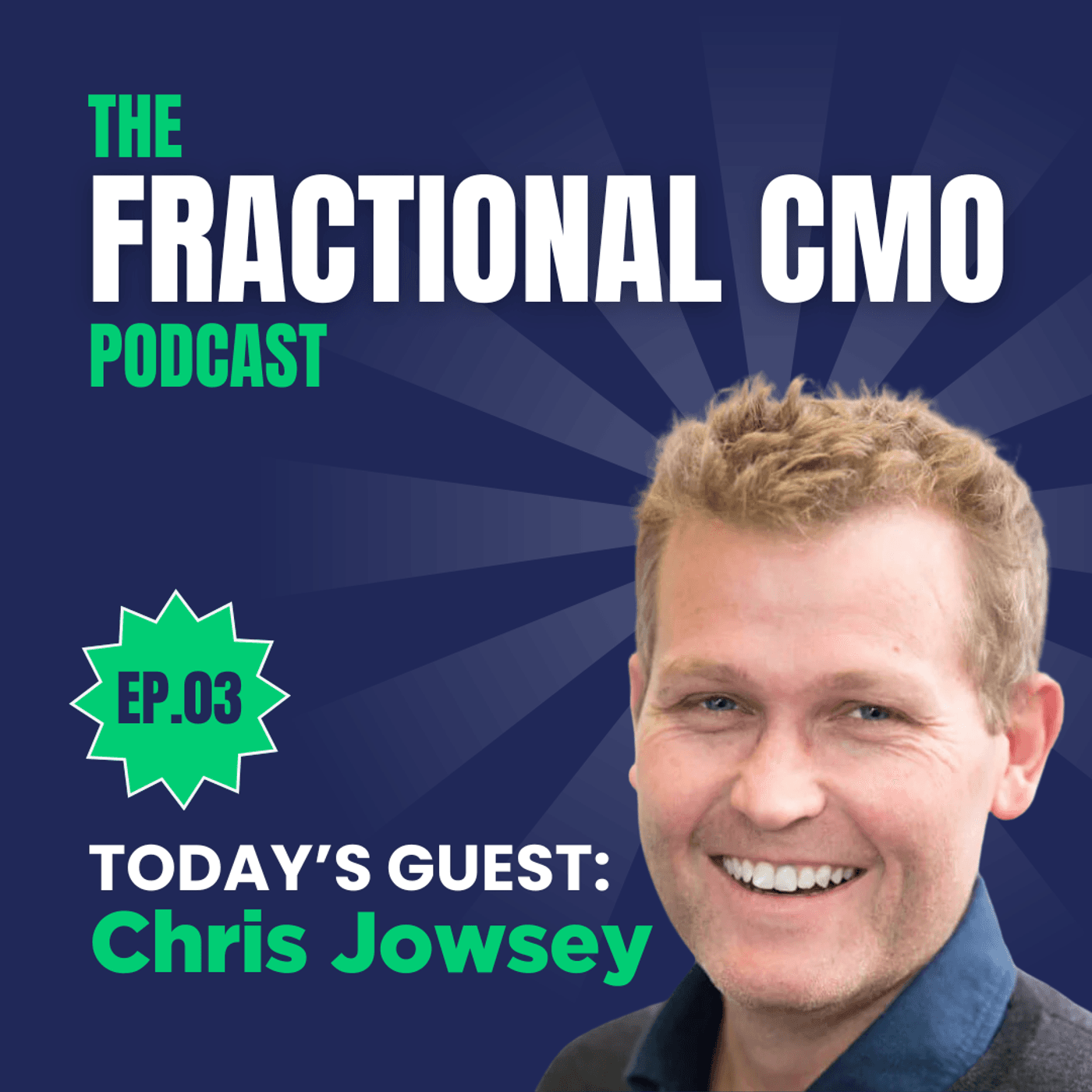
S2 Ep3: Chris Jowsey of Nugget Digital Host: Simon Dell Guest: Chris Jowsey, Founder of Nugget Digital
Overview In this episode of *The Fractional CMO Podcast*, Simon Dell interviews Chris Jowsey, a leading fractional CMO in Australia. Chris discusses key aspects of the fractional CMO role, sharing insights into the differences between fractional CMOs and consultants, the importance of financial fluency, and how AI is reshaping marketing.
---
Key Topics Discussed
- Difference Between Fractional CMO and Marketing Consultant
- Role Definition:
- A fractional CMO integrates more with the in-house team compared to a consultant who operates externally.
- Fractional engagements are typically ongoing with no defined end date, focusing on broader business growth.
- Client Engagement and Industry Focus
- Client Base:
- Chris has primarily worked with B2B businesses, particularly in tech and e-commerce, but sees value across various sectors including manufacturing.
- Engagement Models:
- Engagements are often structured as monthly retainers or daily rates, with Chris noting a preference for retainers due to their stability.
- Challenges Faced in Sales and Marketing
- Initial Struggles:
- Transitioning from being busy in client work to maintaining a consistent sales pipeline was a challenge for Chris.
- He highlighted the importance of accountability in sales and has engaged a fractional sales leader to help maintain focus.
- First Client Experience
- Initial Engagement:
- Discussed the relief and challenges faced with his first client, including navigating client expectations and understanding their internal processes.
- Client Onboarding and Strategy Development
- First 90 Days:
- Chris typically proposes a strategy piece to understand the client’s business and marketing landscape.
- Engages in detailed discussions around financials, sales data, and business goals to align marketing strategies with business objectives.
- Handling Expectations for Results
- Balancing Quick Wins and Long-term Strategy:
- A mix of short-term and long-term goals should be established.
- Emphasized setting realistic expectations with clients regarding the timelines for seeing results.
- Knowledge Transfer and Leader Engagement
- Working with Skilled Business Owners:
- Acknowledged the challenge of engaging with CEOs who have strong industry expertise but may lack in marketing or sales knowledge.
- Highlights the importance of an open dialogue for effective collaboration.
- Future of Fractional CMOs and AI Integration
- Emerging Trends:
- Chris discussed the potential of fractional pods, where marketing skills are pooled together to enhance client offerings.
- Emphasized the importance of AI in streamlining processes and its growing role in marketing strategy development.
---
Key Takeaways
- Financial Acumen: Fractional CMOs must have a good grasp of financials, including P&L statements, to effectively contribute to business strategy.
- Engagement Models: Flexibility in client engagement models helps cater to varying business needs.
- Sales Accountability: Maintaining a consistent sales process is crucial for sustaining a successful fractional practice.
- Results Focus: There must be a balance between delivering immediate results and developing long-term strategies to satisfy business owners.
- Adaptation to Technology: Fractional marketers must adapt to technological advancements like AI to streamline their operations and enhance service delivery.
---
Resources Mentioned
- Chris Jowsey's LinkedIn: [Connect here](https://www.linkedin.com/in/chrisjowsey/)
- Nugget Digital Website: [Visit Nugget Digital](https://www.nuggetdigital.com.au/)
- Podcast Contact: podcast@cemoh.com
Final Thoughts Chris Jowsey provides valuable insights into the evolving role of fractional CMOs, emphasizing the need for adaptability, collaboration, and a proactive approach to client engagement and marketing strategy.
---
This summary serves as a comprehensive guide to the episode's content, highlighting essential discussions and insights from Chris Jowsey on fractional marketing leadership.
Written by AI. May contain mistakes. Listen to the episode to check what was said.
Transcript
Automatic transcript. May contain errors.0:07So welcome to the Fractional Marketing Podcast. I am your host, Simon Dell. I am from a little company called CEMO, spelled C-E-M-O-H dot com. If you want to find out more about us, just go to the website. It's very easy. But if you'd like to connect with me, I am on LinkedIn, obviously, and you can find me at SimonCEMO.com. We are Australia's largest fractional marketing network. Before I introduce my guest today, if you do enjoy what you hear today, whether you're actually listening to this live, whether that's working, we'll see about that in a minute, or if you're listening to us on the podcast through Apple or Spotify or one of the other channels, please, please, please see if you can spend two minutes and write us a nice review.
1:00That's pretty much all the pleasantries out of the way. I am very lucky to be with my guest today, a gentleman by the name of Chris Jowsey, who is down in Sydney. Chris, welcome. How are you? Very well, Simon. It's good to be here. Thanks, mate. We started working with you probably a couple of years ago now, is it? Is that seems a... Yeah, that's right. Yeah. and um your background we'll talk about that in a second but you are perhaps one of the um uh i was gonna see if i can blow smoke up your backside there for a second one of the leading leading fractional uh cmos within our network um very quickly give us an overview about what you do in that role and the sort of people that you're doing it for?
1:56Yeah, sure. So yeah, I guess I've been in this kind of fractional space for the last five years. So I think it kind of started off as consulting. And then probably in the last two years, I think the whole fractional movement is kind of building up speed. And I think the kind of the position itself is kind of firming up. And so I think I've probably moved a little bit further to the fractional piece from consulting in that time. And so just before, just to stop you there, what do you see as the difference? Because we've had that conversation with a couple of people before, is what's the difference between a fractional CMO and a marketing consultant?
2:39yeah i think probably the main difference is that consulting if you're putting it on a scale of kind of in-house external i think consulting's probably further on the external path versus in-house whereas when soon as you start the conversation around fractional and then obviously the client engagement itself you're very much positioned as kind of part of the in-house team even and i think in reality you're kind of one step inside and one step out um but what that means is that kind of on a day-to-day basis you're acting and living and breathing like another employee um with some outside perspective um as opposed to a consultant where you tend to always sit on the other side of the fence yeah and not as integrated um and then from a project point of view consulting seems to be more kind of time-based yeah it's not like you're going into the engagement with without an end in mind yeah whereas fractional you're very much going in with look you know this may on average be a two-year a two-year thing that we're doing but in reality there's no there's no specific end date um yeah yeah i think that i think those two things were spot on is how i see it is a consultant uh a consultant is there for a particular project or a particular problem whereas i think fractional cmos are looking a broader broader business growth um you know and and ongoing and and also exactly as you said there i feel the fractional cmo has a little bit more of longevity to it it's you know it you're there there's i think you spot on there's no real end date to a fractional CMO engagement?
4:30Yeah, I think the mindset has to shift, I think, as a, whether you're a fractional or a consultant, because I think a lot of people that come from a full-time background, they may have come from agency or client side. I think in their mind, they're probably thinking consultant. But it is a bit of a mindset shift to say, okay, no, actually, this is kind of how a fractional engagement would work. Yeah. And that's kind of how you need to lead the conversations as well. And what sort of clients do you deal with? Do you sort of, you're focused on any particular industries or any particular problems?
5:07How do you sort of compartmentalize yourself there? Yeah, I mean, most of my background's in tech and e-commerce and that's kind of where I tended to kind of start. my consulting and fractional business. But I think more so in the last couple of years, the fractional model itself, I think, lends itself well to any type of B2B business. And given there's quite a large number of B2B businesses, I think, in that sweet spot in Australia that really benefit from a fractional, I've tended to work well in that space. And that's across multiple industries. It doesn't necessarily have to be in tech or SaaS, but manufacturing is another.
5:57But any kind of real B2B business, I think there's a lot of value in fractionals. And then obviously there's certain kind of B2C businesses, but they have to be at the right scale, I think, to really kind of benefit from a fractional as opposed to more traditional kind of agency model. model. Is there a particular model that you operate on?
6:26Is it monthly retainers, numbers of days per month? What's your preferred engagement model? Yes. I did this exercise recently where I went back and had a look at the engagements in the last five years. It was pretty much split 50-50 between an ongoing retainer or kind of a daily rate model. I mean, look, I don't have a preference either side for either. I think probably a retainer model probably suits more cases than not. But a daily model, particularly for where there's a lot of ambiguity involved around how the project's going to look, at least initially, is kind of a safe bet for both sides as well.
7:13You mentioned in your notes for today that you had a number of struggles with sales and marketing early on. Talk me through that because I think probably that's one of the big fears people have moving into this model, as you said, moving out of an agency or moving from a full-time role. Yeah. Yeah. I think that I've seen a few different people kind of explain the kind of path for a typical consultant. And I think I've probably taken that similar path in the sense that the first kind of six to 12 months, you're leaning heavily on your immediate network and probably the immediate roles that you've had in the past.
7:53So you're reaching out to them, telling them what you're up to. And usually your first kind of three or four gigs will come from that. And then after that, then it's kind of, you know, you're organically shifting your focus a little bit. you might be shifting industries, you might be shifting models or approaches. And at that stage, that's when you really need to start thinking about, well, okay, what does my own marketing look like? Because obviously you focus more so on everyone else's marketing than their own. And then from a sales point of view, I think that, yeah, this is probably where I struggled initially the most is because, you know, once you get busy, most marketers probably don't really want to be selling.
8:33and so the first thing to go once you get busy is usually your own sales and marketing and so my own challenge I kind of identified it probably around year two, year three was I just didn't have a consistent approach around sales and so look I hired a fractional sales leader and really that was all about accountability, that was just driving that weekly accountability you know who did you meet up with last week who are you having conversations with and then over time how is that developing into pipeline um that kind of regular sales cadence which is pretty straightforward most of us probably know that working within different organizations but just having the the rigor around doing it each week um is is a challenge when you've distracted by so many other things so um i think i just needed to learn that lesson and that's probably the biggest thing that most fractionalists I talk to struggle with.
9:35I know it's one of the things you're trying to solve as well for markets. Yes. Yeah, well, I think it's one of the things we're trying to solve on their behalf, you know, as well as for us. So, yeah. Talk me through that first client. That must have been a – was there a moment of relief there when that sort of first one signed off or the first invoice went out? Yeah, I mean, that was – and that was more of a consulting gig, with a previous company, former colleagues kind of putting you in touch, saying I need this and that, some help on a project. And so that kind of felt like a real natural kind of next step.
10:16But yeah, through that time initially as well, I had my first experiences of kind of ghosting of clients and that whole understanding the process, the sales process, what works and what doesn't work, getting those first kind of rejections. And so, yeah, that all happened in that first kind of two to three months. And then that was also around COVID. So that was probably both a blessing and a curse because COVID forced everyone to take a bit of a reset and a break. And so that was also good timing for me because I think it also just meant that I didn't need to just stay within this path of, you know, my background was in tech, so I need to stay within this tech sector because that's what I knew.
11:05COVID really just meant that I was able to, you know, put the word out to a whole bunch of different industries. And, yeah, within a couple of months, I was working with all sorts of different businesses. So, and that's kind of how I deal with it today. And when you say, I just want to pick up on what you just said there, when you sort of go, you know, you put the word out. what was that like do you pick up did you pick up the phone of people were you just like endless coffees and emails or linkedin or is it just a combination of pretty much all of those things yeah i mean initially i've tried i've tried a whole bunch of different approaches yeah i guess the key ones that i kind of landed on and probably at that stage um it was it's really around you know who are the three to five people i'm going to connect with this week.
11:54And literally it is, you know, I had a very simple script of, hey, this is what I'm up to now. I just want to fill you in on and give you an update, keen to hear what you're up to. And, and just, it starts the conversation. And I just tried to keep it as simple as that because, you know, a lot of people you speak to within your network, often it's not necessarily you sharing, you know, how you can help them, but it's, it's them putting them in touch with someone else in network or you're helping them connect them with someone else in your network. So kind of value exchange is going both ways. And it's one of those things that I think is a, particularly as a direct market, I mean you want to see instant line of sight to your activity and outcomes.
12:39It's one of those things in this business that any kind of trust-based or network-based business, you just have to have faith that doing the work week in, week out over a, you know, three to six month period, um, starts to bear fruit. But yeah, the reality is I think for everybody, it's a numbers game is, you know, you meet with 10 people, you might pick up a referral out of one of those 10, you meet with 20 people, you pick up two referrals and so on, whatever those numbers are and whatever those, you know, percentages are, um, you know, it is just, uh, and, and then I think over time you get better at understanding where those referrals are coming from and the types of people that are going to get you referrals.
13:25So rather than meeting with 10, you're meeting with five and then you just get better and better at doing it. But yeah, those early days, it's the shotgun approach, isn't it? It's just like, I'm just going to point this at someone and hope something hits, don't you? That's right. Yeah. And I think your own marketing is in a similar vein because you're not used to really kind of promoting yourself and your own value and worth. So you're trying different approaches there, whether it's kind of communicating on LinkedIn or writing content. Or for me, it was getting stuck into some research. And that was an early exercise where my initial marketing approach was spending kind of four or five months on a deep research project, uh, and then sharing that with prospective clients.
14:17And, you know, it was a lot of work, but, uh, you know, I, I got one or two clients out of that. So, um, that was another approach as well. Um, let's talk about your approach when it's actually with the clients. Um, you know, you walk in day one, I mean, obviously throughout the whole process of talking to them, you've got some idea of what you're about to face, but what's your sort of process in those first 90 days when you're walking into, you know, work with a client? Yeah. I mean, most clients I'll typically be proposing a strategy piece upfront. Yeah. It's rare to start an engagement without some kind of strategy piece.
15:02Yep. And really, I kind of split that into two parts. One is kind of the business side of it, and then one's kind of developing the marketing strategy. And I think early on, it helps at least just establish where the business, where the client's business is at. Particularly as, you know, I want to have early conversations around, you know, share your P &L with me. How do you make money, whether it's product services. take me into detail around the margin. And so I think that's the initial shock is me asking all these questions of typically the owner, founder, and CFO and getting into the nuts and bolts of how the business works and how it operates.
15:48And then that typically tells you about where the business is at. Have they just gone through a strategic exercise? Because I think a lot of reason we get brought in is because they've typically just gone through, either gone through a change in the business. It could be they've just brought on another, an external advisor who's taken them through a strategic piece of work and they're looking to make a significant change. And someone said, look, maybe you should consider a fractional. And so that works really well because obviously they've just gone through this whole strategic process. They understand the value in that.
16:25and it's also added some clarity around well where do they want to take the business what are their sales goals um if they haven't done that piece of work that's when it's a bit of a challenge to begin with because before you're even having the marketing conversation you're trying to force them to have clarity around you know what what is it they're trying to do what yeah what are their goals and if you're just getting blank then you know you're you're up for a bit of a challenge ahead because you can't start developing marketing strategies or tactics yet until you've at least got agreement over where the business wants to go and where it's heading and what are your sales goals for the next 12 months.
17:09You mentioned there something else. My next question was how far you look when you go in as a fractional CMO. How far beyond the marketing do you look? because you mentioned earlier on about getting access to the P &L, which is something I always ask so I can understand the general health, financial health of the business. But how far do you go beyond just the marketing? Yeah, I'll typically get all the sales data and historicals for the past two years and then try and just tie that back to where I'm hearing from the business around where they want to go. and so I just want to understand and get clarity around okay are the objectives you're giving me are they are they achievable help me understand the historics about how you got there so getting alignment on that up front is really helpful because then obviously you know we can go from there as far as kind of developing strategy and then you know one of the other outcomes is is obviously aligning on budget.
18:16Did you get, like, I mean, sounds an obvious question, but were you familiar with a P &L before you, you know, started, you know, this kind of role or were you, was that something you had to teach yourself as well? Yeah, I mean, I guess my background in e-commerce, being a GM of different business units has just meant that, you know, You had to really make your way around a P &L from a sales and marketing perspective. So having that background just meant that any business I'm going into, I'm kind of just asking those business and sales questions up front before we even get into the marketing side.
18:56But I'd imagine there is a lot of marketing people out there who don't have any financial P &L experience. And starting off on a fractional CMO journey, I would assume your advice would be to anyone starting off on that journey or early on in that journey is to make themselves familiar with how the finances of such a company might work. because that's going to, without a doubt, impact some of the decisions that you make as a marketing leader. Yeah, absolutely. Yeah, I mean, I think that's the step in anyone's kind of marketing journey. I think whether you're on the product side or whether you're getting into a marketing director role, a key part of it has to be really understanding how do you develop budgets and what's the impact on the business.
19:50You know, getting good mates with the CFO, at the organization you're with to really understand how that, how what you're doing on the marketing side and how that impacts. Yeah. Yeah, because you've got to really preempt that before you start developing a budget. And, you know, there's no point walking into this stuff blind. And you just want to be a good partner to the rest of the business. So having that clarity just means that, you know, you're not really running into issues from a finance or sales perspective because you're getting that clarity up front. There's a couple of key challenges I'm going to ask you about now that I see fractional CMOs run straight into when they go into some of these businesses.
20:36And we talked about the financial side of things. But one of the other ones that I see a lot of is there's almost a result, I call it the results now appeal from the business owner. so the business owner is going, hey, thanks very much, and you're trying to talk strategy, long-term, 90-day plans, you know, 12-month plans, whatever, and they're like, no, but we want results now. How do you, you know, they're expecting that kind of, that tap to switch on the moment you walk in the door. How do you sort of deal with that challenge? Yeah, I think there has to be a mix. Assuming we've done this piece of, at least some piece of strategic work, And so you're getting alignment around where the business is going and what your current performance is.
21:25And then I think the strategy you're looking to develop has to have a component of long-term and short-term goals. And assuming that you've got a mix of those, and again, you're trying to get alignment and agreement with the business as you're going through, you have to be able to set the expectation that look based on where you're at and the resources that you're willing to commit these are the types of outcomes we should expect both short-term and long-term and then from a short-term perspective I think that again has to have a mixture of okay well this is something that you know based on experience and and for example if you're going to execute a lead generation campaign or some kind of immediate, you know, campaign that has a return, you know, you're using real data or at least benchmarks to be able to give you some expectations, some solid expectations around return.
22:29And then depending on the, you know, the appetite for risk, you know, there's always kind of of a testing component, which, you know, again, it's all about setting expectations where this may generate a return, it may not. But, again, you're both going into it with acknowledgement that part of this budget may or may not work. And we're looking at doing this over a period of time where, again, some things may or may not work. So I guess it's having that balance where, again, Again, you're trying to say up front, some of these things are going to work and some of them aren't. The longer term pieces are going to take time.
23:09You know, it's going to be six, it might be six months before you start seeing an impact. I think there's a bit of naivety from marketers to not, you know, to almost be shocked when the business is looking for, you know, quick wins or something like that. You know, there is, there has to be a balance. You have to be able to sit there and go, okay, well, there are some things that we can change, or there are some things that we can do quickly that may have some, you know, make some change that may make effect or may grow sales or whatever it is. You know, to sit there and say, oh, no, this is all a process, and this is going to be six months, 12 months down the line.
23:53And I know we would all like that leeway, but I think the reality of the business world is that, you know, people want instant results. And I know it's hard to promise that, but sometimes I feel that we should at least try and understand that the side of, you know, the other side of, you know, the business owner's side of things. Yeah. Yeah, look, I think most businesses, there is a component where you should be able to get quick wins. You should be able to get some kind of immediate return. Now, if you're in a business that has 12 to 18 month average pipeline timeline, well, that's unrealistic to say that you're going to necessarily get a sale.
24:39But as long as you're saying, okay, we're going to show immediate progress in generating leads because that's something you can generate in 30, 60 days, then that's well on your way to be able to show immediate value. I'll tell you one of my favorite ones in that when talking to clients about immediate results is certainly if the business has been around a long enough time, you generally find that they've probably got a database or somewhere there is a list of former clients, old clients, people that maybe inquired two years ago or a year ago or worked with them a year ago. I remember doing that for a company that did staging, staging for real estate agents.
25:22They sold, they rented out all the furniture. And, you know, and I'd said to him, how many of your customers on your database have not ordered from you in the last 12 months? And they pulled up a number. And I said, let's pick up the phone and start calling them. You know, let's just start asking them, why haven't you ordered from us? Is there any jobs coming up? you know and just that sort of simple thing you go that's a that's a quick win you know and that would be part of the long-term strategy is building better relationships with these people so that we don't have that lag of people that once order from us and don't order anymore but just a simple thing is hey why don't we just pick up the phone and call the people that used to fucking buy from us and go why do you buy from us anymore yeah and and that i think is that i think i think that's applicable irrespective of what the business is and what the size of the business is absolutely whether it's software or ai or robotics or manufacturing whatever it is just yeah yeah pick up people who don't you don't talk to anymore and ask them you know i look i had a business a couple years ago that the only reason they sent out an email was once a year when they uh when they were increasing prices but i tell you that as soon as they sent that email out you'd think because, you know, by nature, it's kind of a negative communication piece.
26:47Now we're getting five to ten inquiries off the back of it, people saying, oh, I completely forgot that you did X, Y, and Z. It's frustrating. One of the other challenges I wanted to sort of ask you about this one is when you go into businesses that I would say are led by a – somebody who is skilled in the business that they're in, which kind of sounds a bit obvious, but you find that there's a lot of CEOs out there who are skill-based CEOs. They've come up through the ranks. They know their industry extremely well. They know what their business does extremely well, but they have no idea about sales or marketing or HR or all those kinds of things.
27:29They're very good at what the bit, their knowledge is very much around what that business does. One of the things I see a lot of, and the challenges there for fractional CMOs is that they're always then they're too busy they they they're like I don't have time to do this I don't know that's why you're here and the struggle then can be for the fractional CMO that a lot of the knowledge that you need is in their head um to be to you know to make a decent marketing plan and they're very standoffish in terms of giving their time to, you know, to help you, which then compounds because that makes your job harder because you're not the skills-based person there.
28:09Do you see that a lot? I wouldn't say I see that a lot. I think most of the leaders have been pretty engaging. But yeah, you do come across the odd person that, you know, just doesn't have a lot of time. I mean, I just, I think in that scenario, it's, it can be challenging in the sense that you're, you know, it's going to be difficult to make a lot of progress because there's going to be gaps in your knowledge, but also just, there's a level of, there has to be a level of accountability from the owner in the, in the whole process. Yeah. with marketing. It'd be the same as if you work full-time and the CEO just wasn't engaged in marketing but was holding you accountable because, you know, the ideal partner is someone that feels just as invested as you are in getting the results.
29:05Yeah. And that has to be them providing a certain amount of time and also just getting, you know, agreement in the decisions you're making. I like the ones that want to learn. the ones that have recognized they are self-aware about their failings in certain areas and that might not just be marketing as i said it might be hr might be sales whatever it is but they recognize their failings and not only do they want to bring an expert in like a fractional cmo but they want to learn from that fractional cmo not in a sense that they want to replace them or you know, but they want to understand where they have, where they have not failed in the past, but where their gaps are and upskill themselves so that they can then be more supportive of what you're trying to do.
29:57Yeah, and I think that's the, you know, that's something where the real enjoyment is, particularly when you're working with someone like that's, say, from an engineering background. Yeah. um you know they're very kind of detailed and process orientated they may have one or two tactics in mind when you're starting because i think a lot of you know a lot of businesses have got experience working with agencies and so they're used to this kind of um relationship where you've got a partner that executes yeah but not necessarily a strategic partner that always kind the questions, their decisions. So I think in a lot of cases, they appreciate the kind of the honest feedback.
30:39And when you can kind of validate their ideas, but then also bring three or four others and give them a reason why, you know, this could also work or work instead of. Yeah. Yeah. As you say, they then start really benefiting and, you know, want to learn more and yeah, you can really turn it around into a positive relationship. Yeah. Uh, last couple of questions. I'm, I'm always fascinated by this one because, uh, and you don't have to answer it. We can skip right over it. Have you ever, have you ever terminated a client where you've just gone, I can't, this isn't going to work? No. And do you think that's because all your clients have just been fantastic or you've just, or you've done, or you've done enough due diligence at the start not to get yourself in that, to that position?
31:30No, I don't think so. No, I've had some doozies where I haven't really enjoyed it. And, you know, you just get a sense that if it's not really going where you want it to go, both sides, I just get a sense that, look, it's, you know, things are going to come to an end and that's okay. And so, yeah, I haven't had to put that to a client, but I also you know in those circumstances haven't been that motivated to want to continue either so yeah no fair enough um the last thing or a couple of things I want to ask you about is where you see this whole fractional idea going because obviously it's something that's been in the back of our head for the past four or five years was when we started off in this journey which was in the same sort of time in the middle of COVID.
32:25But, you know, in your notes, you've kind of mentioned this idea of a fractional pod, where all the marketing skills that you need are part of a, presumably a pod, which you can call upon as and when you need it. You know, be that strategy, graphic design, digital, social media, whatever it is. Is that kind of how you see it going? me yeah i think because i think most fractionals they have you know they end up with a really strong network of people that can execute i think that's where you start and so you end up with a really strong kind of agency base you might have a couple of good freelancers and so you end up with this kind of quasi in-house agency model so like you know i always position it as a kind of real blur between agency and in-house yeah and then you kind of start thinking okay well there's certain people that I work with that are great at delivering certain outcomes.
Read the full transcript
33:24That might be, you know, great, a pod of freelancers, agency partners that are great at lead generation. Others are great at messaging and positioning. And now I think probably more so in the last 18 months, starting to work with other fractionals. And I think for me it started off being, well, okay, should I bring in other fractionals that I can then, who can then, you know, be full-time fractionals for other businesses, like a consulting model. But I think where it kind of works best is having other fractionals that have certain skill sets that I don't and pairing up on different programs and different clients.
34:06And so you might have a fractional, like I do, great relationships where one's better at kind of messaging and copywriting and I might be better at data and analytics and performance. And so pairing up with other fractionals in addition to freelancers, I just think it adds another dimension to a client because you've got some redundancy built in if you want to go away on a holiday or if you need help with a particular project and you're not available, the client gets multiple heads at that strategy level. Plus you've then got that team that can execute. Yeah, I just think that that kind of approach is interesting and I think it's where it could be headed.
34:55Last question then. Obviously everyone's talking about AI. You know, marketing is one of those, potentially one of those skills that is ripe for AI and, you know, smart marketing people are already using it for many things. And have we reached peak disruption in the marketing space or are we going to see more disruption? How do you kind of see this plan out? Yeah, I think because most fractionals are solo operators, I think they get a much bigger bang for their buck with AI than marketing teams. Most marketing teams I speak to, particularly ones in bigger companies, are still struggling with things like governance, even just the thought of you using AI instead of delivering the work, you know, just the kind of the typical kind of corporate issues that you find bringing in new technology.
36:03I just think a fractional can move so quickly. But also there's a huge benefit in just being able to kind of streamline how you do things. You know, I'm saving hours in research and developing proposals and so many different parts of the business while still working with, you know, a lot of great people on the freelancing side. So I think, you know, fractionals can evolve their own models really quickly. then I think similar to how you know a lot of fractional marketers get brought in to help in things like marketing tech and you know you you get pulled into then being the expert across CRM and multiple different technology platforms I think AI is something similar where you know because you've you're kind of using on a daily basis is I think a lot of businesses will just expect that fractional marketers will be you know will have that kind of knowledge and expertise in the AI side.
36:57So I think having that as a, you know, as a bow in your quiver, I think it's going to help you as well be kind of, you know, one of the key consultants that a business may bring in to, to help kind of, you know, develop their AI strategy and, and how they can use it across the whole business. Um, mate, it's been an absolute pleasure. And obviously, as I say, you and I could probably talk for hours. Um, and there's a lot of other things to talk about, but, But, you know, I kind of always hold you up as a beacon of, you know, fractional CMO skill or whatever it is. But I think a lot of people could learn a lot of stuff from you.
37:40So thank you for your time today. Last question, if anyone wants to reach out to you, what are the key contact details for you? Yeah, sure. Jump on the website, nuggetdigital.com.au. is where we do everything kind of fractional business-wise. And then we've started a new content series, my2cents.com.au, where we survey marketers every month and kind of just start sharing those insights. So, yep, they're the two places to kind of hit us up. Mate, my business two before this one was called Two Cents. So there you go. Oh, there we go. There's no such thing as an original idea anymore. No, that's right.
38:19Mate, thank you very much for your time. It's been a pleasure. Thanks for being on the show. Cheers
From the publisher
Chris's LinkedIn - / chrisjowsey
Nugget Digital - https://www.nuggetdigital.com.au/
We would love to know what you think so, give us a rating and review on Apple Podcast and Spotify.
🌟SUBSCRIBE to our YouTube channel to learn weekly expert marketing tips and ideas. If you think you have a great story for the podcast, contact our producer at podcast@cemoh.com.
🚀If you need help growing your business, visit cemoh.com to find an experienced marketing consultant to help you.
#FractionalCMO #MarketingStrategy #businesspodcast #cemoh